
Cold-Chain and Transit Risk: What Happens to Peptides During Shipping?
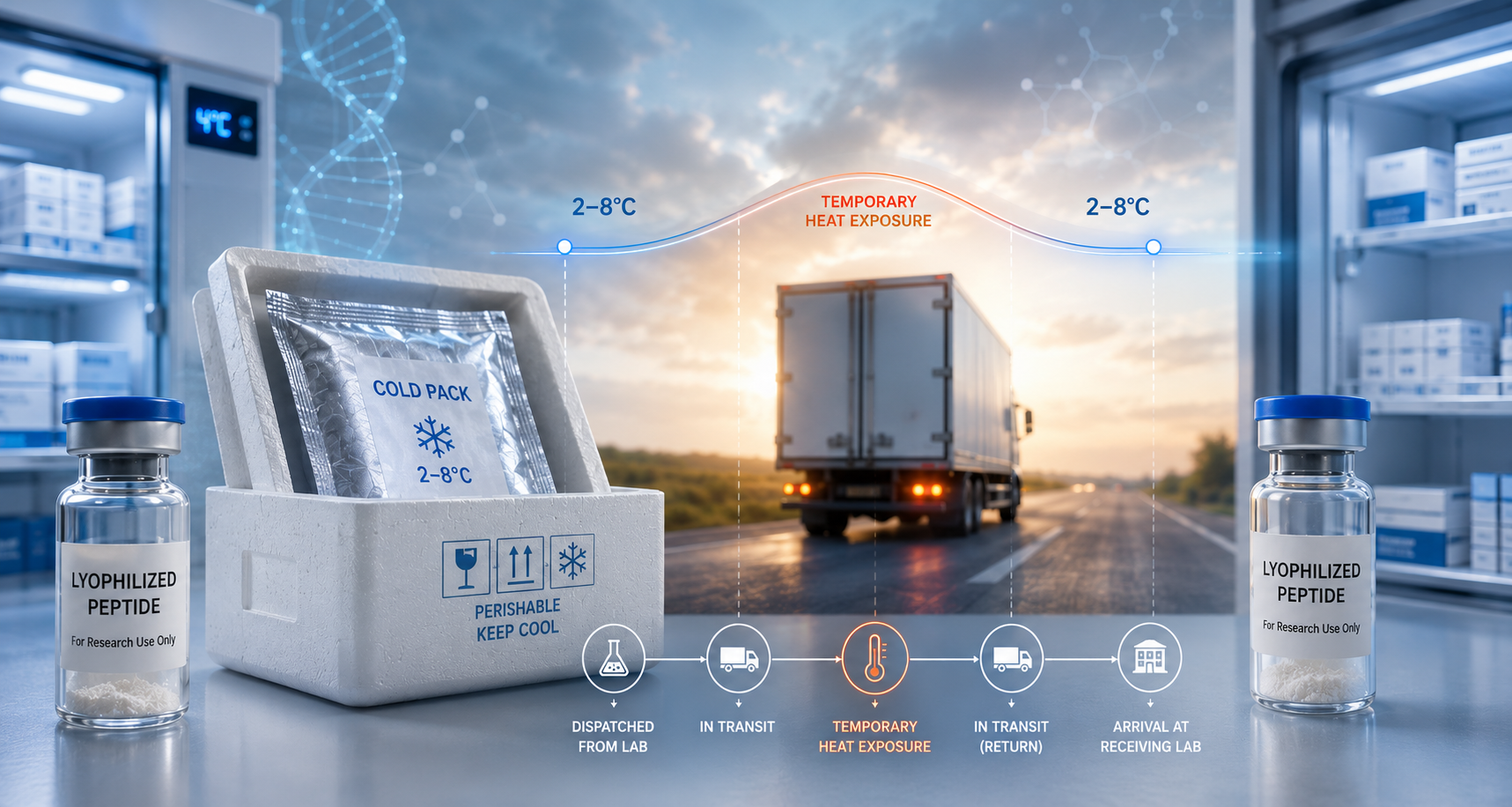
Lyophilized (freeze-dried) peptides are generally robust to the short temperature excursions that occur during standard transit, because removing water slows the chemical reactions that degrade peptides. Reconstituted or liquid peptides are far more sensitive and depend on an unbroken cold chain from the supplier to your bench. In practice, the physical form you order matters more than the exact temperature the package sees along the way.
This article explains why lyophilization protects peptides in transit, which degradation pathways matter most, when cold or insulated shipping is actually worth it, and how to inspect and document a shipment the moment it arrives. As the illustration above traces, the same sealed dry vial can pass through a warm point in transit and still reach freezer storage in usable condition — the outcome that a liquid stock cannot count on.
Sections
- Quick answer: form matters more than the truck
- Why lyophilization protects peptides in transit
- The degradation pathways that transit can trigger
- When cold shipping is worth it
- How to inspect a peptide shipment on arrival
- What a supplier should be able to tell you
- Key takeaways
- Frequently asked questions (FAQs)
Quick answer: form matters more than the truck
The single most useful thing to know about transit risk is that the peptide’s physical form drives it far more than the precise temperature the box reaches. A dry powder and a dissolved solution behave very differently under the same warmth.
- Lyophilized powder in a sealed vial typically tolerates brief warmth during shipping and can be moved to freezer storage for long-term stability once it arrives.
- Reconstituted or pre-mixed liquid peptide degrades faster and should stay cold throughout transit, because the reactions that break peptides down run readily in solution.
The practical implication is simple: match your level of scrutiny to the form you actually ordered, and store the material correctly the moment it reaches you. A researcher receiving dry powder and a researcher receiving a liquid stock are not facing the same risk, and should not inspect the two shipments the same way.
Why lyophilization protects peptides in transit
Lyophilization, or freeze-drying, removes the water that many degradation reactions require in order to proceed. With that water largely gone, hydrolysis and related water-driven pathways slow dramatically, so a dry, sealed vial is far more forgiving of ambient or warm conditions than the same peptide in solution.
This is why many suppliers ship lyophilized peptides without ice and still expect high purity on arrival. The dry state is doing the protective work that a cold pack would otherwise be asked to do. It is worth stressing, though, that this protection assumes the vial stays sealed and dry. A compromised seal, a cracked vial, or moisture ingress changes the risk picture, because reintroducing water reintroduces the reactions that lyophilization was meant to suppress.
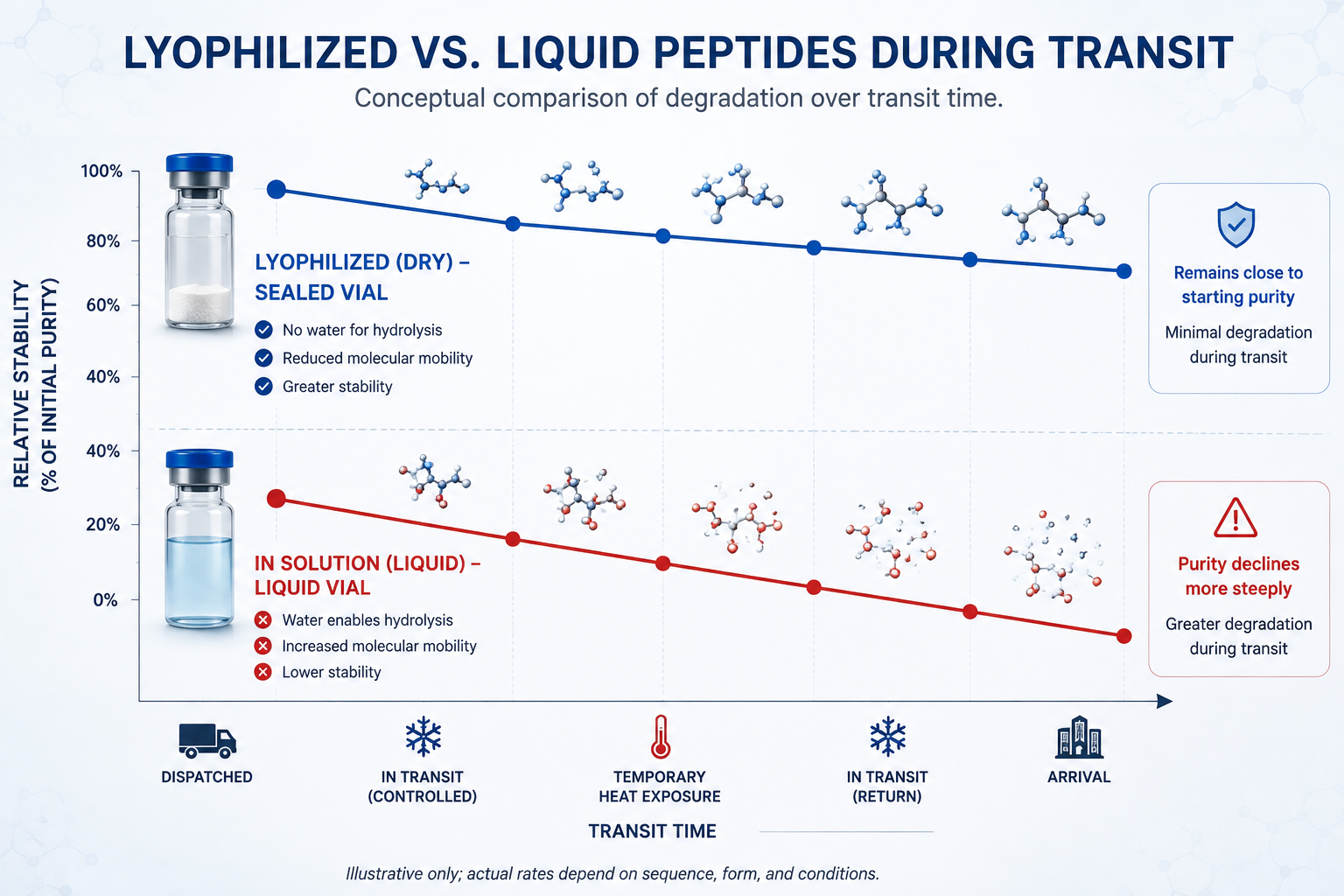
The practical effect of removing that water is a much slower rate of decline over the course of a shipment. Figure 1 contrasts the two forms across transit time: the dry, sealed vial holds close to its starting purity, while the same peptide in solution falls away far more steeply.
The degradation pathways that transit can trigger
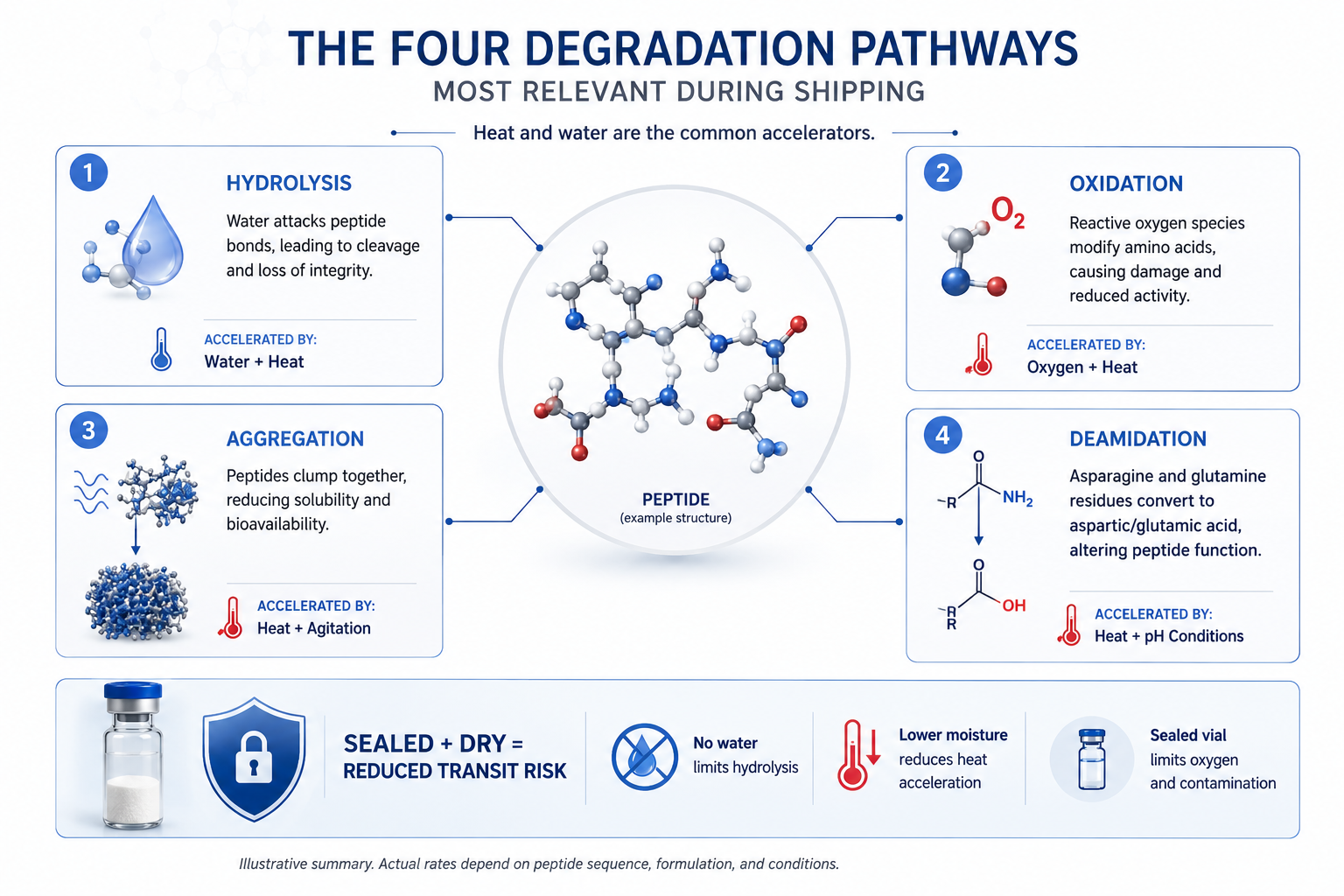
Peptides can degrade through several well-characterized chemical routes, summarized in Figure 2. Most of these are slow in a dry powder and considerably faster in a liquid, which is why form matters so much. Four pathways account for the bulk of transit-related risk:
- Hydrolysis: water-driven cleavage of the peptide backbone. This is most relevant for reconstituted or moisture-exposed material and is largely suppressed in a properly dried powder.
- Oxidation: methionine, cysteine, and tryptophan residues are especially vulnerable, and oxidation is accelerated by heat and exposure to air.
- Aggregation: repeated warming and cooling, or physical agitation, can promote clumping of peptide molecules, particularly in solution.
- Deamidation: asparagine and glutamine residues can convert over time, a process accelerated by heat and by certain pH ranges.
The common thread, captured in Figure 2, is that heat and water accelerate all of them — and a sealed lyophilized vial minimizes both. In a dry powder these pathways generally proceed slowly; in a liquid stock they can proceed much faster.
Freeze-thaw and agitation stress
Repeated freeze-thaw cycles stress peptides that are in solution and can drive aggregation, so a stock that is frozen and thawed many times is at greater risk than one handled carefully. Vibration and shaking during transit mainly affect liquids and reconstituted stocks rather than dry powder. For a lyophilized vial, the main mechanical risk is a cracked vial or a loosened seal, not the cold chain itself. A practical habit that reduces this stress is to aliquot reconstituted stock into single-use portions after arrival, so you thaw only what you need and avoid cycling the whole batch.
When cold shipping is worth it
Cold or insulated shipping is a reasonable safeguard in specific situations rather than a strict requirement for every dry powder. It is most clearly justified for:
- Reconstituted or liquid peptides, where cold shipping with gel packs or an insulated container is appropriate because the material is already in its more vulnerable form.
- Long, aggregation-prone, or oxidation-sensitive sequences, where added protection meaningfully reduces risk.
- Long transit times or hot-season shipping, where insulated packaging adds margin even for lyophilized material.
How to inspect a peptide shipment on arrival
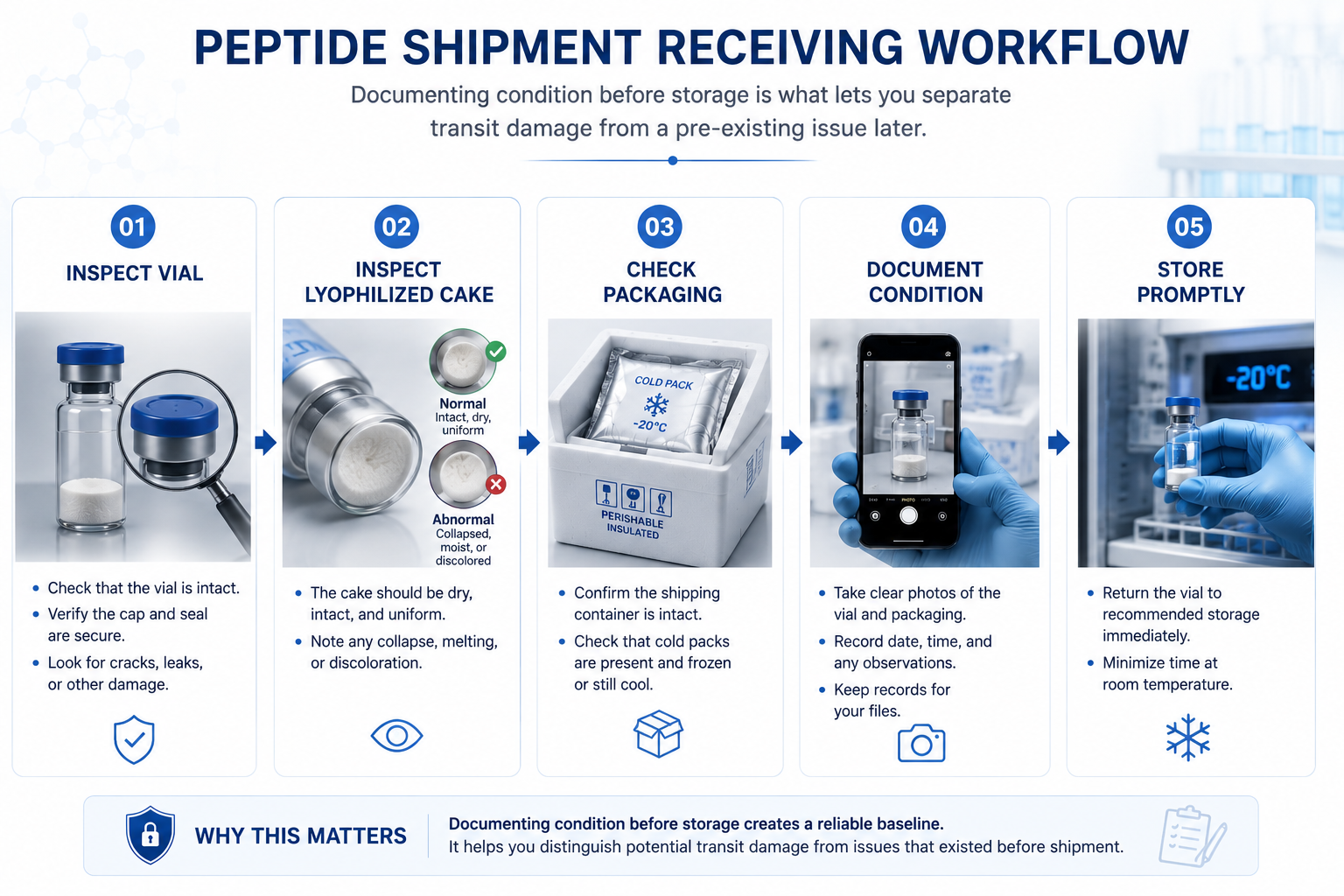
A short, consistent receiving check lets you catch problems early and, just as importantly, document them. The workflow in Figure 3 runs from first inspection through to storage; the paragraphs below walk through each step in turn.
Before storing anything, work through the following:
- Inspect the vial (step 1). Check for cracks, a loose or lifted cap, or visible moisture inside.
- Check the cake (step 2). Confirm the lyophilized cake or powder looks intact and has not collapsed into a sticky film, which can indicate moisture exposure.
- Check the cold packs (step 3). For cold-shipped liquids, note whether the cold packs were still cool and whether the container appears to have held temperature.
- Photograph the shipment (step 4). Capture the packaging and the vial before storing, so any issue is documented against the order.
- Store promptly (step 5). Move lyophilized vials to freezer storage and reconstituted material to refrigeration without delay.
- If anything looks off, contact the supplier before use and reference the batch and order details.
Storage the moment it arrives
Correct storage on arrival is where a good shipment is preserved or quietly lost. As a general practice, move lyophilized powder to freezer storage for long-term stability, following the supplier’s guidance, and place reconstituted peptide in refrigeration to be used within the supplier-recommended window, or aliquot and freeze it. Protect light-sensitive sequences from prolonged light exposure, and label aliquots with date and lot so stability can be tracked over time. Follow your supplier’s specific temperatures and shelf-life windows for the exact product and form you received rather than a generic rule.
What a supplier should be able to tell you
A transparent supplier gives you enough information to distinguish transit damage from a pre-existing issue. Before or after ordering, you should be able to learn:
- Whether the product ships lyophilized or as a liquid, and the recommended storage on arrival.
- The batch-specific purity and identity data, so you can verify the material’s condition against a documented baseline.
- The recommended shelf life for both the unreconstituted and reconstituted states.
- Whether insulated or cold shipping is offered for sensitive orders.
Batch-level documentation is what lets you tell the difference between a peptide that was damaged in transit and one that had an issue before it ever shipped. At Verified Peptides, peptides are supplied lyophilized with batch-level laboratory reports, and insulated options are available for orders where added protection is warranted — giving you a documented baseline to check a shipment against.
Key takeaways
- Lyophilized peptides are generally stable to the short temperature excursions typical of standard transit; reconstituted material needs an unbroken cold chain.
- The form you ordered should set your level of scrutiny on arrival — dry powder and liquid stock are not the same risk.
- Heat and water accelerate hydrolysis, oxidation, aggregation, and deamidation; a sealed dry vial minimizes both.
- Inspect visually, store promptly and correctly, and keep receiving records tied to batch and lot so you can separate transit damage from a prior issue.
Frequently asked questions (FAQs)
Do research peptides need to be shipped cold?
It depends on the form. Lyophilized peptides generally do not require cold shipping for short transit, because they are dry and stable in a sealed vial. Reconstituted or liquid peptides do benefit from a cold chain, since the reactions that degrade peptides run readily in solution.
What happens to a peptide if it gets warm during shipping?
A sealed lyophilized vial usually tolerates brief warmth with little effect, because it lacks the water most degradation reactions require. In solution, warmth accelerates hydrolysis, oxidation, and aggregation, so a liquid stock that got warm is worth checking before use.
How should I store peptides right after they arrive?
As a standard practice, move lyophilized powder to freezer storage and place reconstituted peptide in refrigeration, following the supplier’s recommended temperatures and use-by windows. Aliquoting reconstituted stock before freezing helps avoid repeated freeze-thaw cycles.
Does freeze-thaw cycling damage peptides?
Repeated freeze-thaw mainly stresses peptides in solution and can drive aggregation. Aliquoting reconstituted stock into single-use portions is recommended so you thaw only what you need rather than cycling the whole batch.
How can I tell if a shipment was compromised?
Look for cracked vials, loose caps, moisture inside the vial, or a lyophilized cake that has collapsed into a sticky film. Photograph anything that looks off, and contact the supplier with your batch and order details before using the material.
Is a warm ice pack a sign the peptide is ruined?
Not necessarily. For lyophilized powder, a warm pack does not automatically mean damage, since the dry state provides most of the protection. For a liquid peptide, a warm pack is a reasonable reason to check condition before use.
Suggested references
- United States Pharmacopeia (USP). General guidance on peptide and protein stability and degradation pathways. usp.org
- Thermo Fisher Scientific. Peptide storage and stability technical notes on lyophilized versus reconstituted peptides. thermofisher.com
- Sigma-Aldrich (MilliporeSigma). Peptide handling and storage guidance, including freeze-thaw and aliquoting recommendations. sigmaaldrich.com
- Bachem. Peptide stability and storage literature on lyophilized stability and sensitive-sequence handling. bachem.com
- PubMed / peer-reviewed literature on peptide degradation, covering hydrolysis, oxidation, deamidation, and aggregation. pubmed.ncbi.nlm.nih.gov