
Short answer
Yes. High purity peptides can still carry endotoxin because HPLC purity and endotoxin content are two independent measurements. An HPLC-UV purity result compares the target peptide with other UV-absorbing material in the sample, while endotoxin is a bacterial contaminant present at trace mass and measured by a separate biological assay in endotoxin units (EU). A 99% purity result says nothing either way about endotoxin in peptides, so the two results need to be read side by side.
How purification steps and lab handling raise or lower endotoxin is covered in how peptide purification and handling affects endotoxin load.
What Are Dangerous Endotoxin Levels?
In a research setting, dangerous endotoxin levels are any amount high enough to change the outcome of an experiment, and there is no single number that applies to every assay. Endotoxins are lipopolysaccharides (LPS), a major component of the outer membrane of Gram-negative bacteria.1 They are measured in endotoxin units (EU), which express activity. The cited review gives about 100 pg per EU for reference standard endotoxin; this is not a universal EU-to-mass conversion.2
For pharmaceutical products, regulators expect endotoxin limits to be calculated product by product using pharmacopeial methods, which is why published limits differ so widely.3 For research peptides, the practical threshold depends on how sensitive the experiment is. In one study, commercial-grade synthetic peptide solutions carrying roughly 0.27 to 0.31 EU/mL contained enough LPS to activate mouse microglia in culture.4 In this article, “dangerous” means a risk to data, not a statement about any other use.
Why High Purity Peptides Can Still Harbor Dangerous Endotoxin Levels
High purity peptides can still harbor dangerous endotoxin levels because the amount of LPS that disrupts an experiment is tiny by weight, far too small to move a purity percentage. Purity describes the peptide relative to related impurities; endotoxin contamination is a separate question.
An illustrative calculation shows the scale. Using that approximate reference-standard conversion of 100 pg per EU,2 a peptide carrying 10 EU per mg holds roughly 1 ng of LPS per mg of peptide, which is 0.0001% by mass. This approximate mass comparison is not a way to predict an HPLC result. A vial can read 99% pure and still carry enough endotoxin to matter. Endotoxin can also enter at steps after purification, such as freezing, lyophilization (freeze-drying), or final handling, that the purity test does not assess.2
How Peptide Purity and Endotoxin Contamination Measure Different Things
Peptide purity measures chemical composition, while endotoxin testing measures a biological contaminant by its activity in a reagent-based assay. Each result answers its own question, so neither can stand in for the other.
| Feature | HPLC purity | Endotoxin test |
|---|---|---|
| What it measures | Target peptide as a share of UV-absorbing material5 | Bacterial endotoxin (LPS) activity6 |
| How | Chromatography with UV detection at 220 nm5 | LAL or recombinant reagents that react with endotoxin6, 7 |
| Reported as | Percent | EU per mg or EU per mL |
| What it does not show | Water, counter-ions, and trace contaminants such as endotoxin | Peptide identity, purity, or content |
| Question it answers | Is this mostly the right peptide? | Is bacterial endotoxin present at a level that matters? |
Why HPLC Purity Does Not Automatically Detect Endotoxins
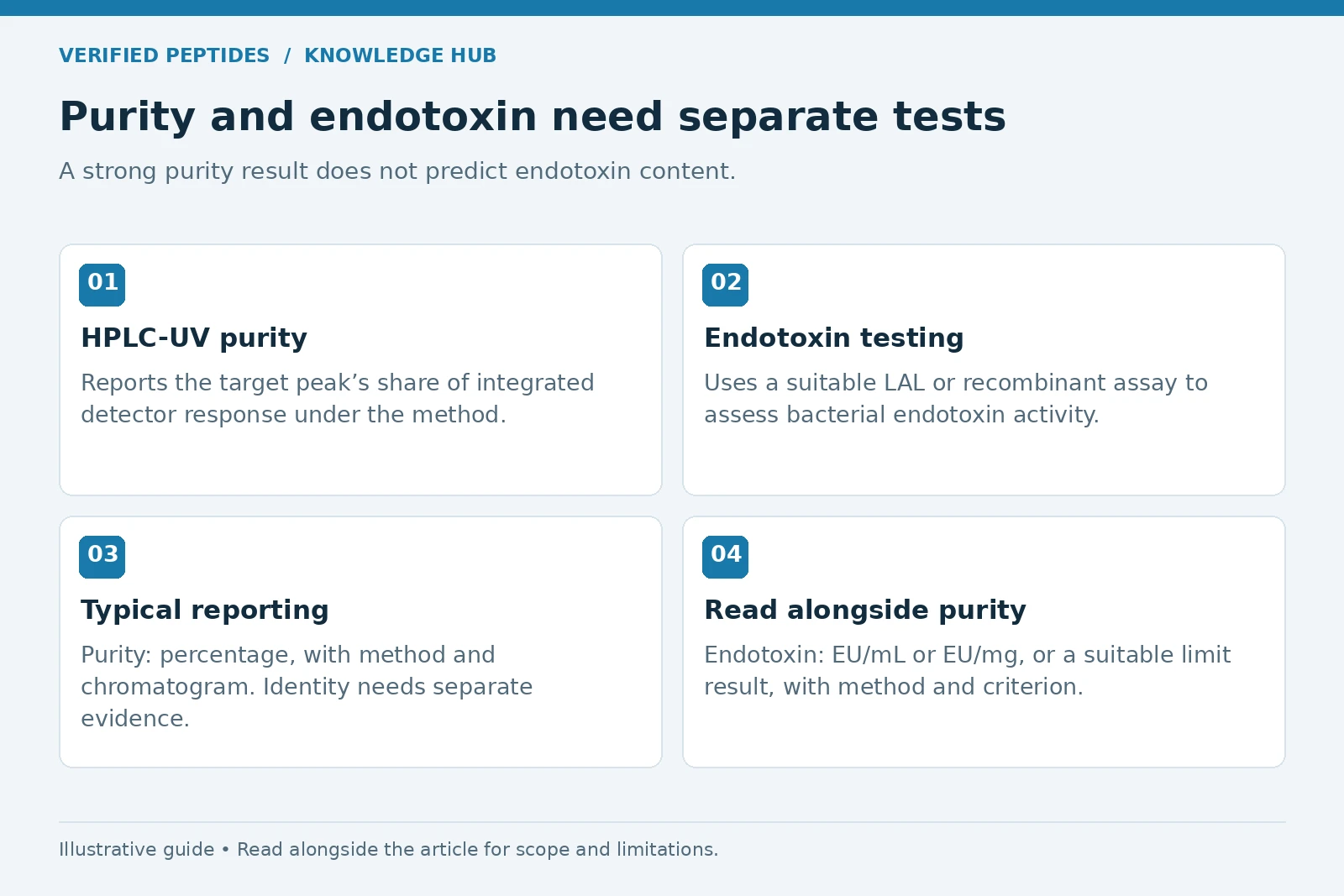
HPLC purity does not detect endotoxins because it is a ratio of UV-absorbing components, not a search for contaminants. Bachem defines HPLC purity as the percentage of the requested peptide relative to the total material absorbing at 220 nm.5
Anything outside that ratio needs its own test. Water and counter-ions, for example, are handled by a separate measurement, net peptide content.5 Endotoxin is the same kind of blind spot: it is present at trace mass and is measured by a biological assay in EU, not by peak area. Reverse-phase HPLC can actually remove some endotoxin, which binds strongly to silica, but endotoxin that builds up on a column can be released in later runs.2 For how to read a chromatogram, see the role of HPLC in peptide characterization.
How Endotoxins Can Enter a Peptide Workflow
Endotoxin mostly enters after synthesis, through water, buffers, columns, and handling, so a purity result taken at one point cannot account for it.2 Stage-by-stage sources and controls are covered in how peptide purification and handling affects endotoxin load.
Why Sterile Conditions and Low Endotoxin Levels Are Not the Same
Sterile means no living microorganisms are present, while low endotoxin means little bacterial LPS is present, and a sample can meet the first without meeting the second. Endotoxins are released by bacteria, and not only when the cells die, so the molecules can remain after the organisms are gone.1
Endotoxins are highly heat stable and are not destroyed under regular sterilizing conditions,1 so removing them takes separate depyrogenation steps, covered in how purification and handling affect endotoxin load. The testing differences are set out in sterility vs endotoxin testing and endotoxin vs sterility vs bioburden.
How Dangerous Endotoxin Levels Can Affect Peptide Research and Testing
Dangerous endotoxin levels can make a peptide appear to cause an effect that LPS is actually causing, especially in immune and inflammation assays. Researchers studying factors thought to activate microglia found that LPS was a frequent and significant contaminant in commercial-grade preparations, including synthetic peptides, and that adding an LPS-neutralizing agent, polymyxin B, reduced much of the apparent activity.4
The same study found sharp differences between lots of one reagent, and significant LPS in a product sold as low endotoxin.4 For peptide work, that means endotoxin contamination can create false positives, add lot-to-lot noise, and make results hard to reproduce. The authors concluded that careful attention to LPS levels and appropriate controls are needed.4
What Testing Methods Are Used to Check for Endotoxins?
Endotoxin testing for peptides uses methods such as the Limulus amebocyte lysate (LAL) bacterial endotoxins test and recombinant reagent assays. The monocyte activation test (MAT) assesses broader pyrogen activity, including non-endotoxin pyrogens. Identify the method on the report so its scope is clear.
- LAL tests (gel-clot, turbidimetric, and chromogenic) are described in USP <85>.6
- Recombinant reagents, such as recombinant Factor C (rFC), are covered by USP <86>.7
- MAT detects both endotoxin and non-endotoxin pyrogens in one in vitro test (Ph. Eur. 2.6.30).8
Results depend on the sample as well as the method. Beta-glucans can cause false positives in LAL tests,9 and the properties of a test sample, along with its storage and handling, can interfere with endotoxin detection.3 A side-by-side look is in comparing LPS detection methods: LAL, rFC, and MAT.
Why Manufacturing Controls Matter Even for High Purity Peptides
Manufacturing controls matter because endotoxin is far easier to keep out than to remove, and a final test only samples the batch.1 A strong purity result shows the chemistry worked; the water, equipment, and cleanroom controls that keep endotoxin out are covered in how peptide purification and handling affects endotoxin load.
Common Misconceptions About Purity, Endotoxin, and Peptide Quality
The most common misconception is that one good number covers everything. Peptide quality is a set of separate results, and each one answers a narrower question than it may seem.
| Misconception | What is actually true |
|---|---|
| A 99% pure peptide is endotoxin free | Purity is a ratio of UV-absorbing material; endotoxin needs its own test5 |
| Synthetic peptides cannot carry endotoxin | Chemical synthesis is low risk, but purification and handling can add it2 |
| Sterile means low endotoxin | Endotoxin survives regular sterilizing conditions1 |
| “Low endotoxin” on a label settles it | Lot results vary; check the batch report4 |
| Every endotoxin method sees the same things | LAL detects endotoxin only; MAT also detects non-endotoxin pyrogens8 |
What To Look for Beyond a Standard Purity Result
Beyond purity and identity, look for a batch-specific endotoxin result with its method and acceptance limit. Quantitative assays may report EU/mg or EU/mL; a suitable gel-clot limit test can legitimately report pass/fail. The important point is knowing what was tested and the limit the result meets.
- Lot number on the report matches the vial
- Identity confirmed, usually by mass spectrometry
- Endotoxin result—quantitative or a valid limit-test result—with the acceptance limit
- Endotoxin method named (LAL type or recombinant); MAT identified separately if used
- Test date and the name of the issuing lab
The Verified Peptides Lab Reports archive lists batch-numbered third-party reports with test dates; some entries also show an endotoxin pass/fail result.10 For what an endotoxin entry on a COA should contain, see LPS testing as part of peptide COA documentation.
How To Build a Better Peptide Quality Review Process
A better peptide quality review process handles purity, identity, and endotoxin as separate checks and matches the endotoxin requirement to the experiment. The steps below fit most labs.
- 1Define the need Decide how sensitive your assay is to LPS; immune and cell-based assays usually need the closest look.
- 2Request the batch report Ask for a COA for your lot that includes an endotoxin result, acceptance limit, and method.
- 3Read results separately Judge purity, identity, and endotoxin each on its own terms.
- 4Protect the sample Use endotoxin-free water, tips, and containers when preparing solutions.
- 5Run controls Where LPS could explain a result, add a control such as polymyxin B.4
- 6Record the lot Log lot numbers and reports so unexpected results can be traced.
Frequently Asked Questions About Purity and Endotoxin
Can high purity peptides still contain endotoxins?
Yes. HPLC purity and endotoxin are measured by separate tests, so a peptide can show high purity and still carry endotoxin from water, equipment, or handling.
What are dangerous endotoxin levels?
In research, they are levels high enough to change an experiment’s outcome; there is no universal cutoff, because sensitivity differs between assays.
Does peptide purity testing detect endotoxins?
No. HPLC purity compares UV-absorbing components. Endotoxin needs a separate LAL or recombinant assay; MAT assesses broader pyrogen activity.
How do endotoxins get into peptides?
Mostly after synthesis, through aqueous buffers, water, columns, glassware, lyophilization steps, and handling.
Why is endotoxin testing important for peptides?
Endotoxin can trigger effects in cell-based and immune assays that look like peptide activity, so testing helps keep results interpretable and reproducible.
All peptides discussed here are for research use only.
Key Takeaways
- Peptide purity and endotoxin are independent results; a 99% purity figure says nothing about endotoxin.
- Endotoxin that disrupts experiments is tiny by weight, far below what a purity percentage can show.
- Endotoxin mostly enters after synthesis, through buffers, equipment, lyophilization, and handling.
- Sterile is not the same as low endotoxin; LPS survives regular sterilizing conditions.
- Read each batch endotoxin result with its method and acceptance limit; a valid limit test can report pass/fail.
References
- Magalhães PO, Lopes AM, Mazzola PG, Rangel-Yagui C, Penna TCV, Pessoa A Jr. Methods of endotoxin removal from biological preparations: a review. Journal of Pharmacy and Pharmaceutical Sciences. 2007;10(3):388-404. J Pharm Pharm Sci
- Thundimadathil J. Controlling endotoxin contamination during peptide manufacturing. R&D World (originally in Controlled Environments), 2012. rdworldonline.com
- US Food and Drug Administration. Pyrogen and Endotoxins Testing: Questions and Answers. Guidance for industry (revised), March 2026. fda.gov
- Weinstein JR, Swarts S, Bishop C, Hanisch UK, Möller T. Lipopolysaccharide is a frequent and significant contaminant in microglia-activating factors. Glia. 2008;56(1):16-26. PMC2926344
- Bachem. What does HPLC purity mean? FAQ. bachem.com
- United States Pharmacopeia. General Chapter <85> Bacterial Endotoxins Test. USP-NF. uspnf.com
- United States Pharmacopeia. Notice: General Chapter <86> Bacterial Endotoxins Test Using Recombinant Reagents (official May 2025). July 2024. usp.org
- MilliporeSigma (Merck). Pyrogen Testing (monocyte activation test, Ph. Eur. 2.6.30). sigmaaldrich.com
- Cornelis P, Pett N, Spackman E. Beta-Glucans: False Positives in the Bacterial Endotoxins Test. Nelson Labs, January 2024. nelsonlabs.com
- Verified Peptides. Lab Reports (batch-specific third-party test reports). verifiedpeptides.com