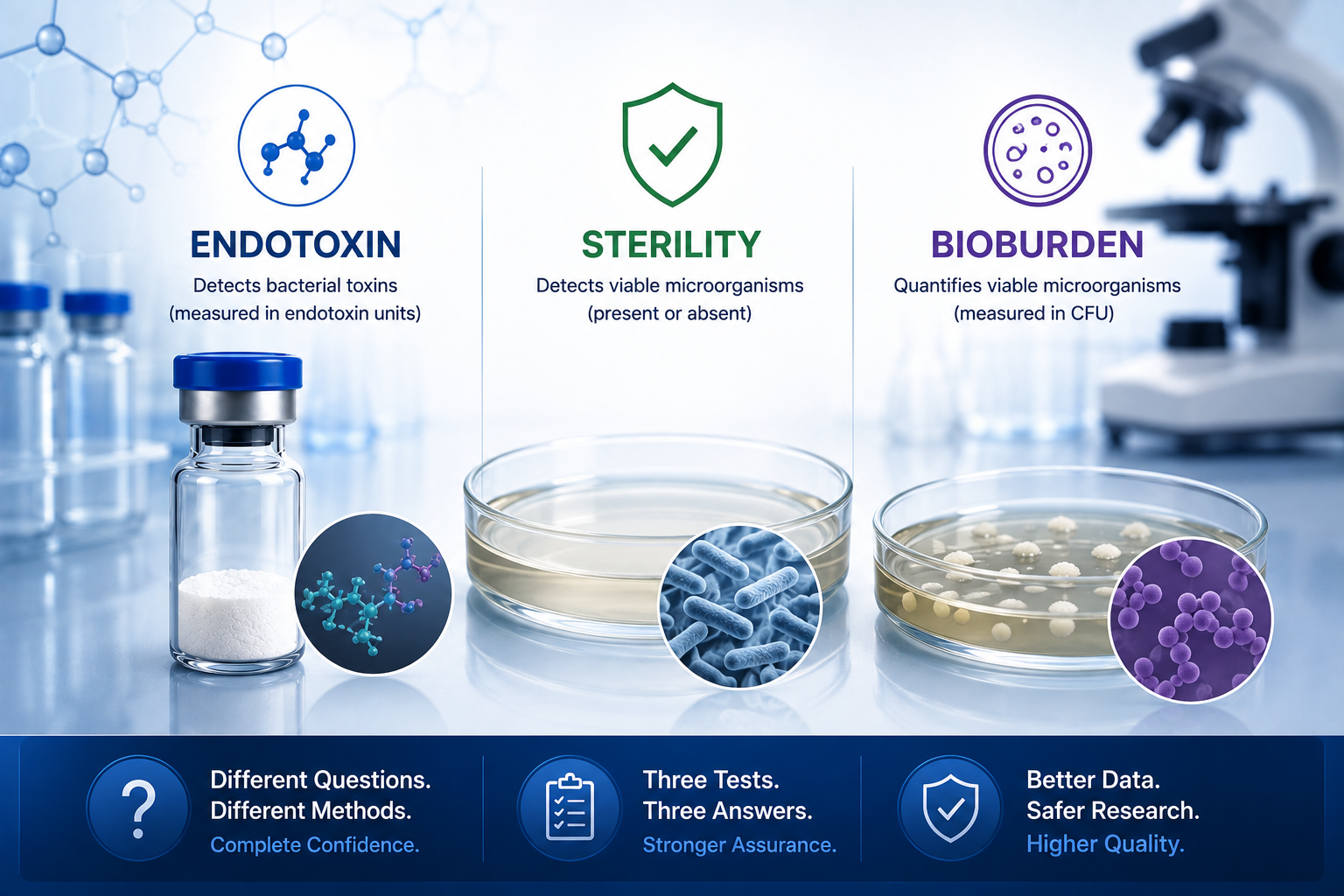
Endotoxin, sterility, and bioburden testing answer three different questions. Endotoxin testing measures the level of bacterial toxin (lipopolysaccharide) present, sterility testing asks whether any viable microorganisms are present at all, and bioburden testing counts how many viable microorganisms are present. They are complementary rather than interchangeable, and a complete Certificate of analysis (COA) often reports more than one.
This article gives a one-line distinction for each test, then explains the methods behind them, what a pass actually means, and how to read all three together on a research
The fastest way to keep these straight is to tie each test to the single question it answers:
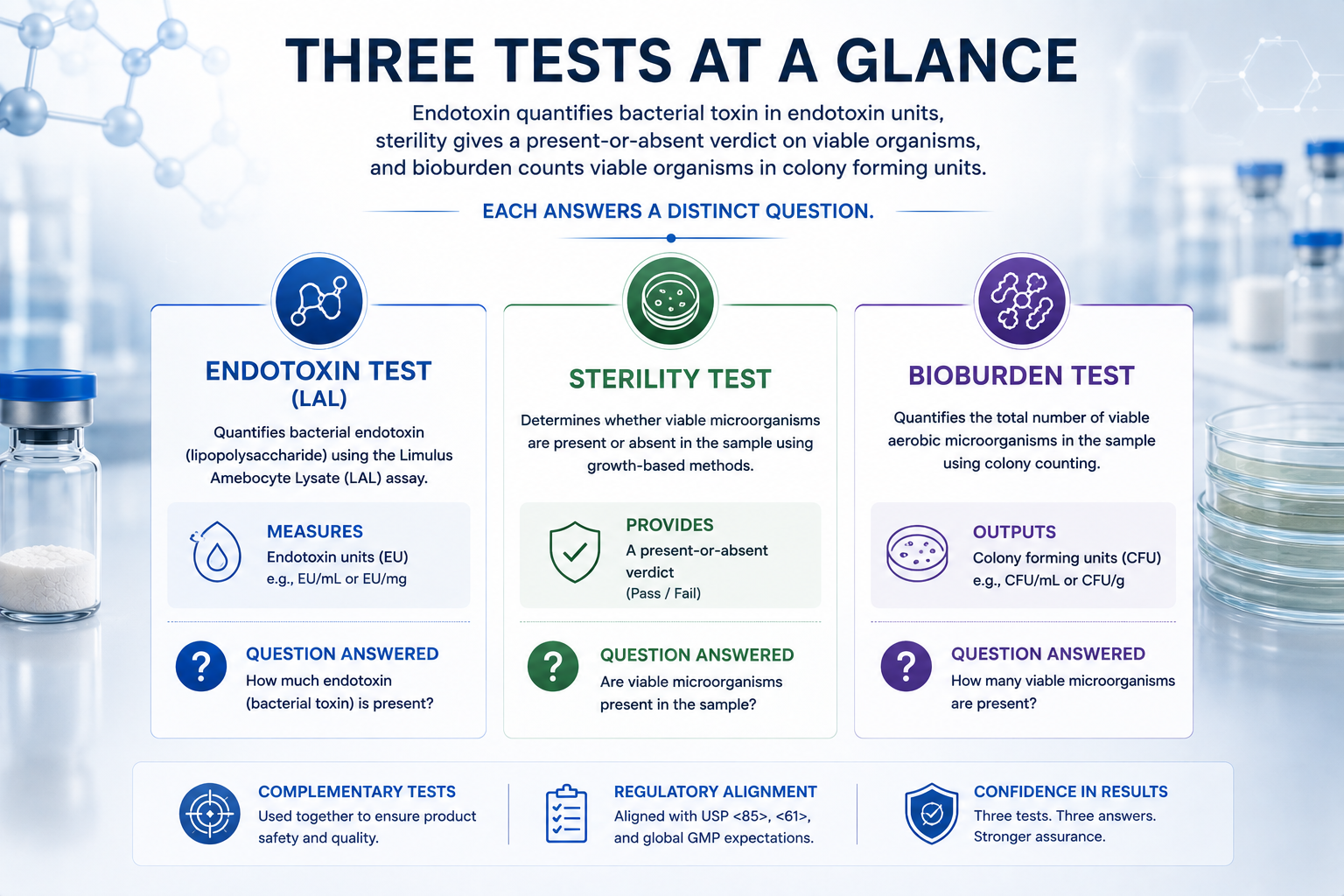
Endotoxin: how much bacterial toxin (lipopolysaccharide) is present — even if the bacteria themselves are already dead.
Sterility: is anything alive in the sample? A yes-or-no answer on viable microbial growth.
Bioburden: how many viable microorganisms are present? A count, not just presence or absence.
The key insight that ties them together: a sample can be free of live organisms yet still contain endotoxin left behind by bacteria that died earlier. That is precisely why endotoxin is tested separately from the two microbial-growth tests — killing the organisms does not necessarily remove the toxin they leave behind.
Figure 1: Three tests at a glance. Endotoxin quantifies bacterial toxin in endotoxin units, sterility gives a present-or-absent verdict on viable organisms, and bioburden counts viable organisms in colony forming units. Each answers a distinct question.
What endotoxin testing measures
Endotoxins are lipopolysaccharides (LPS) found in the outer membrane of Gram-negative bacteria. A crucial property is that they are heat stable: endotoxins can remain after the bacteria have been killed, so sterilization does not necessarily remove them. This is what makes endotoxin its own test rather than something sterility can cover.
The common detection method is the Limulus Amebocyte Lysate (LAL) test, with recombinant Factor C assays as a modern alternative; results are reported in endotoxin units (EU). Endotoxin matters because it can confound sensitive cell-based and immunological assays even at low levels. For cell culture and immune-related research in particular, low endotoxin is often an important requirement rather than a nice-to-have.
What sterility testing measures
Sterility testing is a presence-or-absence check for viable microorganisms — typically bacteria, yeast, and mold. The general approach is to incubate the sample in growth media and observe whether anything grows. A pass means no growth was detected under the test conditions, which makes sterility a qualitative result: it tells you whether something viable is present, not how much.
It is worth being clear about what sterility does not do. It does not measure endotoxin, and it does not count organisms. It answers only the single question of whether anything viable is present in the sample.
What bioburden testing measures
Bioburden is the count of viable microorganisms in or on a sample, usually reported as colony forming units (CFU). Rather than giving a simple pass or fail on presence, it quantifies the level of contamination. Bioburden is often used to monitor a process and to understand the microbial load going into any downstream step.
The contrast with sterility is the useful part to hold onto: bioburden tells you how much, while sterility tells you whether any is present at all.
Sterility versus bioburden at a glance
These two are easy to conflate, so it helps to separate them cleanly:
Sterility is qualitative (present or absent); bioburden is quantitative (a count).
Sterility is the stricter presence check; bioburden characterizes the load that is there.
They answer related but distinct questions and are often reported alongside each other.
Neither one replaces endotoxin testing, which measures toxin rather than living organisms.
Why a sample can pass one test and fail another
Because each test covers a different gap, results do not always move together:
A sterile sample can still contain endotoxin, because LPS persists after bacteria die.
A sample with low bioburden is not automatically endotoxin free.
Endotoxin, sterility, and bioburden each cover something the others do not.
This is exactly why a thorough COA reports more than one of these rather than relying on a single result. Reading them together, rather than in isolation, gives the fullest picture of a batch.
Worth remembering: “sterile” does not mean “endotoxin free.” A sample can pass sterility — nothing alive grows — while still carrying heat-stable endotoxin from bacteria that died before testing. If your assay is endotoxin sensitive, look for the endotoxin result specifically, not just the sterility pass.
How to read these results on a certificate of analysis
When a COA arrives, check each result on its own terms:
Endotoxin: look for a value in EU, the method used (LAL or recombinant Factor C), and any stated limit.
Sterility: look for a clear pass, or the statement that no growth was detected.
Bioburden: look for a CFU count and the method used.
Then confirm the results are batch specific and tied to the lot you actually received, not a generic template. If a result relevant to your application is missing, ask the supplier before use. Batch-specific microbial and endotoxin data is what lets you match the material to your assay’s sensitivity with confidence.
Which test matters most for your application
The right emphasis depends on the experiment, and more than one test is usually relevant:
Cell culture and immune assays: endotoxin is often the most sensitive concern, since it can confound readouts at low levels.
Any work where contamination would ruin cultures: sterility and bioburden are central.
Process monitoring and quality trending: bioburden provides quantitative tracking over time.
The practical recommendation is to match the tests you prioritize to the sensitivity of your specific research use, rather than assuming a single result covers every risk.
Key takeaways
Endotoxin measures bacterial toxin, sterility asks whether anything is alive, and bioburden counts how much is alive — they are complementary, not interchangeable.
A sterile sample can still contain endotoxin, because heat-stable LPS persists after bacteria die.
Read all three together and confirm the results are batch specific and tied to your lot.
Match your test emphasis to your application’s sensitivity, and ask the supplier if a relevant result is missing.
Frequently asked questions (FAQs)
What is the difference between endotoxin, sterility, and bioburden testing?
Endotoxin testing measures bacterial toxin (lipopolysaccharide) levels, sterility testing checks whether any viable organisms are present, and bioburden testing counts how many viable organisms are present. Each answers a different question, so they are complementary rather than interchangeable.
What does an endotoxin test measure?
It measures lipopolysaccharide from the outer membrane of Gram-negative bacteria, commonly using the Limulus Amebocyte Lysate (LAL) test or a recombinant Factor C method. Results are reported in endotoxin units (EU).
Can a sterile product still have endotoxin?
Yes. Endotoxin is heat stable and persists after bacteria die, so a sample can be free of live organisms yet still contain endotoxin. That is why endotoxin is tested separately from sterility.
How is sterility testing different from bioburden testing?
Sterility is a qualitative presence-or-absence check for viable microorganisms, while bioburden is a quantitative count of viable microorganisms reported in colony forming units (CFU). Sterility tells you whether any is present; bioburden tells you how much.
Why does endotoxin matter for cell-based research?
Endotoxin can confound sensitive cell-based and immunological assays even at low levels, so low endotoxin is often important for that work. Checking the endotoxin result specifically — not just a sterility pass — helps avoid a hidden confounder.
What should I look for on a COA for these tests?
Look for a batch-specific endotoxin value with its method, a clear sterility pass, and a bioburden count, all tied to the lot you received. If a result relevant to your application is missing, ask the supplier before use.
Suggested references
United States Pharmacopeia (USP). Chapters on bacterial endotoxins, sterility, and microbial enumeration test frameworks. usp.org
U.S. Food and Drug Administration (FDA). Guidance on endotoxin and pyrogen testing methods and interpretation. fda.gov
Charles River. Testing-laboratory explanations of LAL, recombinant Factor C, sterility, and bioburden. criver.com
Lonza. Technical background on LAL and endotoxin unit reporting. lonza.com
PubMed / peer-reviewed literature on how endotoxin can confound sensitive research readouts. pubmed.ncbi.nlm.nih.gov
FDA Disclaimer: The statements made within this website have not been evaluated by the US Food and Drug Administration. The statements and the products of this company are not intended to diagnose, treat, cure, or prevent any disease. Verified Peptides is a chemical supplier. All products are sold for research, laboratory, or analytical purposes only, and are not for human consumption. This content is informational and is not medical advice.