
Short answer
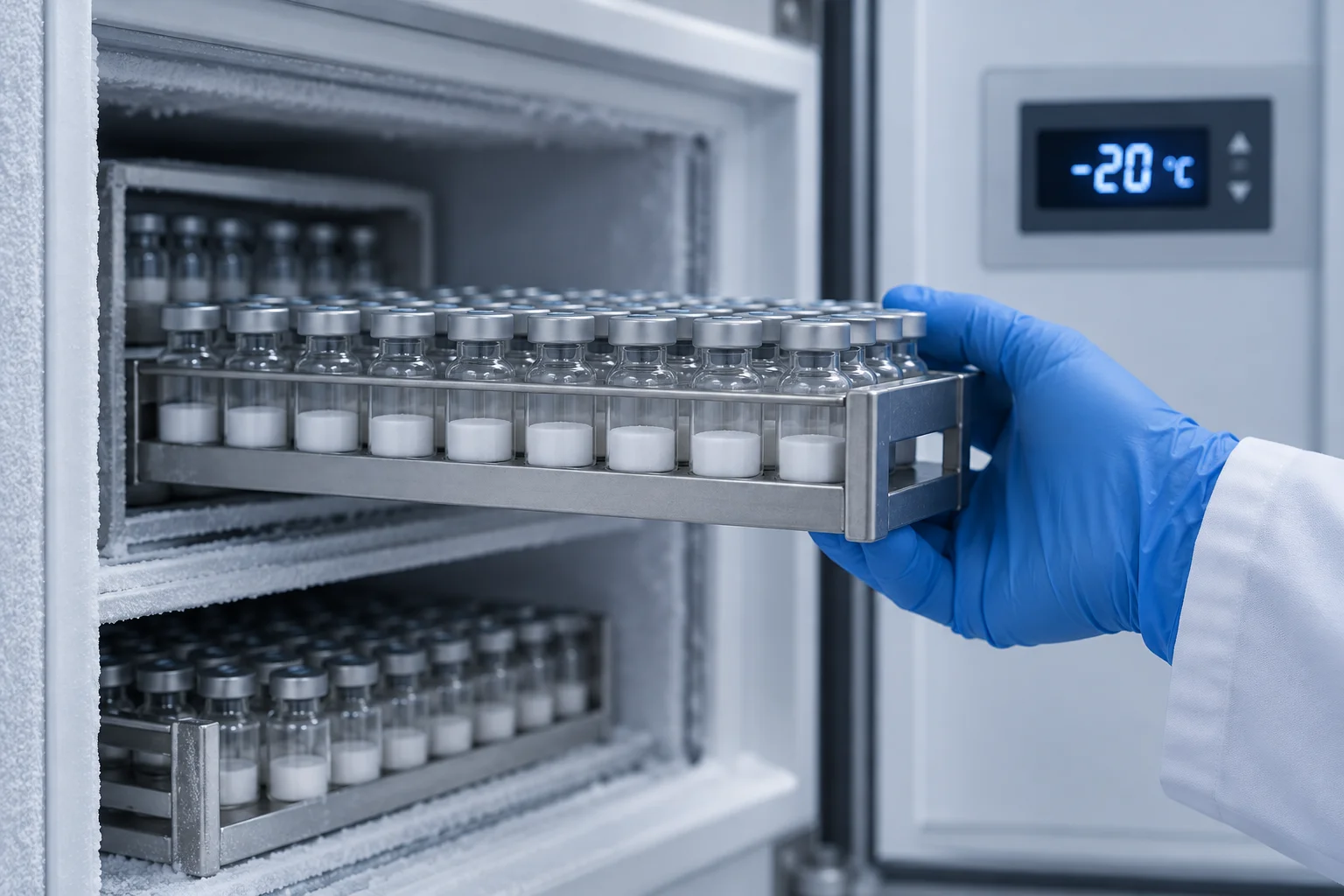
To store lyophilized peptides, keep them cold, dry, dark, and tightly sealed. Supplier guidelines recommend −20 °C or colder for long-term peptide storage, with some suppliers preferring −80 °C, a refrigerator for short-term use only, a desiccator or other dry environment, and protection from bright light. Let a cold vial warm to room temperature before opening it so moisture does not condense on the powder.1, 2, 3
Looking for how long a vial lasts under each condition? See how long lyophilized peptides last.
Why Proper Storage Matters for Lyophilized Peptides
Proper peptide storage matters because freeze-dried peptides are stable, not indestructible. Lyophilization (freeze-drying) removes most of the water that drives chemical breakdown, but heat, moisture, oxygen, and light can still degrade the powder over time.1, 3
For a lab, that degradation shows up as lower purity, less peptide per milligram of powder, and results that are harder to reproduce between experiments. Good lyophilized peptide storage is one of the simplest ways to protect an experiment before it starts.
Understanding the Delicate Nature of Freeze-Dried Peptides
Freeze-dried peptides are delicate because they readily pull moisture back out of the air. Many peptides are hygroscopic, meaning they absorb water vapor, and some are prone to deliquescence, where the powder takes up so much water it starts to dissolve.2, 4
Once water returns, the powder loses the main advantage of being dry. In general, absorbed water makes the solid more mobile and gives water-dependent reactions such as hydrolysis and deamidation a chance to proceed. Bachem notes that moisture absorption both lowers the overall peptide content of the powder and may decrease peptide stability.3 For how the drying process itself works, see what a lyophilized peptide is.
Does Peptide Stability Vary Based on Sequence or Structure?
Yes. Supplier guidelines agree that each peptide’s stability depends on its sequence.2 Peptides containing cysteine (Cys), methionine (Met), or tryptophan (Trp) are prone to oxidation, so GenScript advises storing them under anaerobic (oxygen-free) conditions; peptides rich in aspartic acid, glutamic acid, lysine, arginine, or histidine tend to absorb moisture.2 Bachem adds asparagine (Asn) and glutamine (Gln) to the residues linked to limited shelf lives.3
How Temperature and Moisture Interact
Heat and moisture speed up peptide degradation, and each makes the other worse. Lyophilized peptides can degrade at room temperature too, only slowly: they tolerate days to weeks, which is why cold, dry storage is recommended for anything longer.1, 2
Published data on freeze-dried proteins show the pattern. In a 12-month study of freeze-dried IgG (an antibody protein, not a peptide, so the numbers are not directly transferable), monomer loss at −20 °C stayed under 1%, while losses grew at warmer storage temperatures. At 45 °C, samples with higher moisture exposure lost about 10% of their monomer content within 6 months, and the authors traced much of the moisture to the rubber stoppers.5 The lesson for peptide stability is that heat and moisture work together.
Browning or a sticky, clumped cake can hint that a peptide has degraded or taken up moisture, but only analytical testing confirms it; see how to spot peptide degradation.4
Temperature Control: Cold Isn’t Always Enough
For long-term storage, keep lyophilized peptides at −20 °C or colder, with some suppliers preferring −80 °C. Cold alone is not enough, though: a vial also has to stay sealed and dry, and repeated warming and cooling adds risk.1, 2, 3
| Source | Long-term storage | Short-term and shipping |
|---|---|---|
| Sigma-Aldrich | −20 °C or colder; −80 °C preferred if available | 4 °C or colder on receipt; stable at room temperature for days to weeks1 |
| GenScript | −20 °C, away from bright light | Remaining powder back in the freezer, preferably below −20 °C2 |
| Bachem | Below −15 °C; −50 °C or lower preferred | Shipped at room temperature; refrigerator at 4 °C for short-term use3 |
| Alta Bioscience | −20 °C for long-term storage | Shipped at ambient temperature; cold, dark, dry place on receipt4 |
Do Peptides Need to Be Refrigerated?
Lyophilized peptides do not need refrigeration for short periods, but they should go cold for storage. Dry peptides tolerate room temperature for days to weeks (for example, during shipping), so that is roughly how long they can be unrefrigerated; a refrigerator (about 4 °C) is for short-term storage only, and −20 °C or colder is for anything longer.1, 3, 4 Reconstituted peptides are different: once dissolved, they should be kept cold or frozen in aliquots.2
Temperature cycling is the hidden risk with temperature-sensitive peptides. Each time a vial is warmed, opened, and refrozen, it can pick up moisture and undergo a freeze-thaw cycle, so suppliers recommend splitting peptides into single-use aliquots.2, 4 The freeze-thaw storage SOP covers this in detail.
Humidity Hazards: Moisture Is the Enemy
Humidity is the main threat to moisture-sensitive peptides because water undoes what freeze-drying achieved. Sigma-Aldrich states that exposure to moisture will greatly decrease the long-term stability of lyophilized peptides.1
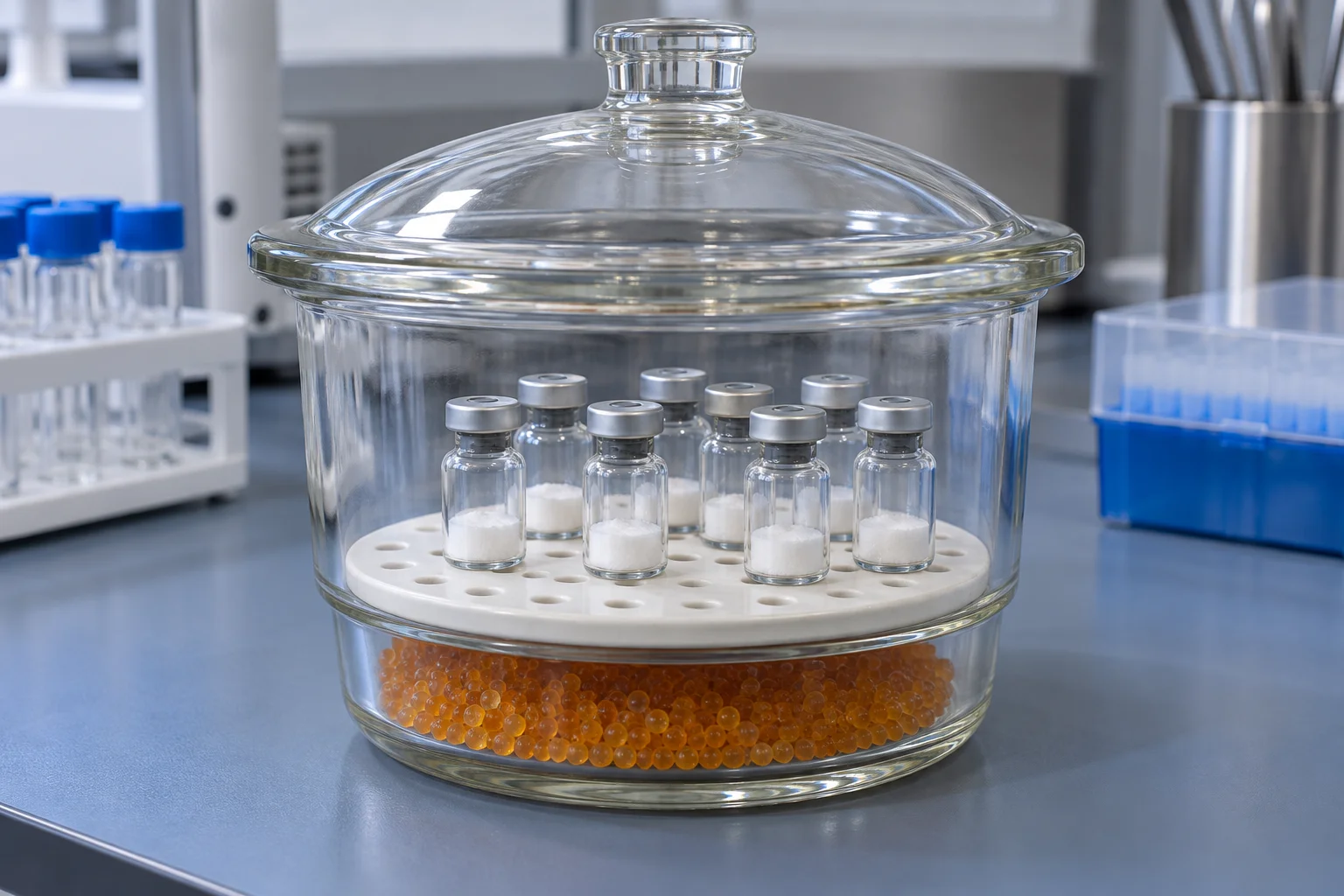
Good humidity control for peptides comes down to three habits: keep vials tightly capped, store hygroscopic peptides in a desiccator (a sealed container with a drying agent), and let a cold vial reach room temperature, ideally inside a desiccator, before opening it.2, 3 Opening a cold vial in room air lets water condense straight onto the powder. When you do open it, weigh out what you need quickly and reseal right away.2, 3
Light Sensitivity: Keeping Your Peptides in the Dark
Lyophilized peptides should be kept away from bright light, and the supplier guidelines cited here ask for dark or low-light storage.1, 2, 4 Light can drive oxidation reactions that change the peptide’s structure.6
Research on proteins shows that both UV A and ordinary visible light can cause photodegradation, with aromatic residues such as tryptophan and tyrosine among the sites studied.6 Light-sensitive peptides, especially those containing these residues, are worth extra care: store them in amber-colored vials or inside an opaque box, and limit time under bench lights while weighing or reconstituting.
Handling Peptides Post-Delivery: What to Do When They Arrive
When peptides arrive, check the package and move the sealed vials into cold, dark, dry storage promptly. Because lyophilized peptides are usually stable during peptide transportation at ambient temperature, a shipment without ice packs is normal.3, 4
- 1Inspect Check that vials are intact, caps are tight, and labels match your order records and lot numbers.
- 2Store Place sealed vials at 4 °C or colder for short-term use, or −20 °C or colder for long-term storage.1
- 3Record Log the arrival date, lot number, and storage location.
- 4Warm before opening Let the vial reach room temperature before removing the cap.1
Shipments delayed in heat are a separate question; see cold chain and transit risk for peptides for how to judge them.
Storage Containers & Vials: Choosing the Right Materials
The right storage containers for peptides are clean, tightly capped vials that keep out moisture, air, and light. Supplier guidelines focus on the seal: a tightly closed container, a desiccator for hygroscopic peptides, and, for oxidation-prone sequences, a dry inert gas such as nitrogen or argon.2, 3, 4
Airtight peptide vials are only as good as their closures. In the IgG study above, the authors suggested that a significant share of the moisture entering the vials came from the rubber stoppers themselves, and proposed drying the stoppers under vacuum and heat as a fix.5 Amber-colored vials add light protection, and clear labels with the peptide name, lot number, and date make inventory checks easier.
Do’s and Don’ts of Lyophilized Peptide Storage
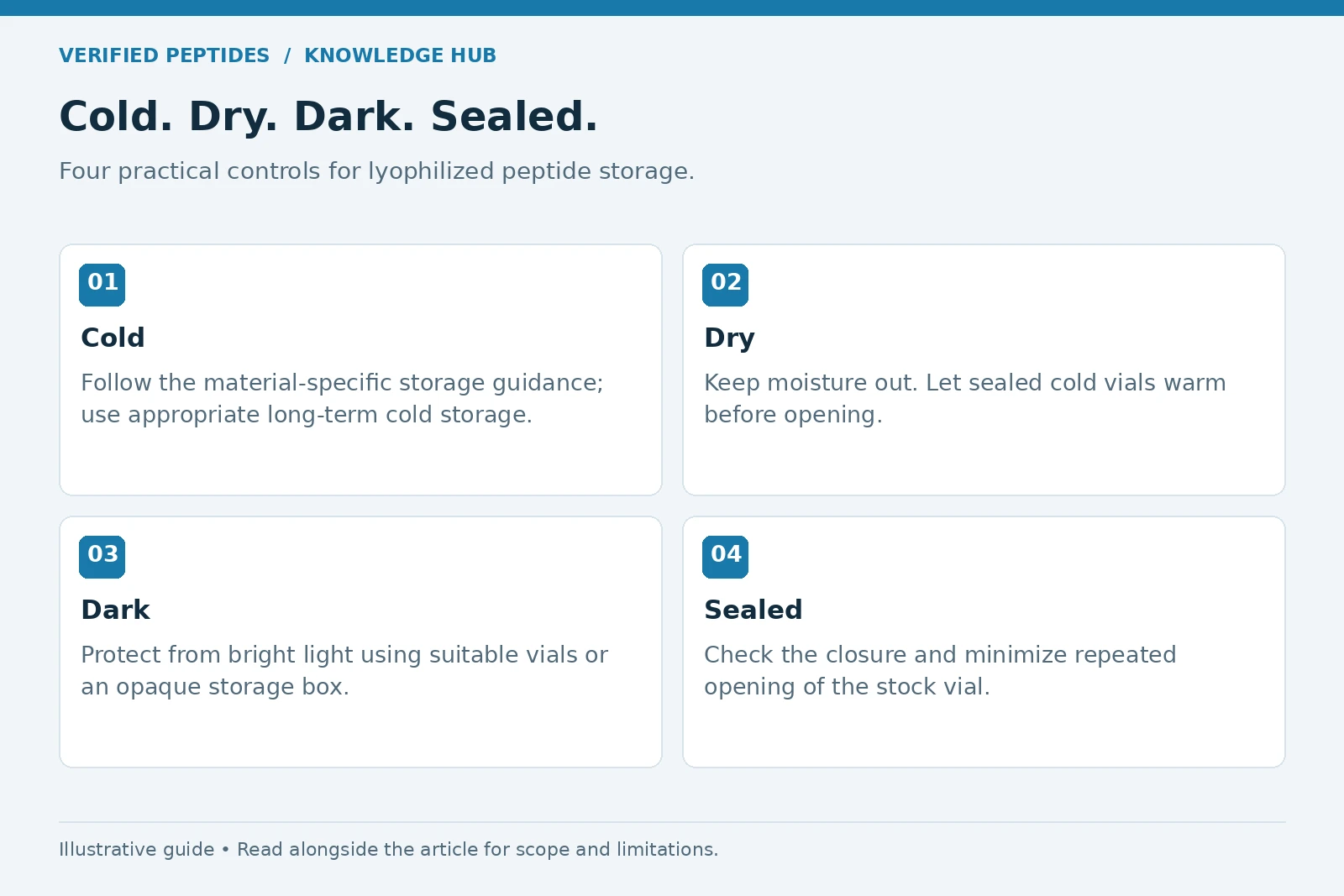
The most common storage mistakes are opening cold vials, leaving them open, and repeated freeze-thaw cycles. Use this peptide storage checklist as a quick summary of the peptide storage best practices above.
Reconstitution Timing: How Storage Affects Solubility
Reconstitute peptides as close as possible to when you need them, because dissolved peptides are far less stable than freeze-dried ones. GenScript describes the shelf life of peptides in solution as very limited and does not recommend storing peptides in solution.2
Storage history also affects peptide reconstitution itself: Alta Bioscience notes that moisture can cause crystal formation in the powder,4 and moisture uptake changes how much peptide each milligram contains, which can throw off concentration calculations.3 A dry, well-stored powder is the easiest starting point. See how to reconstitute lyophilized peptides for the full method.
How to Store Reconstituted Peptides
Use the routine in the FAQ below, and take extra care with sequences containing Cys, Met, Trp, Asn, or Gln, which are the least stable in solution.1, 2 Passing a solution through a 0.2 µm filter can help remove bacterial contamination, but it removes bacteria, not endotoxin; see how purification and handling affect endotoxin load.2, 4 For how long solutions keep, see reconstituted peptide shelf life.
Frequently Asked Questions About Peptide Storage
What temperature do you store lyophilized peptides?
For long-term storage, −20 °C or colder, with some suppliers preferring −80 °C; a refrigerator (about 4 °C) is for short-term storage only.1, 3
Are peptides temperature sensitive?
Yes, though freeze-dried peptides are far more tolerant than peptides in solution. Heat speeds degradation, especially when moisture is also present.1, 5
Do peptides need to be refrigerated?
Not for short periods while dry, but for storage, yes: a refrigerator is for short-term use only and −20 °C or colder is for the long term. Reconstituted peptides should always be kept cold or frozen.1, 2, 3
All peptides discussed here are for research use only.
Key Takeaways
- Store lyophilized peptides cold (−20 °C or colder long term), dry, dark, and tightly sealed.
- Moisture is the biggest threat: warm vials to room temperature before opening, ideally in a desiccator.
- Peptides containing Cys, Met, Trp, Asn, or Gln need extra care against oxidation and moisture.
- Aliquot to avoid repeated opening and freeze-thaw cycles.
- Dissolved peptides are far less stable, so reconstitute close to use and freeze any aliquots you keep.
References
- Sigma-Aldrich (Merck). Handling and Storage of Synthetic Peptides. Technical guide. sigmaaldrich.com
- GenScript. Peptide Storage and Handling Guidelines. genscript.com
- Bachem. Handling and Storage Guidelines for Peptides. Knowledge center. bachem.com
- Alta Bioscience. Peptide Storage and Solubility. altabioscience.com
- Duralliu A, Matejtschuk P, Stickings P, Hassall L, Tierney R, Williams DR. The influence of moisture content and temperature on the long-term storage stability of freeze-dried high concentration immunoglobulin G (IgG). Pharmaceutics. 2020;12(4):303. mdpi.com
- Schöneich C. Photo-degradation of therapeutic proteins: mechanistic aspects. Pharmaceutical Research. 2020;37(3):45. link.springer.com