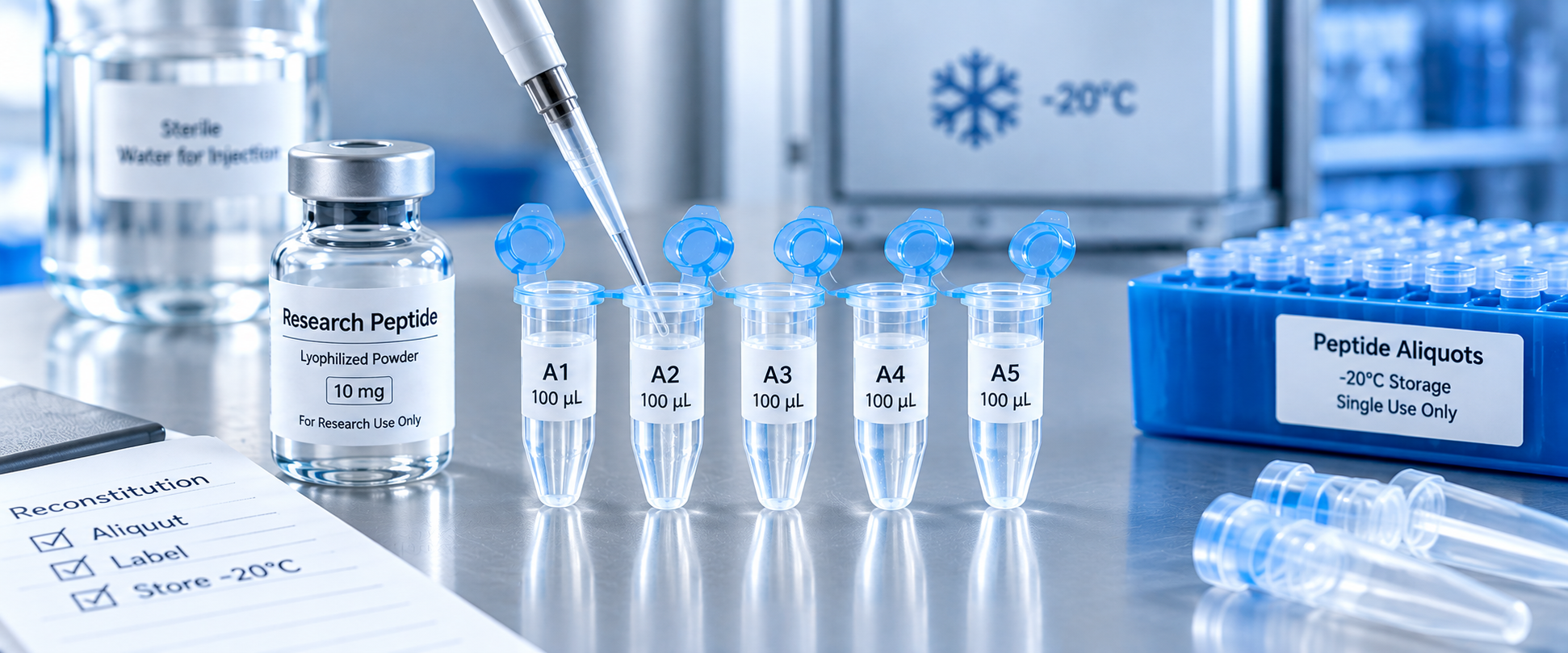
Repeated freeze-thaw cycling is one of the most common and most avoidable causes of peptide degradation. Each cycle exposes the peptide to mechanical stress, local pH shifts, and concentration changes at the ice interface. The single most effective control is to divide reconstituted peptide into single-use aliquots so that each vial is thawed only once.
This article explains why cycling degrades peptides, then gives a practical standard operating procedure (SOP) for preparing single-use aliquots, storing them, thawing them correctly, and documenting the process so it can be repeated consistently across a team.
Why freeze-thaw cycles matter and the one rule that fixes most of it
The scannable answer is this: minimize the number of freeze-thaw cycles any single aliquot experiences, ideally to one, by aliquoting reconstituted peptide into single-use volumes before freezing. Most of the degradation risk from routine handling comes from repeatedly warming and refreezing the same vial, and single-use aliquoting removes that risk almost entirely.
The practical target most technical guides converge on is straightforward: store lyophilized peptide cold and dry, aliquot after reconstitution, and avoid repeated warming and refreezing of the same vial. Treat this as a research-handling practice rather than a stability guarantee, since exact behavior depends on the specific sequence and buffer.
What actually happens to a peptide during a freeze-thaw cycle
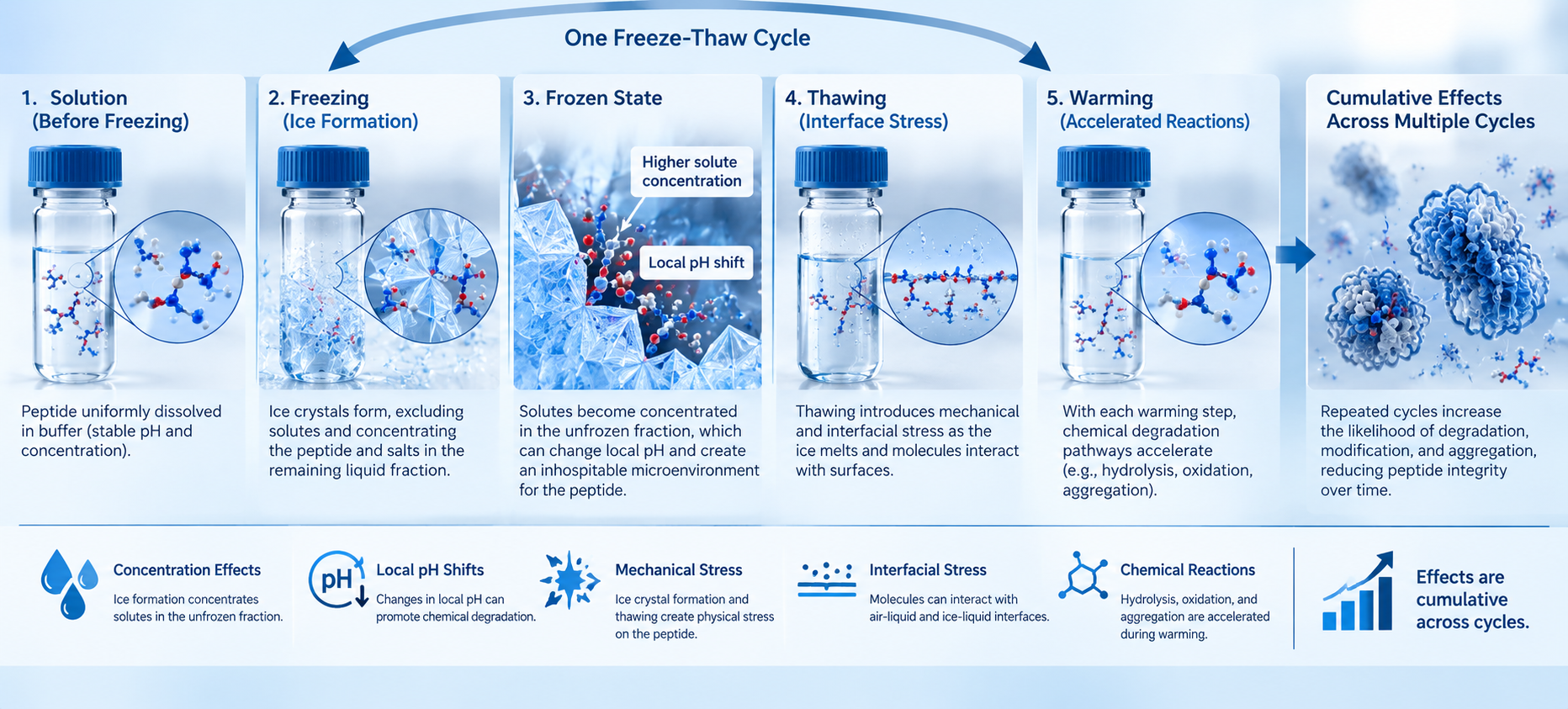
Several things happen at once during each cycle. As ice crystals form, they concentrate the dissolved solutes into the shrinking liquid fraction and can shift the local pH. Freezing and thawing also create mechanical and interfacial stress, and every warming step accelerates hydrolysis, oxidation, and aggregation. Repeated cycling simply gives these processes more opportunities to occur.
Some sequences are more vulnerable than others. Peptides containing methionine, cysteine, or tryptophan are generally more prone to oxidation, while aspartate, glutamine, and asparagine residues are prone to their own specific degradation pathways. One point is consistent across technical sources: lyophilized (freeze-dried) powder is generally far more stable than peptide already in solution, which is why the SOP below moves material into aliquots and back into the freezer quickly after reconstitution.
Figure 1: What a single freeze-thaw cycle does. Ice formation concentrates solutes and can shift local pH, while freezing, thawing, and warming add mechanical and interfacial stress that can drive hydrolysis, oxidation, and aggregation. Effects are cumulative across cycles.
Before you start: materials and conditions
This SOP assumes you have the following on hand:
Sterile low-binding microcentrifuge tubes or vials for the aliquots.
An appropriate reconstitution solvent for your peptide.
A calibrated pipette, labels, and a permanent marker.
Access to a reliable freezer that holds a steady temperature.
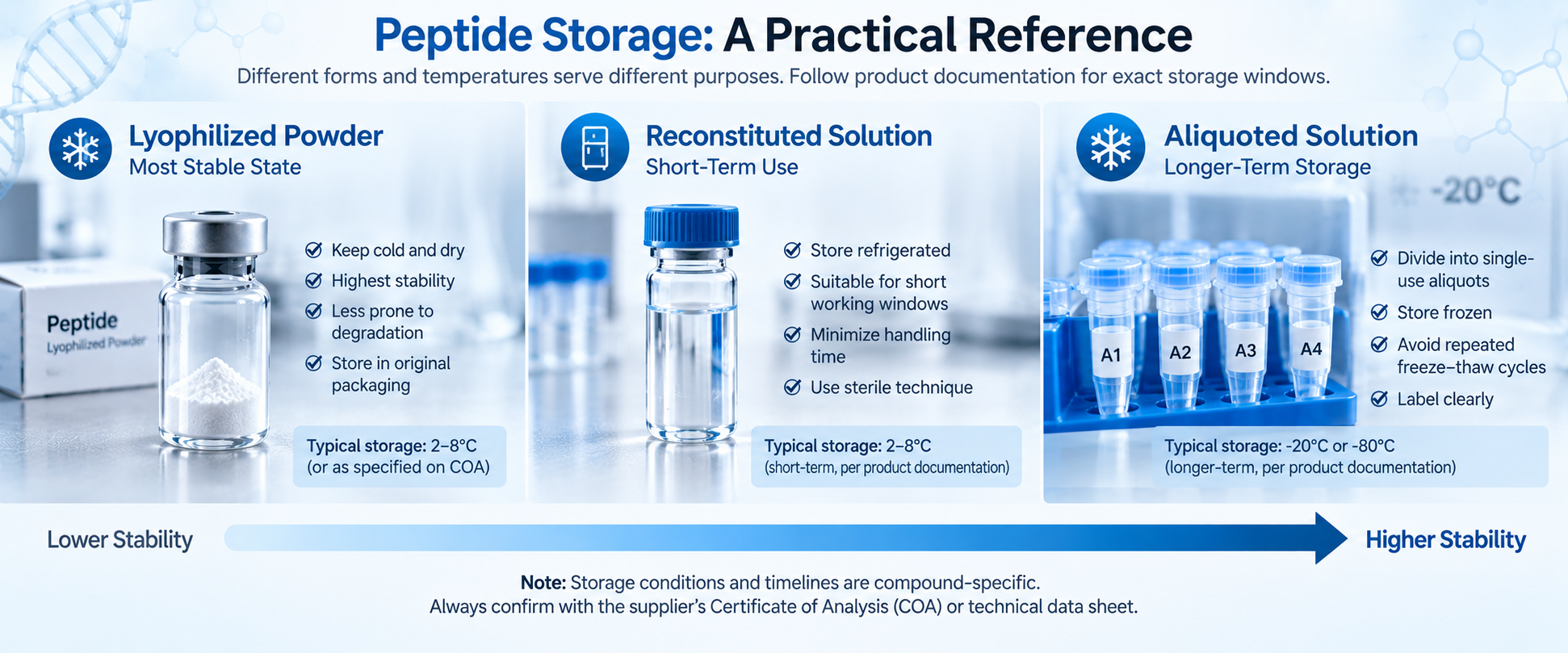
Technical guides generally reference a few storage tiers: room temperature only for short handling windows, refrigeration for short-term solution storage, and freezing at -20 C or -80 C for longer-term storage. These are directional. For any compound-specific storage window, defer to the supplier Certificate of Analysis (COA) and technical data sheet for your exact product.
Step-by-step SOP
Follow these steps in order for each new vial:
Inspect and equilibrate. Let the sealed lyophilized vial come to room temperature before opening, which limits condensation from forming inside the vial.
Reconstitute gently. Add the appropriate solvent slowly down the vial wall and swirl gently rather than vortexing.
Aliquot immediately. Divide the solution into single-use aliquots, each sized to one experiment, before freezing anything.
Label every aliquot. Record the compound, concentration, solvent, date, and your initials on each tube.
Freeze promptly. Move the aliquots into the freezer without delay, and record the storage location and temperature.
Thaw once. Thaw only the aliquots you need, use them, and do not refreeze any leftover thawed solution.
How to size and label aliquots
Size each aliquot to a single experiment or single working session so that no vial is ever opened twice. Put enough detail on the label that any team member can identify the contents without reaching for the lab notebook. Controlling condensation also helps here: equilibrating a vial to room temperature before opening reduces moisture uptake in any remaining powder.
Thawing without adding stress
Thaw gently, typically on ice or in a refrigerator, rather than under hot water, to limit thermal and interfacial stress. Mix gently after thawing and avoid vigorous vortexing or repeated pipetting, both of which introduce shear and air. Use the thawed material promptly and discard any unused portion rather than refreezing it.
Worth remembering: the goal of the whole SOP is one thaw per aliquot. If a step ever tempts you to refreeze a partly used tube, that is the moment sample integrity is most at risk. Size aliquots small enough that refreezing is never necessary.
Storage temperature and timeline reference
Technical guides tend to describe the same general pattern, which is useful to keep in a scannable form:
Lyophilized powder, kept cold and desiccated, is the most stable state.
Refrigerated solution is for short working windows only.
Frozen aliquots at -20 C or -80 C are for longer holds.
Specific shelf life depends on sequence, purity, solvent, and container, so treat these as directional and confirm them against the product documentation. Colder is generally more protective for long-term storage, but for most workflows, avoiding cycling matters more than the exact freezer temperature.
Figure 2: A directional storage-tier reference. Lyophilized powder kept cold and dry is the most stable state, refrigerated solution suits short working windows, and frozen aliquots suit longer holds. Confirm exact windows against the product documentation.
Common mistakes that quietly ruin samples
Most avoidable losses come from a short list of habits:
Reconstituting the whole vial and refreezing the leftover repeatedly.
Storing solution in a frost-free freezer that cycles temperature automatically.
Leaving vials at room temperature during long bench sessions.
Vigorous vortexing that drives aggregation and foaming.
Poor labeling that leads to guesswork about age and cycle count.
Opening cold vials without equilibrating, which pulls condensation into the powder.
Documenting the SOP for your lab
To make the procedure repeatable, turn the steps above into a one-page SOP with a version number, a named owner, and a revision date. Pair it with a simple aliquot log that records the lot, reconstitution date, aliquot count, storage location, and thaw events.
A documented, consistently followed SOP makes results more reproducible and easier to troubleshoot when a batch behaves unexpectedly, because you can trace exactly how a given aliquot was handled.
Key takeaways
Aliquot to single use, keep lyophilized material cold and dry, thaw gently and once, and never refreeze thawed solution.
Each freeze-thaw cycle concentrates solutes, shifts local pH, and adds stress that can drive hydrolysis, oxidation, and aggregation.
Minimizing cycle count is the highest-leverage habit for preserving research peptide integrity.
Storage numbers are directional; consult the product Certificate of Analysis and storage documentation for compound-specific guidance.
Frequently asked questions (FAQs)
How many freeze-thaw cycles can a research peptide tolerate?
There is no universal number. The safest practice is to design the workflow so each aliquot is thawed only once. Tolerance depends on sequence, purity, solvent, and concentration, so a peptide that survives several cycles in one buffer may not in another.
Why does repeated freezing and thawing degrade peptides?
Each cycle concentrates solutes at the ice interface, shifts local pH, and adds mechanical and thermal stress. Together these can drive hydrolysis, oxidation, and aggregation, and repeated cycling gives those processes more chances to occur.
Should I aliquot a peptide before freezing it?
Yes. Single-use aliquoting after reconstitution is the most effective single control, because it removes the need to thaw and refreeze the same vial. Size each aliquot to one experiment so no tube is opened twice.
What temperature should reconstituted peptides be stored at?
Use refrigeration for short working windows and freezing at -20 C or -80 C for longer holds. These are general patterns; follow the product documentation for the specific storage window that applies to your peptide.
What is the correct way to thaw a frozen peptide aliquot?
Thaw gently on ice or in a refrigerator rather than under hot water, mix gently instead of vortexing vigorously, use the material promptly, and do not refreeze the unused portion.
Is lyophilized peptide more stable than peptide in solution?
Generally, yes. Lyophilized powder kept cold and dry is the most stable form, which is why aliquoting and freezing quickly after reconstitution is emphasized throughout this SOP.
Suggested references
Merck (Sigma-Aldrich). Handling and storage guidelines for peptides and proteins, covering storage temperatures and degradation pathways. sigmaaldrich.com
GenScript. Peptide storage and handling guidelines on storage temperatures, reconstitution, and aliquoting. genscript.com
PubMed / peer-reviewed literature on peptide and protein degradation pathways (oxidation, deamidation, aggregation). pubmed.ncbi.nlm.nih.gov
FDA Disclaimer: The statements made within this website have not been evaluated by the US Food and Drug Administration. The statements and the products of this company are not intended to diagnose, treat, cure, or prevent any disease. Verified Peptides is a chemical supplier. All products are sold for research, laboratory, or analytical purposes only, and are not for human consumption. This content is informational and is not medical advice.