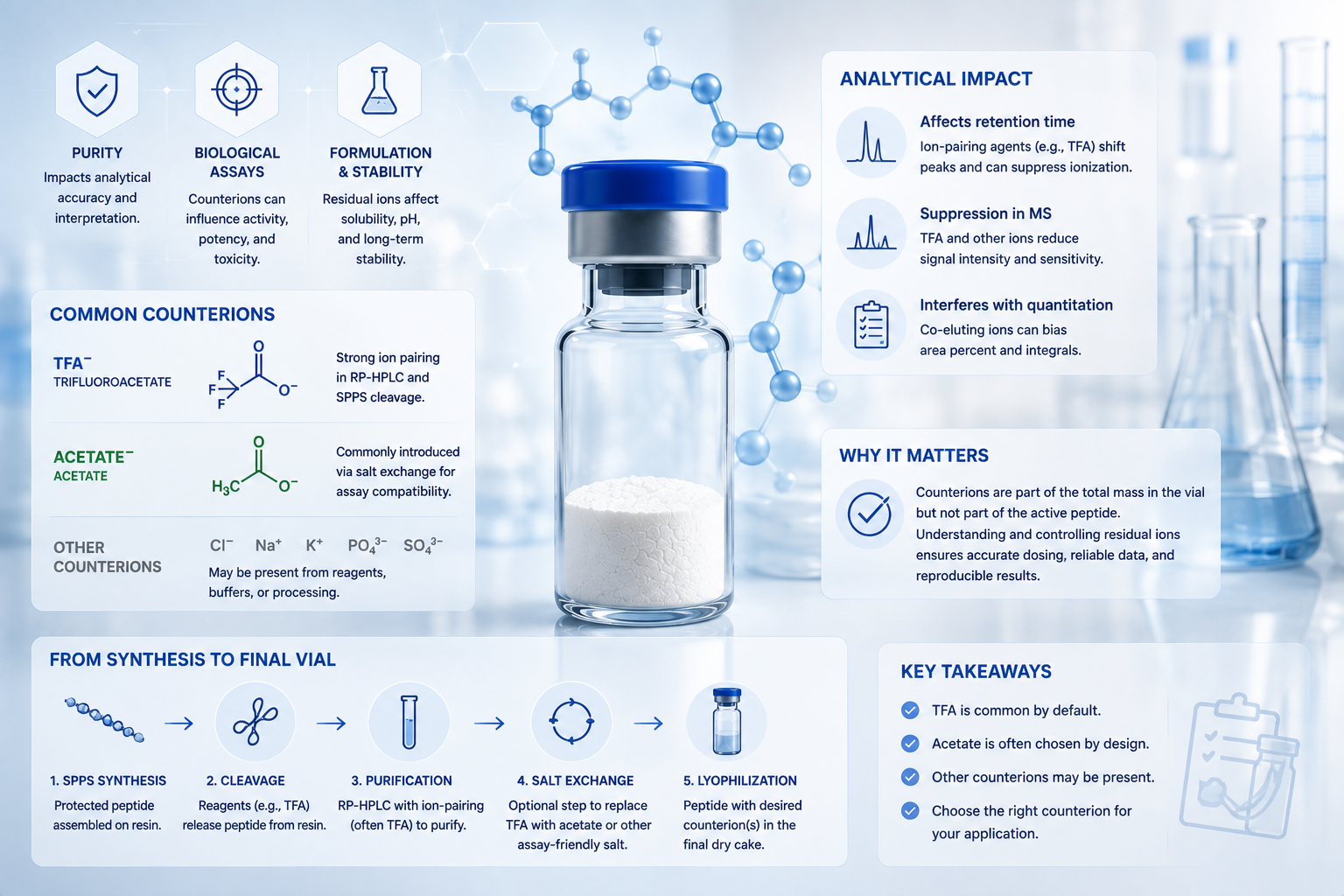
Counterions are charged molecules that pair with a peptide’s charged groups to form a stable salt. Trifluoroacetate (TFA) and acetate are the two most common in synthetic peptides. They are a normal, expected part of the material rather than a contaminant — but residual TFA can affect sensitive cell assays, and every counterion reduces the net peptide mass actually present in a vial.
This article explains what counterions are, where TFA and acetate come from, how they affect experiments and net content, and how to read counterion data on a certificate of analysis (COA). Knowing which counterion your peptide carries, and how much, is what keeps concentration and dosing calculations accurate.
Quick answer: what a counterion is and why it matters
A counterion balances the electrical charge on a peptide and is present as a salt. It is not a contaminant in the usual sense, but it does have real, practical effects you should account for. Two concerns matter most: assay interference, mainly from TFA, and reduced net peptide content, which comes from any counterion.
TFA is common because it is used during peptide synthesis and purification, so peptides made by standard methods frequently carry residual trifluoroacetate.
Acetate is often preferred for sensitive biological work, because it is generally considered gentler in cell-based assays.
The bottom line: know which counterion your peptide carries and roughly how much, so that results and dosing calculations in your experiments stay accurate. The right choice depends on your specific application, not on a single universally correct answer.
Where TFA comes from
Trifluoroacetic acid is central to how most synthetic peptides are made. It is widely used as the acid that cleaves the finished peptide from the resin in solid-phase peptide synthesis (SPPS), and as the ion-pairing agent in reversed-phase HPLC purification. Because it appears at both of these key steps, peptides purified by standard reversed-phase HPLC commonly carry residual trifluoroacetate as their counterion.
Residual TFA levels vary from batch to batch depending on the process and on how thoroughly the peptide was exchanged or lyophilized afterward. Importantly, the presence of TFA is expected and does not by itself indicate a low-quality peptide — it is a normal consequence of the chemistry, not a defect.
Why acetate is often preferred
Acetate is generally considered gentler for cell-based and other sensitive assays, which is why many researchers request it when residual TFA might confound a biological readout. Suppliers can perform a salt exchange to convert a TFA salt into an acetate or hydrochloride salt, giving you control over which counterion ends up in the vial.
That said, the best counterion depends on the experiment. Acetate is a common default for sensitive biological work, but there is no single choice that is correct for every application — solubility needs, downstream compatibility, and assay sensitivity all factor in.
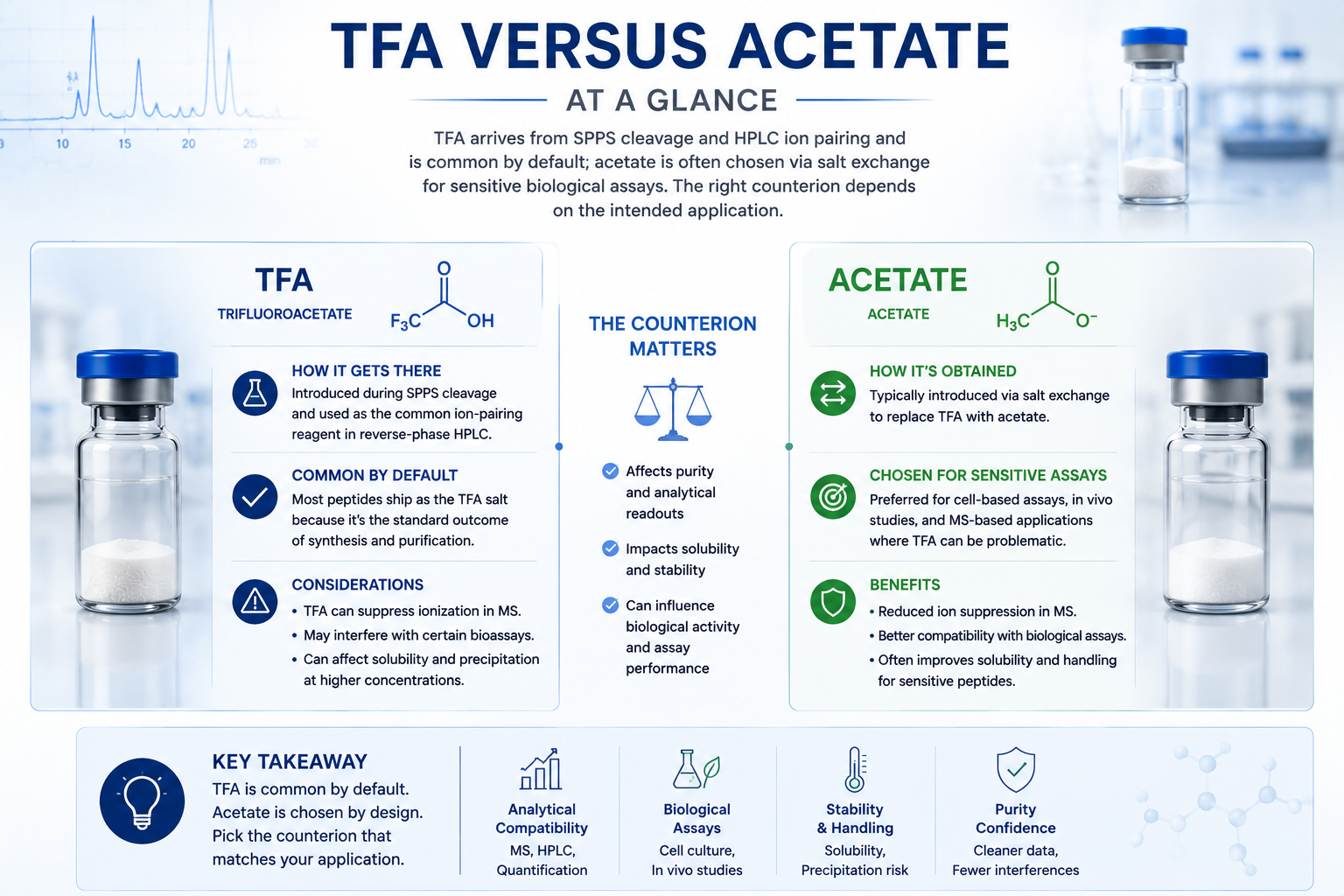
Figure 1: TFA versus acetate at a glance. TFA arrives from SPPS cleavage and HPLC ion pairing and is common by default; acetate is often chosen via salt exchange for sensitive biological assays. The right counterion depends on the intended application.
How residual TFA can affect experiments
Some studies report that residual TFA can affect cell viability, proliferation, or other readouts in sensitive assays. These effects are context dependent and vary with concentration, cell type, and the specific assay, so residual TFA is best understood as a variable to control rather than a universally harmful substance.
For sensitive cell work, controlling or removing TFA reduces a potential confounder. The practical framing is cautious: TFA is not universally problematic, but where counterion effects are plausible it is worth accounting for. Including appropriate controls — for example, comparing across salt forms or accounting for the counterion in your experimental design — is a sensible safeguard when effects could realistically occur.
Counterions and net peptide content
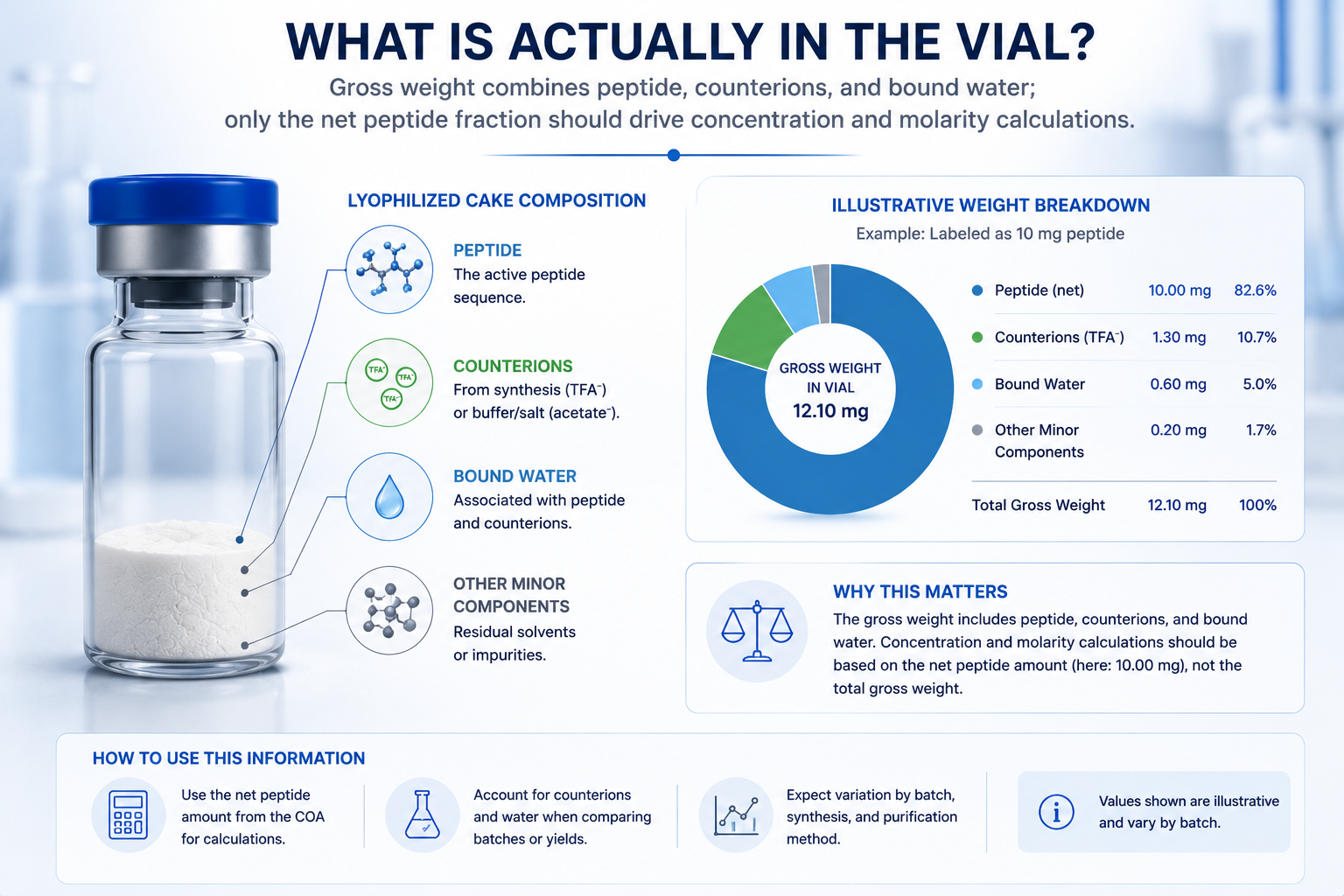
Here is the key practical point that trips up many concentration calculations: the mass in a vial includes the peptide plus counterions plus bound water and any salts. The actual peptide mass is therefore less than the gross weight printed on the label. Net peptide content (also called peptide content) is the fraction of the total that is actual peptide, and it is often reported on a COA.
Ignoring net content leads to systematic errors in concentration, and to unfair comparisons between lots or suppliers. A vial labeled by gross weight may contain meaningfully less peptide once counterions and water are subtracted, so working concentrations should be calculated from net peptide content, not gross vial weight.
Worth remembering: two vials with identical gross weights can contain different amounts of actual peptide if their net content differs. Comparing products fairly — and dosing your assays accurately — means comparing net peptide mass, never the label weight alone.
How to calculate using net peptide content
The calculation is straightforward once you know where to look:
Find the net peptide content percentage on the COA for your specific batch.
Multiply the stated vial mass by that percentage to get the true peptide mass. For example, 10 mg of gross material at 80% net content is 8 mg of actual peptide.
Use that true mass when computing molarity or working concentration, rather than the gross vial weight.
Compare products on net peptide mass, not label weight, so two suppliers are evaluated on the same basis.
Figure 2: What is actually in the vial. Gross weight combines peptide, counterions, and bound water; only the net peptide fraction should drive concentration and molarity calculations. Values shown are illustrative and vary by batch.
Other counterions you may encounter
While TFA and acetate dominate, you may see other salt forms depending on the synthesis and formulation:
Hydrochloride (chloride) salts as an alternative to TFA for some peptides.
Acetate as a common, biologically gentle option.
Occasional others depending on the specific synthesis and downstream requirements.
Whichever counterion is present, it should be documented so you know exactly what is in the vial. A clearly stated salt form removes ambiguity from your calculations and your assay design.
How to read counterion data on a certificate of analysis
A batch-specific COA is where you confirm what you are actually working with. When you receive one, look for the following:
Salt form or counterion identity — for example, whether the peptide is supplied as a TFA salt or an acetate salt.
Net peptide content, and where reported, residual counterion levels.
Batch-specific method data — confirm that the purity method (often HPLC) and the counterion information are tied to your actual lot, not a generic specification.
If counterion data is missing and your assay is sensitive, ask the supplier before use. A transparent, batch-specific COA is ultimately what lets you account for counterions properly and design experiments with confidence.
When to request a salt exchange
A salt exchange converts the peptide from one counterion to another, most often from TFA to acetate. It is worth requesting in specific situations:
Sensitive cell-based assays where residual TFA is a plausible confounder.
Studies where counterion identity must be controlled across conditions, so it is consistent rather than variable.
Cases where a specific salt form is required for solubility or downstream compatibility.
A salt exchange adds cost and time, so weigh it against how sensitive your assay actually is. When in doubt, discuss the intended application with your supplier so you can choose the right salt form together rather than defaulting to one blindly.
Key takeaways
Counterions like TFA and acetate are a normal part of synthetic peptides; TFA can affect sensitive assays, and all counterions reduce the net peptide mass in a vial.
TFA comes from SPPS cleavage and reversed-phase HPLC ion pairing, so residual trifluoroacetate is expected rather than a sign of poor quality.
Calculate working concentrations from net peptide content, not gross vial weight, and compare products on net peptide mass.
Request acetate or a salt exchange when the assay warrants it, and read the batch-specific COA for counterion identity and net content before designing sensitive experiments.
Frequently asked questions (FAQs)
What is a peptide counterion?
A counterion is a charged molecule that pairs with the peptide’s charged groups to form a stable salt. In synthetic peptides, trifluoroacetate (TFA) and acetate are the two most common. The counterion balances the peptide’s charge and is a normal part of the material rather than a contaminant.
Why does my peptide contain TFA?
TFA is used during the synthesis cleavage step and as the ion-pairing agent in reversed-phase HPLC purification. Because it appears at both stages, residual trifluoroacetate is common and expected in peptides made by standard methods, and its presence does not by itself indicate low quality.
Does residual TFA affect experiments?
Some sensitive cell assays can be affected by residual TFA, depending on concentration and cell type. It is a variable worth controlling rather than something universally harmful. For sensitive work, removing or exchanging TFA reduces a potential confounder, and appropriate controls help where effects are plausible.
How do counterions change net peptide content?
Counterions and bound water add mass, so the true peptide mass is less than the gross vial weight. Net peptide content is the fraction that is actual peptide. Use net content, not gross weight, for concentration calculations to avoid systematic errors.
Is acetate better than TFA?
Acetate is generally gentler for sensitive biological assays, which is why it is often preferred there. However, the best counterion depends on the specific experiment and downstream requirements, so there is no single universally correct choice.
When should I ask for a salt exchange?
Consider a salt exchange for sensitive cell work, when counterion identity must be controlled across conditions, or when a specific salt form is needed for solubility or compatibility. Weigh the added cost and time against how sensitive your assay is, and discuss the application with your supplier.
Suggested references
PubMed / peer-reviewed literature examining how residual trifluoroacetate can influence biological readouts in cell assays. pubmed.ncbi.nlm.nih.gov
Sigma-Aldrich (MilliporeSigma). Technical guidance on salt forms, counterions, and peptide content. sigmaaldrich.com
GenScript. Explanations of TFA versus acetate salts and net peptide content calculations. genscript.com
Bachem. Background on SPPS cleavage and reversed-phase HPLC ion pairing that introduce counterions. bachem.com
Thermo Fisher Scientific. Technical notes on peptide content, salt forms, and analysis. thermofisher.com
FDA Disclaimer: The statements made within this website have not been evaluated by the US Food and Drug Administration. The statements and the products of this company are not intended to diagnose, treat, cure, or prevent any disease. Verified Peptides is a chemical supplier. All products are sold for research, laboratory, or analytical purposes only, and are not for human consumption. This content is informational and is not medical advice.