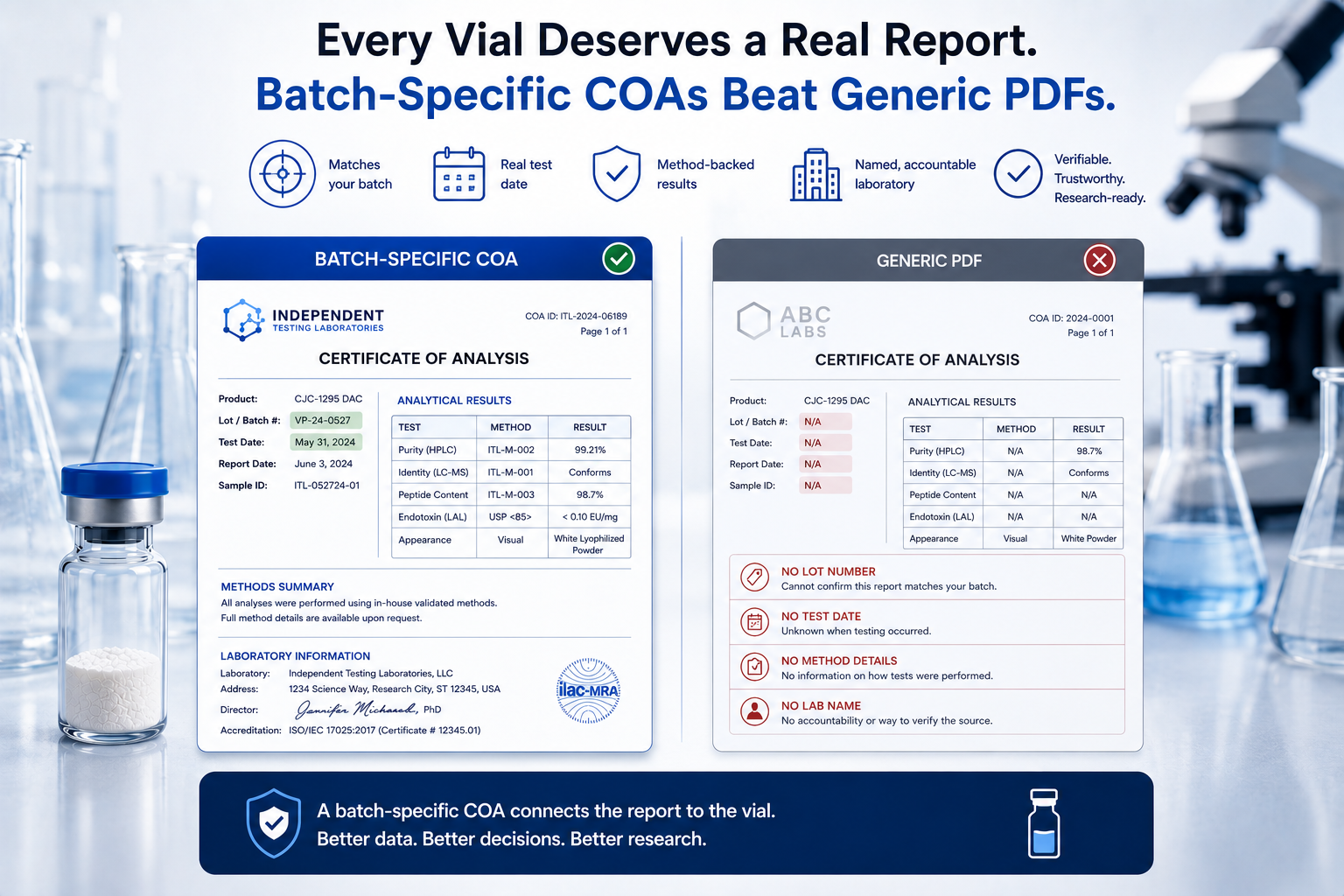
A batch-specific certificate of analysis (COA) reports the actual test results for the exact lot you received. A generic PDF is a reused document that says nothing verifiable about your vial. Only lot-specific data lets you confirm the purity, identity, and content of what is actually in your hands — which is why the distinction matters when you are comparing suppliers.
This article explains what a COA is, what a genuine batch-specific one contains, the red flags of a generic document, how to verify a COA, and why all of this matters for reproducible research.
Quick answer: a COA is only useful if it matches your lot
A certificate of analysis is a document reporting the test results for a specific batch of material. The word “specific” is doing the heavy lifting here.
A batch-specific COA carries a lot or batch number, a test date, and results tied to that exact production run.
A generic PDF is often a single reused file that does not correspond to the vial you received.
The practical implication is simple: if the document is not tied to your lot number, it cannot verify your material. A polished-looking PDF with no link to your actual vial tells you nothing you can rely on.
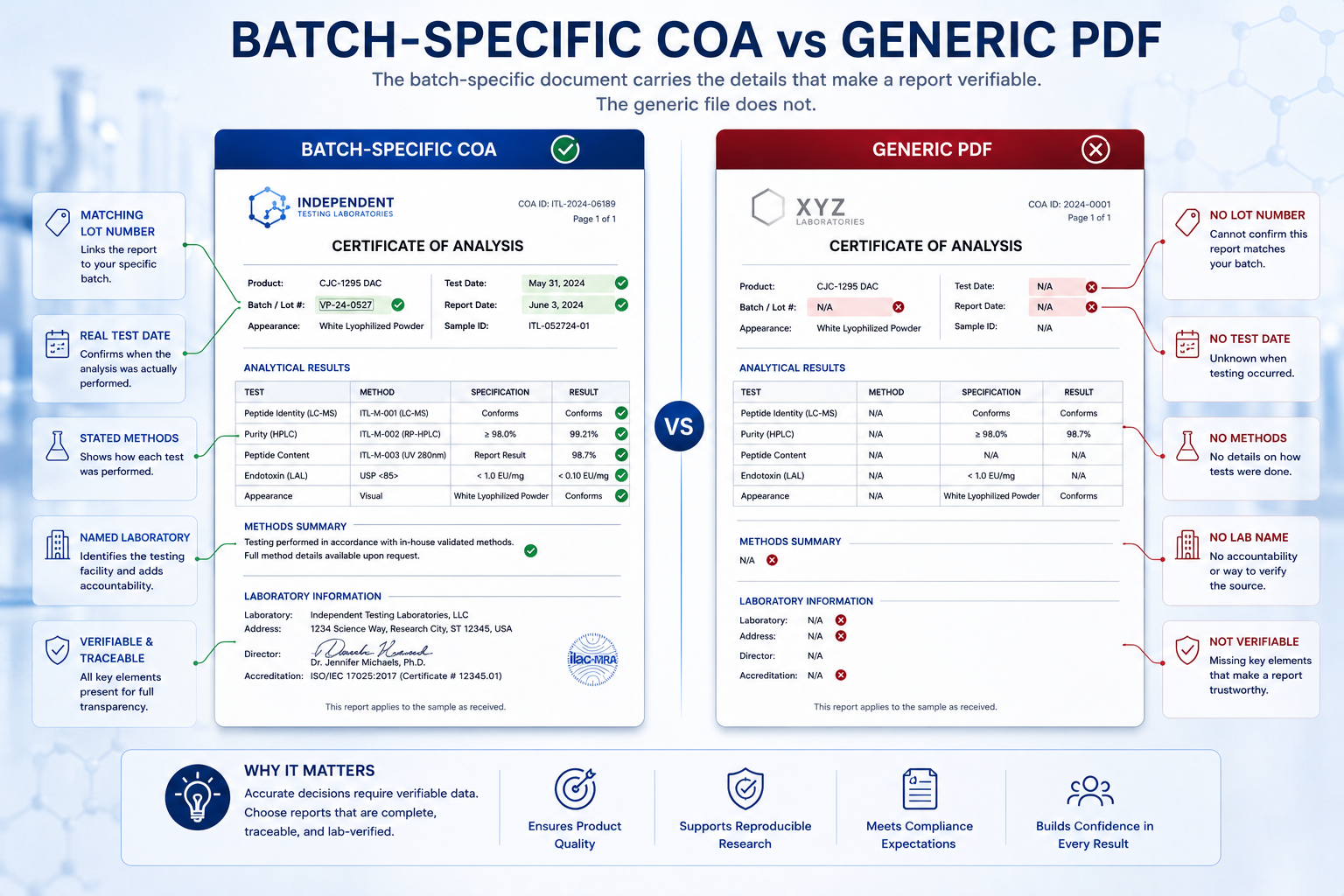
Figure 1: Batch-specific COA versus generic PDF. The batch-specific document carries a matching lot number, a real test date, stated methods, and a named laboratory; the generic file lacks the elements that make a report verifiable.
What a certificate of analysis is
A COA is a formal record of analytical testing performed on a defined batch. Its purpose is to document that a specific lot met defined quality parameters when it was tested. A meaningful COA is produced from actual testing of that batch — ideally by a recognized analytical laboratory — rather than assembled from generic specifications.
This is what separates a COA from marketing claims. A statement that a product is “99% pure” in a product description is not the same as a measured result on your lot; only testing of the specific batch, documented and traceable, provides that.
What a real batch-specific COA contains
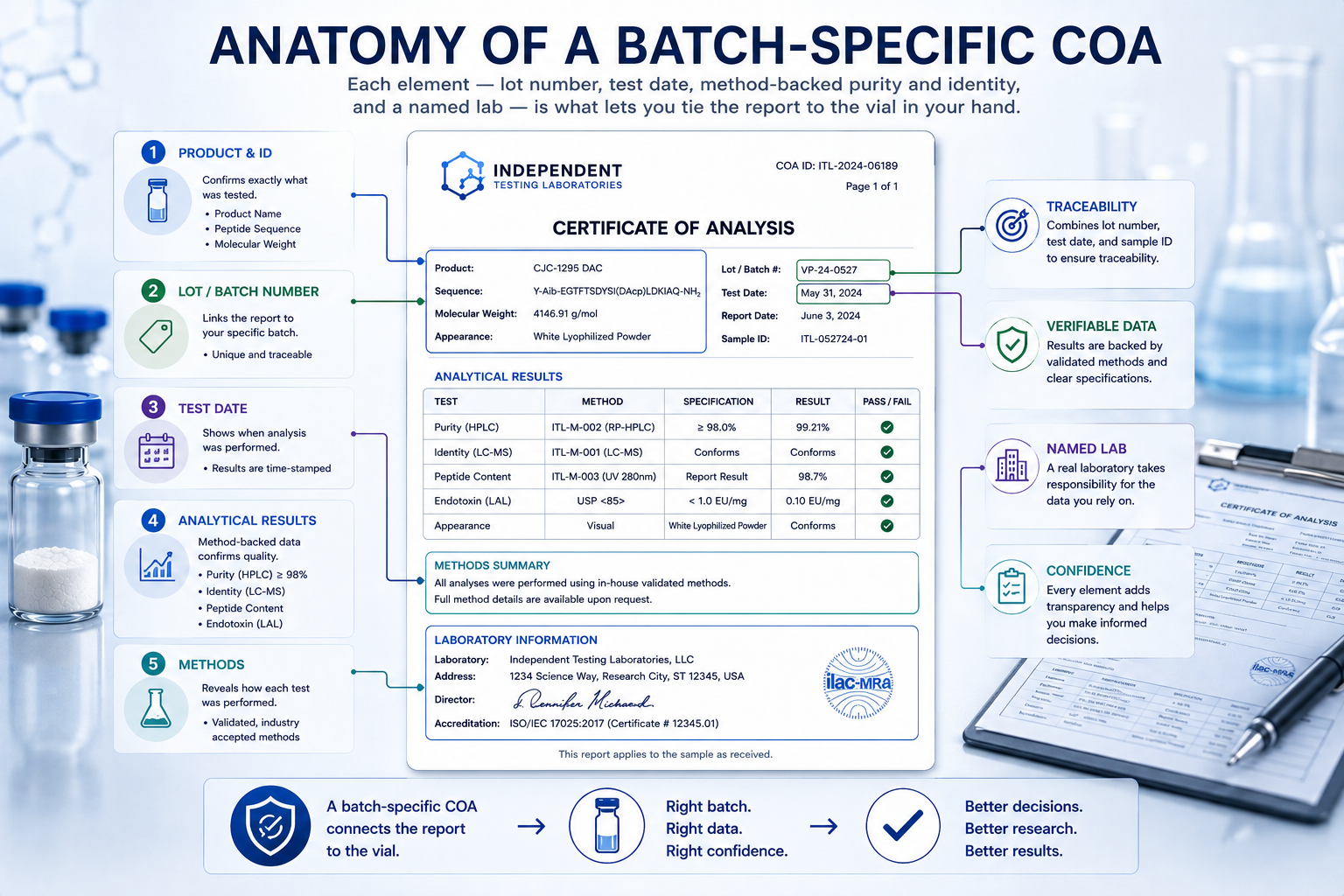
A genuine batch-specific COA generally includes:
A unique lot or batch number that matches the label on your vial.
The product identity and the test date.
Purity by a stated method, commonly HPLC, often with the chromatogram included.
Identity confirmation, commonly by mass spectrometry.
Net peptide content where relevant, plus microbial and endotoxin results where offered.
The name of the testing laboratory and a way to confirm the report is authentic.
Figure 2: Anatomy of a batch-specific COA. Each element — lot number, test date, method-backed purity and identity, and a named lab — is what lets you tie the report to the vial in your hand.
Why the lot number is the anchor
The lot number links the physical vial to a specific set of test results. Without a matching lot number, results cannot be tied to your material — the data might be real, but it is not demonstrably about your vial. A matching lot number is what makes a COA verifiable rather than decorative, so the single most useful habit is to cross-check the COA lot number against the vial label every time.
The red flags of a generic PDF
A few signs indicate a document that cannot confirm the specific material you received:
No lot or batch number, or a lot number that does not match your vial.
No test date, or a date that never changes across orders.
A single file reused for many different products or shipments.
No named testing laboratory and no way to verify authenticity.
Purity claimed in text but no supporting chromatogram or method.
Taken together, these are signs that the document is decorative rather than verifiable — it cannot confirm what is in your particular vial.
Why this matters for reproducible research
Purity and content vary between production runs, so lot-specific data is what keeps experiments consistent. Using material that does not match its documentation introduces an uncontrolled variable into your work — one that is easy to overlook until results stop making sense.
Batch-level records also let you trace an anomalous result back to a specific lot, which makes findings easier to defend and reproduce. Verifiable documentation supports reproducibility; generic PDFs, by their nature, cannot support that kind of traceability.
Worth remembering: if two orders of the “same” peptide come with the identical PDF, the document is not describing either lot — it is describing nothing. Reproducibility depends on being able to tie each vial to its own measured results.
How to verify a COA
Verifying a COA takes only a few checks:
Match the lot number on the COA to the lot number on your vial.
Confirm the test date is recent and specific rather than static across orders.
Check that purity and identity are reported with methods — for example HPLC and mass spectrometry.
Confirm the testing laboratory is named and, where possible, contact or cross-check it.
Look for a published archive of lot-specific reports you can search.
If the document cannot be tied to your lot, ask the supplier for the batch-specific report before use.
Third-party testing versus manufacturer-only claims
Independent third-party testing adds a layer of verification beyond the manufacturer’s own statement. A recognized analytical lab and a verifiable report strengthen confidence in the result, whereas manufacturer claims alone, without supporting batch data, are weaker evidence. Where possible, favor suppliers that provide independent, lot-specific analytical reports. Verified Peptides, for example, publishes an archive of batch-specific third-party lab reports that researchers can cross-check against the lot number on their vial.
Key takeaways
A batch-specific COA reflects your exact lot; a generic PDF does not. The lot number, test date, methods, and named lab are what make it verifiable.
Match the lot number to your vial, check that purity and identity are method-backed, and confirm the test date is specific rather than static.
Lot-specific documentation keeps experiments consistent and lets you trace anomalies back to a batch.
Favor independent third-party testing, and require lot-specific, verifiable documentation for any material used in research.
Frequently asked questions (FAQs)
What is a certificate of analysis?
A certificate of analysis (COA) is a document reporting the analytical test results for a specific batch of material. It documents that the lot met defined quality parameters when it was tested.
What is the difference between a batch-specific COA and a generic PDF?
A batch-specific COA is tied to your exact lot number and test date, with results from testing that production run. A generic PDF is a reused file that does not correspond to the vial you received, so it cannot verify your material.
What should a peptide COA include?
Look for a matching lot number, a test date, purity by a stated method such as HPLC, identity by mass spectrometry, net content where relevant, and the name of the testing laboratory with a way to confirm authenticity.
How do I verify a COA is legitimate?
Match the lot number on the COA to your vial, check that the test date is specific rather than static, confirm the purity and identity methods are reported, and verify the named laboratory where possible. A searchable archive of lot-specific reports is a strong sign.
Why does the lot number matter so much?
The lot number is the anchor linking the physical vial to its test results. Without a matching lot number, the COA cannot verify your material — the data is not demonstrably about your vial.
Is third-party testing better than manufacturer-only claims?
Independent third-party testing adds verification beyond the manufacturer’s own statement and strengthens confidence in the reported results. Manufacturer claims without supporting batch data are weaker evidence.
Suggested references
United States Pharmacopeia (USP). Guidance on certificates of analysis and what analytical documentation and batch records should contain. usp.org
U.S. Food and Drug Administration (FDA). Background on the role and expected content of a certificate of analysis. fda.gov
Sigma-Aldrich (MilliporeSigma). Example of lot-specific COA structure and searchable batch documents. sigmaaldrich.com
Thermo Fisher Scientific. Examples of batch-specific analytical documentation and verification. thermofisher.com
Verified Peptides. Published archive of batch-specific third-party lab reports researchers can cross-check. verifiedpeptides.com/lab-reports
FDA Disclaimer: The statements made within this website have not been evaluated by the US Food and Drug Administration. The statements and the products of this company are not intended to diagnose, treat, cure, or prevent any disease. Verified Peptides is a chemical supplier. All products are sold for research, laboratory, or analytical purposes only, and are not for human consumption. This content is informational and is not medical advice.