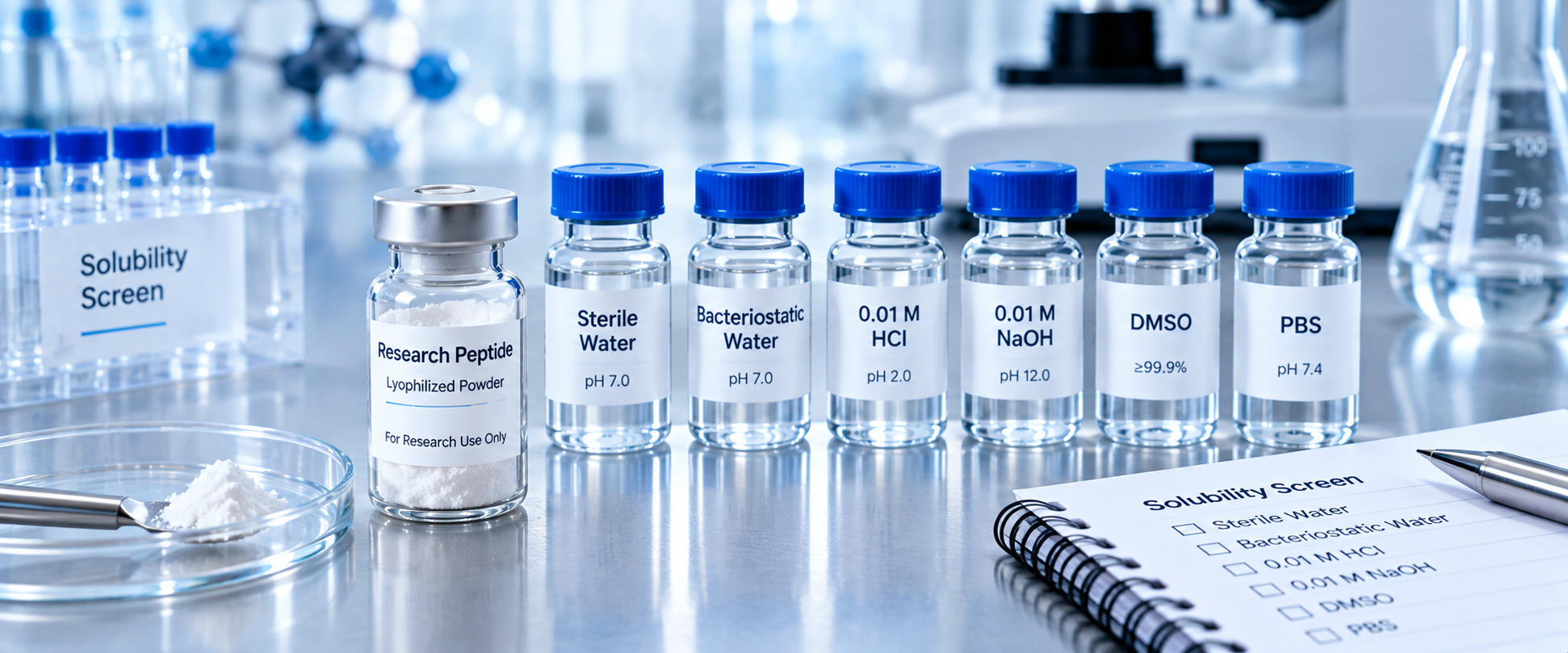
Solvent choice is largely predictable from the sequence. Count the charged and polar residues against the nonpolar ones, check the net charge at neutral pH, and the sequence tells you whether to start in water, in a dilute aqueous acid or base, or in a small volume of an organic solvent before diluting. Two rules hold throughout: always test a small aliquot before committing the whole vial, and always start with the mildest solvent that has a reasonable chance of working.
This article covers how to classify a sequence, the ordered screening path for each class, the sequences that resist both approaches, what to avoid, and how to record the result so it is reproducible. All material discussed is for research use only and is not for human or veterinary use.
Quick answer: how the sequence decides the solvent
Here is the rule set in scannable form. A peptide with a high proportion of charged and polar residues and a clear net charge generally dissolves in water or a dilute aqueous buffer. A peptide dominated by nonpolar residues generally needs a small volume of an organic solvent first, then dilution into an aqueous medium.
Net positive peptide: a dilute aqueous acid is the usual next step after plain water.
Net negative peptide: a dilute aqueous base is the usual next step.
Strongly hydrophobic or near-neutral peptide: a minimal volume of a water-miscible organic solvent such as DMSO, followed by slow dilution, is the common approach.
Two constants hold no matter the class: test a small aliquot, and move from mildest to harshest rather than the reverse. One more constraint is yours to apply: the appropriate solvent also depends on what your downstream assay tolerates, so a stock you cannot dilute into the working system is not a solved problem.
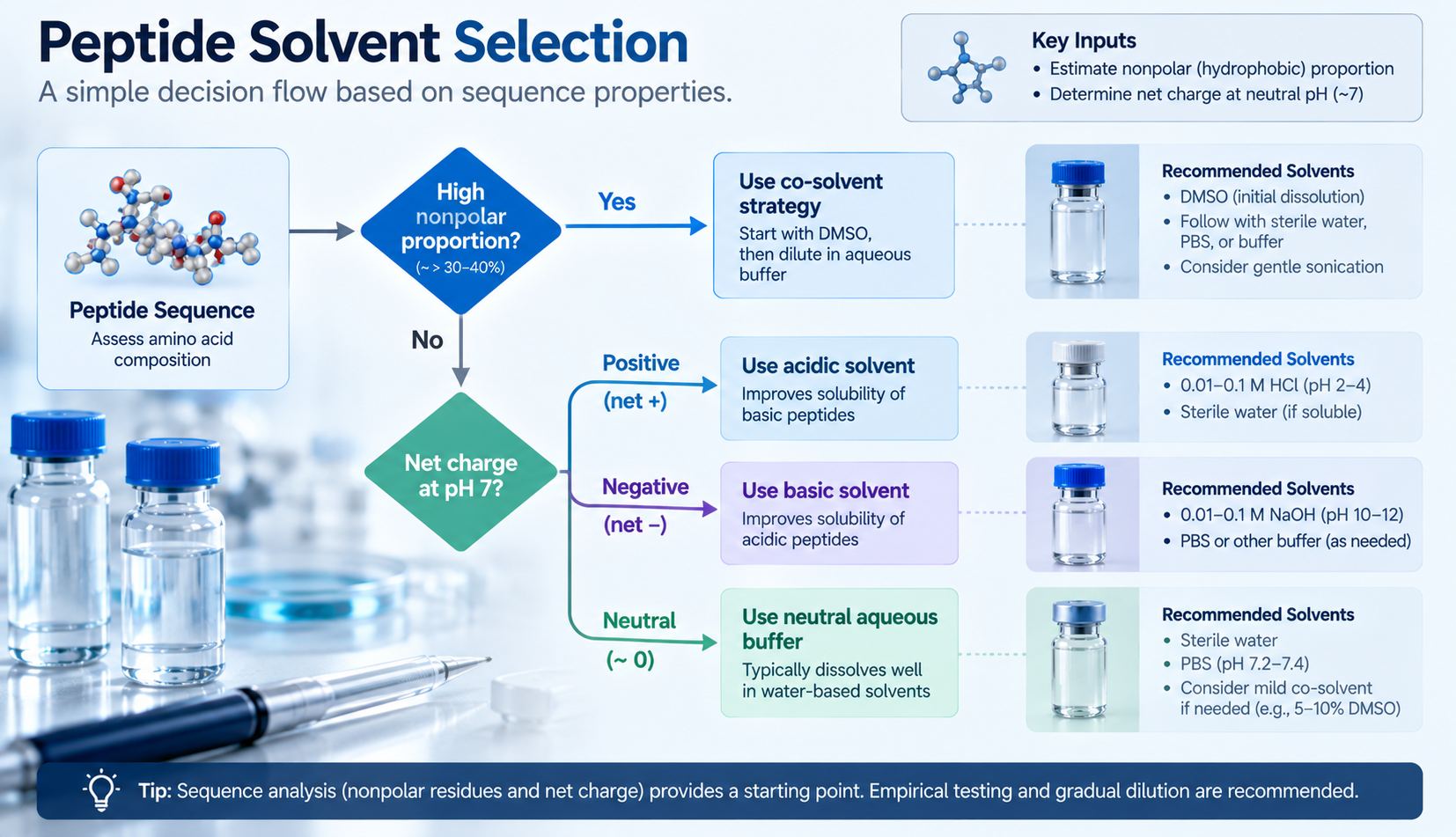
Figure 1: The solvent selection decision flow. Start at the sequence, branch on the proportion of nonpolar residues, then on net charge, and arrive at water, dilute acid, dilute base, or an organic-first approach. Always run it on a small aliquot.
What makes a peptide hydrophobic or hydrophilic
Hydrophobicity is a property of the whole sequence, driven by which side chains it contains and how they are distributed. It is a spectrum rather than two boxes: most peptides sit somewhere between the extremes rather than at one end. The two practical inputs you will use are the residue composition and the net charge at neutral pH.
Chain length and secondary structure matter too. A long hydrophobic stretch can drive aggregation even in a sequence that looks manageable on paper, so composition alone does not always predict behavior. This is why the prediction below narrows the search rather than eliminating the test.
Reading the sequence: nonpolar, polar, and charged residues
Grouping the residues makes them countable:
Nonpolar (aliphatic or aromatic): alanine, valine, leucine, isoleucine, methionine, phenylalanine, tryptophan, and proline.
Polar, uncharged: serine, threonine, asparagine, glutamine, tyrosine, cysteine, and glycine.
Charged: aspartate and glutamate (acidic); lysine, arginine, and histidine (basic).
The working heuristic: if more than roughly half the residues are nonpolar, expect poor water solubility and plan an organic-first approach. To put a number on the same judgment, the GRAVY score from the Kyte and Doolittle hydropathy scale averages the hydropathy of every residue and is freely calculable from a sequence using a tool such as Expasy ProtParam. Treat the score as a guide, not a guarantee: sequences with the same score can behave differently depending on the order of their residues.
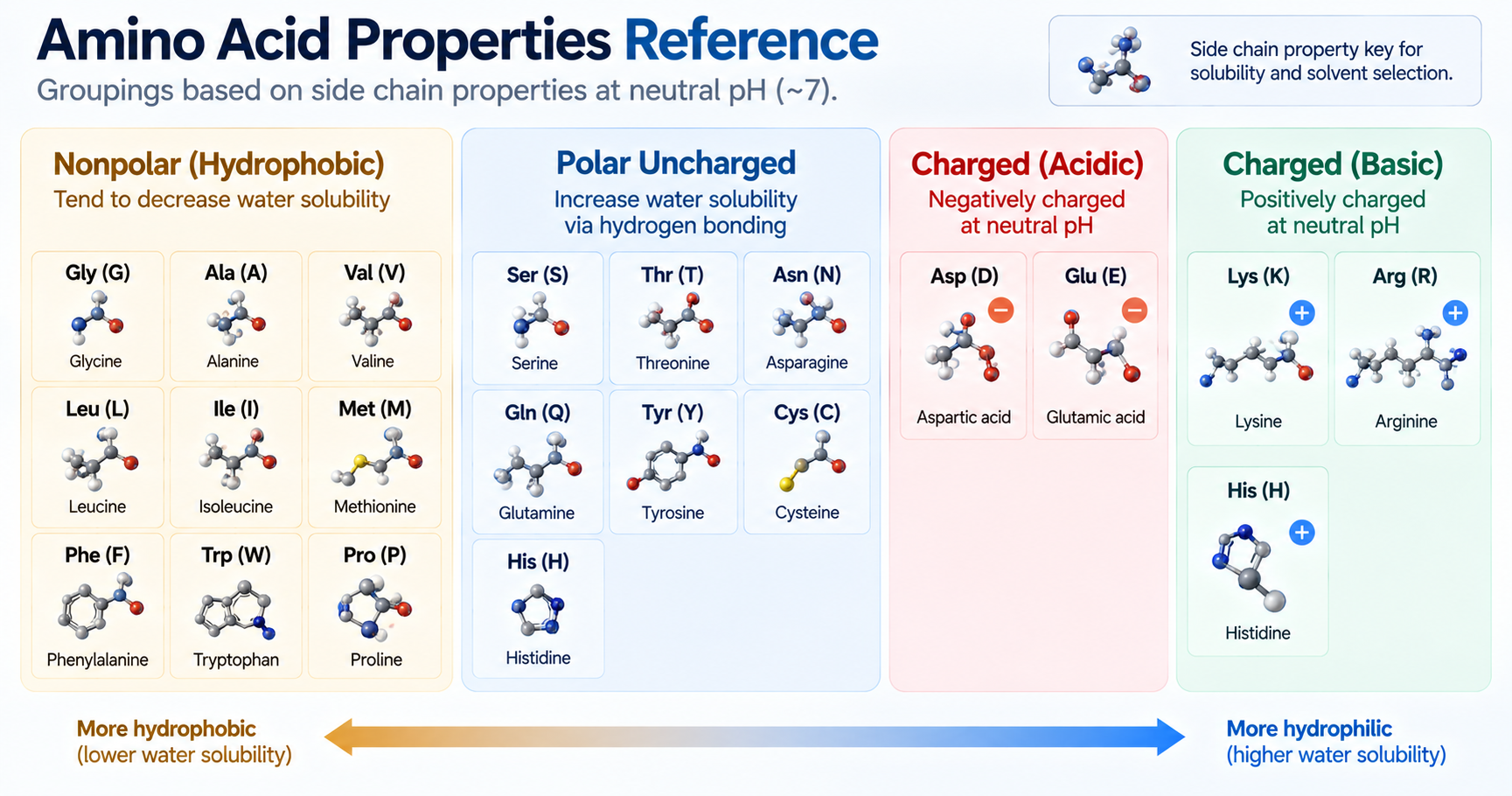
Figure 2: A residue classification reference. Grouping the amino acids into nonpolar, polar uncharged, and charged (acidic and basic) turns the core prediction step into a quick count you can do at the bench.
Net charge at neutral pH and why it decides which direction to move
Net charge tells you whether to acidify or alkalize the aqueous solvent, because a peptide is generally most soluble when it carries charge and least soluble near its isoelectric point. The count is simple: add one for each basic residue, subtract one for each acidic residue, and account for the terminal groups unless they are capped.
Net positive peptides generally respond to a dilute aqueous acid such as dilute acetic acid. Net negative peptides generally respond to a dilute aqueous base such as dilute ammonium hydroxide or ammonium bicarbonate. A peptide with roughly balanced acidic and basic residues has no easy pH direction, which is part of why these near-neutral sequences are often the hardest to dissolve. Because changing pH can affect stability for sequences with sensitive residues, the mildest effective condition is the right one.
Worked example: for a short sequence with two lysines and one arginine (three basic) and one aspartate (one acidic), the net charge is roughly +2 at neutral pH. That net positive value points toward plain water first, then a dilute aqueous acid such as dilute acetic acid if water alone does not clear it.
The screening order that avoids wasted material
Run the test on a small weighed aliquot, not the whole vial, and escalate one step at a time. Working in this order means a failed attempt costs a fraction of the material rather than all of it.
Equilibrate the vial. Bring it to room temperature before opening so condensation does not settle onto the powder.
Try water first. Attempt sterile or high-purity water at a modest concentration and observe.
Follow the net charge. If it does not clear, move in the direction the net charge indicates, using a dilute aqueous acid or base.
Go organic if needed. If it still does not clear, dissolve in the minimum volume of a water-miscible organic solvent, then add aqueous medium slowly with mixing.
Use gentle assistance sparingly. Brief sonication or vortexing can help; use warming sparingly, because heat can degrade some sequences.
Record the concentration, solvent, and observations at each step, so the condition that eventually works is reproducible rather than half-remembered.
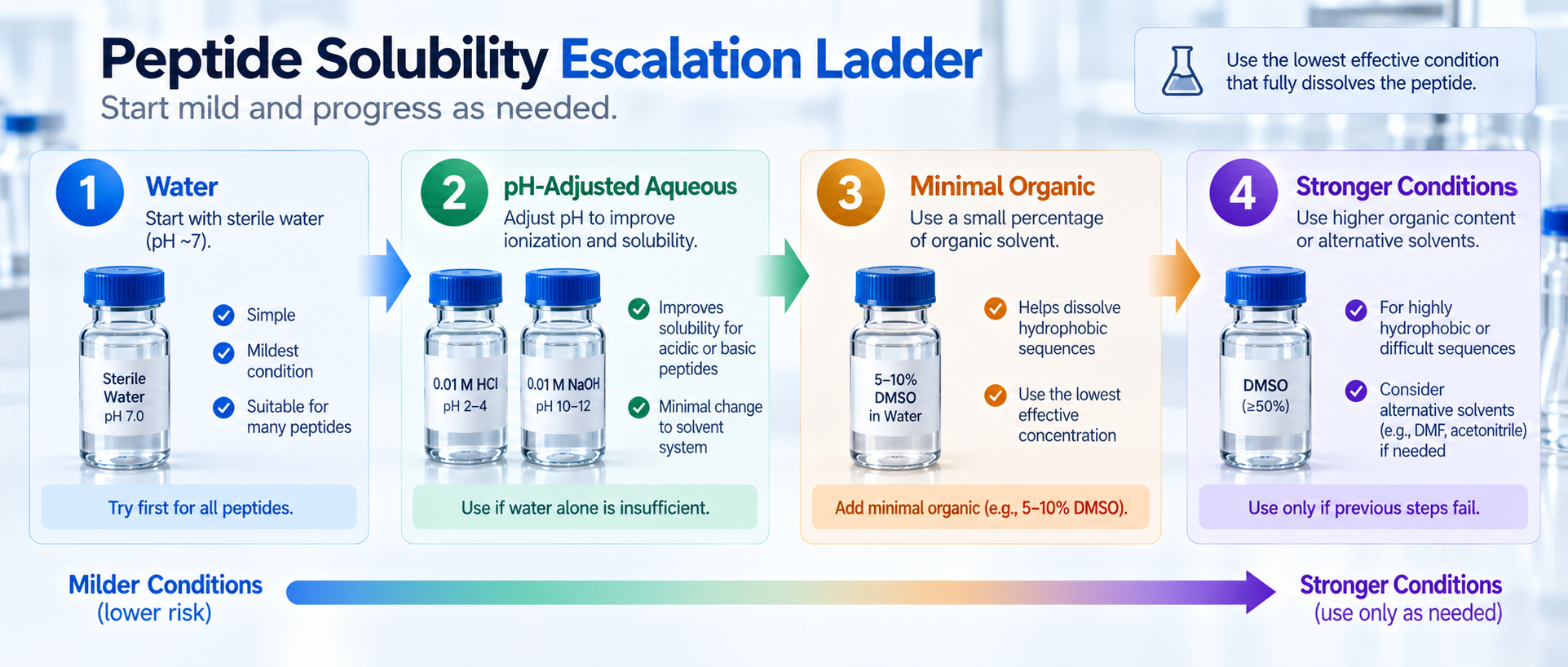
Figure 3: The escalation ladder. Move from water, to pH-adjusted aqueous, to a minimal volume of organic solvent, and only then to stronger conditions. Going one rung at a time is the central discipline of solvent screening.
Solvent options for hydrophilic peptides
Most hydrophilic peptides go into water or a dilute aqueous buffer without help. The common aqueous options, and what each is generally used for:
High-purity or sterile water: the default first attempt and the cleanest diagnostic.
Dilute acetic acid: generally used for net positive sequences.
Dilute ammonium bicarbonate or ammonium hydroxide: generally used for net negative sequences.
Buffers with high salt content can reduce solubility for some sequences, so plain water first is often the better diagnostic before you reach for a buffer. The practical benefit of succeeding here is real: the fewer cosolvents in the stock, the fewer variables in the downstream work.
Solvent options for hydrophobic peptides
The standard approach is to dissolve in a minimal volume of a water-miscible organic solvent, then dilute slowly into the aqueous medium while mixing. The commonly used organic solvents and their general trade-offs:
DMSO: the broadest first option for a sequence that will not go into water or a pH-adjusted aqueous solvent.
Acetonitrile and alcohols: effective for some sequences.
Stronger denaturing conditions: reserved for genuinely difficult cases.
Minimal volume matters because the final percentage of organic solvent in the working solution is often constrained by the downstream assay. Add the aqueous medium slowly: adding it too quickly can cause the peptide to crash out, and adding the organic stock into the aqueous medium rather than the reverse is often more forgiving. Two sequence-specific cautions are worth checking rather than treating as fixed rules: cysteine-containing and methionine-containing peptides can be sensitive to certain solvent conditions, so confirm compatibility for your sequence before committing material.
Sequences that resist both: aggregation and sparingly soluble peptides
Some sequences are not simply hydrophobic; they are aggregation prone, and more solvent does not fix aggregation. The pattern to recognize is a cloudy or gelled solution rather than undissolved powder, often from long stretches of nonpolar residues or high beta-sheet propensity.
General strategies for these cases include working at a lower concentration, using chaotropic conditions, and preparing fresh rather than storing dilute solutions. Set expectations honestly: for some sequences the achievable stock concentration is lower than you hoped, and planning around that is better than forcing it. Record the failure conditions too, because that record is what makes the next attempt smarter.
What not to do
A short list of habits wastes material or risks degrading the peptide:
Do not start with the harshest solvent available. Escalating is easy to plan; de-escalating is not.
Do not commit the whole vial to a first attempt.
Do not use prolonged heating or aggressive sonication as a default, since both can degrade sensitive sequences.
Do not assume a solvent that worked for one peptide transfers to another, even a closely related sequence.
Do not ignore what the downstream assay tolerates. A stock that will not dilute into the working system is not solved.
Do not repeatedly freeze and thaw a stock when small single-use aliquots are an option.
Recording the result so it is reproducible
The useful record is the exact condition that worked, not just the fact that it dissolved. Worth capturing: batch or lot number, aliquot mass, solvent identity and concentration, final peptide concentration, temperature, any assistance used, and the visual result.
Recording net peptide content from the batch certificate of analysis alongside the mass is what makes the concentration figure accurate, since the powder includes water and counterions and the peptide mass is lower than the powder mass. The payoff is simple: a documented condition turns a one-time success into a repeatable protocol for the next batch.
Key takeaways
Predict first: count nonpolar against polar and charged residues, compute net charge at neutral pH, and optionally check the GRAVY score.
Screen in order: small aliquot, water first, then the pH direction net charge indicates, then a minimal volume of organic solvent with slow dilution.
Prediction narrows the search but does not eliminate the test, and some sequences will only reach a modest concentration.
Check the batch certificate for net peptide content, and log the working condition so it can be reused for the next batch.
Frequently asked questions (FAQs)
How do you know if a peptide is hydrophobic or hydrophilic?
Count the nonpolar residues against the polar and charged ones, and check the net charge at neutral pH. A GRAVY score calculated from the sequence, using a tool such as ProtParam, puts a number on the same judgment.
What solvent should you try first?
High-purity or sterile water on a small aliquot, because it is the mildest option and succeeding there leaves the fewest variables downstream. If water does not clear it, escalate to a pH-adjusted aqueous solvent, then to a minimal volume of organic solvent.
How does net charge tell you whether to use acid or base?
Net positive peptides generally respond to a dilute aqueous acid, and net negative peptides to a dilute aqueous base, because a peptide is generally least soluble near its isoelectric point. Move in the direction the net charge indicates.
When should DMSO be used?
DMSO is the common first organic option for a sequence that will not dissolve in water or a pH-adjusted aqueous solvent. Use the minimum volume, dilute slowly, and check what percentage of organic solvent the downstream assay tolerates.
Why did my peptide turn cloudy or gel instead of dissolving?
That pattern generally points to aggregation rather than simple insolubility. The response is a lower working concentration and fresh preparation, not a stronger solvent, since more solvent does not fix aggregation.
Is it safe to heat or sonicate a peptide to help it dissolve?
Brief, gentle assistance is commonly used, but prolonged heating and aggressive sonication can degrade sensitive sequences. Use both sparingly, and record when you use them so the condition stays reproducible.
How much peptide should you use for a solubility test?
Use a small weighed aliquot, never the whole vial, so a failed attempt costs a fraction of the material. The exact amount depends on your sequence and how much you can spare.
Does net peptide content affect the concentration I calculate?
Yes. The powder includes water and counterions, so the peptide mass is lower than the powder mass. Use the net peptide content figure on the batch certificate of analysis when you calculate concentration.
Suggested references
Bachem. Peptide solubility technical note, on classifying sequences and selecting solvents. bachem.com
Bachem. Handling and storage guidelines for peptides, on room-temperature equilibration and aliquoting. bachem.com
Merck (Sigma-Aldrich). Solubility guidelines for peptides, organized by residue composition and net charge. sigmaaldrich.com
GenScript. Peptide solubility guidelines, useful for cross-checking general rules. genscript.com
Expasy ProtParam documentation, on the GRAVY score and the Kyte and Doolittle hydropathy scale. web.expasy.org
FDA Disclaimer: The statements made within this website have not been evaluated by the US Food and Drug Administration. The statements and the products of this company are not intended to diagnose, treat, cure, or prevent any disease. Verified Peptides is a chemical supplier. All products are sold for research, laboratory, or analytical purposes only, and are not for human consumption. This content is informational and is not medical advice.