
Short answer
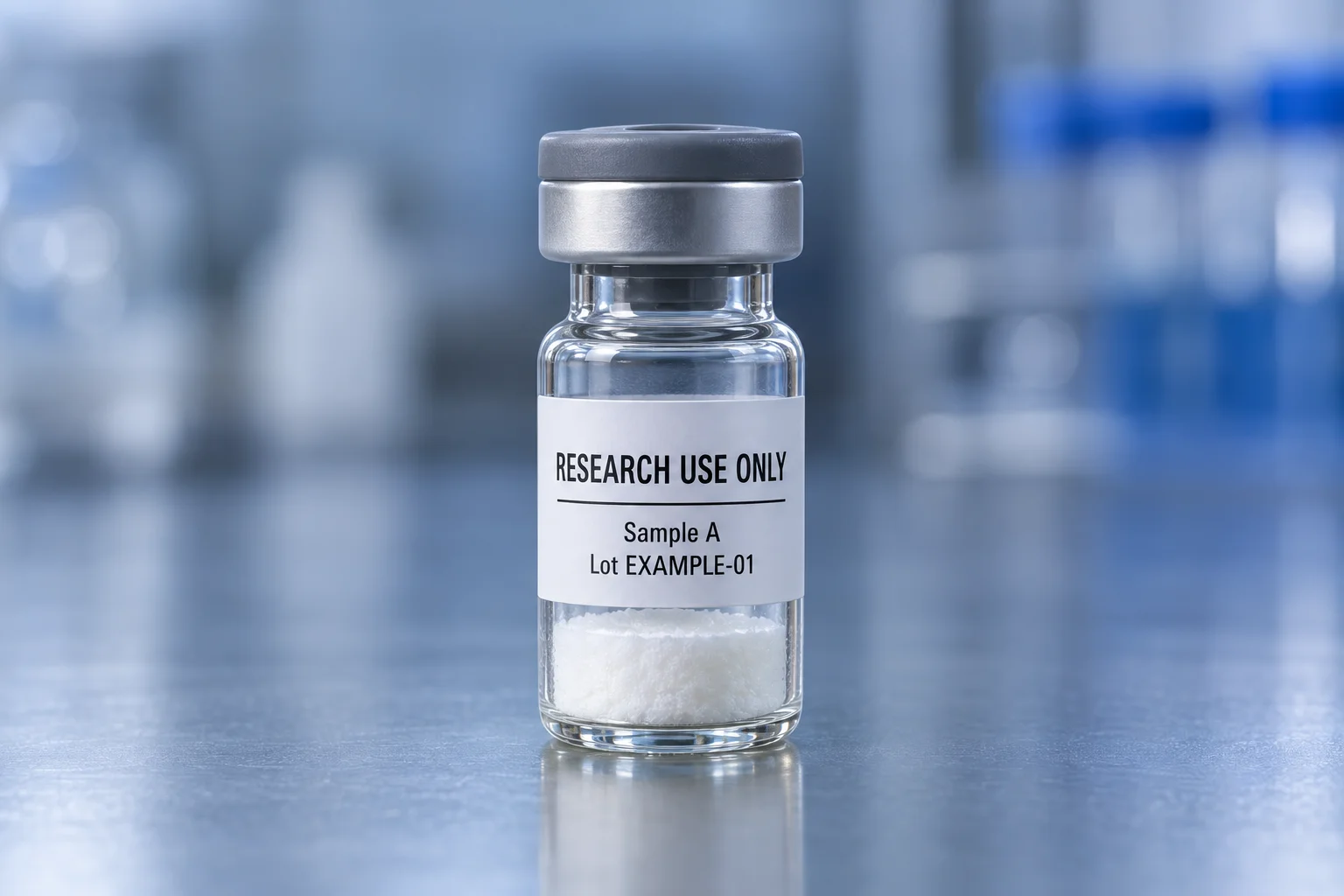
RUO (research-use-only) is a label that tells you a product is sold for laboratory research and has not been reviewed or approved by FDA for any non-research use. It is not a quality grade, a certification, or an approval. What separates legitimate peptide suppliers is how they behave around the label: documented manufacturing, batch-specific testing, research-only packaging and marketing, and honesty about what kind of company they are.
Comparing specific suppliers on documentation and testing? See how to evaluate a research peptide supplier in 2026.
Quick Answer: What the Research-Use-Only Label Means
Research-use-only (RUO) is a designation that suppliers of chemical reagents, biological materials, and instruments use to show that a product is meant for in vitro or laboratory research and has not been reviewed or approved by regulators for any non-research use. In FDA rules, the RUO statement comes from the labeling regulation for IVDs (in vitro test kits, reagents, and instruments), where it marks a product that is still in the laboratory research phase of development.1, 2
RUO is not an approval or a certification. No agency grants it: the seller applies it, and with it comes an obligation to keep the product, its marketing, and its communications within research boundaries.
How the FDA Frames Research-Use-Only Products
FDA judges a product by its intended use, and the label alone does not settle that question. Under FDA regulations, intended use means the objective intent of the people responsible for the product, shown by labeling claims, advertising, oral or written statements, and the circumstances in which the product is distributed.3
FDA’s 2013 guidance for IVDs says that merely placing an RUO label on a product does not exempt it from FDA requirements, and that FDA may find a different intended use from other evidence, including how the product is marketed.2 That guidance covers only IVDs, but it shows how FDA reads the label: as a warning backed by conduct, not a shield.
For peptides the point is the same: an RUO research chemical has not been through FDA review or approval, and FDA has said it warned companies selling unapproved GLP-1 receptor agonist products labeled “for research purposes” while those products were being sold directly to the public with instructions for personal use.4 On a legitimate supplier’s site, the disclaimer reflects the product’s real regulatory status; it is not boilerplate.
RUO Suppliers vs 503A and 503B Facilities
Facilities working under sections 503A and 503B of the FD&C Act (the main federal statute FDA enforces) are a separate regulatory category from RUO chemical suppliers. Only 503B outsourcing facilities register with FDA and must meet current good manufacturing practice (CGMP) requirements.5 An RUO supplier is neither, and should say so plainly.
| Category | What it is | Oversight and status |
|---|---|---|
| RUO chemical supplier | Sells reagents for laboratory research | Products not FDA-approved; intended use judged from labeling, marketing, statements, and distribution3 |
| 503A facility | Licensed pharmacist in a state-licensed facility, or a physician, under section 503A | Not subject to CGMP requirements; compounded products are not FDA-approved5 |
| 503B outsourcing facility | Compounder registered with FDA under section 503B | Overseen and inspected mainly by FDA; CGMP applies; products are not FDA-approved5 |
What RUO Is Not
- Not a quality grade. RUO says nothing about purity or analytical standards; testing and documentation establish quality.
- Not FDA approval. It does not imply safety or performance for any non-research use.
- Not a license to market for personal use. Advertising and statements count as evidence of intended use, whatever the label says.3
- Not “unregulated.” Chemical suppliers remain subject to general business, labeling, and shipping rules.
Because the label is self-applied, two suppliers can put the same RUO statement on the same peptide while working to very different standards. The way a supplier behaves around the label tells you at least as much as the label itself.
What Legitimate RUO Peptide Suppliers Do Differently
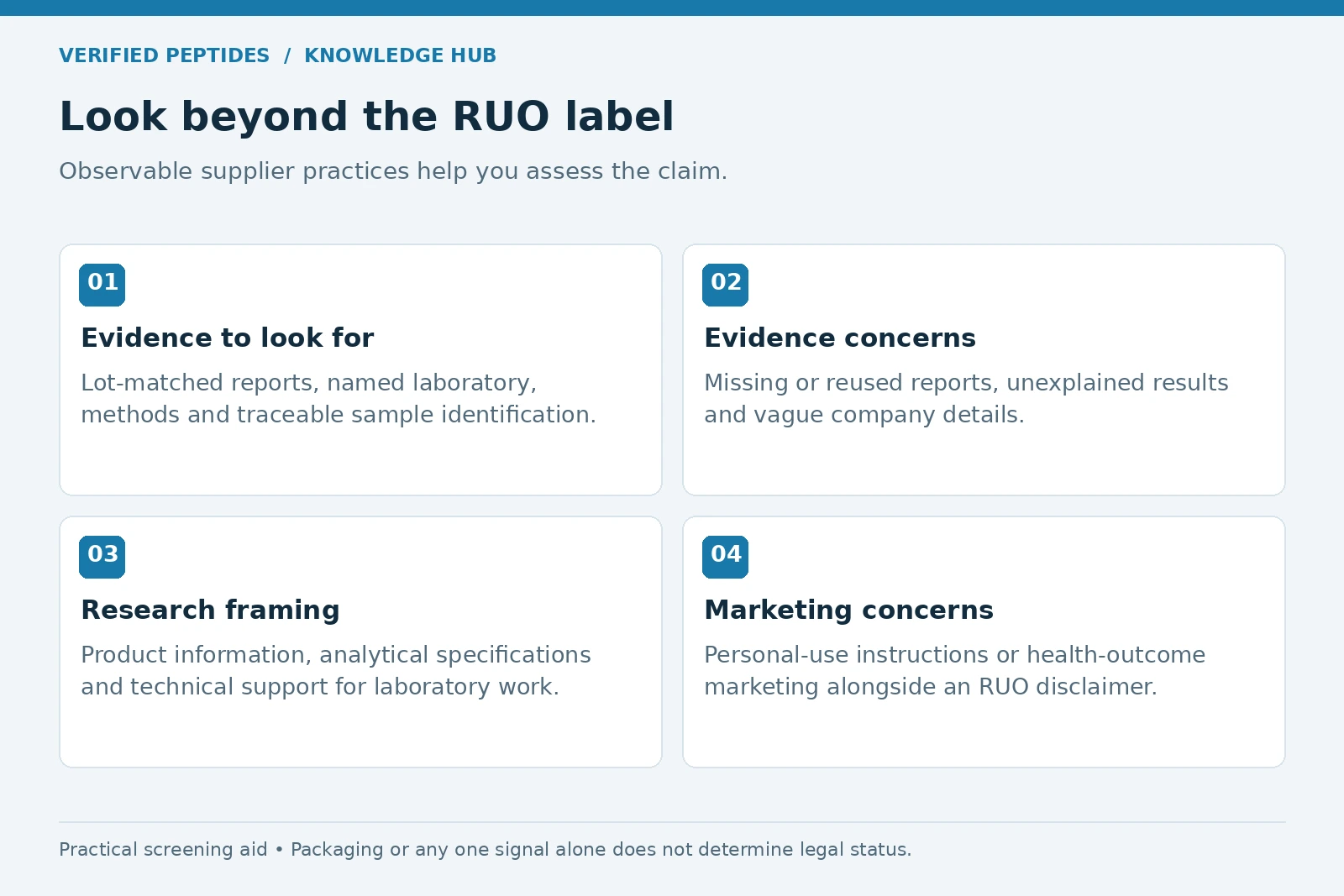
Legitimate RUO suppliers behave like analytical chemical suppliers, not like wellness brands. The six behaviors below are practical criteria you can check from the outside.
1. They Manufacture in Controlled Facilities
Peptides should be made in controlled environments with documented standard operating procedures for synthesis, purification, and packaging, and with traceability from raw materials to finished vials. Good Manufacturing Practice (GMP) guidance for active pharmaceutical ingredients, ICH Q7, shows what this looks like in a regulated setting: written procedures, batch records, and traceable materials.6 Research reagents are generally not made under full pharmaceutical GMP, so ask which standard applies.
2. They Test Each Batch and Publish the Results
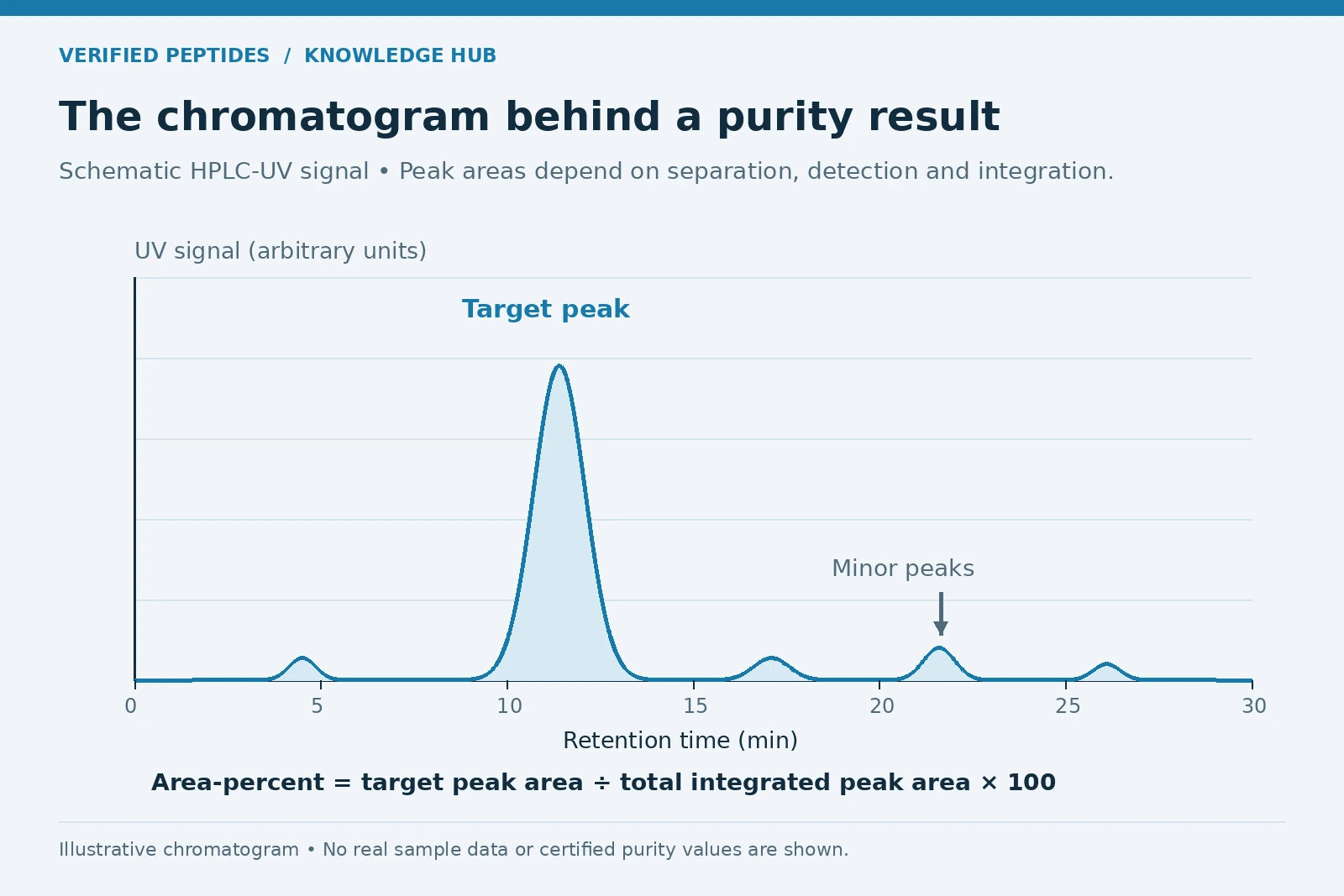
Legitimate suppliers test each batch, ideally through an independent third-party lab, and publish batch-specific certificates of analysis (COAs: reports of test results for one batch). A typical peptide panel covers purity by HPLC (high-performance liquid chromatography) and identity by mass spectrometry, and may add net peptide content.7 Sterility and endotoxin testing are added where relevant; endotoxin is lipopolysaccharide (LPS) from the outer membrane of Gram-negative bacteria, often tested with the LAL assay.8 What a complete COA should show is covered in batch-specific COAs vs generic PDFs.
3. They Label and Ship Products as Research Chemicals
Peptides are typically supplied as lyophilized (freeze-dried) powder in research vials; solutions are offered mainly for defined analytical uses such as calibration standards, with stability data, storage instructions, and batch documentation. Capsules and retail-style packaging are not research formats. Labels carry a clear RUO statement and a warning against any non-laboratory use, and no amounts, schedules, or health claims appear on packaging or product pages.
4. Their Marketing Stays Within Research Framing
Product descriptions summarize what a peptide has been studied for in published research, with no testimonials, health-outcome claims, or personal-use schedules. Disclaimers appear prominently and consistently, which matters because FDA weighs advertising and statements, not just the label, when judging intended use.3
5. They Are Transparent About What They Are and Aren’t
A legitimate supplier states plainly that it is a chemical supplier, not a 503A or 503B facility. Questions about personal use are declined and redirected to qualified professionals, and staff do not offer personal advice or present the company as a substitute for a licensed practitioner.
6. They Engage With the Research and Analytical Community
Look for long-standing relationships with reputable analytical labs and staff who can answer technical questions about methods, batch documentation, and storage. For why lab independence matters, see in-house vs third-party lab testing.
Red Flags That Suggest a Supplier Is Not Operating as a Legitimate RUO Supplier
The clearest red flag is a research-only disclaimer next to marketing that promises personal results. Any one sign below is a reason to ask questions; several suggest the label is cover.
- Marketing that promises health outcomes, before-and-after results, or changes in appearance or body composition.
- Personal-use amounts, schedules, or instructions on product pages or in customer messages.
- Capsules, retail-style packaging, or pre-mixed solutions marketed for personal use, or any solution product with no stability data, storage instructions, or batch documentation.
- A “research only” disclaimer next to copy such as “start your transformation.”
- Claims to be a 503A or 503B facility that the company cannot back with licensing or FDA registration.5
Documentation red flags (missing or reused COAs, unnamed labs, prices far below market) are covered in how to evaluate a research peptide supplier.
Why This Matters for Research Reproducibility and Risk
Research data are only as reliable as the materials they come from, and poorly characterized, untraceable batches add variability that undermines reproducibility.
One analysis estimated that the cumulative prevalence of irreproducible preclinical research exceeds 50%, at a cost of roughly US$28 billion a year in the United States alone, and named biological reagents and reference materials among the main causes.9 NIH likewise asks grant applicants to explain how key biological and chemical resources will be authenticated.10 Recording each lot number with its COA lets you compare lots if results shift; see batch-to-batch variability in peptides.
Choosing a supplier that actually operates under RUO principles is also risk management for your data, your institution’s compliance posture, and your collaborators.
RUO Conduct Checklist
Use this checklist to see whether a supplier behaves according to RUO principles, not just whether it uses the label. Most items can be checked on its website and in one support exchange.
- A clear RUO statement and research-use disclaimer on the website and on labels.
- Labeling and formats consistent with research use, with no personal-use amounts or instructions.
- Marketing copy that stays within research framing.
- An honest statement of company status: a chemical supplier, not a 503A or 503B facility.
- Customer communications that decline personal-use questions and stick to technical topics.
- Batch documentation you can check; for the full documentation and lab checks, see how to evaluate a research peptide supplier.
As one example, the Verified Peptides Lab Reports archive lists batch-numbered third-party reports with test dates; some entries also show an endotoxin pass/fail result.11 For what each COA field should show, see what a good peptide COA should include.
Frequently Asked Questions About Research-Use-Only Peptides
What does research-use-only (RUO) mean for peptides?
It means the peptide is sold as a laboratory research chemical, has not been reviewed or approved by FDA for any non-research use, and is not intended for personal use of any kind.
Are RUO peptides regulated by the FDA?
They are not FDA-approved, and the RUO label is not an approval or clearance, but FDA can still act: it judges intended use from labeling, advertising, statements, and distribution, and it has warned sellers whose research labels did not match how products were sold.3, 4
Is RUO a quality certification?
No. RUO is a regulatory framing; quality is shown by analytical testing, independent verification, and batch documentation.
How are RUO peptide suppliers different from 503A and 503B facilities?
RUO suppliers sell laboratory reagents, while 503A and 503B facilities prepare compounded products under those sections of the FD&C Act, with their own licensing, registration, and oversight.5
What should a research peptide supplier publish?
Batch-specific test reports for each lot, with the documentation checks covered in how to evaluate a research peptide supplier.
What are the biggest red flags when vetting a peptide supplier?
From an RUO standpoint: health-outcome marketing, personal-use instructions, retail-style formats sold for personal use, and claims of 503A or 503B status the company cannot support.
Why does the RUO framing matter for research?
Sourcing from suppliers that follow RUO principles supports reproducibility, traceability, and institutional compliance.
Can a supplier use the RUO label and still operate improperly?
Yes. Labeling, marketing, documentation, and customer communication show whether a supplier really operates under RUO principles; the label alone does not.
All peptides discussed here are for research use only.
Key Takeaways
- RUO is a research-use designation the seller applies; it is not a quality grade, a certification, or FDA approval.
- FDA judges intended use from labeling, advertising, statements, and distribution, so a disclaimer alone does not settle it.
- RUO chemical suppliers are a separate category from 503A and 503B facilities.
- Legitimate suppliers document manufacturing, publish batch-specific test results, and keep formats, marketing, and communications within research framing.
- Use the RUO conduct checklist here, and the full supplier evaluation guide for documentation checks.
References
- US Code of Federal Regulations. 21 CFR 809.10(c), Labeling for in vitro diagnostic products (exemptions for products in the laboratory research phase of development and for investigational use). ecfr.gov
- US Food and Drug Administration. Distribution of In Vitro Diagnostic Products Labeled for RUO or IUO (full title abbreviated). Guidance for industry and FDA staff, November 25, 2013. fda.gov
- US Code of Federal Regulations. 21 CFR 201.128, Meaning of intended uses (as amended by 86 FR 41401, August 2, 2021). ecfr.gov
- US Food and Drug Administration. FDA’s Concerns with Unapproved GLP-1 Drugs Used for Weight Loss. fda.gov
- US Food and Drug Administration. Compounding and the FDA: Questions and Answers. fda.gov
- US Food and Drug Administration / ICH. Q7 Good Manufacturing Practice Guidance for Active Pharmaceutical Ingredients (sections 11.2 impurity profiles and 11.4 certificates of analysis). fda.gov
- Bachem. Quality Control of Amino Acids & Peptides: A Guide. Knowledge center. bachem.com
- US Food and Drug Administration. Pyrogen and Endotoxins Testing: Questions and Answers. Guidance for industry (revised), March 2026. fda.gov
- Freedman LP, Cockburn IM, Simcoe TS. The economics of reproducibility in preclinical research. PLoS Biology. 2015;13(6):e1002165. journals.plos.org
- National Institutes of Health. Guidance: Rigor and Reproducibility in Grant Applications (authentication of key biological and/or chemical resources). grants.nih.gov
- Verified Peptides. Lab Reports (batch-specific third-party test reports). verifiedpeptides.com