
Understanding Peptide Stability Under Various pH Conditions
Author: Dr. Numan S. Date: October 30, 2025
Why pH Plays a Critical Role in Peptide Stability
Peptide stability is a critical concern in biochemical research and formulation development, as unstable peptides can lose potency through degradation. One of the most influential factors is the pH of the environment. Even slight changes in pH can alter a peptide’s charge state and conformation, affecting its solubility and tendency to aggregate [1]. For example, a peptide at an unfavorable pH may approach its isoelectric point, reducing electrostatic repulsion and promoting aggregation of the peptide structure [1]. Thus, controlling pH is essential to maintain peptide solubility and prevent physical instability like aggregation.
In addition to physical effects, pH profoundly affects chemical peptide degradation pathways. Many degradation reactions are pH-dependent: certain bond hydrolysis or modification reactions accelerate under acidic or basic conditions. For instance, peptide bonds can undergo acid-catalyzed hydrolysis or base-catalyzed isomerization depending on the pH [1]. As a result, the pH conditions of a solution can dramatically speed up or slow down peptide degradation. Research has demonstrated that peptide stability strongly depends on pH, and selecting an optimal pH can significantly reduce degradation rates [1]. In peptide research, maintaining the proper pH is therefore crucial to avoid artifactual peptide breakdown during experiments.
Because pH has such a pervasive influence on peptide stability, careful pH control is a standard strategy in peptide formulation. In fact, adjusting the solution pH and using appropriate buffers is often the first and most practical approach to improve peptide stability [1]. Formulators will screen a range of pH values to find conditions where the peptide remains intact and active. The following sections explore how acidic, neutral, and basic pH environments impact peptides, the factors that modulate stability across these pH ranges, and methods to measure and enhance peptide stability for reliable research outcomes.
Acidic vs. Basic Conditions
Extreme pH environments (very low or very high pH) tend to destabilize peptides, but the mechanisms of peptide degradation differ between acidic and basic conditions. Acidic pH (e.g. pH < 4) often promotes hydrolytic reactions. In strongly acidic solutions, peptide bonds may undergo acid-catalyzed cleavage; for example, some peptides experience deamidation of amide groups at pH 1–3, leading to backbone cleavage or side-chain modifications [1]. Protonation of certain side chains in acid can sometimes protect against immediate hydrolysis, but very low pH can also cause other chemical changes. A molecular dynamics study on a collagen-like peptide found its stability decreased in strongly acidic environments compared to neutral pH [5], illustrating that harsh acid can disrupt peptide structural integrity.
In basic pH conditions (e.g. pH > 8), other degradation pathways dominate. Peptides in alkaline solution commonly undergo base-catalyzed reactions such as racemization (epimerization) of chiral centers and beta-elimination reactions in susceptible residues [1]. For instance, at pH above 7, the primary degradation route for certain peptides (like gonadorelin or triptorelin) is base-catalyzed epimerization of amino acid residues [1]. Alkaline pH also accelerates deamidation via cyclic imide (succinimide) intermediates in sequences containing asparagine or glutamine [2]. In practical terms, peptides tend to degrade faster in strongly basic solutions due to these reactions. Additionally, high pH can promote oxidation of sensitive residues like cysteine (which deprotonates to a reactive thiolate) and methionine, leading to disulfide rearrangements or sulfoxide formation [2]. Just as with acidic environments, peptide stability decreases in very basic conditions relative to mild pH [5]. Thus, both low and high pH extremes pose challenges: acidic media can hydrolyze peptides, while basic media can cause isomerization, oxidation, and other modifications.
Neutral pH and Physiological Environments
Neutral pH (~7 to 7.4) represents physiological conditions and is often used in peptide research assays and therapeutic formulations. Many peptides are designed to function at or near neutral pH, but this environment is not always the absolute best for chemical stability. At physiological pH, peptide degradation still occurs, albeit by different pathways. For example, asparagine residues can slowly deamidate at neutral to slightly basic pH, and oxidations of methionine or cysteine can occur due to deprotonation of side chains around neutral pH [1]. Neutral pH may avoid the most rapid acid- or base-catalyzed reactions, but some degradation (like deamidation and oxidation) proceeds over time.
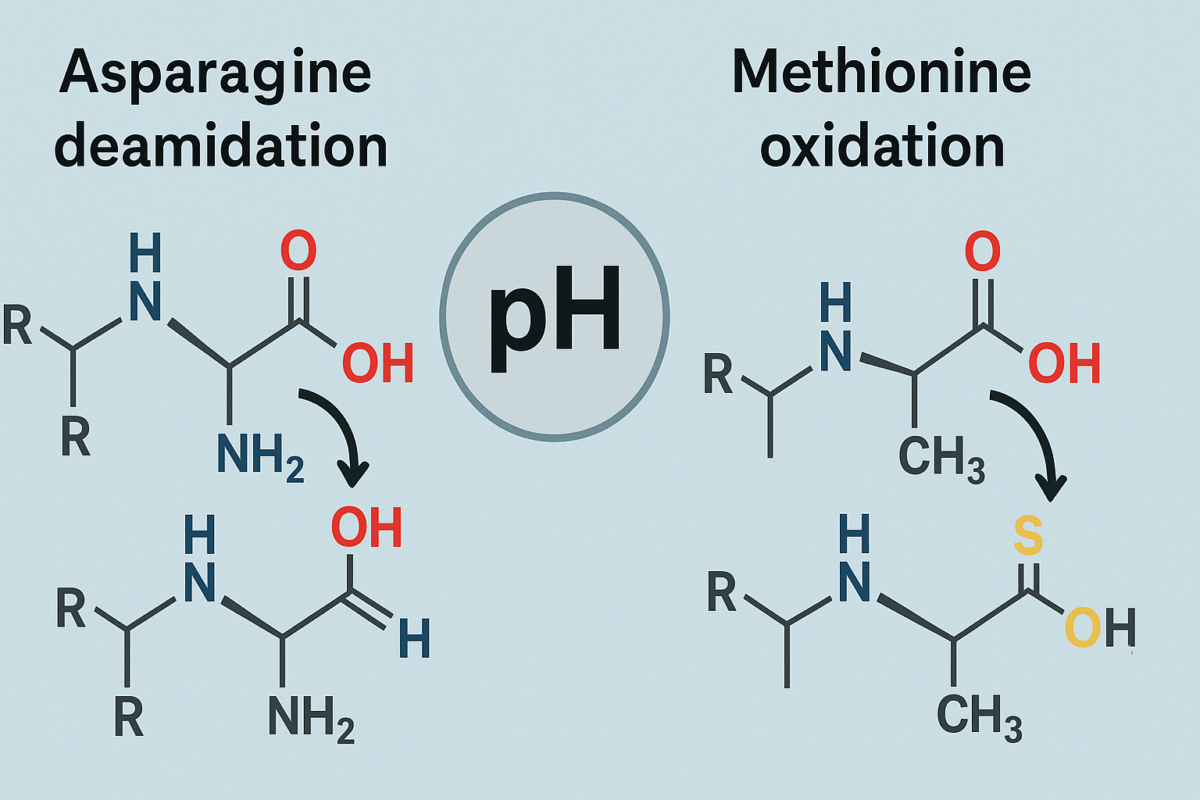
Figure 1: Illustration showing how asparagine deamidation and methionine or cysteine oxidation occur at neutral pH, highlighting key peptide degradation pathways.
On the other hand, neutral pH is gentler on peptide structure than extreme pH. Peptides generally retain their native conformations better at physiological pH than in very acidic or alkaline solutions. Indeed, studies often find peptides have maximal stability in a mildly acidic to neutral range. Formulation experiments typically screen stability from pH ~3 up to ~10 and find an optimal window; for many peptides, that optimal pH for stability is slightly acidic (around 4–6) rather than strictly pH 7 [1]. Still, neutral pH is a compromise between stability and biocompatibility. Since intravenous and subcutaneous peptide drugs must be near neutral pH for safety (acceptable range ~pH 3–10.5 for IV injections) [1], understanding peptide behavior at neutral pH is crucial. Peptides that are stable at neutral pH and 37 °C for a reasonable period are more viable as therapeutics. In summary, physiological pH conditions provide a moderate environment where peptides avoid the most extreme degradation pathways, though they may not be at absolute maximum stability. Researchers often favor slightly acidic formulations if possible to prolong shelf-life, while still being close enough to neutral for physiological compatibility.
Temperature and Solvent Effects
Temperature has a well-known accelerating effect on chemical reactions, and peptide degradation is no exception. Higher temperatures will generally speed up the pH-dependent degradation pathways of peptides [2]. For example, a peptide that slowly deamidates at pH 7 and 4 °C may deamidate much faster at pH 7 and 37 °C. Therefore, what might appear as a stable peptide at room temperature could become unstable at physiological temperature or under heat stress. In practical terms, peptides should be stored at low temperatures (e.g. –20 °C) to slow down degradation kinetics [3]. This is one reason peptide samples are often kept refrigerated or frozen; reduced temperature preserves stability across all pH conditions by damping the reaction rates of hydrolysis, oxidation, and other pathways. Additionally, temperature can influence physical stability – heat can induce peptide unfolding or aggregation, especially near certain pH levels where the peptide is already partially destabilized.
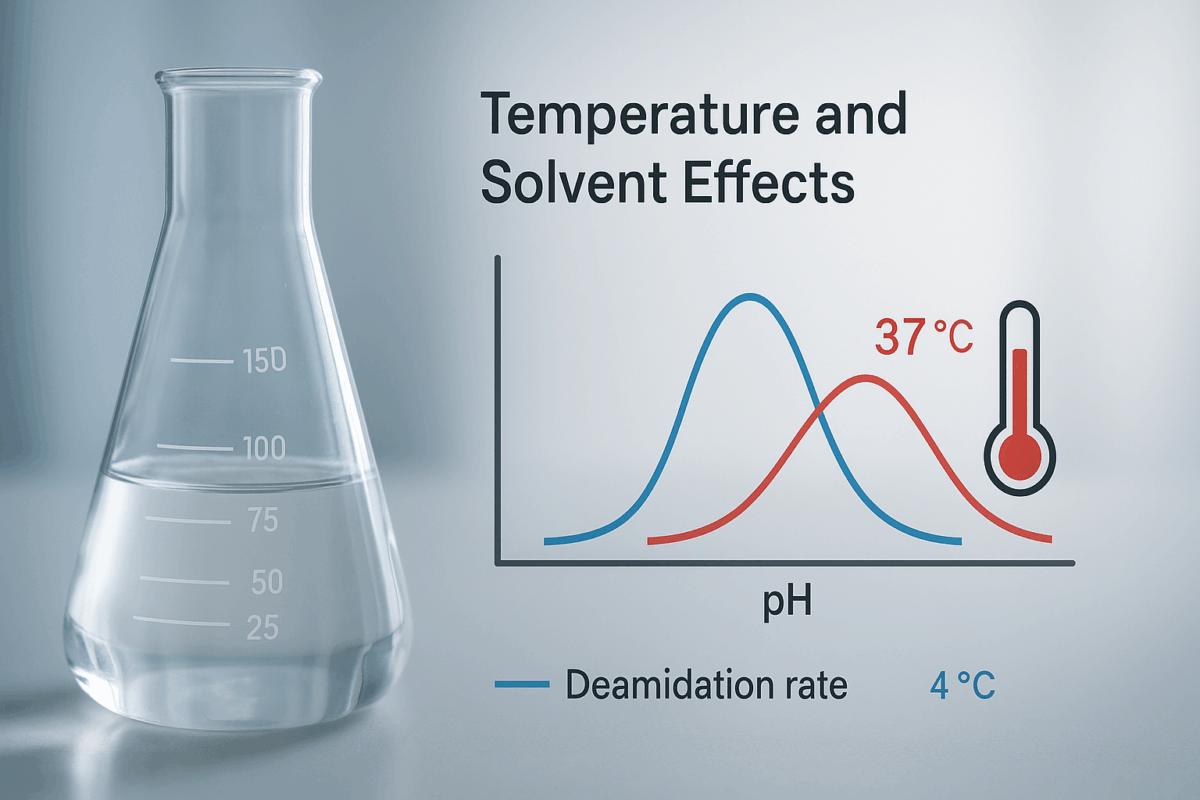
Figure 2: Peptide Deamidation Rate
The solvent environment also plays a crucial role in peptide stability. Solvent effects include the presence of organic co-solvents, the overall polarity (dielectric constant) of the solution, and water content. Adding co-solvents or lyoprotectants can sometimes improve stability by reducing hydrolytic degradation. For instance, incorporating glycerol or other polyols in an aqueous solution can lower the dielectric constant and has been shown to significantly slow down peptide deamidation rates [1]. Less water availability in the immediate environment means fewer opportunities for water to attack peptide bonds or side chains. Similarly, adding ethanol or propylene glycol to a citrate-buffered peptide solution (moderately acidic pH) increased the stability of the peptide eptifibatide by reducing its degradation rate. On the other hand, some peptides may require water to maintain structure, so completely removing water can cause aggregation or precipitation. The solvent pH is also a factor – certain buffers may have different effective pH in the presence of organic solvents. In summary, using co-solvents and optimizing the solvent composition can enhance peptide stability at a given pH by slowing chemical reactions, but these must be chosen carefully to avoid harming the peptide’s native structure.
Sequence and Structural Variations
Every peptide’s inherent stability is ultimately rooted in its amino acid sequence and three-dimensional structure. Sequence variations – even minor changes – can alter how a peptide reacts to pH. Certain amino acids are well-known “hot spots” for instability under specific pH conditions. For example, peptides containing aspartic acid (Asp) in their sequence can undergo Asp-Gly bond hydrolysis via cyclic imide formation, especially in an acidic pH range [2]. Likewise, sequences with asparagine (Asn) or glutamine followed by small residues (e.g. Asn-Gly) are prone to deamidation at neutral to basic pH, forming Asp or isoAsp residues over time [2]. The presence of cysteine and methionine will make a peptide susceptible to oxidation, particularly at higher pH where thiol and thioether groups are more reactive. On the flip side, incorporating non-natural amino acids or stabilizing motifs can improve pH stability. Replacing an Asn with a similar but more stable residue (like Asp or a synthetic analog) can eliminate a deamidation site, for instance. Understanding the sequence’s weak points allows researchers to predict which pH might cause the most rapid degradation of a given peptide.
The secondary and tertiary structure of a peptide (if any) also affect its pH stability. Many small peptides are unstructured in solution, but others have helices, beta-turns, or even disulfide-stabilized tertiary structures. A peptide with a well-defined folded structure may be more resistant to chemical attack because key residues are buried inside. For example, cyclotides (peptides with a cyclic backbone and cystine knot) exhibit extraordinary stability against pH changes and heat, owing to their rigid, compact structure. This shows that a peptide’s structural topology can confer resilience to pH-induced denaturation or bond breakage. Conversely, an unfolded or flexible peptide exposes more of its backbone and side chains to solvent, potentially making it more vulnerable to pH-catalyzed reactions. pH itself can induce structural changes: a peptide might maintain a helical structure at one pH but unfold at a more extreme pH. Such conformational changes can either increase degradation (by exposing fragile bonds) or sometimes decrease it (if the structure at a given pH happens to hide a labile site). In designing stable peptides, scientists often consider peptide structure modifications like cyclization, stapling, or adding disulfide bonds to constrain the peptide, thereby enhancing stability across a range of pH conditions. In summary, the specific sequence and 3D structure dictate a peptide’s intrinsic stability profile – determining which pH levels it can tolerate and which will trigger rapid breakdown.
Mechanisms of Peptide Degradation
Peptides can degrade via multiple mechanisms, broadly classified into chemical and physical pathways. Chemical instability involves covalent bond alterations – essentially the peptide’s chemical structure is modified or cleaved. Common chemical degradation routes include hydrolysis of the peptide bonds (backbone cleavage), deamidation of glutamine or asparagine side chains, oxidation of susceptible residues (like Met and Cys), β-elimination reactions (often affecting cystine or serine at high pH), racemization (conversion of L- to D-amino acids under basic conditions), and various isomerizations. These reactions change the molecular identity of the peptide, potentially inactivating it. Many chemical degradation pathways are strongly influenced by pH, as discussed earlier – for example, Asp-Pro bond hydrolysis tends to occur in acidic conditions via a cyclic imide intermediate, whereas Asn deamidation proceeds faster at neutral to alkaline pH [5].
Physical instability mechanisms do not involve making or breaking covalent bonds, but rather changes in the peptide’s higher-order structure or state. Physical degradation includes processes like unfolding or loss of secondary structure, aggregation of peptide molecules into insoluble clumps, adsorption to container surfaces, and precipitation out of solution. pH can also drive these processes; if a peptide carries no net charge at a certain pH (the isoelectric point), it is more likely to aggregate and precipitate due to minimal electrostatic repulsion. Aggregation can be reversible or irreversible, but in either case it reduces the amount of active monomeric peptide in solution. Sometimes physical and chemical degradation are linked – for instance, aggregates may form after a peptide is partially cleaved, or oxidation might induce unfolding that leads to aggregation.
Overall, peptide degradation is a combination of these chemical and physical pathways. In real-world scenarios, a peptide might undergo slight deamidation (chemical) that changes its charge and prompts aggregation (physical), especially under suboptimal pH conditions. By understanding the specific mechanisms at play (e.g. knowing that a particular peptide is mainly lost through oxidation vs. aggregation), scientists can devise targeted strategies to mitigate those routes of instability.
Strategies to Enhance Peptide Stability
Improving peptide stability is a key goal when developing robust peptide reagents or drug formulations. A variety of strategies can be employed to protect peptides from pH-related degradation and other instabilities. One fundamental strategy is pH optimization itself: formulating the peptide in a solution pH that maximizes its stability. As discussed, many peptides are most stable in slightly acidic conditions. Selecting a buffer that maintains the peptide in its optimal pH range (often around pH 4–6 for minimizing deamidation and oxidation) can dramatically reduce degradation rates in solution. For example, simply adjusting a peptide formulation from pH 7.4 to pH 5 can slow certain degradation pathways like Asn deamidation. Along with pH selection, using an appropriate buffer type is important – a buffer that does not catalyze degradation or interact negatively. This might mean using gentle buffers (acetate, citrate, histidine, etc.) at suitable concentrations. In peptide formulation practice, pH and buffer choice are often the first levers pulled to enhance stability.
Another set of stability-enhancing strategies involves controlling the storage conditions and adding excipients. Lowering the storage temperature is a simple and effective approach: keeping peptides refrigerated or frozen will slow all degradation reactions significantly. Lyophilization (freeze-drying) is frequently used to store peptides in a dry solid state, virtually halting hydrolytic reactions. However, if a peptide must be in solution, adding stabilizing agents can help. Co-solvents like glycerol or PEG can protect labile bonds by reducing water activity, as noted earlier for deamidation. Similarly, sugars such as sucrose or trehalose are common excipients that stabilize peptides and proteins; they preferentially exclude water from the peptide surface and can inhibit aggregation and oxidation. Antioxidants (e.g. methionine, ascorbic acid) or metal chelators (e.g. EDTA) are used to prevent oxidative damage, especially in formulations at neutral to high pH where oxidation risk is greater. Additionally, limiting exposure to light and oxygen by using opaque, airtight containers will forestall light-induced or air oxidation of peptides. Practically, a peptide formulation might include a buffer at pH ~5, a sugar like mannitol for physical stability, and an antioxidant, all stored cold to maximize shelf-life. By combining these formulation tactics, one can often achieve a markedly more stable peptide solution.
Finally, chemical and structural modifications to the peptide can bolster stability. PEGylation, the covalent attachment of polyethylene glycol chains to a peptide, is a well-established method to improve stability and half-life. PEGylation increases the peptide’s size and shields it from proteolysis and can also improve thermal and pH stability. For example, PEGylated peptides have shown greater resistance to heat-induced degradation and prolonged activity in vivo. Other modifications include cyclization of the peptide backbone (head-to-tail cyclization or disulfide bridging to form a loop), which can reduce conformational flexibility and make the peptide less susceptible to unfolding or enzymatic attack. Incorporating non-natural amino acids or stapling certain helical peptides can likewise enhance stability by pre-organizing the structure. It’s worth noting that some peptides are engineered as prodrugs or salts to be stable at non-physiological pH and then convert to the active form in the body. In summary, by designing the peptide molecule for stability (through sequence changes or attachments) and by optimizing the formulation conditions (pH, buffer, excipients, temperature), researchers can greatly improve peptide stability. Employing these strategies leads to more reliable experimental results and more effective peptide therapeutics.
Frequently asked questions (FAQs) about Peptide Stability
What is peptide stability and why is it important?
- Peptide stability refers to a molecule’s ability to maintain its structural and functional integrity over time. Stable peptides resist degradation from environmental factors such as temperature, pH, and enzymatic activity. In research and pharmaceutical development, stability determines reproducibility, shelf life, and biological effectiveness, making it a critical factor in both experimental design and therapeutic formulation.
How does pH affect peptide structure and degradation?
- pH profoundly influences peptide charge states, hydrogen bonding, and side-chain interactions. Acidic conditions often promote hydrolysis and cleavage of peptide bonds, while basic conditions accelerate deamidation and oxidation reactions. At neutral or physiological pH (~7.0–7.4), peptides may still degrade slowly through oxidation or isomerization, but the rate of decomposition is generally reduced compared to extreme pH values.
What methods are used to measure and improve stability?
- Researchers commonly evaluate peptide stability using techniques such as high-performance liquid chromatography (HPLC), mass spectrometry, and circular dichroism spectroscopy. To enhance stability, scientists may adjust formulation buffers, introduce stabilizing excipients, or chemically modify residues—such as through acetylation, PEGylation, or cyclization—to protect against hydrolysis and oxidation.
What are the most common causes of peptide instability?
- The leading causes of instability include hydrolysis of peptide bonds, oxidation of methionine and cysteine residues, deamidation of asparagine and glutamine, and aggregation due to conformational changes. Environmental conditions such as temperature, light exposure, moisture, and improper pH can further accelerate these degradation pathways.
How can researchers design experiments for optimal peptide stability?
- Designing experiments for stability begins with selecting appropriate buffers and maintaining controlled pH and temperature conditions. Researchers should store peptides in lyophilized form when possible, minimize freeze-thaw cycles, and protect samples from light and oxygen. Stability studies under different conditions help identify the most favorable parameters for long-term storage and consistent biological performance.
References
- Nugrahadi PP, Hinrichs WLJ, Frijlink HW, Schöneich C, Avanti C. Designing Formulation Strategies for Enhanced Stability of Therapeutic Peptides in Aqueous Solutions: A Review. Pharmaceutics. 2023;15(3):935mdpi.com
- Sigma-Aldrich (MilliporeSigma). Peptide Stability and Potential Degradation Pathways. Technical Article (accessed 2025)sigmaaldrich.com
- Liu M. What is the stability of Semax peptides? Bosetech Bio Blog. 2023 (accessed 2025)bosetech-bio.com
- Li J et al. Far UV Circular Dichroism (CD) Spectroscopy Analysis. Creative Proteomics (Web Resource) (accessed 2025)creative-proteomics.com
- Malde AK et al. Effect of pH on structure and stability of collagen-like peptide: Insight from molecular dynamics simulation. J Comput Biophys Chem. 2011;10(2):139-152worldscientific.com
- Al Musaimi O, Lombardi L, Williams DR, Albericio F. Strategies for Improving Peptide Stability and Delivery. Pharmaceuticals. 2022;15(10):1283mdpi.com