

Short answer
Third-party validation means an independent laboratory, not the seller, tests a peptide sample and documents the results against its batch identifier. Verified Peptides publishes batch-specific third-party Certificates of Analysis in its Lab Reports archive, so researchers can check the reported results and see which tests were performed before using a peptide.
This guide explains what third-party validation involves, why it matters for peptide research, and how Verified Peptides documents it.
What Is Third-Party Validation in Peptide Research?
Third-party validation is independent testing of a peptide batch by a laboratory separate from the seller, with safeguards against commercial pressure. It checks the submitted sample against the selected identity, purity, and other specifications, and records the results in a laboratory report or certificate of analysis. In practice, the lab’s name, methods, and results appear on the report, and the report is tied to a batch number. Laboratories seeking ISO/IEC 17025 accreditation are assessed against that standard, which covers competence and impartiality.1 It is also a practical way to meet the expectation, shared by funders such as NIH, that key chemical resources be authenticated.2 Validation does not replace good lab practice, but it gives that practice a reliable starting point.
Why Third-Party Testing Is Critical for Research Integrity
Third-party testing is critical because supplier-reported values are not always accurate, and peptide research depends on the material being what it claims to be. A published evaluation of synthetic peptides bought for research found large gaps between supplier-stated and independently measured purity, including one sample whose main compound had a different structure than ordered.3 The same evaluation found that most impurities were sequences missing one or more amino acids, a common synthesis byproduct. For research-grade peptides, where small amounts of closely related impurities can matter, batch-specific verification is an important quality control step.
How Third-Party Labs Test and Validate Peptides
Labs typically support identity assessment with mass spectrometry, measure peptide purity with HPLC, and add tests for content and contaminants as specified.4 Each step produces a record, so the final certificate can be traced back to the sample and its data.
- 1Receive and log The sample is recorded against its batch number.
- 2Confirm identity Mass spectrometry compares the observed mass with the mass expected for the sequence.
- 3Measure purity HPLC separates the peptide from related impurities and reports purity as a percentage.
- 4Run added tests Net content, endotoxin, or microbial tests as specified.5
- 5Review and report Results are checked and issued as a certificate of analysis.
A matching intact mass supports identity but does not prove the full sequence or stereochemistry. HPLC area purity describes the peaks the method detects, not the peptide fraction of the total powder.
Why Researchers Trust Verified Peptides
Researchers can check Verified Peptides’ quality claims rather than take them on trust, because the company publishes independent test results batch by batch. Researchers can open a report, read the methods and results, and decide for themselves.
Transparent, Batch-Specific COAs
Verified Peptides publishes third-party certificates of analysis in its Lab Reports archive, organized by month and identified by batch number, with results such as HPLC purity and, for many batches, endotoxin.6 Matching the batch number on a vial to its report is the core check; see why batch-specific COAs matter.
Independent Laboratory Partnerships
Testing is performed by independent analytical laboratories rather than in-house, which separates the party that sells a peptide from the party that tests it. That separation is the main safeguard against conflicts of interest, and it lets researchers judge the lab on its own accreditation and reporting practices; see in-house vs. third party lab testing.
Reliable, Repeatable Quality for Experimental Accuracy
Published batch reports let researchers compare reported purity and other results across available lots. Check that methods are comparable before interpreting a difference as batch drift. For projects that span several orders, that history is often as useful as any single report; see batch-to-batch variability.
Benefits of Third-Party Validation for Research Outcomes
Third-party validation benefits research outcomes by reducing material-related variables, supporting reproducibility, and strengthening documentation and quality control, whether the work is a single experiment or a multi-year study.
- Fewer unexplained results caused by impure or misidentified material.
- Clearer methods sections that cite batch and purity details.
- Easier comparisons across experiments, lots, and collaborators.
- Documentation that supports audits and grant reporting.2
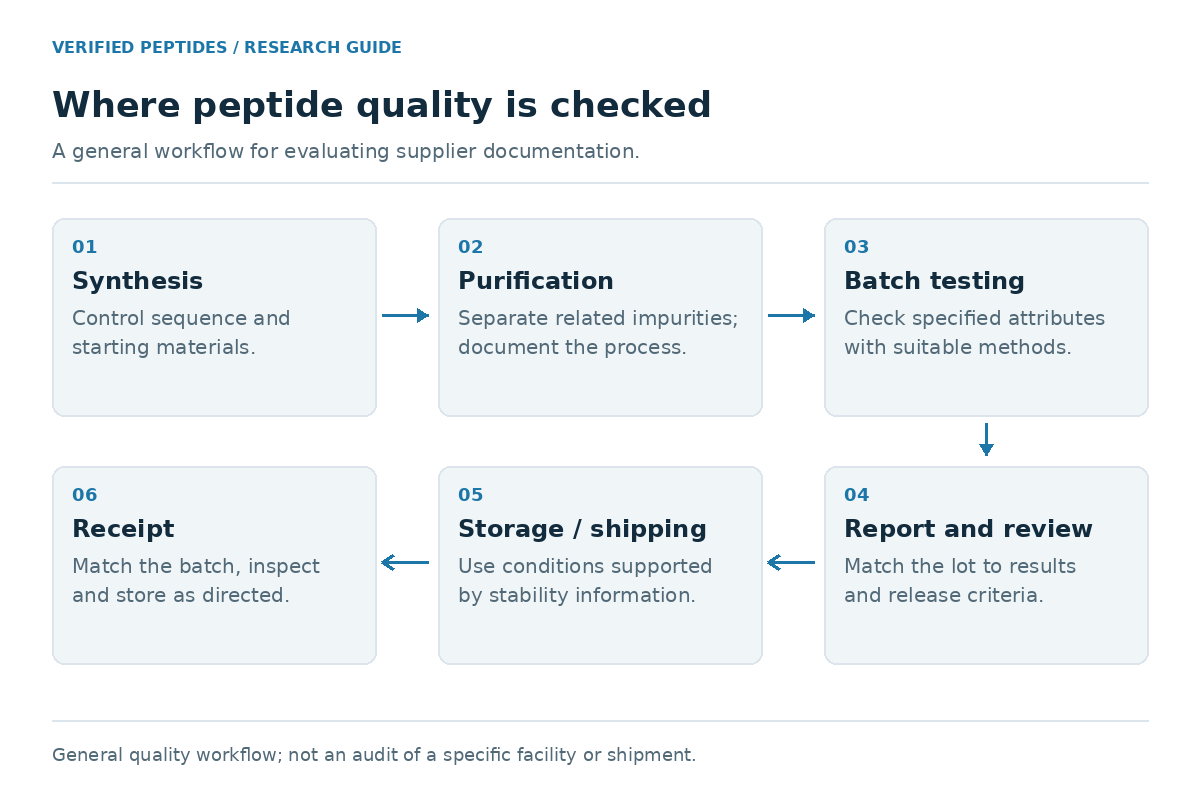
Quality Checks from Synthesis to Shipping
Quality depends on every stage, from synthesis and purification to testing, storage, and shipping, and each stage can be documented or checked. Gaps at any stage can undo the care taken at the others.
Synthesis and purification shape the impurity profile, independent testing checks the sampled batch attributes, and careful storage and shipping protect lyophilized peptides afterward. Verified Peptides documents the testing stage in its Lab Reports archive and publishes storage guidance and shipping and cold-chain guidance in its Knowledge Hub, so researchers can handle materials correctly on arrival. On receipt, checking the batch number, storing vials as directed, and recording both in lab notes completes the chain.
Conclusion: Trusted Peptides Begin with Independent Verification
- Third-party batch verification means an independent lab tests a sample from the identified batch and documents the measurements performed.
- Independent testing matters because supplier-stated values are not always accurate.
- Verified Peptides publishes batch-specific third-party certificates of analysis in its Lab Reports archive.
- Matching batch numbers to reports, and comparing lots over time, is how researchers put third-party validation to work.
- Storage and shipping guidance helps protect that quality after testing.
Trust in a peptide supplier is strongest when it rests on documents you can check yourself, batch by batch.
Frequently asked questions
What is third-party validation in scientific research?
It is independent verification of a material, method, or result by a party separate from the original work, with safeguards against bias. For peptides, it commonly means an outside lab checking a batch-linked sample.
Why is third-party testing important for peptides?
Because quality can vary by batch and supplier-stated values are not always accurate. Outside testing helps check those claims; look for the identity, purity, and contaminant results your experiment needs.
How do labs verify peptide purity?
Most labs use HPLC, which separates the target peptide from related impurities and reports purity as a share of total UV signal. Mass spectrometry is commonly paired with it to support identity assessment, and the method should be named on the report.
What is included in a peptide Certificate of Analysis?
Typically the peptide name, batch number, test dates, methods, specifications, and results for identity and purity, plus content or contaminant tests where performed, along with the lab’s details.
How does third-party validation improve research accuracy?
It reduces uncertainty about the measured attributes of the material, so differences in results are less likely to come from impure or misidentified peptides. It also gives reviewers and collaborators a clear record of what was used.
All peptides discussed here are for research use only.
References
- International Organization for Standardization. ISO/IEC 17025:2017 General requirements for the competence of testing and calibration laboratories. iso.org
- National Institutes of Health. Guidance: Rigor and Reproducibility in Grant Applications (authentication of key biological and/or chemical resources). grants.nih.gov
- Verbeke F, Wynendaele E, Braet S, D’Hondt M, De Spiegeleer B. Quality evaluation of synthetic quorum sensing peptides used in R&D. Journal of Pharmaceutical Analysis. 2015;5(3):169-181. PMC5762210
- Mant CT, Chen Y, Yan Z, et al. HPLC analysis and purification of peptides. Methods in Molecular Biology. 2007;386:3-55. Full text
- US Food and Drug Administration. Pyrogen and Endotoxins Testing: Questions and Answers (Edition 2). Guidance for industry, March 2026. fda.gov
- Verified Peptides. Lab Reports archive: batch-specific third-party Certificates of Analysis. verifiedpeptides.com/lab-reports