

Short answer
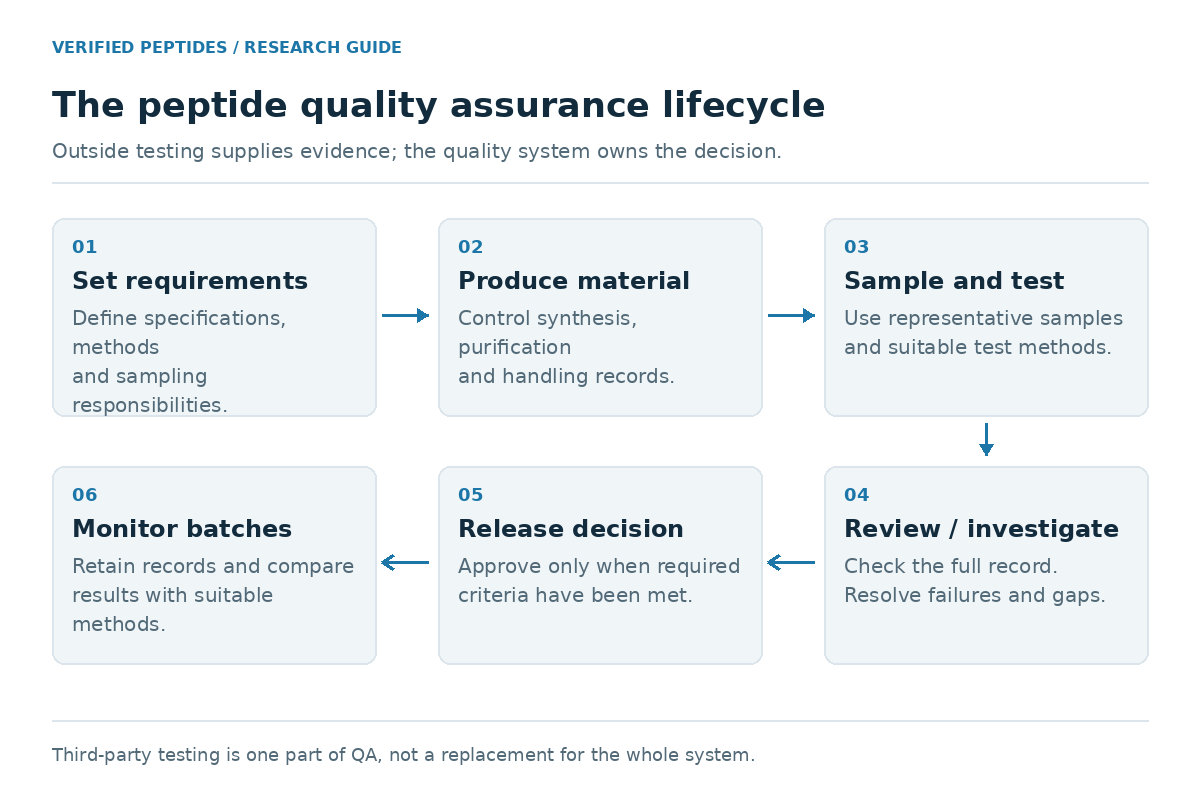
Quality assurance procedures are the planned, documented steps that make sure every peptide batch is tested, recorded, and released in a consistent way. Third-party testing provides outside analytical evidence within that system. The supplier’s quality team still defines specifications, reviews results, handles failures, and decides whether to release a batch.
This guide explains what QA procedures are, how third-party testing fits in, which procedures are common, and how to choose a reliable partner.
Why Quality Assurance Procedures Matter in Peptide Research
Quality assurance procedures matter because peptide quality can vary from batch to batch, and only a consistent, documented process shows that each batch was checked the same way.
That consistency supports reproducible peptide research. NIH expects researchers to authenticate key chemical resources because they can vary over time and influence data.1 Third-party testing adds an outside check to that process, so documented steps are verified by a separate testing organization. Without defined procedures, one good result says little about the next batch; see batch-to-batch variability.
What Are Quality Assurance Procedures?
Quality assurance procedures are the planned and systematic activities that give confidence a product will meet its quality requirements: written methods, specifications, training, documentation, review, and record keeping.2
Quality Assurance vs. Quality Control
Quality assurance is process-focused and aims to prevent problems, while quality control is product-focused and detects problems through inspection and testing.2 For peptides, quality control is the HPLC run or the endotoxin assay; quality assurance is the system that decides which tests are required, who reviews the results, and how records are kept.
The Value of Third-Party Validation
Third-party validation adds independence: an outside laboratory with documented impartiality safeguards checks the supplier’s reported results.
ISO/IEC 17025 sets requirements for laboratory competence and impartiality, and accreditation bodies use it to assess testing labs.3 Independent validation also guards against a documented problem: in one evaluation of research peptides, measured purity often fell short of the purity stated on supplier certificates.4 Third-party testing is also easier to compare across suppliers, because the same tests and report format can be requested every time. For more on independence, see in-house vs. third party lab testing.
Common Third-Party Quality Assurance Procedures
Common procedures include sample receipt and chain of custody, validated analytical methods, system suitability checks, defined acceptance criteria, independent review, and a signed report.
Identity and Purity Testing
Mass spectrometry supports identity assessment by comparing observed and expected mass. A matching intact mass alone cannot establish full sequence or stereochemistry. Purity testing is usually done by HPLC testing, which reports the target peak as a share of integrated UV signal; co-eluting or undetected material may be missed.5 HPLC testing also produces a chromatogram that can be compared across batches, and purity testing results are only meaningful alongside the method used.
Before samples run, labs typically confirm that the HPLC system is performing as expected using system suitability checks, using method-appropriate criteria; USP <621> is one compendial reference. Analytical validation evaluates characteristics appropriate to the test, such as specificity, accuracy, and precision.6, 7
Content and Contaminant Testing
Net peptide content measures how much of the powder is peptide rather than water, salts, or counter-ions such as trifluoroacetate.8
Contaminant testing covers bacterial endotoxin, commonly measured with LAL or recombinant reagent assays, and microbial testing where specified.9 Each result belongs on the Certificate of Analysis (CoA) with its method and acceptance criterion; see certificates of analysis explained.
Benefits of Independent QA for Peptide Research
Independent QA gives researchers more confidence in their materials, cleaner documentation, and results that are easier to compare and reproduce.
- Objectivity
- Results come from a separate testing organization with impartiality safeguards.
- Comparability
- The same methods across batches make differences meaningful.
- Documentation
- Batch-specific CoAs support lab compliance, audits, and publications.
- Early detection
- Problems are found before material reaches an experiment.
Risks of Skipping Third-Party QA
Skipping outside testing removes an independent check. Competent in-house testing can still verify material, but absent or incomplete testing leaves gaps that can compromise experiments.
The risks are concrete: closely related impurities can affect results, misidentified material can invalidate a study, and unmeasured endotoxin can interfere with cell-based work.10, 4, 9 In regulated manufacturing, relying on a supplier’s analysis without verifying it is itself a cited compliance failure.11 Skipped purity testing also removes the baseline needed to compare later batches.
How to Choose a Reliable QA Partner
Choose a QA partner that is accredited, independent, and transparent about its methods and data, including the record-keeping needed for lab compliance.
- ISO/IEC 17025 accreditation, with a scope that covers the methods you need.
- Independence from the supplier whose material is being tested.
- Reports with batch number, dates, methods, acceptance criteria, and approval.
- Raw data available on request, such as chromatograms and spectra.
- Record-keeping that follows data integrity principles such as ALCOA+.12
- Comparable methods over time, with laboratory or method changes assessed.
The Future of Quality Assurance in Peptide Research
Quality assurance is moving toward more automation, stronger digital data integrity, and more publicly shared batch documentation.
Updated guidance on analytical method validation, such as ICH Q2(R2), now addresses newer approaches including multivariate methods, while automated review tools can help flag anomalies in large data sets.7 For researchers, the practical change is more access to batch-specific data before purchase; see AI and automation in peptide quality control.
Conclusion: Setting Standards Through Third-Party QA
- Quality assurance procedures are the documented system behind consistent peptide quality, not a single test.
- Quality control tests the product; quality assurance defines which tests, reviews, and records are required.
- Third-party testing provides independent evidence for the attributes actually tested; it does not replace the full QA system.
- Choose QA partners with relevant accreditation, independence, and transparent data.
Well-defined quality assurance procedures set the standard every batch is measured against, which is what makes peptide research results comparable over time.
Frequently asked questions
What are quality assurance procedures in research?
They are the planned, documented processes that make sure materials and data meet defined quality requirements, including written methods, specifications, training, review, and record keeping.
Why is third-party QA important for peptides?
It adds an outside check of the submitted batch sample. Check which identity, purity, and contaminant tests were actually performed; independence alone does not guarantee a complete test panel.
What tests are done for peptide purity?
Purity is usually measured by HPLC with UV detection, often paired with mass spectrometry to support identity assessment. Net peptide content and contaminant tests are reported separately.
What is included in a Certificate of Analysis?
Typically the product and batch number, test dates, methods, specifications, results, and the issuing laboratory’s details and approval. Many also include chromatograms and mass spectra.
How do labs ensure peptide safety?
Labs do not certify peptides as safe for any use. They test defined quality attributes, such as endotoxin, microbial contamination, and impurities, and report whether each result meets its specification.
All peptides discussed here are for research use only.
References
- National Institutes of Health. Guidance: Rigor and Reproducibility in Grant Applications (authentication of key biological and/or chemical resources). grants.nih.gov
- American Society for Quality. Quality Assurance and Quality Control. asq.org
- International Organization for Standardization. ISO/IEC 17025:2017 General requirements for the competence of testing and calibration laboratories. iso.org
- Verbeke F, Wynendaele E, Braet S, D’Hondt M, De Spiegeleer B. Quality evaluation of synthetic quorum sensing peptides used in R&D. Journal of Pharmaceutical Analysis. 2015;5(3):169-181. PMC5762210
- Mant CT, Chen Y, Yan Z, et al. HPLC analysis and purification of peptides. Methods in Molecular Biology. 2007;386:3-55. Full text
- United States Pharmacopeia. General Chapter <621> Chromatography. usp.org
- International Council for Harmonisation. ICH Q2(R2) Validation of analytical procedures (scientific guideline, European Medicines Agency). ema.europa.eu
- Sikora K, Jaśkiewicz M, Neubauer D, Migoń D, Kamysz W. The role of counter-ions in peptides: an overview. Pharmaceuticals. 2020;13(12):442. PMC7761850
- US Food and Drug Administration. Pyrogen and Endotoxins Testing: Questions and Answers (Edition 2). Guidance for industry, March 2026. fda.gov
- D’Hondt M, Bracke N, Taevernier L, et al. Related impurities in peptide medicines. Journal of Pharmaceutical and Biomedical Analysis. 2014;101:2-30. PubMed 25044089
- US Code of Federal Regulations. 21 CFR 211.84: Testing and approval or rejection of components, drug product containers, and closures. ecfr.gov
- Medicines and Healthcare products Regulatory Agency. GXP Data Integrity Guidance and Definitions, Revision 1. March 2018. gov.uk