

Short answer
To evaluate a research peptide supplier, check four things before qualifying it: batch-specific test evidence (HPLC purity and mass spectrometry identity tied to the lot number on the vial), transparency about who tested the material, product information and packaging that protect peptide quality, and RUO labeling with no use claims. Then confirm the supplier’s results on the first lots you accept, ideally with independent testing.
In short: insist on evidence, not adjectives.
What Does It Mean to Evaluate a Research Peptide Supplier?
Evaluating a research peptide supplier means running structured due diligence to confirm that the material matches its label, was made and shipped in a way that protects its integrity, and is sold within research-only boundaries. It is part analytical review, part regulatory check, and part operational assessment.
Regulated manufacturing offers a useful model. Under ICH Q7, materials are obtained against an agreed specification from suppliers approved by the quality department, and a supplier’s certificate of analysis can stand in for some in-house tests only when there is a system for evaluating that supplier.1 Research labs are not bound by those rules, but the logic transfers well: define what you need, then qualify the peptide supplier against it.
Why Evaluating a Research Peptide Supplier Matters in 2026
Knowing how to evaluate a research peptide supplier matters because published testing shows that labels and supplier certificates are not always accurate, and that gap can quietly undermine an experiment. In one evaluation of 98 research peptides, only 44% met the required 95% purity when retested, the authors reported a large discrepancy between supplier certificates and their own results, and one sample’s main compound had a different structure from the peptide ordered.2
Products from illegal online sellers show how wide the gap can get: a Belgian study of frequently encountered falsified peptide products reported purity between 5% and 75% for cysteine-containing peptides, and some samples contained arsenic and lead.3 Regulators are also paying attention. In warning letters sent to online peptide vendors in August 2026, FDA concluded that evidence from the sellers’ websites outweighed RUO statements on product labeling.4 For researchers, NIH already expects key chemical resources to be authenticated,5 so a documented evaluation also supports reproducibility.
What Quality Signals Should Researchers Look For?
The core quality signals are an HPLC purity result with its chromatogram, mass spectrometry (MS) confirming identity, and both tied to the specific lot. HPLC (high-performance liquid chromatography) separates the peptide from related impurities; MS measures molecular mass to show it is the right molecule. Purity alone cannot confirm identity, which is why the two are paired.
Purity also needs context. GenScript, for example, recommends greater than 95% purity for in vitro bioassays and studies, and greater than 98% for applications such as crystallography and structure-activity studies.6 A reliable peptide supplier states the purity grade so you can match it to your application. Look as well for net peptide content, the share of the powder that is actually peptide rather than water and counter-ions, which can vary from batch to batch;7 and, for cell-based work, endotoxin results. For the full field list, see what a good peptide COA should include.
How To Review Testing, Purity, and Batch Documentation
Review batch documentation by matching the lot number on the certificate of analysis (COA) to the lot number on the vial, then checking that the report shows real data for that lot. ICH Q7 describes an authentic COA as one that lists each test performed with its acceptance limits and numerical results, is dated and signed by authorized quality personnel, and names the original manufacturer.1
Strong documentation includes the HPLC chromatogram image (not just a number), method conditions, observed versus theoretical mass from MS, and the test date. A single “representative” COA reused across lots tells you little about the vial you received; see batch-specific COAs vs. generic PDFs for how to tell them apart, and certificates of analysis explained if you are new to reading them.
Verify the COA, Not Just Read It
Reading a COA is a start; confirming it is stronger. ICH Q7 advises complete analyses on at least three batches before relying on a supplier’s certificates in place of in-house testing, and checking that reliability at regular intervals afterward.1 A research lab can adapt this by independently testing the first lots it accepts from a new supplier, then spot-checking later lots.

What Transparency Tells You About a Research Peptide Supplier
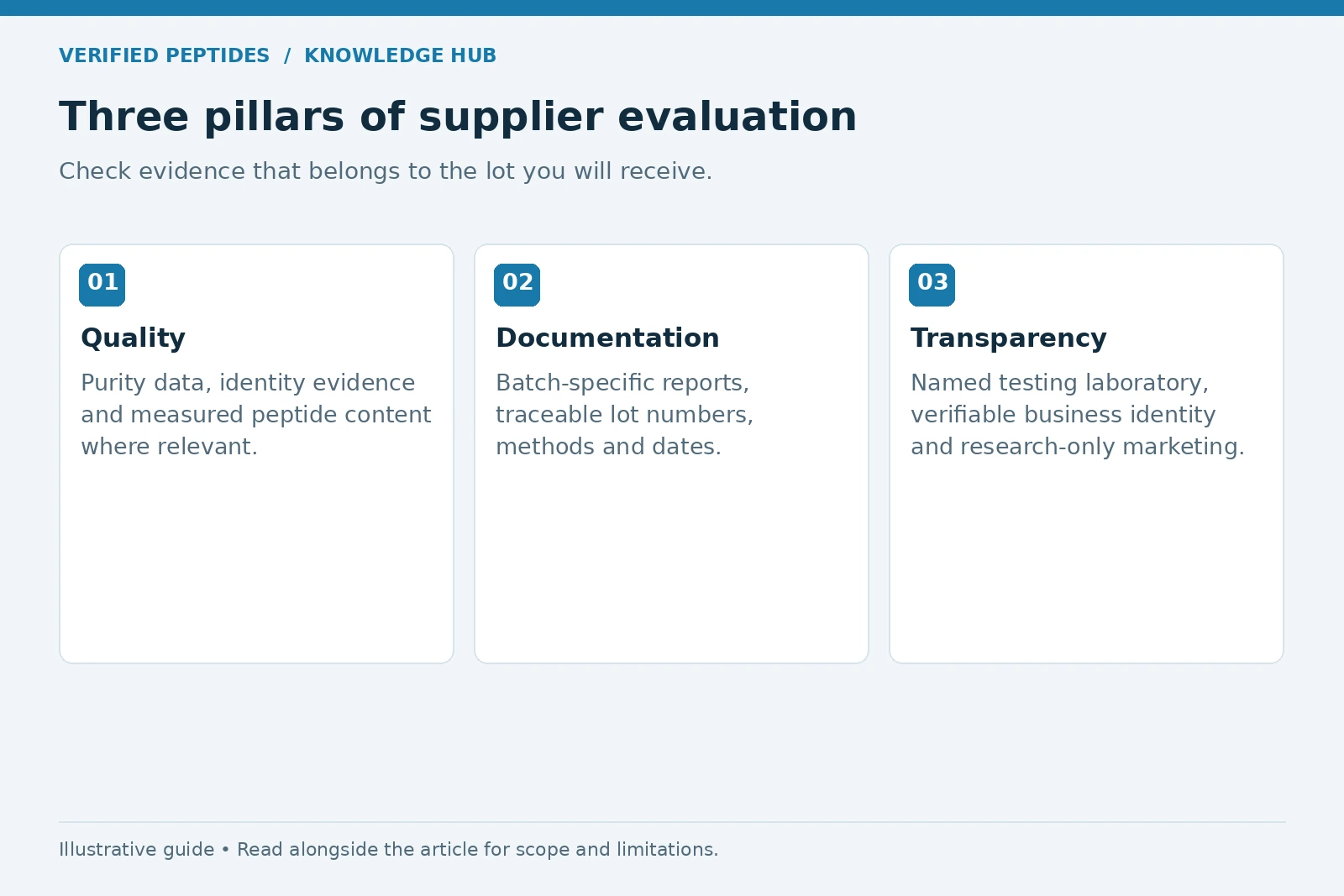
Supplier transparency tells you whether claims can be checked. A transparent supplier names the laboratory that tested each lot, publishes or provides batch-specific reports, states the salt form and net peptide content, and gives a verifiable business name, address, and responsive technical support.
Who did the testing matters. ISO/IEC 17025 sets requirements for the competence, impartiality, and consistent operation of testing laboratories,8 and accreditation applies to a defined scope, so check that the scope covers the tests on the report.9 Testing by a lab independent of the seller removes an obvious conflict of interest; in-house vs. third-party lab testing explains the trade-offs. As one example of public batch documentation, the Verified Peptides Lab Reports archive lists batch-numbered third-party reports with test dates; some entries also show an endotoxin pass/fail result.10 Opacity is itself a signal: a supplier that will not say who tested its material leaves you nothing to verify.
How Shipping, Packaging, and Storage Standards Affect Confidence
Packaging and storage guidance show whether a supplier understands how peptides degrade. Moisture is a key risk: Bachem notes that absorbed moisture reduces peptide content and may decrease stability, and reports that peptides are typically shipped at ambient temperature.11
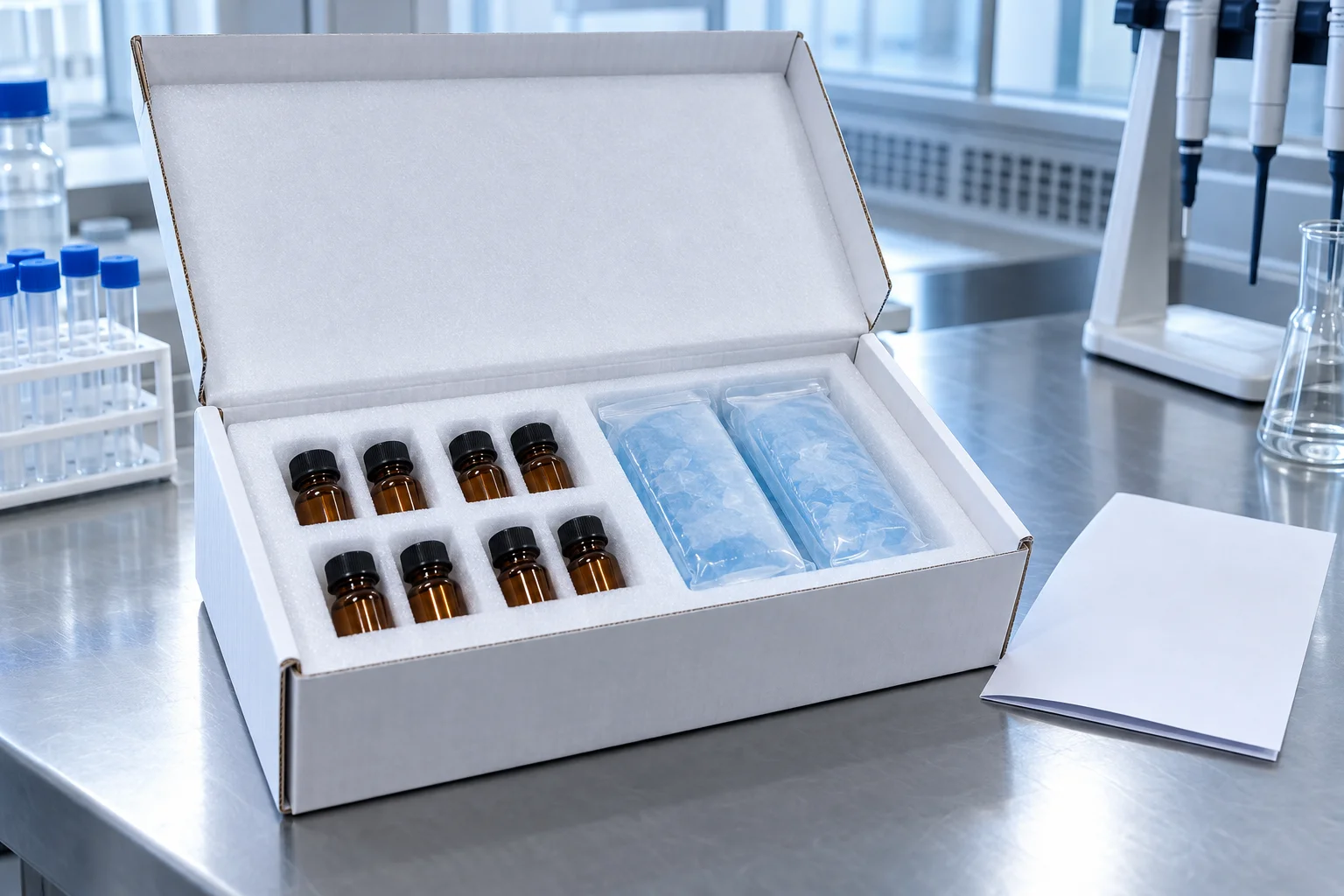
For long-term storage, lyophilized peptides are kept at −20 °C or colder, with some suppliers preferring −80 °C, and away from bright light.12 Look for sealed, labeled vials with the lot number, protection from light and moisture, insulated packaging when conditions call for it, and written storage instructions. A shipment that arrives damaged, unlabeled, or with no storage guidance says more about quality culture than any marketing page.
What Product Information Should a Reliable Supplier Provide?
A reliable supplier provides enough product information to reproduce your work: the sequence and any modifications, molecular formula and weight, salt form or counter-ion, purity grade, net peptide content where measured, lot number, storage conditions, and an RUO label free of use claims.
The counter-ion matters because it adds mass and can affect some experiments; residual trifluoroacetate (TFA), common after purification, has been reported to alter cell growth.13 Clear RUO labeling should not sit next to wellness or performance claims; research-use-only explained covers what legitimate suppliers do differently.
How To Compare Research Peptide Suppliers More Effectively
Compare suppliers by scoring each one against the same written rubric, using evidence rather than website claims. Request the lot-matched COA for the exact material you would receive, accept a small qualification lot, and verify it before relying on the supplier for ongoing work.
| Criterion | What to check | Evidence to request |
|---|---|---|
| Documentation | Lot-matched COA with HPLC and MS data | COA for the lot you will receive |
| Testing independence | Named lab; accreditation scope | Lab name and accreditation details |
| Product information | Sequence, salt form, net peptide content | Product data sheet |
| Packaging and storage | Sealed, labeled, protected vials | Packaging and storage description |
| Consistency | Results stable across lots | COAs from two or more past lots |
| Support | Clear technical answers | Response to a specific technical question |
Keep the scores with your records, and qualify more than one source for critical peptides so a single supplier problem does not stall a project; see how labs should build supplier redundancy.
What Red Flags Should Researchers Watch For?
The clearest red flags are missing or reused COAs, purity claims without data, no identity confirmation, and marketing that contradicts research-only labeling. Red flags often tell you more than positive signals, because they are hard to explain away.
| Area | Strong signal | Red flag |
|---|---|---|
| COA | Batch-specific, matches vial lot | None, or the same COA for every lot |
| Purity | Chromatogram and method shown | A percentage with no data |
| Identity | MS observed vs. theoretical mass | No identity test |
| Testing lab | Named, with accreditation scope | Unnamed or “in-house only” with no detail |
| Labeling | Clear RUO label, no use claims | Wellness, weight, or performance claims |
| Business identity | Verifiable name, address, support | No address; untraceable payment channels only |
| Pricing | Consistent with testing and handling costs | Far below comparable suppliers |
How Pricing Fits Into Supplier Evaluation Without Telling the Whole Story
Price is a sanity check, not a quality measure. Synthesis, purification, independent testing, and careful packaging all cost money, so a price far below comparable suppliers raises the question of which step was skipped.
A higher price does not prove quality either. Compare cost per milligram of actual peptide where net peptide content is reported, and weigh it against the cost of a failed or unrepeatable experiment. Documentation decides; price only prompts questions.
Common Mistakes To Avoid When Evaluating a Research Peptide Supplier
The most common mistake is accepting a purity number without checking that it belongs to your lot. Others follow the same pattern of trusting claims over evidence:
- Reading a COA without matching its lot number to the vial.
- Assuming HPLC purity proves identity.
- Ignoring net peptide content and salt form when preparing solutions.
- Choosing on price or website design alone.
- Skipping independent verification of early lots.
- Evaluating once and never rechecking later lots.
How To Build a Better Checklist for Choosing a Research Peptide Supplier in 2026
Build your checklist from the criteria above, write it down, and apply it to every supplier the same way. A practical version has six steps:
- 1Define requirements. Purity grade, identity method, net peptide content, and endotoxin needs for your application.
- 2Collect documents. Lot-matched COA with chromatogram, MS data, test date, and named lab.
- 3Check transparency. Accreditation scope, business identity, clear RUO labeling.
- 4Score suppliers. Use one rubric for every candidate.
- 5Verify early lots. Independently test the first lots before relying on supplier certificates.1
- 6Recheck over time. Compare COAs across lots and record lot numbers with your data.
Knowing how to evaluate a research peptide supplier comes down to checking evidence rather than claims. For deeper reading on peptide quality, start with what researchers need to know about COAs.
Frequently Asked Questions
How do you evaluate a research peptide supplier?
Check for a lot-matched COA with HPLC and MS data, a named testing lab, complete product information, and clear RUO labeling, then verify the first lots you accept independently.
What should you look for in a peptide supplier?
Batch-specific documentation, identity confirmation by mass spectrometry, transparency about testing, and packaging that protects against moisture and light.
How do you compare research peptide suppliers?
Score each supplier against the same written rubric using documents you request, not website claims, and qualify more than one source for critical peptides.
What red flags should researchers watch for?
Missing or reused COAs, purity claims without chromatograms, no identity testing, an unnamed lab, and marketing that contradicts research-only labeling.
Why does supplier transparency matter?
Transparency makes claims checkable. If a supplier will not name its testing lab or share lot-level data, there is nothing to verify.
All peptides discussed here are for research use only.
Key Takeaways
- Evaluating a research peptide supplier means checking evidence: lot-matched HPLC and MS data, not adjectives.
- Match purity grade to the application, and look for net peptide content and salt form.
- Supplier transparency, including a named, accredited testing lab, makes claims verifiable.
- Score every supplier with one rubric, and use price only as a sanity check.
- Verify early lots independently and recheck later lots over time.
Run every new supplier through the same checklist.
References
- US Food and Drug Administration / International Council for Harmonisation. Q7 Good Manufacturing Practice Guidance for Active Pharmaceutical Ingredients (section 7.1 general controls, 7.3 testing of incoming materials, and 11.4 certificates of analysis). Revision 1, September 2016. fda.gov
- Verbeke F, Wynendaele E, Braet S, D’Hondt M, De Spiegeleer B. Quality evaluation of synthetic quorum sensing peptides used in R&D. Journal of Pharmaceutical Analysis. 2015;5(3):169-181. PMC5762210
- Janvier S, Cheyns K, Canfyn M, Goscinny S, De Spiegeleer B, Vanhee C, Deconinck E. Impurity profiling of the most frequently encountered falsified polypeptide drugs on the Belgian market. Talanta. 2018;188:795-807. Sciensano repository (doi:10.1016/j.talanta.2018.06.023)
- US Food and Drug Administration, Center for Drug Evaluation and Research. Warning letter to an online peptide vendor, MARCS-CMS 734884, August 24, 2026 (one of the August 2026 letters; see footnote 1 on labeling statements). fda.gov
- National Institutes of Health. Guidance: Rigor and Reproducibility in Grant Applications (authentication of key biological and/or chemical resources). grants.nih.gov
- GenScript. Recommended Peptide Purity. genscript.com
- AAPPTec. Peptide Quality: Frequently Asked Questions. peptide.com
- International Organization for Standardization. ISO/IEC 17025:2017 General requirements for the competence of testing and calibration laboratories. iso.org
- ANSI National Accreditation Board (ANAB). What Is Laboratory Accreditation? The ANSI Blog. blog.ansi.org
- Verified Peptides. Lab Reports (batch-specific third-party test reports). verifiedpeptides.com
- Bachem. Handling and Storage Guidelines for Peptides. Knowledge center. bachem.com
- Sigma-Aldrich (Merck). Handling and Storage of Synthetic Peptides. Technical guide. sigmaaldrich.com
- Sikora K, Jaśkiewicz M, Neubauer D, Migoń D, Kamysz W. The role of counter-ions in peptides: an overview. Pharmaceuticals. 2020;13(12):442. PMC7761850