

Short answer
A certificate of analysis (COA) is a document that reports test results for a specific batch of material and shows whether it met its specifications for identity, purity, and other quality attributes. For researchers, certificates of analysis are the quickest way to check that lab-tested material matches its label, as long as the COA is batch-specific, complete, and traceable to the lab that did the testing.
This guide explains what a COA contains, how to read one, how third-party and in-house COAs differ, and which gaps should make you ask questions.
What Is a Certificate of Analysis (COA)?
A certificate of analysis is a batch-specific record of test results, issued by a manufacturer or an analytical lab, that states whether the material met its specifications. Certificates of analysis can come from a manufacturer, a supplier, or an independent analytical lab, and the issuer matters as much as the numbers.
For peptides, a COA usually reports identity by mass spectrometry and purity by HPLC, plus net content and contaminant tests where they were performed. It describes the batch that was tested, not every batch of the same product, which is why batch-specific COAs matter.
Why Certificates of Analysis Matter in Scientific Research
Certificates of analysis matter because they are the main evidence that research-grade materials are what they claim to be, and they become part of the experimental record.
NIH expects key chemical resources to be authenticated, and a COA is often the first piece of that evidence.1 COAs also support reproducibility: citing batch numbers and test results lets other labs judge and repeat the work, and keeps your own records consistent across orders. For research-grade materials used across many experiments, a COA on file also speeds up troubleshooting when results look unexpected.
What’s Included in a COA? Key Data Points to Review
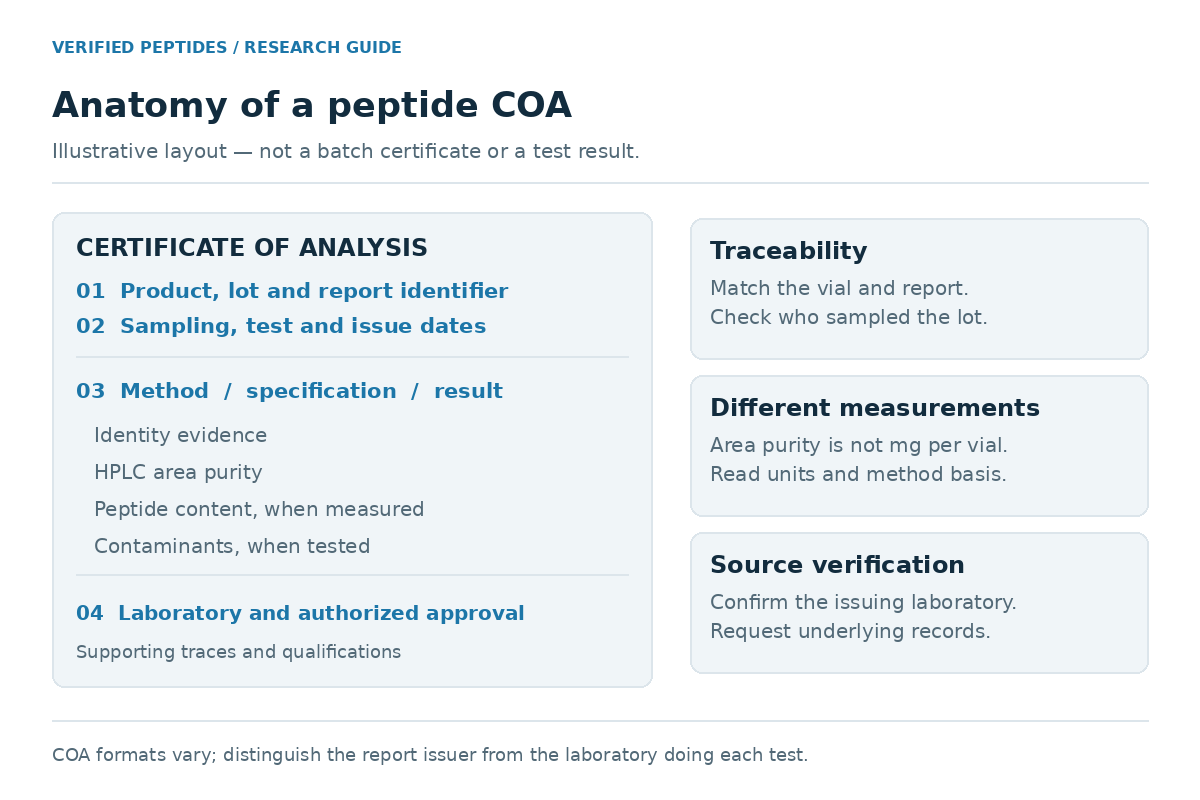
Most COAs share the same core fields, and each one answers a specific question about the batch.
| COA field | What it tells you |
|---|---|
| Product name and batch or lot number | Which material the results describe |
| Test and issue dates | When the testing was done |
| Identity (mass spectrometry) | Whether the molecule matches its expected mass |
| HPLC area purity | Target peak area among the detected and integrated peaks |
| Net peptide content | Peptide versus water, salts, and counter-ions2 |
| Contaminant tests | Endotoxin, microbial, or residual solvent results where tested3 |
| Methods and specifications | How each test was run and its acceptance limit |
| Lab details and approval | Who tested the batch and who signed off |
Key COA Terms: Assay, Impurity Profile, and Lot Number
HPLC area purity and quantitative assay are different measurements. A high area percentage does not establish milligrams per vial or net peptide content.
Three terms often cause confusion. “Assay” usually refers to a quantitative measurement of the target, the “impurity profile” is the pattern of minor components seen alongside it, and the “lot number” is the identifier that ties every result to one batch. Purity testing results should always appear with the method used to produce them; see what a good peptide COA should include.
Third-Party Testing vs In-House COAs
A third-party COA is issued by an independent analytical lab, while an in-house COA is issued by the manufacturer or seller itself. Both can be accurate. An outside report adds separation from the seller, but check sampling, methods, and impartiality safeguards in either case.
Supplier COAs are not always reliable: a published evaluation of research peptides found large discrepancies between COA-stated purity and independently measured purity.4 Even in regulated manufacturing, a supplier’s report can be relied on only when its results are periodically verified.5 See in-house vs. third party lab testing.
How to Read a Certificate of Analysis
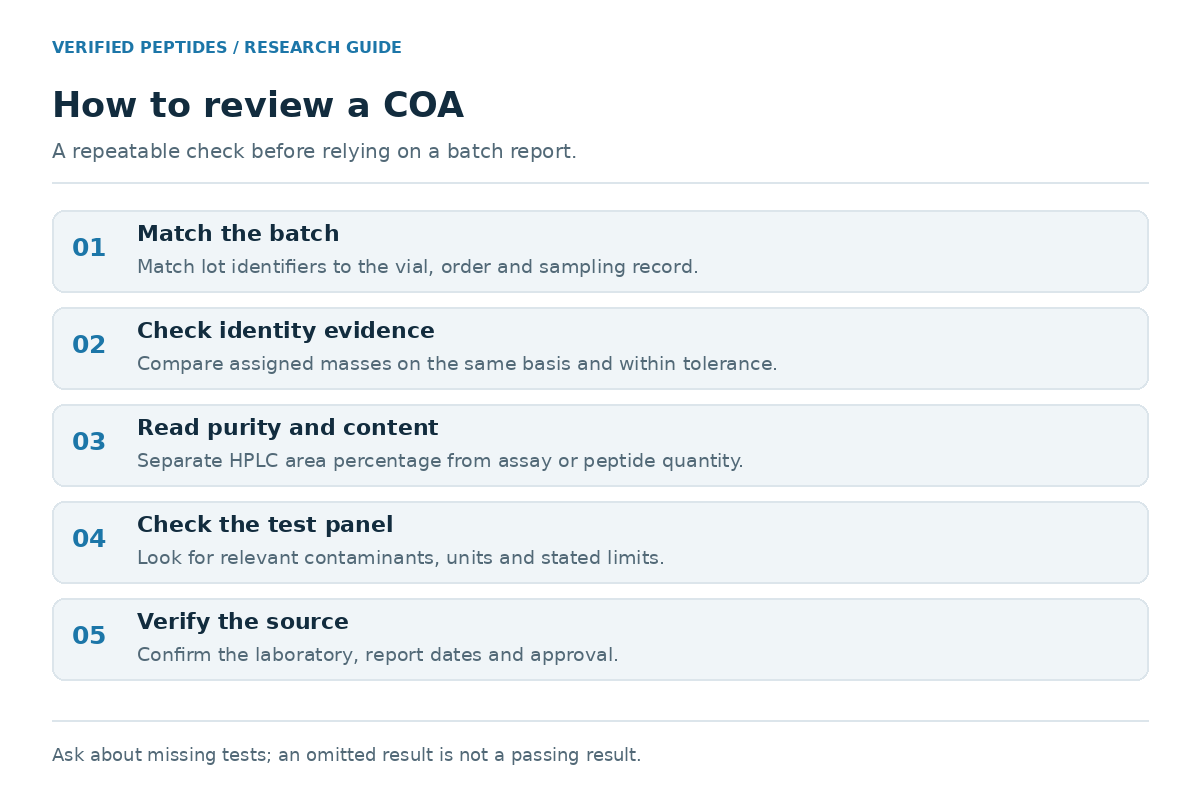
Read a COA in a fixed order: confirm the batch, check identity, then purity, then content and contaminants, and finally the lab and method details. Lab-verified reports often include the chromatogram and spectrum, which help you assess the results. A printed trace is useful, but reprocessing or auditing may require original instrument data and integration settings.
- 1Match the batch The batch or lot number should match your vial or order.
- 2Check identity Compare like-for-like masses within the method’s tolerance; a mass match alone is not full sequence confirmation.
- 3Check purity Compare the HPLC result to its specification and review the chromatogram.
- 4Review other tests Note which tests were performed, not only which passed.
- 5Verify the source Confirm the lab name, contact details, dates, and signature.
COAs and Compliance: Ensuring Regulatory Alignment
For research-use materials, COAs support research compliance and good documentation rather than satisfying a single legal requirement, but regulated industries offer useful benchmarks.
In US pharmaceutical manufacturing, a supplier’s report of analysis may be accepted only alongside identity testing and periodic validation of the supplier’s results.5
Why ISO/IEC 17025 Matters for COAs
Testing labs accredited to ISO/IEC 17025 must meet requirements for competence, impartiality, and how reports are issued, which is why accreditation is a useful quality assurance signal.6 Many institutions also expect COAs to be kept as part of their quality control records.
Where to Source Products with Verified COAs
Source from suppliers that publish batch-specific, third-party certificates of analysis before purchase and make it easy to match each report to the batch you receive.
Useful signs include a searchable report archive, reports that name the analytical lab, and consistent methods across batches. For reference, Verified Peptides publishes batch-specific third-party COAs in its Lab Reports archive.7 Lab-verified results, with the lab’s name and contact details on the report, are easier to confirm independently. If a supplier cannot provide a COA on request, consider the missing document a gap in quality control.
Red Flags in a COA to Watch For
Red flags are observable gaps: missing information, mismatches, or results that cannot be traced to a real, lab-verified source.
- No batch or lot number, or one that does not match your material.
- Missing test dates, or dates that predate the batch.
- No lab name, address, or contact details.
- Results listed without methods or specifications.
- Purity reported with no identity confirmation.
- Identical chromatograms or unexplained repeated results across lots; repeated rounded purity values alone are not proof of a problem.
- No chromatogram or spectrum available on request.
Key takeaways
- Certificates of analysis report test results for one specific batch against its specifications.
- Check batch number, identity, purity, content, contaminant tests, and the issuing lab, in that order.
- Outside reports add an independent check; results from either source should be traceable to suitable methods and samples.
- Missing details, mismatched batches, and unexplained duplicate data across lots are gaps worth questioning.
Keep each COA with your experimental records; it is the simplest form of CoA verification you can do every time.
Frequently asked questions
What is a certificate of analysis used for?
It is used to confirm that a specific batch of material met its specifications before use, and to document that evidence for records, audits, and publications.
Is a certificate of analysis the same as a lab report?
Not exactly. A COA usually summarizes batch results against specifications. A lab report records the testing performed and may include more detail, but it does not necessarily contain all raw instrument data. The terms can overlap.
Who provides a certificate of analysis?
Usually the manufacturer or supplier, either from its own testing or from an independent analytical lab. A supplier can also issue a COA summarizing outside testing; check who performed each test and ask for the original laboratory report.
How do I read a CoA for chemicals or research reagents?
Use the same order as for peptides: match the batch, check identity and purity against specifications, review contaminant tests, and confirm the lab and dates.
What does USP Verified mean on a certificate of analysis?
USP Verified refers to a United States Pharmacopeia verification program, mainly for dietary supplements, that audits manufacturing and tests products against USP standards.8 It is not a standard feature of research peptide COAs.
All peptides discussed here are for research use only.
References
- National Institutes of Health. Guidance: Rigor and Reproducibility in Grant Applications (authentication of key biological and/or chemical resources). grants.nih.gov
- Sikora K, Jaśkiewicz M, Neubauer D, Migoń D, Kamysz W. The role of counter-ions in peptides: an overview. Pharmaceuticals. 2020;13(12):442. PMC7761850
- US Food and Drug Administration. Pyrogen and Endotoxins Testing: Questions and Answers (Edition 2). Guidance for industry, March 2026. fda.gov
- Verbeke F, Wynendaele E, Braet S, D’Hondt M, De Spiegeleer B. Quality evaluation of synthetic quorum sensing peptides used in R&D. Journal of Pharmaceutical Analysis. 2015;5(3):169-181. PMC5762210
- US Code of Federal Regulations. 21 CFR 211.84: Testing and approval or rejection of components, drug product containers, and closures. ecfr.gov
- International Organization for Standardization. ISO/IEC 17025:2017 General requirements for the competence of testing and calibration laboratories. iso.org
- Verified Peptides. Lab Reports archive: batch-specific third-party Certificates of Analysis. verifiedpeptides.com/lab-reports
- United States Pharmacopeia. USP Verified Mark (Dietary Supplement Verification Program). usp.org