

Short answer
Peptide batch testing means analyzing a sample from each production batch, or lot, so researchers know that the specific material they receive matches its specification. An independent laboratory adds an outside check. Representative sampling, comparable methods, and traceable reports make that check useful for repeatable research.
This guide explains why batch testing matters, what it measures, how independent labs add objectivity, and how to judge a testing laboratory.
Why Batch Testing Is Critical in Peptide Research
Batch testing is critical because every synthesis and purification run can differ slightly, and only a batch-level test shows what is actually in the material a researcher uses. Closely related impurities, such as sequences missing an amino acid, are inherent to peptide synthesis and can affect experimental results.1, 2
Funders regard this as part of rigorous science. NIH, for example, expects researchers to authenticate key chemical resources because they can differ between labs or over time and can influence data.3 For research-grade peptides, a batch-specific test is the most direct form of that authentication, and it is the starting point of any peptide quality testing program.
The Role of Independent Testing in Ensuring Objectivity
Independent testing adds objectivity by separating the seller from the analyst. The lab is paid for testing, so independence still needs safeguards against client pressure, selective reporting, and biased sampling.
Impartiality is written into laboratory standards: ISO/IEC 17025 sets requirements for the competence, impartiality, and consistent operation of testing laboratories.4 The need is practical, too. A published evaluation of synthetic peptides bought for research found large gaps between supplier-stated purity and independently measured purity.2 That is why laboratory validation by a competent outside lab adds evidence beyond a seller’s own numbers; see in-house vs. third party lab testing.
Key Quality Metrics Measured in Peptide Batch Testing
A useful batch-testing plan addresses identity, purity, quantity, and contaminants relevant to the intended experiment. Check which tests were actually ordered.
| Metric | What it confirms | Typical method |
|---|---|---|
| Identity | Observed mass matches the expected peptide; sequence may need further testing | Mass spectrometry |
| Peptide purity | Target peak area among the peaks detected and integrated by the method | HPLC with UV detection |
| Net peptide content | How much of the powder is peptide rather than water, salts, or counter-ions5 | Amino acid analysis or similar |
| Endotoxin | Bacterial endotoxin level against a stated limit6 | LAL or recombinant reagent assays |
| Microbial testing | Presence of microorganisms, where specified | Sterility or microbial limits tests |
Batch Testing vs. Single-Sample Testing: Understanding the Difference
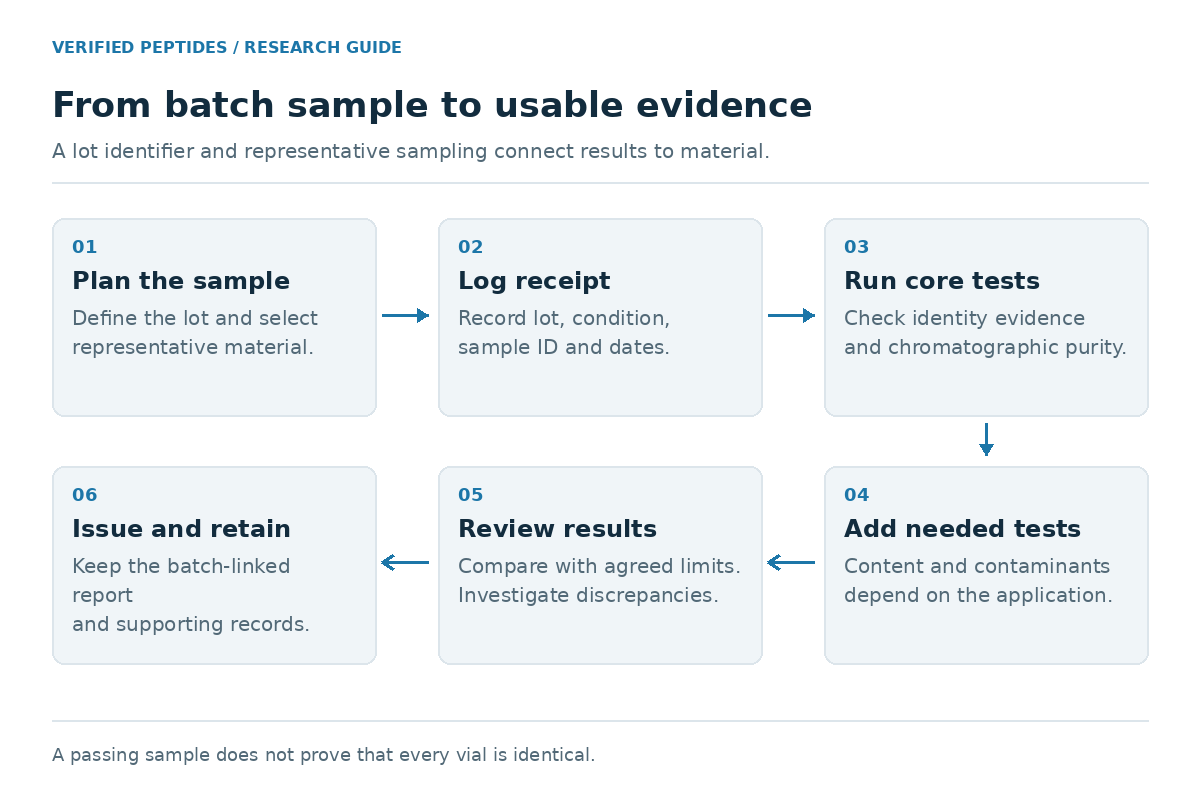
Batch testing links results to a defined lot and a sampling plan. It still tests selected samples, not every vial: one test can support a lot decision only when the sample is representative.
A one-time test, or a generic certificate reused across lots, cannot show whether later batches match. Lot numbers and test dates connect a report to the supplied batch. Ask who sampled it and whether sampling occurred before or after filling into vials. Regulated manufacturing uses the same logic: US rules require representative samples from each lot to be collected for testing.7
A batch report is only as representative as the sampling behind it. Testing a bulk sample does not automatically establish uniform fill content in every finished vial.
How Consistency Impacts Research Outcomes
Consistent batches remove one source of variation; reproducibility also depends on experimental design and technique. If purity, identity, or content shift between lots, an experiment repeated with a new batch may behave differently for reasons unrelated to the question being studied.
Tracking peptide consistency over time also reveals drift early. Our guide to batch-to-batch variability explains which fields to compare across reports and which differences typically warrant a question to the supplier.
Choosing a Reputable Independent Testing Laboratory
A reputable lab is independent from the seller, technically competent for the methods it runs, and transparent about how results were produced.
Look for ISO/IEC 17025 Accreditation
ISO/IEC 17025 is the international standard that accreditation bodies use to assess testing laboratories, covering competence, impartiality, and consistent operation.4 Accreditation is typically granted for defined methods, so it is worth confirming that the scope covers the tests on the report. Independent testing labs that share their accreditation details make this check simple.
Checklist for Choosing a Peptide Testing Laboratory
- The lab is named on each report, with contact details.
- Accreditation is current, and its scope includes the methods used.
- Methods and conditions are described, not just results.
- Results are tied to a batch number and test date.
- Raw data, such as chromatograms and spectra, is available.
- The lab discloses ownership links and manages client pressure; fees do not depend on a passing result.
- Methods stay comparable across batches; investigate method or laboratory changes.
Common Peptide Testing Methods Used in Batch Testing
In peptide quality testing, the core methods are HPLC for purity and mass spectrometry for identity, often supported by amino acid analysis, endotoxin assays, and, less commonly, NMR.
HPLC reports the target peak area as a share of integrated signal, typically from UV detection. Co-eluting or undetected material can be missed, so this is not total powder purity.8 Mass spectrometry checks whether the observed mass matches the expected peptide. A mass match supports identity but does not establish the full sequence or stereochemistry. Using two methods together is common because one can cover gaps in the other’s specificity.9 NMR can add structural detail but is used less often for routine batch release. For more on each method, see peptide separation by HPLC and MALDI mass spectrometry.
Addressing Contamination and Impurities Early
Testing each batch can catch the problems covered by the selected methods before research begins; it cannot rule out contaminants that were not tested.
Related impurities, such as truncated or oxidized sequences, arise during synthesis and storage, while endotoxin and microorganisms can enter during processing and handling.1, 6
Endotoxin Testing
Endotoxin testing is a separate measurement from purity, so a high purity percentage does not answer whether endotoxin is present. Request contaminant results relevant to your experiment. It is commonly run with LAL or recombinant reagent assays and reported against a stated limit.6 For the differences between these tests, see endotoxin vs. sterility vs. bioburden.
Batch Testing for Regulatory and Compliance Requirements
For research-use peptides, batch testing mainly supports documentation and good practice rather than satisfying a single regulatory release requirement.
Regulated pharmaceutical manufacturing offers a useful benchmark: a manufacturer relying on a supplier’s report must conduct at least one specific identity test on the component and establish the reliability of the supplier’s analyses at appropriate intervals.7 Research labs often apply the same logic as part of quality control in peptide production and use, keeping batch records and certificates with experimental data to support audits, publications, and grant reporting.3 See also what legitimate suppliers do differently.
Key takeaways
- Representative batch testing checks the specified attributes of a defined lot; it does not prove every vial is identical.
- Independent testing labs add objectivity by separating testing from selling; impartiality safeguards still matter.
- Batch-specific results, tied to lot numbers and dates, are what make comparisons over time meaningful.
- Look for ISO/IEC 17025 accreditation, transparent methods, and raw data when judging a testing lab.
Ask for the batch report every time you reorder; consistent documentation gives you a record to compare, but the actual results and sampling still matter.
Frequently asked questions
What is batch testing in peptide production?
It is the analysis of a sample from each production batch, or lot, to support identity assessment, purity, and other specifications before the batch is released. The results are tied to that batch number.
Why is independent batch testing important?
It separates testing from selling and gives you an outside record to check. Compare batches only when the methods are comparable, and confirm that sampling and reporting were handled fairly.
How often should peptide batches be tested?
Generally, every batch. Each synthesis and purification run can differ, so results from one batch do not reliably describe the next.
What does peptide purity mean in research?
On an HPLC report, purity usually means the target peak’s share of the integrated signal. It can miss co-eluting or undetected material and does not tell you how much of the powder is peptide. Net content is a separate measurement.
Can independent testing detect contaminants in peptides?
Yes, when the right tests are run. Endotoxin assays, microbial tests, and impurity profiling detect different contaminants, so a report should list each test performed.
All peptides discussed here are for research use only.
References
- D’Hondt M, Bracke N, Taevernier L, et al. Related impurities in peptide medicines. Journal of Pharmaceutical and Biomedical Analysis. 2014;101:2-30. PubMed 25044089
- Verbeke F, Wynendaele E, Braet S, D’Hondt M, De Spiegeleer B. Quality evaluation of synthetic quorum sensing peptides used in R&D. Journal of Pharmaceutical Analysis. 2015;5(3):169-181. PMC5762210
- National Institutes of Health. Guidance: Rigor and Reproducibility in Grant Applications (authentication of key biological and/or chemical resources). grants.nih.gov
- International Organization for Standardization. ISO/IEC 17025:2017 General requirements for the competence of testing and calibration laboratories. iso.org
- Sikora K, Jaśkiewicz M, Neubauer D, Migoń D, Kamysz W. The role of counter-ions in peptides: an overview. Pharmaceuticals. 2020;13(12):442. PMC7761850
- US Food and Drug Administration. Pyrogen and Endotoxins Testing: Questions and Answers (Edition 2). Guidance for industry, March 2026. fda.gov
- US Code of Federal Regulations. 21 CFR 211.84: Testing and approval or rejection of components, drug product containers, and closures. ecfr.gov
- Mant CT, Chen Y, Yan Z, et al. HPLC analysis and purification of peptides. Methods in Molecular Biology. 2007;386:3-55. Full text
- International Council for Harmonisation. ICH Q2(R2) Validation of analytical procedures (scientific guideline, European Medicines Agency). ema.europa.eu