
Short answer
In-house testing is done by the same organization that makes or sells a product, while third party lab testing is done by an independent laboratory. Both can be technically sound. Outside testing adds separation from the seller, while good methods, representative samples, and transparent reporting determine how useful either result is.
This guide compares the two approaches, explains where conflicts of interest arise, and shows how to choose a lab you can trust.
Why Lab Testing Matters in Research and Product Development
Lab testing matters because it is the only objective way to confirm that a material matches its description before it is used. In research, untested or mislabeled materials can undermine results and waste time, which is why funders such as NIH expect key chemical resources to be authenticated.1, 2
What Is Third Party Lab Testing?
Third party lab testing is analysis performed by an independent laboratory that is separate from both the seller and the buyer. The lab receives a sample, runs agreed methods, and issues a report. ISO/IEC 17025 applies to first-, second-, and third-party laboratories alike, so “third party” describes independence; lab accreditation is what speaks to competence.3 Accreditation bodies use the standard to assess labs, so asking for a lab’s accreditation certificate and scope is a quick first check.
Strengths and Weaknesses of In-House Testing
In-house testing is fast, convenient, and useful for routine process checks, but its results are harder for outsiders to trust because the same organization benefits from a passing result.
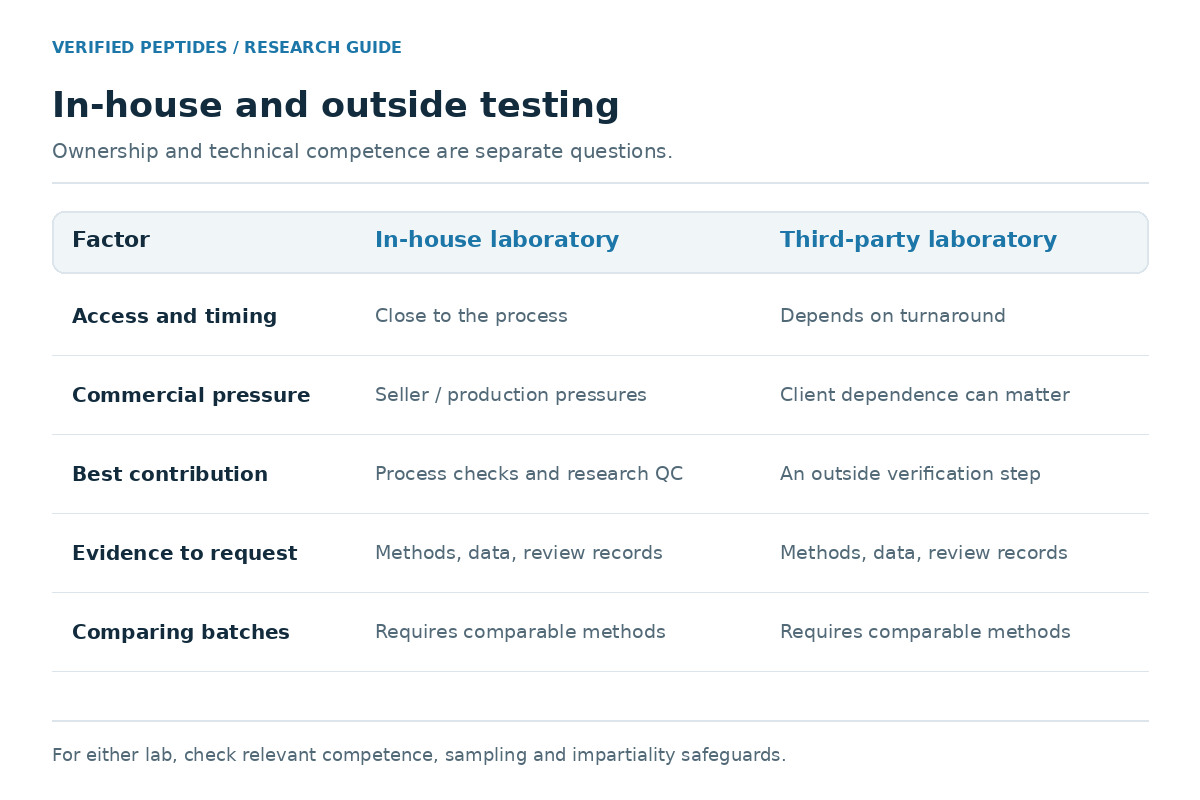
| Aspect | In-house testing | Third party lab testing |
|---|---|---|
| Speed | Often faster; testing is on site | Depends on lab turnaround |
| Cost | Lower per test once equipment exists | Fee per test or batch |
| Independence | Lower; the organization reviews its own product | Separate organization; client pressure still needs managing |
| Testing transparency | Varies; methods may not be shared | Reports typically name the lab and methods |
| Best use | Process checks, research QC, and release testing | External verification and release support |
Benefits of Third Party Lab Testing
The main benefits of third party lab testing are impartiality, comparability, and credibility. Independent results can be compared across batches and suppliers, and they carry more weight with collaborators, reviewers, and institutions. They can reduce duplicate testing, but critical experiments may still need a researcher’s own checks. Lab accreditation to ISO/IEC 17025 adds evidence of technical competence, which supports both research integrity and regulatory compliance where it applies.3
Potential Conflicts of Interest in Lab Testing
A conflict of interest exists when the party producing a result also benefits from what that result says. In lab testing, that can mean a seller testing its own product, or a lab whose business depends heavily on a single client.
Conflicts of interest do not prove a result is wrong, but they create risk: favorable sample selection, selective retesting, or unreported failures. ISO/IEC 17025 requires laboratories to identify risks to their impartiality on an ongoing basis, which is one reason independent validation by accredited labs is preferred when results will be relied on by others.3
Best Practices for Choosing a Third Party Lab
Choose a lab that is accredited for the relevant methods, independent of the seller, and transparent in its reporting. A lab that answers questions about its methods openly is usually easier to rely on.
- Confirm ISO/IEC 17025 accreditation and that its scope covers the tests you need.
- Check ownership links, client dependence, and safeguards against pressure. A repeat testing contract alone does not prove bias.
- Ask for methods and raw data, such as chromatograms and spectra.
- Make sure reports carry the batch number, test dates, and lab contact details.
- Use comparable methods over time; keeping one lab helps consistency but does not guarantee it.
Case Examples: When Testing Goes Wrong
Accepting results without checking their basis creates avoidable risk. Two documented examples show why verification matters.
In a published evaluation of synthetic peptides bought for research, independent quality control found large discrepancies between supplier-stated and measured purity, and one sample’s main compound was not the requested peptide.2 In regulated manufacturing, FDA warning letters cite firms for relying on suppliers’ certificates of analysis without validating them, which US rules require.4, 5
That peptide study used the researchers’ own in-house quality control. It supports checking supplier claims; it does not show that all in-house testing is inferior to commercial third-party testing.
Future of Lab Testing in Research Integrity
The direction is toward more testing transparency: published batch reports, accessible raw data, and digital records that follow data integrity principles such as ALCOA+.6 Regulatory compliance expectations in many industries are also pushing toward electronic, auditable records, and automation and software review may make anomalies easier to spot; see AI and automation in quality control.
Striking the Balance Between In-House and Third Party Testing
- Use in-house testing for speed and routine process monitoring.
- Use outside testing for an independent check, while retaining competent in-house QC where appropriate.
- Look for lab accreditation, independence, and testing transparency when choosing a lab.
- Consider an undisclosed testing source a gap worth asking about.
Many organizations combine both: in-house checks during production and independent validation before release.
Frequently asked questions
What is third party lab testing?
It is analysis by a separate laboratory. The seller or buyer may pay the testing fee; ownership links and pressure to produce favorable results are the conflicts to examine.
Why is independent lab testing important?
It separates testing from selling and makes the results easier to check independently. Client pressure can still exist, and comparisons require suitable, comparable methods.
What are the risks of in-house testing?
The main risk is a conflict of interest, which can lead to selective reporting or retesting. Methods and raw data may also be less visible to buyers.
How do conflicts of interest impact testing results?
They do not automatically make results wrong, but they raise the risk of bias in sample selection, retesting, and reporting. Independent, accredited labs reduce that risk.
How do you choose a trusted third party lab?
Look for ISO/IEC 17025 accreditation covering the relevant methods, independence from the seller, and reports that include methods, raw data, batch numbers, and dates.
All peptides discussed here are for research use only.
References
- National Institutes of Health. Guidance: Rigor and Reproducibility in Grant Applications (authentication of key biological and/or chemical resources). grants.nih.gov
- Verbeke F, Wynendaele E, Braet S, D’Hondt M, De Spiegeleer B. Quality evaluation of synthetic quorum sensing peptides used in R&D. Journal of Pharmaceutical Analysis. 2015;5(3):169-181. PMC5762210
- International Organization for Standardization. ISO/IEC 17025:2017 General requirements for the competence of testing and calibration laboratories. iso.org
- US Code of Federal Regulations. 21 CFR 211.84: Testing and approval or rejection of components, drug product containers, and closures. ecfr.gov
- US Food and Drug Administration. Warning letter citing reliance on supplier certificates of analysis without validating the supplier’s results (21 CFR 211.84(d)(2)). February 2020. fda.gov
- Medicines and Healthcare products Regulatory Agency. GXP Data Integrity Guidance and Definitions, Revision 1. March 2018. gov.uk