
Short answer
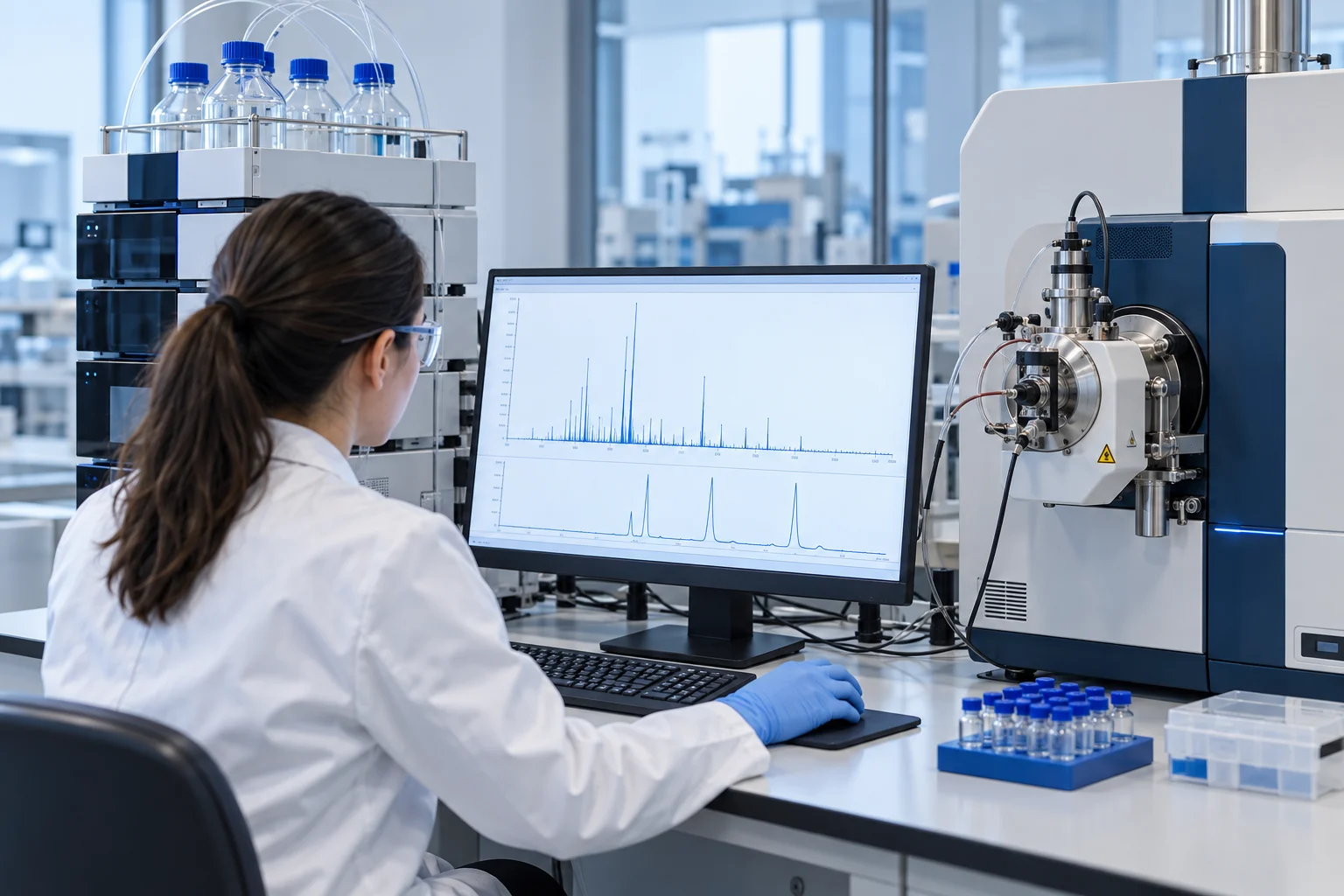
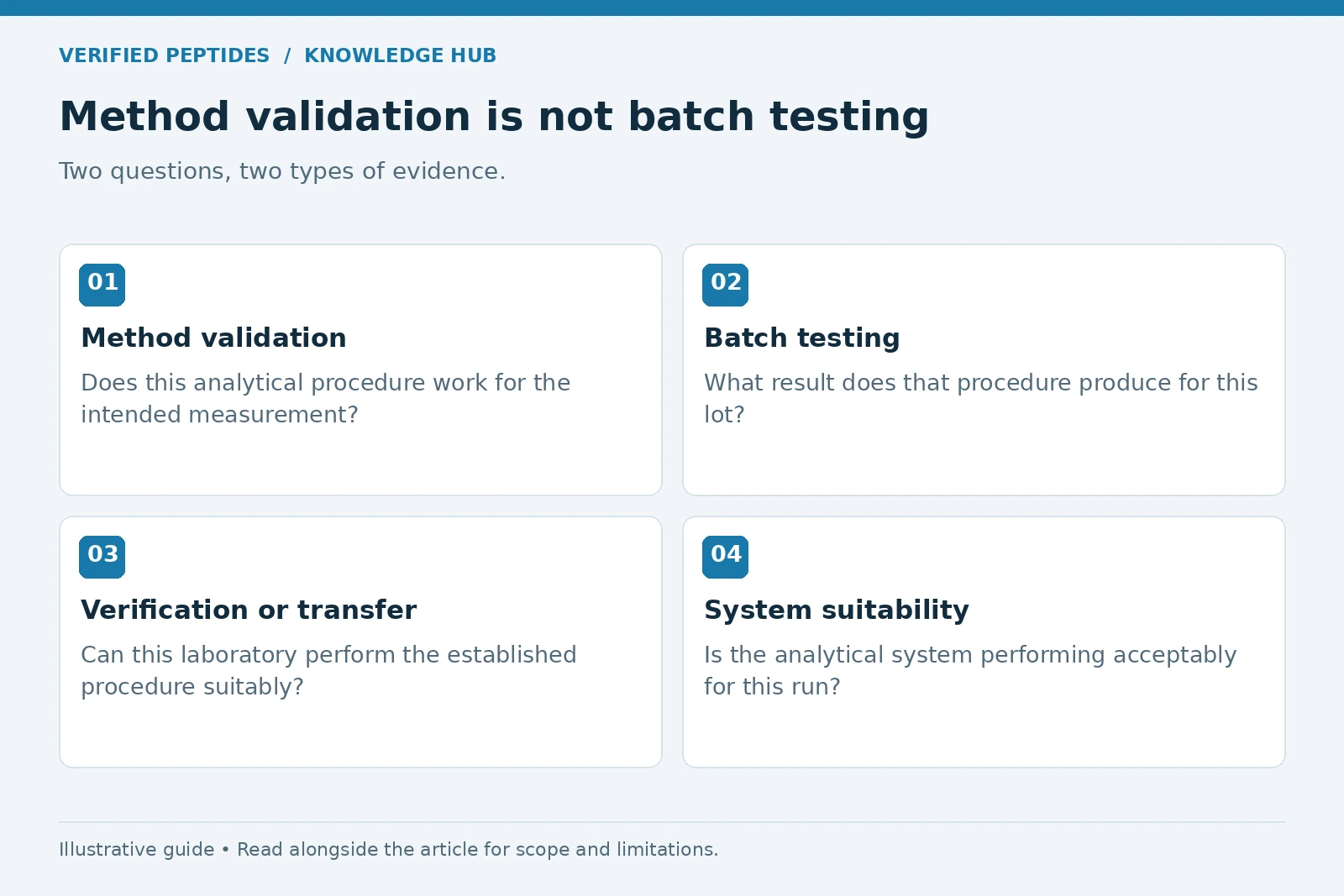
Peptide method validation demonstrates that an analytical procedure is suitable for its intended measurement, such as purity, identity, or content. Batch testing then applies that procedure to a particular lot. Ask whether the method is suitable for the peptide and sample—not just whether a report says “validated.” Independent testing adds another check but does not replace method quality.
For how a single lot is sampled, tested, and released, see independent peptide batch testing.
What Is Peptide Method Validation?
Method validation is documented evidence that a procedure works for a defined purpose. For a peptide purity method, that includes showing it can distinguish relevant impurities from the target and measure reliably over the required range. “Laboratory validated” is not a universal product grade: ask what was validated, for which sample type, and against which criteria.1
Method Validation vs. Batch Testing
Method validation and batch testing answer different questions. Analytical method validation, often shortened to method validation, is the documented demonstration that a test procedure is fit for its intended purpose.2 Batch testing then runs that procedure on one lot. A reliable result needs both: a poorly validated method can give a misleading number, and a validated method says nothing about a batch until it is run on it.
Two related terms also appear on lab reports. FDA guidance describes established pharmacopeial methods as verified (shown to work in a given lab) rather than validated, and describes method transfer studies in which a second lab shows it gets comparable results.3
The ICH Q2(R2) Characteristics of Analytical Method Validation
The international reference for analytical method validation is ICH Q2(R2), which came into effect in the EU in June 2024. Written for pharmaceutical registration, it gives labs a common vocabulary for how well any method works, including peptide HPLC and mass spectrometry.2
| Characteristic | What it shows | Peptide example |
|---|---|---|
| Specificity | The method measures the intended substance without interference | The main HPLC peak is the target, not a hidden impurity |
| Accuracy | Results are close to the true or reference value | A content test recovers a known amount of standard |
| Precision | Agreement of repeated measurements; repeatability, within-lab variation, and between-lab reproducibility are distinct levels. | Repeat purity runs give consistent values |
| Response and reportable range | The calibration relationship and interval over which results are suitable; the response need not always be linear. | Detector response checked across the expected interval |
| Detection and quantitation limits | The smallest amount that can be detected, or reliably measured | How small an impurity peak can be reported |
| Robustness | Performance remains suitable after small, deliberate changes in method conditions. | Slight shifts in column temperature or solvent |
The required characteristics depend on the intended measurement. Identity tests emphasize selectivity; quantitative tests also need suitable accuracy, precision, and range. ICH Q2(R2) allows appropriate linear or nonlinear calibration models. Robustness is normally explored during development. Changes to equipment, reagents, or procedures should be assessed to decide whether verification, transfer, or partial or full revalidation is needed.23
What Can Go Wrong Without Laboratory Validation
Without validated methods and batch-specific testing, these failures can go unnoticed:
- Purity that looks better than it is. A method may not separate a related impurity from the target peak.
- Incomplete identity evidence. A matching intact mass can miss same-mass sequence variants or stereochemical differences; choose additional characterization for the uncertainty.
- Less peptide than expected. Water and counter-ions add weight, and residual trifluoroacetate (TFA) can affect cell-based experiments.5, 6
- Misleading numbers. A method that is not specific can hide an impurity under the main peak and report a purity that looks fine.2
- Irreproducible results. NIH notes that the quality of research resources is critical to reproducing results.7
Peptide Purity and Accuracy: How Labs Confirm Composition
Labs confirm composition by combining orthogonal methods, meaning methods based on different principles, because a single method is rarely unequivocal.4 ICH Q2(R2) likewise says that where one procedure lacks specificity, other procedures should make up for it.2
A Typical Synthesis and Testing Workflow
A common route for a synthetic research peptide is:
- 1Synthesis. Built one amino acid at a time by solid-phase peptide synthesis, then cleaved from the resin.6
- 2Purification. Reversed-phase HPLC removes by-products; the peptide usually ends up as a TFA salt.6, 8
- 3Freeze-drying. Lyophilization typically yields a white powder.1
- 4Testing and documentation Appropriate identity, purity, content, and other tests are performed against defined criteria and linked to the lot. The panel depends on the material and intended work.
- 5Independent verification. A sample of the same batch can go to a third-party lab, whose report carries the same batch number.
Tools Used to Test Peptide Purity and Identity
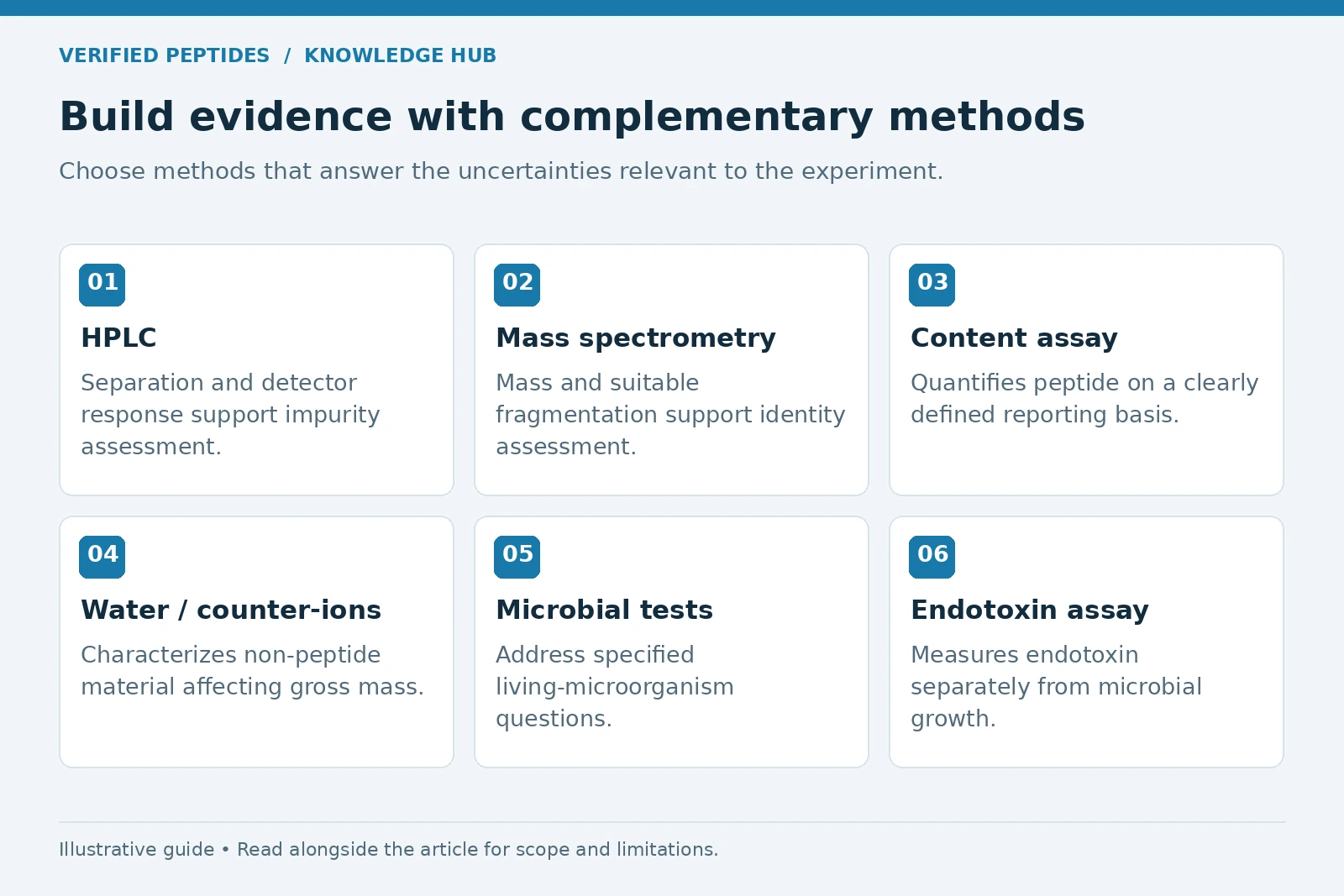
The core tools are HPLC for purity and mass spectrometry for identity, supported by other tests. Each has limits:
| Method | What it answers | What it cannot show |
|---|---|---|
| HPLC with UV detection | The assigned target peak’s share of the integrated UV signal under specified conditions1, 8 | Water, salts, or anything that does not absorb UV at that wavelength |
| Mass spectrometry (MS) | Identity: observed vs. expected molecular weight1 | Isomers such as leucine vs. isoleucine, or D- vs. L-amino acids4 |
| Tandem MS (MS/MS) | Sequence information from fragment ions, with coverage and interpretation appropriate to the peptide4 | Every structural feature automatically. Disulfide mapping and difficult isomer questions require a specifically designed workflow.4 |
| Amino acid analysis or a suitable quantitative assay | Peptide content on a defined mass-fraction or amount basis. UV methods require appropriate response and interference controls.5 | Sequence; amino acid analysis breaks the peptide down first1, 4 |
| Ion chromatography, Karl Fischer, GC | Counter-ions such as TFA, water, and residual solvents1, 6 | Purity or identity |
Purity and content are different. HPLC area percent compares integrated detector signals; peptide content quantifies how much peptide is present. Water and counter-ions can lower peptide mass fraction without appearing as ordinary peptide peaks. Read whether content is reported as a percentage or measured mg per vial; avoid applying a percentage correction twice. See peptide counter-ions.5
Who Validates the Method: Independent vs. In-House Labs
Either kind of lab can validate a method; what matters is that the lab reporting a result has shown the method works for that peptide in its own hands. A manufacturer’s validated method does not automatically carry over to an outside lab, which is why FDA guidance describes transfer and verification studies.3 Independence adds objectivity but does not replace competent testing; see in-house vs. third-party lab testing.
Certificates of Analysis and Validation: What a COA Can and Cannot Show
A COA reports batch results; a method-validation report documents whether the procedure is fit for purpose. One does not replace the other. Ask whether the method was validated or appropriately verified for the intended measurement, and request enough method detail and supporting analytical data to assess any uncertainty.
How Testing Helps Investigate Mislabeled Material
An appropriate identity test can reveal a wrong or modified compound, but intact mass alone cannot distinguish every possible substitution. Verify the report as well as the material: match its sample and lot identification and confirm it with the issuing lab when necessary. An accreditation claim should clearly distinguish work inside and outside the laboratory’s accredited scope.49
Quality Control for Researchers: Why It Starts with Validation
Start with evidence that the material is suitable for the experiment. A supplier report, independent analysis, and targeted in-house checks can all contribute to authentication. Choose extra testing to resolve a real gap rather than treating “validated” as a guarantee. A practical routine is:7
- Record the batch number of every vial.
- Check the appearance and paperwork on receipt, before the lot is used.
- File the COA and independent report together, matched by batch.
- For key experiments, consider an identity check by LC-MS at a core facility.
- Compare new lots with old ones; see batch-to-batch variability.
- Keep a retained aliquot so a questioned result can be re-tested.
How Laboratory Validation Supports Regulatory Compliance
Laboratory validation supports compliance by creating a documented, traceable record of what was tested, how, and by whom. In pharmaceutical manufacturing, test methods must be shown to be fit for purpose,2, 3 and these rules do not apply directly to research peptides, but the same records support institutional audits, publications, and grant reporting. They also help when a result is questioned later, because the evidence trail already exists.
ISO/IEC 17025 Accreditation: Choosing a Trusted Third-Party Lab
ISO/IEC 17025 is the international standard for the competence, impartiality, and consistent operation of testing laboratories, and accreditation bodies assess labs against it.10 Check that a lab’s scope of accreditation covers the tests you need: the scope lists the specific methods a lab is accredited for, so accreditation for one test does not cover another.9 Then ask who tested the batch, how, and when; clear answers are a sign of a transparent testing program. The full lab checklist is in our in-house vs. third-party guide, and Verified Peptides keeps its third-party results, organized by batch and test date, in a public Lab Reports archive.11
Frequently asked questions
What does laboratory validation mean for peptides?
The precise term is method validation: evidence that a test works for its intended purpose. Batch testing applies that test to a lot. A “validated peptide” label alone does not tell you which attributes were measured.
Why is third-party testing important in peptide manufacturing?
It adds an outside analytical opinion and a report others can verify. Suitable methods, representative sampling, and impartiality controls still determine the strength of the evidence.
How do labs test for peptide purity?
Commonly with reversed-phase HPLC and UV detection, reporting target-peak area percent. The method must separate relevant impurities; complementary identity and content tests answer different questions.
What’s the difference between COA and lab validation?
A COA records results for a batch. Method validation documents that the procedure used to obtain a result is fit for purpose. Ask for each type of evidence when it is relevant.
Is in-house peptide testing reliable?
Yes. Relevant expertise, suitable methods, independent quality review, and complete records can make in-house results reliable. Outside testing provides an additional check rather than making internal results automatically invalid.
All peptides discussed here are for research use only.
Key takeaways
- Method validation establishes fitness for purpose; batch testing measures a specific lot.
- ICH Q2(R2) defines what analytical method validation covers, from specificity to robustness.
- Orthogonal methods such as HPLC and mass spectrometry each catch what another misses.
- ISO/IEC 17025 accreditation counts only for the tests within a lab’s scope.
- Suitable methods, traceable batch evidence, and correct handling support research reproducibility.
When in doubt, ask who tested the batch, how, and when; clear answers are a sign of a transparent testing program.
References
- Bachem. Quality Control of Amino Acids & Peptides: A Guide. Knowledge center. bachem.com
- International Council for Harmonisation. ICH Q2(R2) Validation of analytical procedures (scientific guideline, European Medicines Agency). ema.europa.eu
- US Food and Drug Administration. Analytical Procedures and Methods Validation for Drugs and Biologics. Guidance for industry, July 2015 (sections VI.C compendial procedures, VIII.A revalidation, VIII.B.2 method transfer). fda.gov
- Swietlow A, Rode H, Szajek A, Verlander M, Eggen I, Gregg B (USP Therapeutic Peptides Expert Panel). Control strategies for synthetic therapeutic peptide APIs, Part I: analytical consideration. Pharmaceutical Technology. 2014;38(3). pharmtech.com
- AAPPTec. Peptide Quality: Frequently Asked Questions. peptide.com
- Sikora K, Jaśkiewicz M, Neubauer D, Migoń D, Kamysz W. The role of counter-ions in peptides: an overview. Pharmaceuticals. 2020;13(12):442. PMC7761850
- National Institutes of Health. Guidance: Rigor and Reproducibility in Grant Applications (authentication of key biological and/or chemical resources). grants.nih.gov
- Mant CT, Chen Y, Yan Z, et al. HPLC analysis and purification of peptides. Methods in Molecular Biology. 2007;386:3-55. PMC7119934
- National Institute of Standards and Technology. NIST Handbook 150, 2020 Edition Update 1: NVLAP Procedures and General Requirements (sections 1.3.5, 1.5.29 scope of accreditation; A.5 reports). October 2024. nist.gov
- International Organization for Standardization. ISO/IEC 17025:2017 General requirements for the competence of testing and calibration laboratories (reviewed and confirmed 2023). iso.org
- Verified Peptides. Lab Reports (batch-specific third-party test reports). verifiedpeptides.com