
Short answer
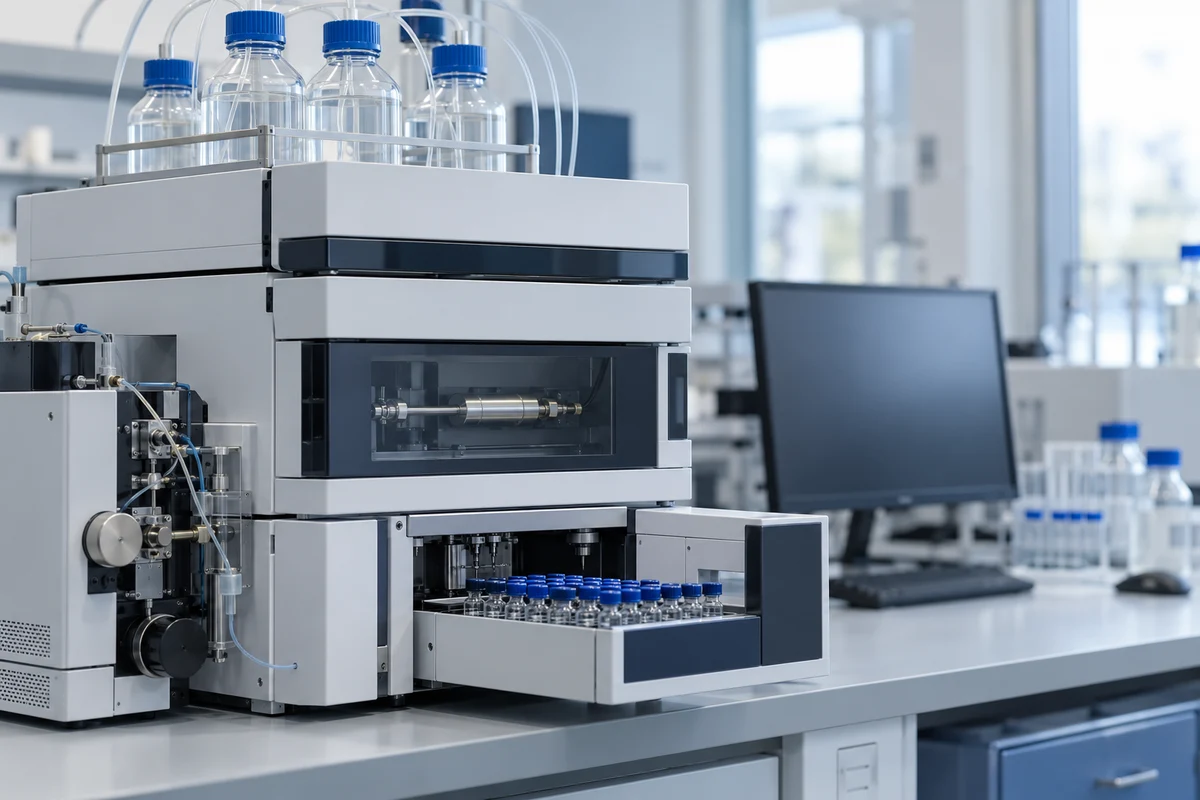
Peptide separation by HPLC pushes a sample through a column packed with fine particles under high pressure, separating peptides by properties such as hydrophobicity or charge. Reversed-phase HPLC is the most common approach, and it is used to measure purity, confirm identity alongside mass spectrometry, and build peptide maps in protein analysis.
This guide explains why HPLC remains a standard tool, how to choose a column and mobile phase, how it compares with other techniques, and how to solve common separation problems.
Why Peptide Separation by HPLC Remains a Gold Standard
HPLC remains a standard method for peptides because it combines high resolution, reproducibility, and broad applicability, and it works at both analytical and preparative scale.1
Small, tightly packed particles give HPLC many separation opportunities along a column, so peptides that differ by a single residue or modification can often be resolved. Retention time, the point at which a peptide leaves the column, is highly reproducible under fixed conditions, which makes comparisons between runs and batches meaningful. That is why HPLC peptide analysis appears on most peptide Certificates of Analysis as the purity measurement, and why HPLC is central to peptide characterization. HPLC area purity is method-dependent: undetected or co-eluting material can be missed, and area percentage is not the peptide mass fraction of the powder.
Types of HPLC Used in Peptide Analysis
The main types are reversed-phase, ion exchange, hydrophilic interaction (HILIC), and size-exclusion HPLC, with the reversed-phase mode used most often.1
- Reversed-phase HPLC (RP-HPLC)
- Separates by hydrophobicity. The default for synthetic peptide purity and peptide mapping.
- Ion exchange
- Separates by charge; useful for charge variants and as a second, complementary dimension.
- HILIC and mixed-mode
- Retain polar peptides that elute too early in reversed phase.1
- Size exclusion
- Separates by size; used to assess aggregation and oligomeric state.1
Each mode can run as analytical chromatography, which measures what is present, or preparative chromatography, which collects purified material. Analytical work uses small columns and sample volumes, while preparative work scales both up. For a closer look at each mode, see an overview of HPLC modes for peptide separation.
Choosing the Right Column and Mobile Phase
For most peptides, start with a C18 reversed-phase column and a water and acetonitrile gradient containing an acidic additive, then adjust for the peptide’s size, polarity, and detection method.2 Column temperature matters too: modest, consistent heating can sharpen peaks and stabilize retention, provided the peptide tolerates it. Shorter alkyl chains such as C8 or C4, or wider-pore particles, are often used for larger or very hydrophobic peptides, while polar-embedded or mixed-mode phases can change selectivity for difficult pairs.1, 2
Mobile phase optimization usually centers on the acid additive. Trifluoroacetic acid (TFA) gives sharp peaks through ion pairing but suppresses electrospray mass spectrometry signal, so LC-MS work often uses formic acid instead, with difluoroacetic acid as a middle ground.3 TFA can also remain with the purified peptide as a counter-ion. Gradient elution, a gradual increase in organic solvent, controls how quickly peptides elute, and shallower gradients typically improve resolution of closely related peptides at the cost of longer runs.
HPLC vs. Other Peptide Separation Techniques
HPLC offers a useful combination of resolution and quantitative detection for peptides. Other methods provide different selectivity, scale, or sample-preparation advantages; capillary electrophoresis, for example, can also deliver very high separation efficiency.
| Technique | Strength | Limitation | Typical role |
|---|---|---|---|
| HPLC or UHPLC | High resolution; quantitative | Higher equipment cost | Purity analysis, peptide mapping |
| Low-pressure or flash LC | Capacity and low cost | Lower resolution | Cleanup and first-pass purification |
| Solid-phase extraction | Fast and simple | Not a high-resolution separation | Desalting and sample preparation |
| Capillary electrophoresis | Different mechanism (charge and size) | Small sample capacity | Orthogonal purity check1 |
| Gel electrophoresis | Visual size estimate | Low resolution for small peptides | Larger peptides and proteins |
In practice, labs combine these methods, often using SPE or low-pressure columns for cleanup and HPLC for the final measurement. For purification strategy, see chromatographic techniques for peptide purification.
Common Challenges in Peptide Separation and How to Solve Them
Most HPLC problems with peptides show up as poor peak shape, drifting retention time, co-eluting peaks, or low recovery. A system suitability check, such as a standard peptide mixture run before samples, helps separate instrument problems from sample problems, and pharmacopeial chapters such as USP <621> define these checks.4
When a method works, document it fully. Recording the column, mobile phase, gradient, temperature, and detection settings makes HPLC peptide analysis repeatable across instruments and labs, and supports comparisons across batches. Method transfer and system suitability still need checking when instruments or laboratories change.
- Broad or tailing peaks. Often caused by secondary interactions or overloading. Check the acid additive, reduce the load, or try another column.
- Retention time drift. Usually linked to mobile phase preparation, temperature, or column equilibration. Standardize these and run a reference sample.
- Co-eluting impurities. Flatten the gradient, change selectivity with another column or additive, or add an orthogonal method.
- Low recovery or carryover. Sticky or hydrophobic peptides can adsorb to surfaces. Adjust solvents and add wash steps between runs.
- Poor solubility. Dissolve the sample in a solvent compatible with the starting mobile phase. See solubility troubleshooting.
Applications in Pharmaceutical Research and Proteomics
In pharmaceutical research and proteomics, peptide separation by HPLC is used for purity testing, peptide mapping, and as the front end of LC-MS analysis. Peptide mapping digests a protein into peptides with an enzyme and separates them, usually by RP-HPLC, to create a fingerprint for comparison. LC-MS/MS assignments are needed to establish sequence coverage and locate many modifications; a UV chromatogram alone does not establish the amino acid sequence.5 It is a core technique for protein analysis in biopharmaceutical characterization.2 See peptide mapping analysis for more.
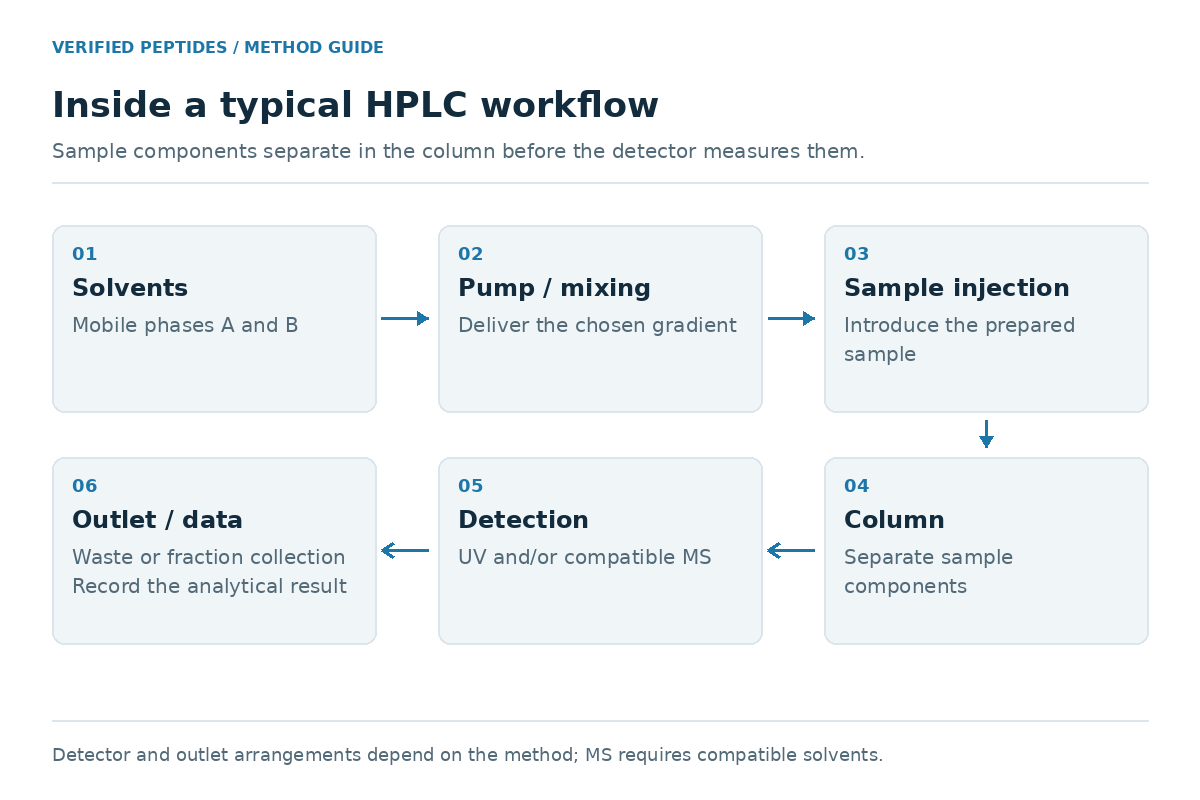
In proteomics, LC-MS integration couples HPLC directly to mass spectrometry, so peptides are separated and identified in a single run; see electrospray ionization. In synthetic peptide work, analytical chromatography with UV detection measures peptide purity, while mass spectrometry, including MALDI, supports identity assessment. A matching intact mass alone does not establish the full sequence or stereochemistry.
Emerging Trends in HPLC for Peptide Mapping
Current trends point toward faster, higher-resolution separations and tighter coupling with mass spectrometry. Ultra-high-performance systems (UHPLC) use smaller particles and higher pressures to raise peak capacity and shorten run times,2 and additives such as difluoroacetic acid aim to keep good chromatography while improving MS sensitivity.3 Automation, multidimensional separations, better data-processing software, and greener solvents are also making these workflows more routine and less resource-intensive.6 For where the field is heading, see the evolution of peptide mapping techniques.
Key takeaways
- Peptide separation by HPLC offers high resolution and reproducible results, which is why it anchors purity testing.
- RP-HPLC with a C18 column and an acidified water and acetonitrile gradient is the usual starting point.
- Choose TFA for sharp UV peaks and formic acid or difluoroacetic acid when mass spectrometry sensitivity matters.
- Pair HPLC with mass spectrometry or an orthogonal method to confirm identity and catch co-eluting impurities.
For peptide quality assessment, HPLC and complementary methods answer different questions and work best together.
Frequently asked questions
Why is HPLC used for peptide separation?
Because it separates closely related peptides with high resolution and reproducible retention times, and it can measure chromatographic area purity under a defined method. It also connects directly to mass spectrometry.
What is the best mobile phase for peptide separation?
For reversed-phase HPLC, a water and acetonitrile gradient with an acid additive is the common starting point. TFA generally gives the sharpest peaks for UV work, while formic acid is often preferred for LC-MS.
How does reversed-phase HPLC work for peptides?
Peptides bind to a hydrophobic stationary phase, such as C18, and elute as the organic solvent increases. More hydrophobic peptides elute later, so the gradient separates peptides by hydrophobicity.
What are the limitations of HPLC in peptide analysis?
HPLC cannot confirm identity on its own, some impurities can co-elute with the main peak, and very polar or aggregating peptides can be hard to separate. Pairing it with mass spectrometry or an orthogonal method addresses most of these gaps.
Is HPLC suitable for modified or synthetic peptides?
Yes. HPLC is widely used for synthetic peptides and can often resolve modified forms, such as oxidized or truncated sequences, though unusual modifications may need method adjustments.
All peptides discussed here are for research use only.
References
- Mant CT, Chen Y, Yan Z, et al. HPLC analysis and purification of peptides. Methods in Molecular Biology. 2007;386:3-55. Full text
- Waters Corporation. Selecting a Reversed-Phase Column for the Peptide Mapping Analysis of a Biotherapeutic Protein (application note). 2017. waters.com
- Waters Corporation. Comparing Mobile Phase Additives for the Separation of mAb Tryptic Peptides: A Case Study on Formic, Difluoroacetic, and Trifluoroacetic Acid (application note). 2019. waters.com
- United States Pharmacopeia. General Chapter <621> Chromatography. usp.org
- Corradini D. Peptide mapping by reversed phase chromatography. LC GC Europe. 1996. iris.cnr.it
- Ferrazzano L, Catani M, Cavazzini A, et al. Sustainability in peptide chemistry: current synthesis and purification technologies and future challenges. Green Chemistry. 2022. doi:10.1039/d1gc04387k