
Short answer
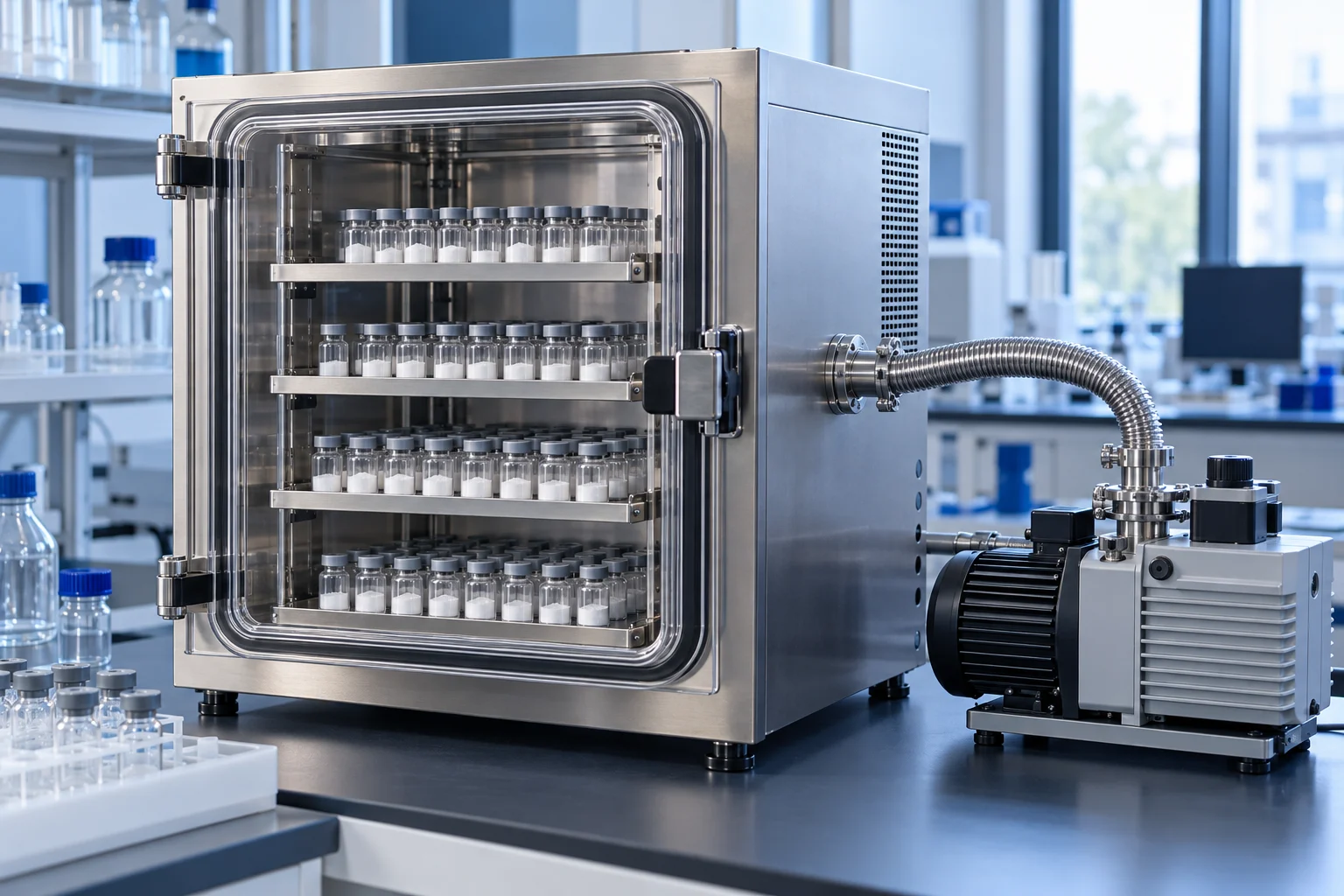
Lyophilized powder is material that has been freeze-dried: frozen, then held under vacuum so the ice turns straight into vapor, leaving a dry powder or “cake.”1, 2 Peptide lyophilization matters because water drives most peptide degradation. Dry, sealed, cold storage often extends peptide shelf life compared with solution storage; use stability guidance for the actual preparation.3 The dry form may support ambient shipping when stability data allow it. For reconstitution, calculate concentration from net peptide content rather than gross powder weight.4
Want the freeze-drying cycle step by step? See our peptide lyophilization protocol.
What Is Peptide Lyophilization? A Scientific Breakdown
Peptide lyophilization is freeze-drying applied to peptides: water is removed from a frozen peptide solution, mostly by sublimation, so ice passes directly to vapor without melting.1, 2 What remains is a dry, lightweight solid that is redissolved (reconstituted) before use.
It matters for peptide research and storage because of water. In solution, peptides can undergo hydrolysis, often at aspartic acid (Asp); deamidation, often at asparagine-glycine (Asn-Gly) or glutamine-glycine (Gln-Gly) sequences; and oxidation, notably of cysteine (Cys) and methionine (Met).5 Peptides stored in solution are also susceptible to bacterial degradation.3 Removing water slows these pathways; the FDA’s inspection guide notes that products are made in lyophilized form because of their instability in solution.1
Understanding the Freeze-Drying Process and How it Works
Freeze-drying runs in three stages: freezing, primary drying (ice sublimes under vacuum), and secondary drying (bound water is desorbed).2, 6 Each stage runs within set time, temperature, and pressure limits.1 For what each stage does to the peptide, see what a lyophilized peptide is.
A product can look dry and still hold water. Labconco notes that residual moisture after primary drying may be as high as 7% to 8%, and that values range from less than 1% to 3% for most finished products.2
Why Excipients Matter in Freeze-Drying
Excipients are the non-peptide ingredients in a formulation, and they can make or break a freeze-dried product. Some act as cryoprotectants that reduce dehydration stress during the process.6 Bulking agents give the cake its structure: a 2023 review describes mannitol as a preferred bulking agent, while noting that it can form a metastable hemihydrate in the cake and has been linked to vial breakage, so cycles must be tuned around its behavior.7 Each formulation also has a collapse temperature it must stay below during drying; for sucrose it is about −32 °C.2
The Difference Between Lyophilized and Liquid Peptides
In general, a freeze-dried peptide is more stable than the same peptide in solution.5 GenScript describes most dry peptides as stable for several years at −20 °C, while the shelf life of peptides in solution is very limited.3
| Feature | Lyophilized powder | Peptide in solution |
|---|---|---|
| Typical stability | Several years at −20 °C for most sequences3 | Preparation-specific; follow guidance or stability data for the peptide and solvent3, 4 |
| Room temperature | Short exposures may be acceptable; follow product-specific guidance8 | Not recommended for storage4 |
| Weight and volume | Lighter and smaller, with the water removed6 | Carries the full solvent volume |
| Main risks | Moisture uptake, oxygen, and light3, 4 | Hydrolysis, deamidation, oxidation, and bacterial growth3, 5 |
For a fuller comparison, including where liquid formats are used, see lyophilized vs non-lyophilized peptides.
Preserving Purity: Stability Through Lyophilization
Peptide lyophilization helps preserve purity by removing the water that drives hydrolysis, deamidation, and bacterial growth, so fewer breakdown products form during storage.3, 5
Dry does not mean invulnerable. Moisture absorbed from the air reduces the overall peptide content and may also decrease stability.4 Peptides containing Cys, Met, or tryptophan (Trp) are prone to oxidation and need storage under anaerobic (oxygen-free) conditions; GenScript suggests purging buffers with argon or nitrogen for them.3
Can Lyophilization Affect Peptide Integrity?
Yes, it can. Freezing and drying are stresses in their own right, which is why formulations use excipients to reduce dehydration stress.6 Some sequences may aggregate or pick up moisture, and if a product exceeds its collapse temperature during drying, the cake structure can collapse; the FDA describes meltback as a form of cake collapse caused by a change from solid to liquid.1, 2 Integrity is therefore checked analytically rather than assumed (see the quality checks below).
Common Freeze-Drying Challenges and How They Are Addressed
- Collapse and residual moisture. Keep the product below its collapse temperature, and set moisture limits from worst-case data.1, 2
- Excipient behavior. Understanding how excipients such as mannitol behave during freeze-drying helps optimize the cycle.7
- Moisture pickup after opening. Let the container reach room temperature in a desiccator before it is opened.4
The Shelf Life Advantage: Extending Usability Without Compromise
Stored dry, sealed, and dark at −20 °C or colder, most lyophilized peptides remain stable for several years; sequences containing Cys, Met, Trp, Asn, or Gln may keep for less time.3, 4
Long-term data support this for some peptides. In one published study, lyophilized multi-peptide mixtures kept at −80 °C were reported stable for at least 17 years, and 17 of 18 peptides remained stable after up to three months at +4 °C or room temperature, with samples analyzed by HPLC and mass spectrometry.9
For timelines by storage condition, see how long lyophilized peptides last.
Transporting Peptides: Convenience Meets Consistency
Some freeze-dried peptides can be shipped at ambient temperature when supported by product-specific stability guidance.4 General handling guides describe room-temperature tolerance for some dry peptides,8 but this does not establish a shipping window for every peptide. Follow the supplier’s shipping conditions, including protection needed for heat or delays.
Freeze-dried material is also lighter and smaller than the original solution, and lyophilization can reduce cold-chain requirements when the product’s stability supports it.6 The approach is decades old: some of the first uses of freeze-drying came in the 1940s, to keep sensitive biological materials stable without refrigeration.6 Consistency follows from that stability. When every vial travels dry, labs at different sites are more likely to receive material in the same condition. On arrival, follow the labeled storage conditions; freezing is common for longer-term storage of research peptides.
Accuracy in Application: Ensuring Reproducible Research
A dry peptide lets researchers prepare a fresh solution while keeping the rest of the lot dry. Base the concentration on net peptide content from the batch documentation. Gross powder weight may include counterions, residual water, or excipients, and HPLC purity alone does not tell you the net peptide mass.
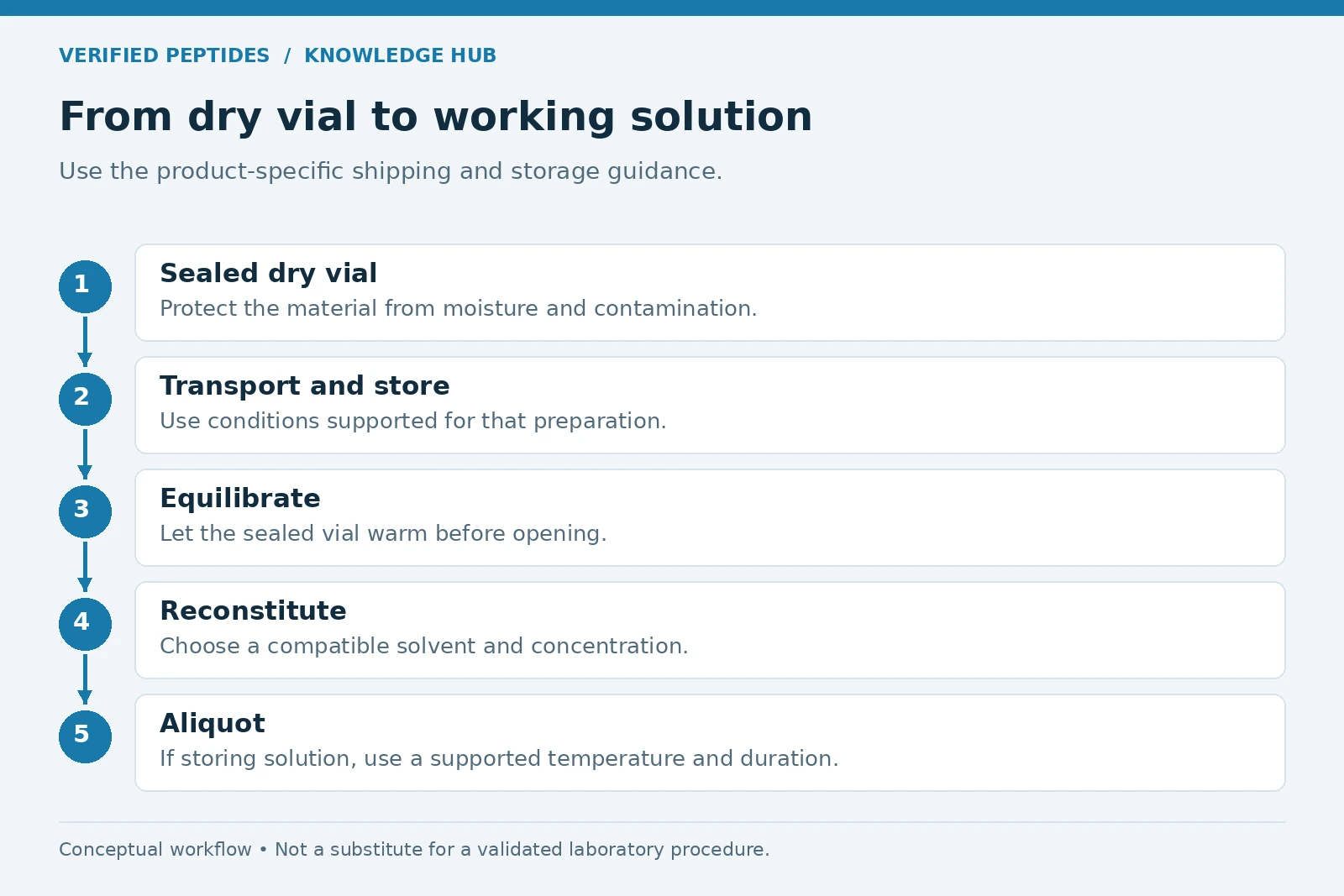
Two habits protect that accuracy. First, let the container reach room temperature in a desiccator before opening and weighing: peptides tend to be hygroscopic, and absorbed moisture lowers the peptide content of what you weigh.4 Second, avoid repeated freeze-thaw cycles by preparing single-use aliquots.3, 8
Quality Control Checks for Lyophilized Peptides
Standard checks confirm that freeze-drying worked and that the peptide came through it intact. The FDA lists cake volume and appearance as critical aspects, and moisture in vials as an obvious concern.1
| Check | What it shows |
|---|---|
| Cake appearance and volume | Collapse, meltback, or an incorrect fill1 |
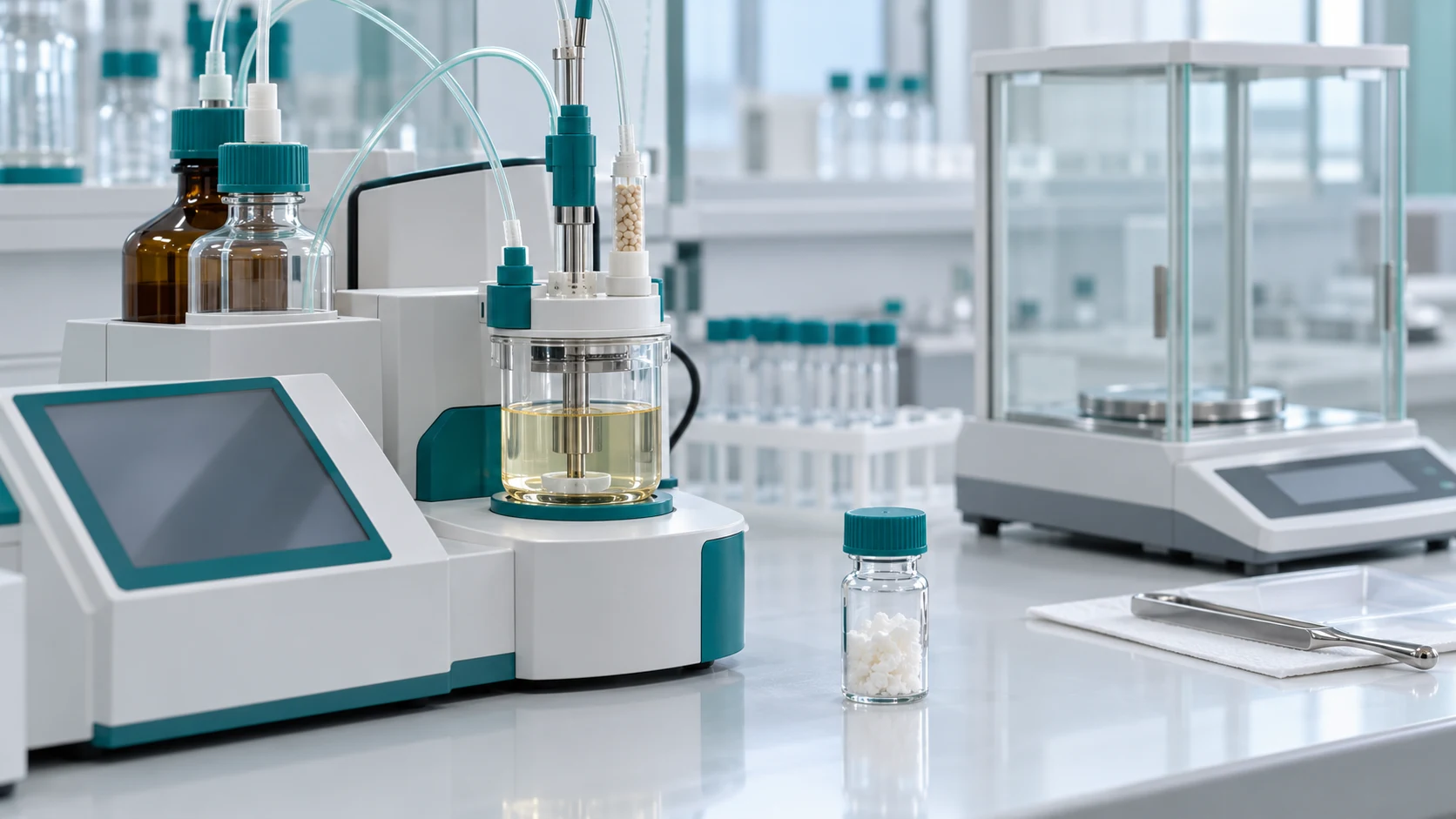
| Residual moisture (Karl Fischer titration) | Water left in the vial, measured by a titration that reacts specifically with water; it affects stability and shelf life2, 10 |
| HPLC | Purity, and any new impurity peaks after drying or storage9 |
| Mass spectrometry | Identity, by confirming the expected molecular mass9 |
Reconstitution: Bringing Lyophilized Peptides Back to Life
To reconstitute a dry peptide correctly, first let the sealed vial reach room temperature, ideally in a desiccator, so moisture does not condense on the cold powder.3, 4
Then dissolve it in a solvent suited to the sequence (see how to reconstitute lyophilized peptides), and if a solution must be kept, use a solvent and pH compatible with the peptide and experiment. Divide it into single-use aliquots and follow storage conditions and a storage period supported for that preparation.3, 8
Common Research Applications That Rely on Lyophilization
Peptide lyophilization underpins any work that needs one peptide lot to stay consistent over time; for longer storage, suppliers advise keeping peptides as the lyophilizate (the freeze-dried solid).4 Common uses include:
- Stock peptides for assays, kept dry and dissolved per experiment.8
- Long-term reference lots and multi-peptide mixtures, such as those followed for 17 years at −80 °C.9
- Lyophilized assay kits, where components are combined in a single tube and shipped at room temperature.6
- Pharmaceutical manufacturing.1
Which Peptides Benefit Most From Lyophilization?
Sequences that degrade fastest in solution gain the most. Bachem flags peptides containing Asn, Gln, Met, Cys, and/or Trp as having limited shelf lives;4 Asp residues and Asn-Gly or Gln-Gly motifs are prone to hydrolysis and deamidation;5 and Cys, Met, and Trp are prone to oxidation.3 Peptides containing aspartic acid, glutamic acid, lysine, arginine, or histidine also absorb moisture from the air, so they benefit from the dry form but need a desiccator to keep that benefit.3
Lyophilization and Regulatory Compliance
Regulatory requirements for peptide lyophilization apply to pharmaceutical manufacturing. Under good manufacturing practice (GMP), the FDA’s inspection guide expects manufacturing directions to set time, temperature, and pressure limits, moisture limits to be set from worst-case data, and lyophilizers generally to be sterilized after each cycle.1
Peptides sold for research generally fall outside those pharmaceutical requirements, so researchers rely on supplier documentation such as batch-specific test reports. For example, the Verified Peptides Lab Reports archive lists batch-numbered third-party reports with test dates; some entries also show an endotoxin pass/fail result.11 For what the research-use-only label does and does not mean, see research-use-only explained.
Lab Storage 101: Keeping Lyophilized Peptides in Prime Condition
Follow the peptide’s labeled storage guidance. Many research suppliers recommend −20 °C or colder for dry peptides, with some preferring −80 °C, in tightly sealed vials protected from light and moisture.3, 4, 8
- Use refrigerated or frozen storage only for the periods supported for that preparation.8
- Keep moisture-prone peptides in a desiccator in a tightly capped vial.3
- Keep vials away from bright light.3
- Limit air exposure, especially for Cys-, Met-, and Trp-containing peptides.3, 5
- Warm vials before opening, and aliquot solutions to avoid repeated freeze-thaw cycles.8
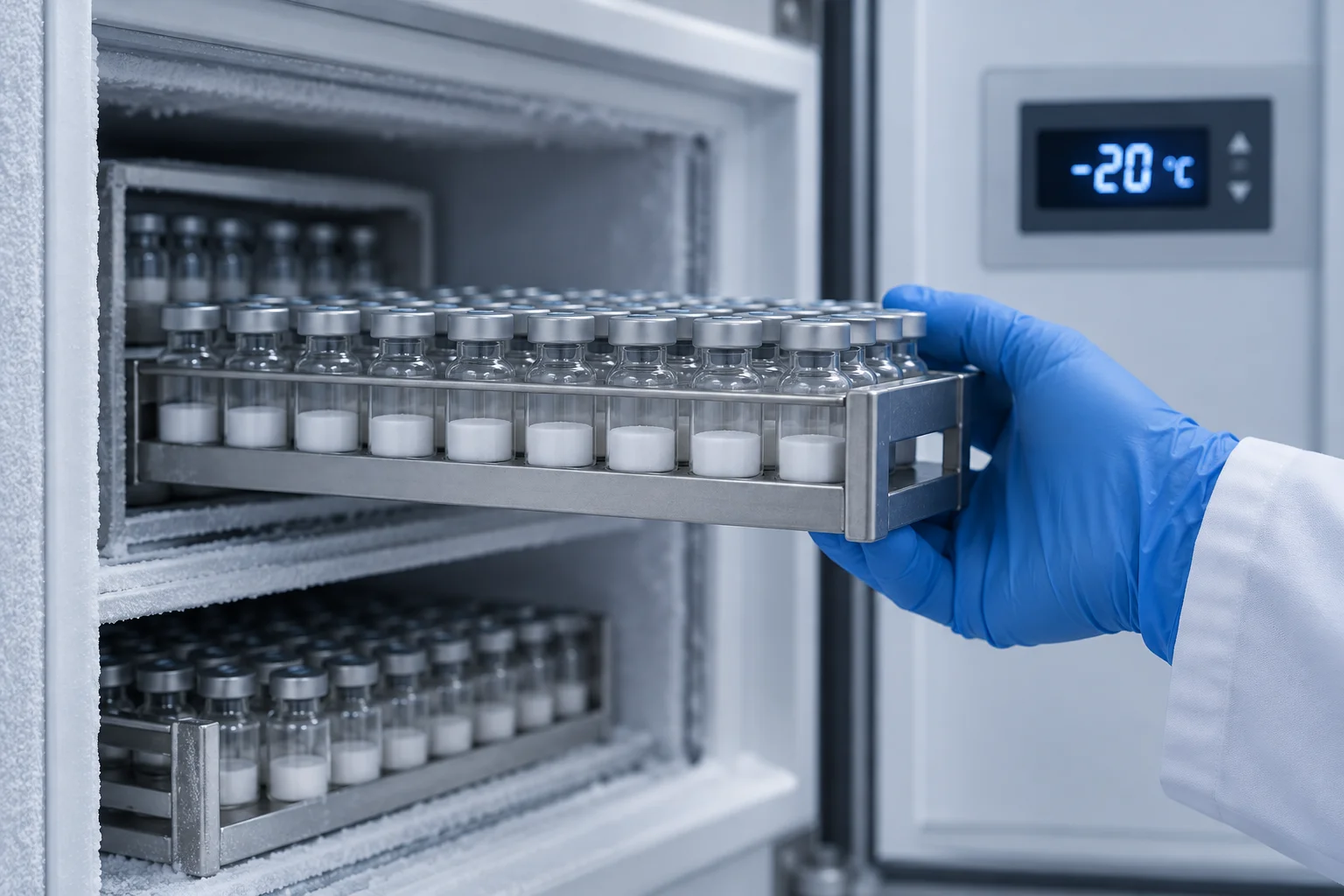
For temperature, humidity, and light in more detail, see our lyophilized peptide storage guide.
Frequently asked questions
What is lyophilized powder?
Lyophilized powder is a substance that has been freeze-dried: frozen, then dried under vacuum so the ice turns directly into vapor.1, 2 Research peptides are commonly stored this way and redissolved before use.
Why are peptides lyophilized?
Peptides are lyophilized because they are unstable in solution, where hydrolysis, deamidation, oxidation, and bacterial growth can degrade them.3, 5 Dry, most keep for several years at −20 °C.3
What is the importance of lyophilization?
Lyophilization can extend shelf life and make shipping easier by removing water. The actual storage period and need for temperature-controlled shipping depend on the product.1, 6 It is used for research peptides, assay reagents, and pharmaceutical products alike.
What are the benefits of lyophilized powder?
The main benefits are potentially longer shelf life, easier shipping, lower weight and volume, and preparing fresh solutions when needed. Shipping conditions remain product-specific, and solution concentration should use net peptide content.3, 4, 6
What is the major benefit of lyophilization over freezing?
Freeze-drying removes much of the water that can contribute to degradation. Some dry preparations tolerate short room-temperature exposure better than solutions, but both shipping tolerance and shelf life depend on the peptide and formulation.4, 8 It also avoids the damage that repeated freeze-thaw cycles cause.8
All peptides discussed here are for research use only.
Key Takeaways
- Lyophilized powder is freeze-dried material: frozen, then dried by sublimation under vacuum.
- Removing water slows hydrolysis, deamidation, oxidation, and bacterial growth in peptides.
- Stored dry, sealed, dark, and at −20 °C or colder, most lyophilized peptides keep for several years.
- Use shipping and storage conditions supported for the peptide; dry form alone does not establish ambient-shipping tolerance.
- Cake appearance, residual moisture, HPLC, and mass spectrometry confirm that freeze-drying preserved the peptide.
References
- US Food and Drug Administration. Guide to Inspections of Lyophilization of Parenterals (7/93). Inspection guide. fda.gov
- Labconco Corporation. A Guide to Freeze Drying for the Laboratory. Booklet (hosted by Thermo Fisher Scientific). thermofisher.com
- GenScript. Peptide Storage and Handling Guidelines. genscript.com
- Bachem. Handling and Storage Guidelines for Peptides. Knowledge center. bachem.com
- Sigma-Aldrich (Merck). Peptide Stability and Potential Degradation Pathways. Technical article. sigmaaldrich.com
- Cytiva. Advantages of Lyophilization. Knowledge center, December 2024. cytivalifesciences.com
- Thakral S, Sonje J, Munjal B, Bhatnagar B, Suryanarayanan R. Mannitol as an excipient for lyophilized injectable formulations. Journal of Pharmaceutical Sciences. 2023;112(1):19-35. doi:10.1016/j.xphs.2022.08.029
- Sigma-Aldrich (Merck). Handling and Storage of Synthetic Peptides. Technical guide. sigmaaldrich.com
- Ashkani EG, McKenna BD, Bryant JL, et al. Stability of multi-peptide vaccines in conditions enabling accessibility in limited resource settings. International Journal of Peptide Research and Therapeutics. 2024;30:42. doi:10.1007/s10989-024-10620-y
- Metrohm. Water in Lyophilizates (e.g., Vaccines in Sample Vials). Application note AN-K-004. metrohm.com
- Verified Peptides. Lab Reports (batch-specific third-party test reports). verifiedpeptides.com