
Short answer
Most cases of a peptide not dissolving can be predicted from the sequence. Overall charge and the share of hydrophobic residues decide which solvent and pH will work, so classify the peptide before adding any liquid. Charged, hydrophilic peptides usually dissolve in water or a mildly acidic or basic solution; hydrophobic or neutral peptides often need a small amount of organic solvent first, followed by slow dilution.
Looking for the general reconstitution workflow rather than troubleshooting? See how to reconstitute lyophilized peptides.
Quick Answer: Classify the Sequence Before You Add Solvent
Before opening the vial, estimate the peptide’s net charge and how hydrophobic it is. These two numbers usually predict peptide solubility better than size or molecular weight, and they tell you whether to start with water, a dilute acid, a dilute base, or an organic solvent.1, 2
- Count acidic groups. Give −1 to each Asp (D), Glu (E), and the free C-terminal carboxyl group.1, 3
- Count basic groups. Give +1 to each Arg (R), Lys (K), and the free N-terminal amine. Sigma-Aldrich counts His (H) as +1 below pH 6 and 0 above it.4
- Add them up. A negative total means an acidic peptide, a positive total a basic peptide, and zero a neutral peptide.5
- Estimate the hydrophobic share. Count Ala, Val, Leu, Ile, Phe, Trp, Met, and Pro (Pro counts toward hydrophobicity but also disrupts beta-sheet aggregation). Peptides with 50% or more hydrophobic residues may be insoluble in water.6
- Flag sensitive residues. Note any Cys, Met, or Trp, since they change which solvents are safe to use.2
As a rule of thumb, a strongly charged, hydrophilic peptide usually dissolves in sterile water, while a hydrophobic or neutral peptide often needs an organic co-solvent first. Thermo Fisher notes that peptides with more than 25% charged and less than 25% hydrophobic residues are usually water soluble, and GenScript that peptides shorter than six residues generally dissolve in pure water.1, 6
Volume matters too: many peptides that look insoluble are simply over-concentrated. And a cloudy or gel-like solution is a signal to change approach, not to add force or heat. Supplier guidance describes a gel, a cloudy liquid, or visible particles as a suspension rather than a true solution.4
How Charge and Hydrophobicity Drive Peptide Solubility
Charged side chains attract water and keep peptide molecules apart, while hydrophobic side chains avoid water and pull molecules together. The balance between the two, set by the sequence and the pH of the solvent, largely determines whether a peptide dissolves or aggregates.2, 7
Net charge depends on pH. The isoelectric point (pI) is the pH at which a peptide’s positive and negative charges cancel out. Near that pH the net charge is close to zero, and peptides with no net charge usually dissolve poorly in water and better in organic solvents.1 Moving the pH away from the pI adds charge back. That is why acidic peptides (net negative) tend to dissolve better in slightly basic conditions, and basic peptides (net positive) tend to dissolve better in slightly acidic conditions.2, 3 For how pH also affects chemical stability over time, see peptide stability under various pH conditions.
Why hydrophobic peptides aggregate
Hydrophobic side chains cluster together to avoid water, and these clusters link peptide molecules into aggregates.7 Aggregates scatter light, so they show up as a slight haze, floating particles, or a gel even when the peptide is chemically intact. Gel-like aggregates often form when the peptide shifts into a beta-sheet structure, in which neighboring chains line up in an ordered, water-resistant stack.7
Length adds risk. Longer sequences have more sites for chains to stick to each other, and higher concentrations bring molecules closer together, so a long or beta-sheet-prone peptide can aggregate even when its charge looks favorable.7 Changes in pH, temperature, and ionic strength can also increase the tendency to aggregate.7 Dispersed proline residues tend to break up secondary structure and can improve solubility.2 To confirm whether haze is aggregation, see methods for characterizing peptide aggregation.
A Simple Solvent Decision Path
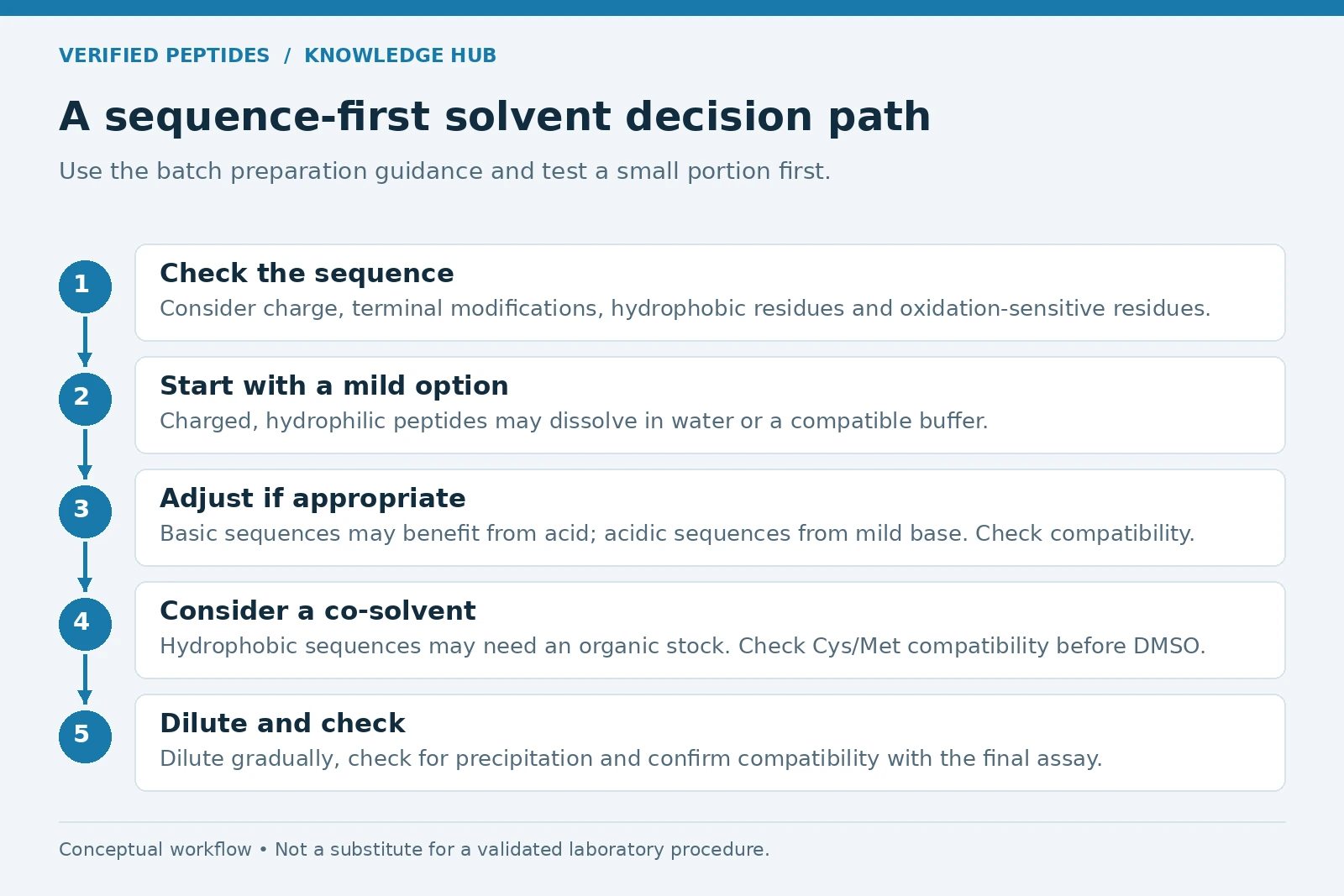
Start with the mildest solvent likely to work, and step up only if it fails. Dissolve the peptide completely in the smallest effective volume of the strongest solvent you need, then dilute slowly, rather than pouring more water onto a stubborn powder.2, 4
Test a small portion first, not the whole vial. Alta Bioscience suggests that about 1 mg is usually enough for a solubility test, and volatile solvents are easier to remove by freeze-drying if the first choice fails.3
- 1Try sterile water for charged, hydrophilic peptides. Add water, swirl gently, and allow time; Bachem notes reconstitution can occasionally take up to several hours.2
- 2Raise the pH slightly for acidic peptides. Add a small amount of dilute base, then dilute with water. Published starting points include 0.1 M ammonium bicarbonate (Sigma-Aldrich), 0.1% aqueous ammonia (Bachem), and 0.5% ammonium hydroxide (Alta Bioscience).2, 3, 4
- 3Lower the pH slightly for basic peptides. If water fails, add a small amount of acetic acid (sources suggest 10% to 30%; Sigma-Aldrich gives 25%), followed by dilution with water.1, 3, 4
- 4Use an organic solvent for hydrophobic or neutral peptides. Dissolve first in a minimal volume of DMSO, DMF, acetonitrile, or acetic acid, then dilute into the working buffer.2, 4
- 5Dilute slowly, then add buffer last. Add the concentrated solution dropwise into water or buffer with gentle, constant mixing, and stop if precipitate appears. Salts in buffers can cause aggregation, so add buffer only once the peptide is fully dissolved.4, 8
When to use DMSO and how much
DMSO (dimethyl sulfoxide) is useful for very hydrophobic peptides that do not contain cysteine or methionine. Add a small amount of high-purity DMSO until the peptide dissolves, then slowly add water or buffer with gentle mixing.3 GenScript gives a starting point of 50 to 100 µl of DMSO per 1 mg of peptide.1
Keep the final DMSO fraction as low as possible. High concentrations of organic solvents are incompatible with cell-based systems, and DMSO is difficult to remove by drying.2, 3 In Sigma-Aldrich’s protocol for peptide sets, DMSO or DMF stocks are diluted slowly with water to about 10% (v/v) organic solvent.4 This is an intermediate stock dilution that aids dissolution, not a final assay concentration; cell-based assays typically need far lower final organic solvent levels, so confirm the tolerance for your system. Prepare a concentrated stock and dilute in stages. For a fuller guide to organic solvents, see hydrophobic vs. hydrophilic peptides: choosing solvents.
Avoid DMSO for cysteine- or methionine-rich peptides: Sigma-Aldrich describes these residues as unstable in DMSO, and Alta Bioscience notes that DMSO promotes disulfide formation in cysteine peptides and suggests DMF instead.3, 4
Troubleshooting by Sequence Type
Each sequence type has its own likely failure and fix. Find the closest row, and try the first approach before the backup.
| Sequence type | How to spot it | First approach | If it still will not dissolve |
|---|---|---|---|
| Hydrophilic, highly charged | Many Asp, Glu, Arg, Lys; few hydrophobic residues | Sterile water, gentle swirling6 | Check for over-concentration or counterion effects; add more volume |
| Basic | Net charge above zero | Water, then a small amount of acetic acid, then dilution1 | Small volume of organic solvent, then slow dilution |
| Acidic | Net charge below zero | Water, then a little dilute ammonium bicarbonate or ammonia2, 4 | Small volume of organic solvent; avoid high pH if Cys is present |
| Hydrophobic or neutral | Net charge near zero, or about half or more hydrophobic residues | Minimal DMSO, DMF, or acetonitrile, then staged dilution4 | Bath sonication; chaotropes such as urea or guanidine only if the assay tolerates them2 |
| Cys, Met, or Trp present | Any of these residues | Degassed, oxygen-free solvent; avoid DMSO with Cys or Met2, 4 | DMF instead of DMSO; acidic, degassed buffer for free Cys3, 9 |
| Long or aggregation-prone | Long chains, beta-sheet-prone stretches | Dissolve at low concentration first7 | Concentrate later if needed; confirm aggregation analytically |
Hydrophilic peptides that resist water are usually over-concentrated, or the counterions in the powder are shifting the pH. Peptides supplied as trifluoroacetate salts with many Arg and Lys residues tend to be soluble at neutral pH.2 Counterions are covered in acetate and other counterions.
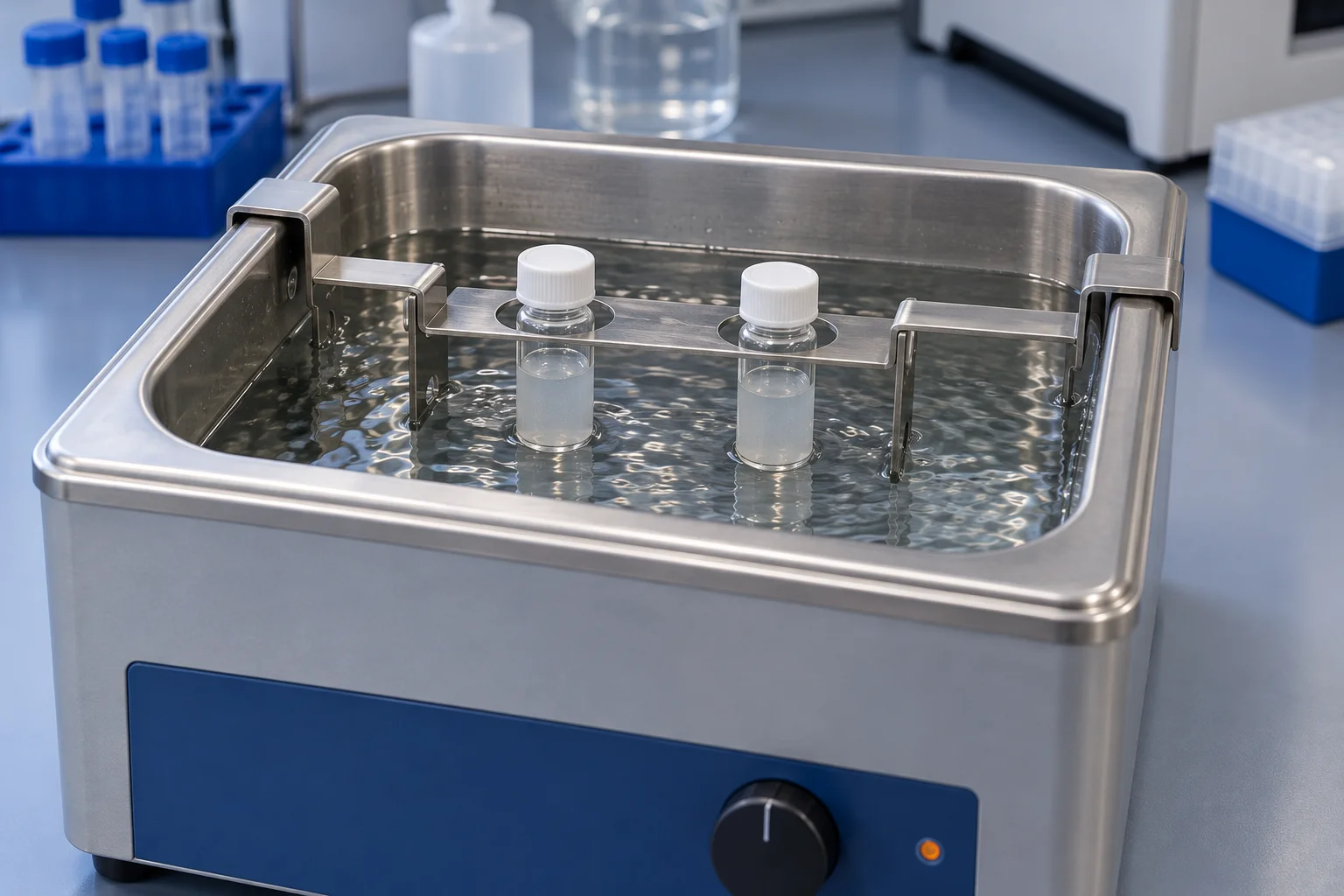
Hydrophobic peptides usually need an organic co-solvent and staged dilution. Several minutes in a water bath sonicator, rather than a probe, can speed up the dissolution of larger particles.2 Sigma-Aldrich advises sonicating before moving to a stronger solvent, to confirm the peptide really is insoluble.4
Acidic and basic peptides usually respond to a small pH nudge in the direction that adds charge: up with dilute base for acidic sequences, down with dilute acid for basic ones.3 Sigma-Aldrich advises avoiding pH above 8 where possible.4
Cysteine, methionine, and oxidation-sensitive sequences
Peptides containing Cys, Met, or Trp need extra care because oxidation can create insoluble products that look like a solubility failure.2
Sulfur-containing Met and Cys are particularly prone to oxidation, and cysteine thiols can link into disulfide bonds between molecules, forming aggregates; disulfide exchange can also scramble existing bonds.7 Bachem notes that free thiols oxidize rapidly to disulfides above pH 7 and recommends carefully degassed acidic buffers, while GenScript advises against ammonium hydroxide for Cys peptides.1, 2 Use freshly prepared, degassed solvents, limit air in the vial headspace, or purge with nitrogen or argon.3, 10 Keeping the material cold and out of direct light during handling is a sensible extra precaution. A cloudy solution here may reflect chemical change, not just a poor solvent choice.
Handling Errors That Mimic True Insolubility
Many peptides that seem not to dissolve are actually victims of handling. Rule these out before blaming the sequence or the batch.
- Opening a cold vial. Moisture condenses on cold powder and can cause clumping. Let the vial reach room temperature, ideally in a desiccator, before opening.2, 3
- Powder stuck above the liquid. Lyophilized material can cling to the vial wall or stopper. A brief spin or gentle tap collects it at the bottom before solvent goes in.11
- Aggressive vortexing. Vigorous mixing causes foaming and makes the solution hard to judge. Gentle swirling, slow pipetting, or bath sonication is usually enough.2, 11
- Over-concentrating for convenience. This is a common, avoidable cause of a hazy solution, since crowded molecules aggregate faster.7
- Forcing it with heat. Sources differ: Alta Bioscience lists gentle warming as a useful tactic, while Bachem advises avoiding excessive warming. Adjusting pH or concentration is usually the safer first move.2, 3
- Assuming the label weight is all peptide. Lyophilized powder also holds water and counterions, so its net peptide content is lower than the vial weight.12
The stock concentration calculator works out volumes from the net amount of peptide.
A Short Reconstitution Checklist
Use this checklist at every reconstitution, and record what worked for the next lot of the same sequence.
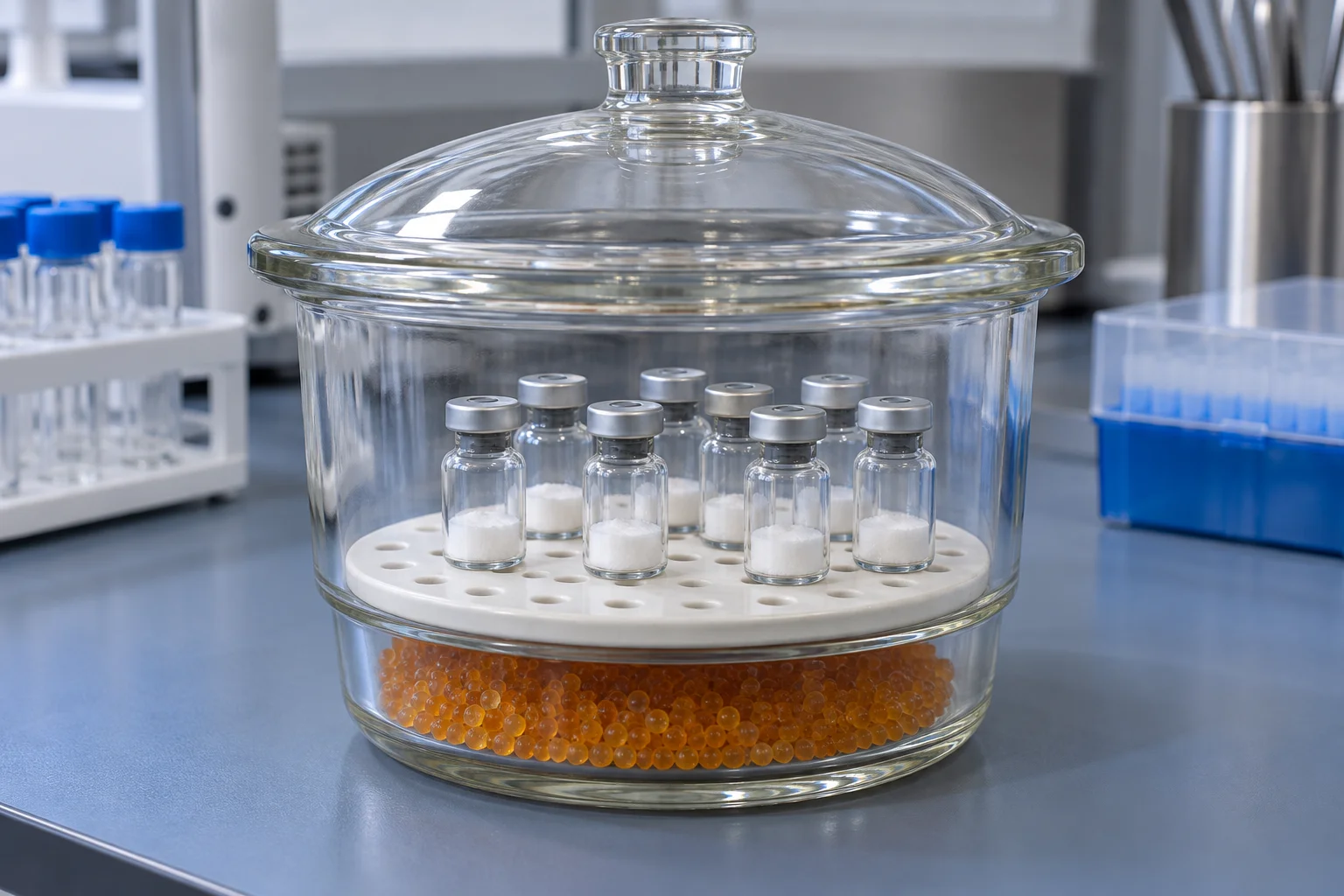
- Let the vial reach room temperature before opening.2
- Estimate net charge and the share of hydrophobic residues from the sequence.
- Choose the mildest solvent likely to work and a reasonable volume; GenScript suggests stock solutions of around 1 to 2 mg of peptide per mL.1
- Add solvent down the vial wall, then swirl gently; use bath sonication if needed.
- If the solution is cloudy, adjust pH or add a minimal co-solvent rather than heating or forcing it.
- Record the solvent, pH, concentration, mixing method, time to clear, and appearance for the next batch of the same sequence.
Keep those notes with the lot number so a one-off fix becomes a reproducible protocol. If storage is necessary, use a buffer and pH compatible with the peptide and assay, divide the solution into single-use aliquots, and follow the preparation’s storage guidance. Avoid repeatedly thawing the same aliquot.3, 10
Frequently Asked Questions About Peptide Solubility
Why won’t my peptide dissolve in water?
The sequence is likely hydrophobic or close to its isoelectric point, or the solution is over-concentrated. Classify the sequence, then try a larger volume or a mild pH shift before a stronger solvent.
How do you dissolve a hydrophobic peptide?
Dissolve it in a minimal volume of a stronger solvent such as DMSO or acetic acid, then dilute slowly into the working buffer while keeping the co-solvent fraction low.4
Does peptide sequence affect solubility?
Yes. Amino acid composition largely decides solubility: charged residues favor water, while a high share of hydrophobic residues favors aggregation.2
Why is my reconstituted peptide cloudy?
Cloudiness usually means aggregation, over-concentration, or a pH near the isoelectric point, and the peptide is suspended rather than dissolved. Adjust pH, volume, or co-solvent instead of heating or forcing it.4
Can you use DMSO to dissolve peptides?
Yes, for hydrophobic peptides: dissolve in a little DMSO, then dilute slowly.3
Is it safe to use DMSO on any peptide?
No. Avoid or minimize DMSO for cysteine- or methionine-rich peptides, and confirm that the final DMSO level suits the downstream assay.4
Does pH affect peptide solubility?
Yes. Acidic peptides tend to dissolve better slightly basic, basic peptides slightly acidic, and solubility tends to be lowest near the isoelectric point, where net charge is close to zero.1, 3
What pH helps acidic versus basic peptides dissolve?
A slightly raised pH, such as dilute ammonium bicarbonate, helps acidic peptides; a slightly lowered pH, such as a small amount of acetic acid followed by dilution, helps basic peptides.4
How much solvent should I use to reconstitute a peptide?
Start with enough for a workable stock; GenScript suggests around 1 to 2 mg of peptide per mL. If the solution stays hazy, add volume before changing solvents.1
Can over-concentration cause a peptide to look insoluble?
Yes, it is a common and avoidable cause. Reconstitute in a larger volume before concluding the material is insoluble.7
Does heating help dissolve a stubborn peptide?
Gentle warming sometimes helps, but excessive warming should be avoided. Adjusting pH, concentration, or solvent is usually the safer fix.2
All peptides discussed here are for research use only.
Key Takeaways
- Peptide solubility is largely predictable from net charge and hydrophobicity, so classify the sequence before adding any liquid.
- Start with the mildest solvent, nudge pH away from the isoelectric point, and use a minimal organic co-solvent only for hydrophobic or neutral peptides.
- Dissolve completely first, then dilute slowly; add buffer salts last.
- See cloudiness as a prompt to adjust volume, pH, or co-solvent, not to heat or force the solution.
- Oxidation-sensitive and aggregation-prone sequences need extra care and can mimic simple insolubility.
Write down what worked for each sequence; a documented protocol makes the next reconstitution reproducible.
References
- GenScript. Peptide Solubility Guidelines (technical PDF). genscript.com
- Bachem. Peptide Solubility. Knowledge center, July 2021. bachem.com
- Alta Bioscience. Peptide Storage and Solubility. altabioscience.com
- Sigma-Aldrich (Merck). Handling and Storage of Synthetic Peptides. Technical guide. sigmaaldrich.com
- Merck (MilliporeSigma). Synthetic Peptide Handling & Storage Protocol. Technical documents. merckmillipore.com
- Thermo Fisher Scientific. Peptide Design: Principles & Methods (Pierce protein methods). thermofisher.com
- Nugrahadi PP, Hinrichs WLJ, Frijlink HW, Schöneich C, Avanti C. Designing formulation strategies for enhanced stability of therapeutic peptides in aqueous solutions: a review. Pharmaceutics. 2023;15(3):935. PMC10056213
- R&D Systems (Bio-Techne). Peptides (technical information: solubility and storage). rndsystems.com
- Bachem. Handling and Storage Guidelines for Peptides. Knowledge center. bachem.com
- GenScript. Peptide Storage and Handling Guidelines. genscript.com
- Thermo Fisher Scientific. Reconstitution and Storage of Gibco PeproTech Recombinant Proteins (protocol flyer). thermofisher.com
- AAPPTec. Peptide Quality: Frequently Asked Questions. peptide.com