AOD-9604 Peptide (10MG)

This batch of AOD-9604 has been third party lab tested and verified for quality.

TESTED FOR:

TESTED FOR:

Original price was: $84.99.Current price is: $67.99.

Discount Quantity Price
0% 1 - 4 $84.99
10% Off 5 - 9 $76.49
15% Off 10 - 24 $72.24
25% Off 25 + $63.74
This product is in powder form and is not reconstituted. All products and materials sold on this site are not for human consumption and subject to our Terms and Conditions.

Bottle: vial - sealed - flip top
Vial size: 3ml
Form: powder (lyophilized)
Not reconstituted

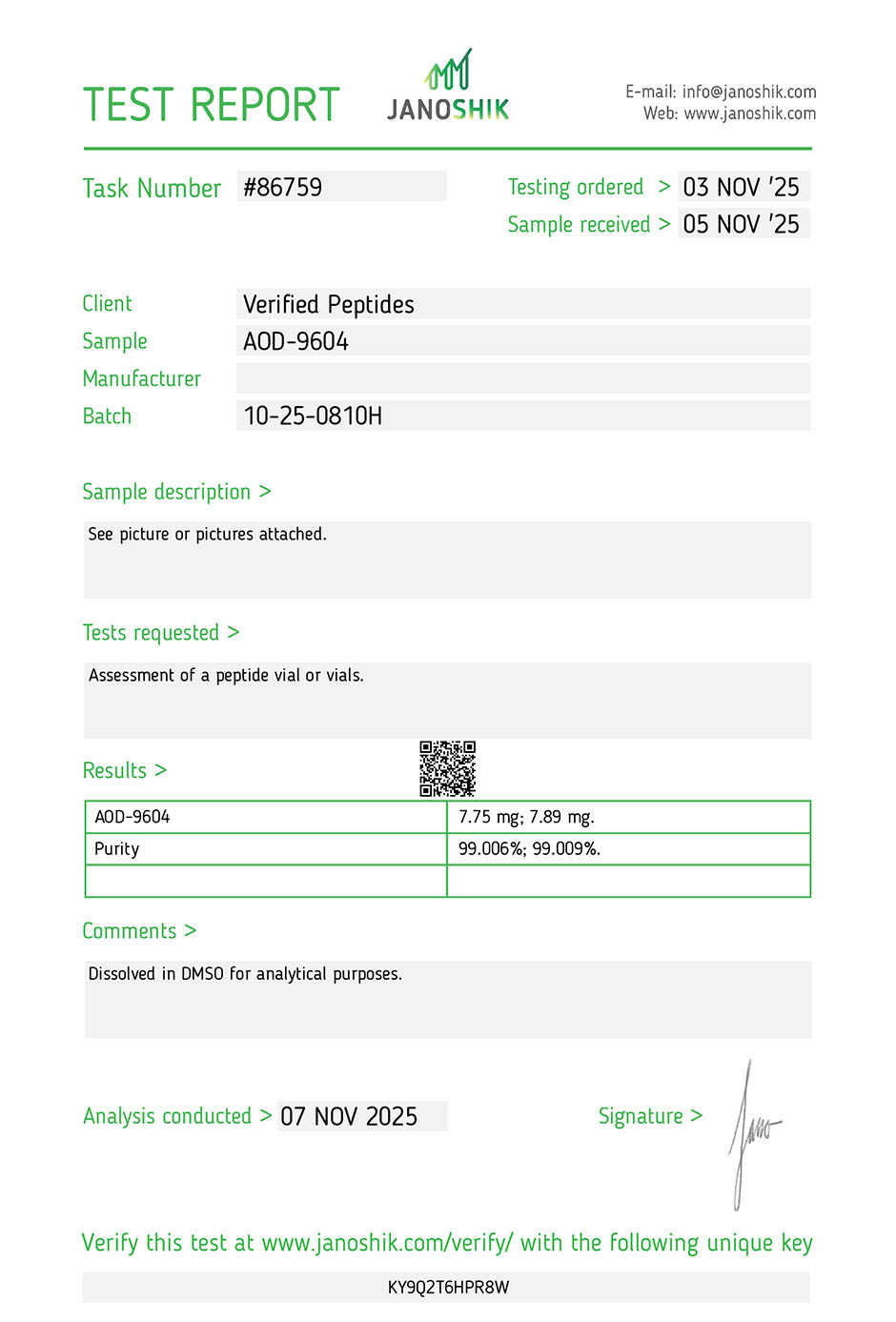
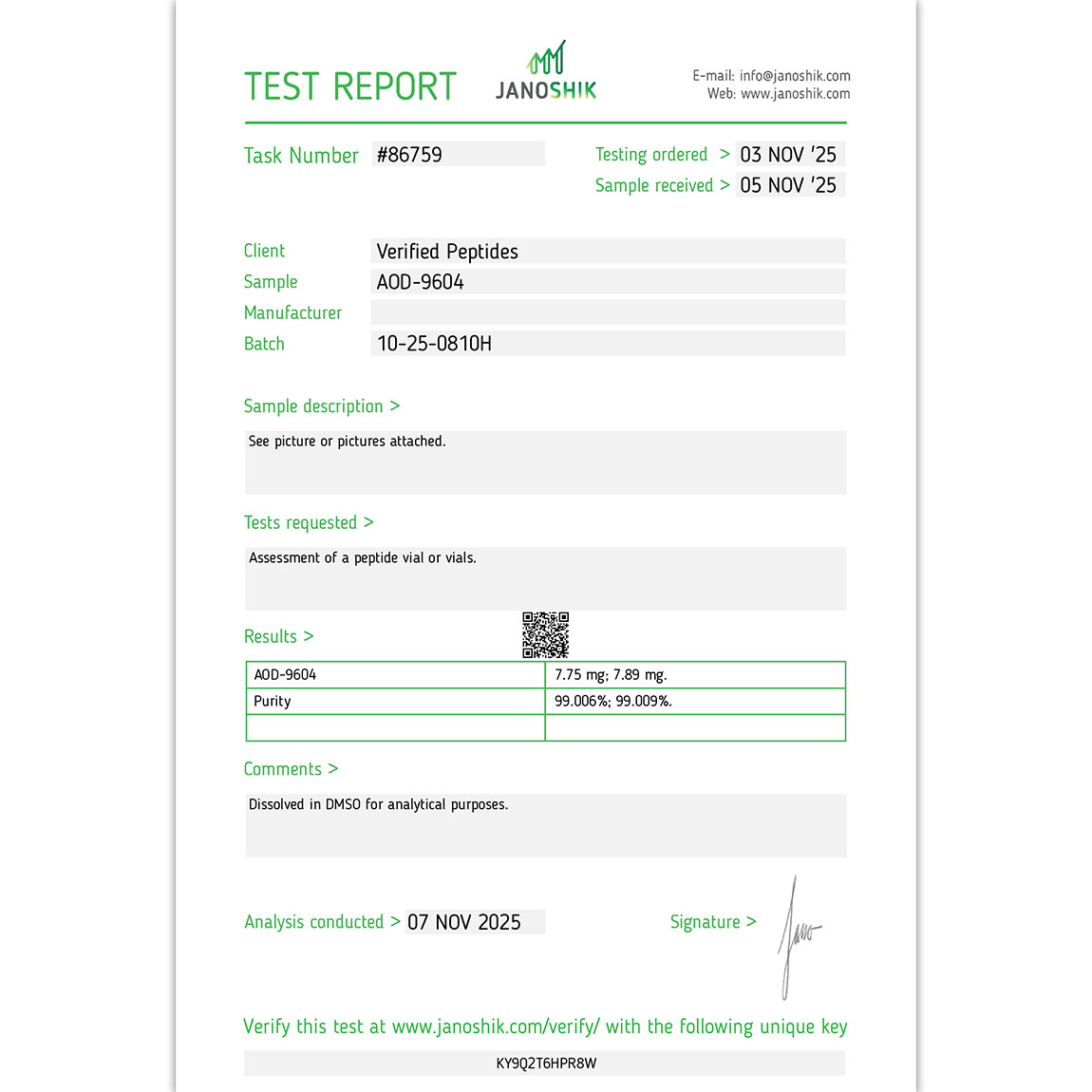
AOD9604 Test ResultsResults

AOD9604 Peptide Test results

Date Tested:

November 7, 2025

Purity:

99.006%

Weight:

7.75mg

Endotoxins (LPS):

Pass

Batch #:

10-25-0810H
Our peptides are tested by Janoshik analytical testing lab.
Certificates of Analysis

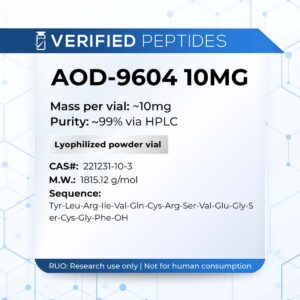
AOD-9604 Peptide Information

FORM

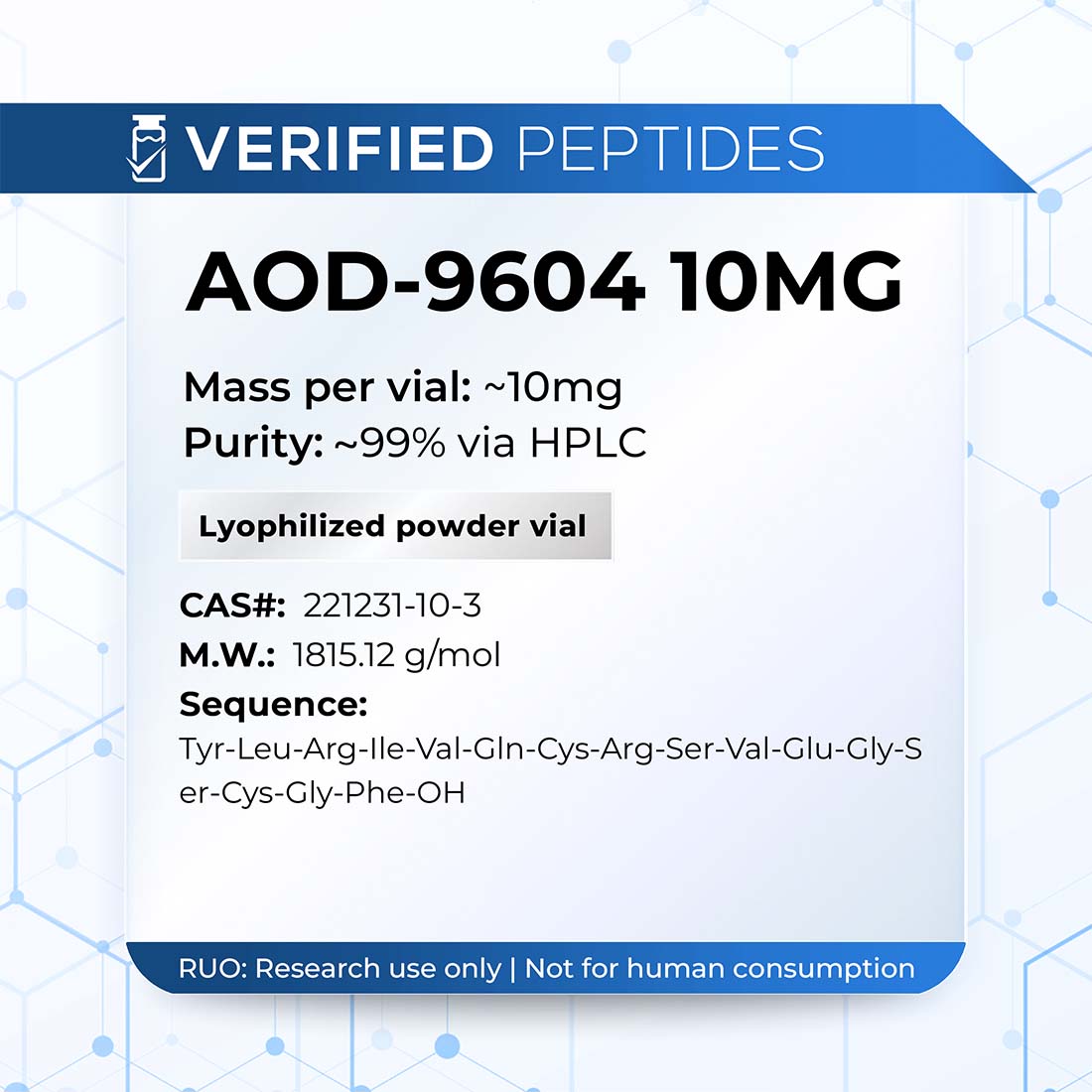
Powder (lyophilized)

CAS NUMBER

221231-10-3

SEQUENCE

 Tyr-Leu-Arg-Ile-Val-Gln-Cys-Arg-Ser-Val-Glu-Gly-Ser-Cys-Gly-Phe-OH

OTHER NAMES

WEIGHT

10mg

Molecular Weight

1815.12 g/mol

Terms

Subject to our Terms and Conditions. This material is sold for laboratory research use only. Not for human consumption, animal, or medical use.

Why isn’t there more information on AOD-9604 peptide?

Due to the legal landscape of peptides and research products, providing information that may imply anything beyond laboratory research use is a legal liability. We’re an expert biotechnology company that provides high quality peptides and products for purchase to advance scientific research in this field.

Lab technician professionals using Verified Peptides 99% pure peptides in a lab.

Why Choose Verified Peptides?

The industry's most trusted source for research peptides

The #1 Leader In Peptide Testing
300+ Certificates of Analysis

What does this mean for you? You can be sure we don't cut corners on testing every single batch.
Visit our Lab Reports page.

A Long Standing Trusted Company
5+ Years of Peptides

We pioneered third party lab testing and have stood the test of time. Our first lab report dates back to 2019 proving our track record.

The Best $/mg Prices At The Highest Quality

You won't find this degree of testing and quality at this price.

Peptides Tested For More Than Just Purity

We conduct an array of tests via HPLC and other methods for our peptides:
purity, weight, endotoxins(LPS),
sterility (bacteria & yeast), and TFA content. 

Transparency. Trusted. Reliable.

  • Batch number on every vial
  • Published Certificates of Analysis
  • Expert customer service
  • Satisfaction and quality guarantee
  • Cold pack styrofoam shipping
  • Secure credit card payment

Explore Other High-Purity Peptides
Original price was: $84.99.Current price is: $67.99.
$53.00
$119.00

Hear What Our Customers Say

Trusted by thousands of researchers for high-quality peptides

This is a first class operation. Quality products and the best customer service. There may be many similar type of companies out there, but this one is trusted and affordable. No price gouging! I highly recommend this company!
C
Patricia
Return customer

Verified Peptides is hands down my favorite website for these products. I can always count on the products to be legitimate and effective, all while being affordable. Will continue to give them my business.
C
Brandon C.
Return customer

Outstanding product, outstanding price, outstanding shipping

C
Shawn F.
Return customer

What is the AOD9604 Peptide?

AOD9604 is a synthetic fragment derived from the C-terminus of human growth hormone (hGH), specifically residues 177–191 with an N-terminal tyrosine modification. It was investigated for its lipolytic (fat-breaking) and antilipogenic (fat-storage preventing) activity. Prior in vitro and in vivo work linked this fragment to increased fat oxidation and lipolysis. Unlike full-length growth hormone, AOD9604 is designed to focus on metabolic effects related to fat metabolism without the broader growth-promoting effects of hGH, making it a subject of interest in obesity and metabolic research.

AOD9604 Research Studies

Peer review research studies

🔬 Animal Study

AOD9604 and hGH in Mice: Reduced Fat Without Less Eating

Study Objective and Why It Matters

This study tested whether chronic administration of AOD9604 or human growth hormone (hGH) could alter body weight, fat mass, and β3-adrenergic receptor (β3-AR) expression in obese versus lean mice. The research also probed β3-AR's role using β3-AR knockout mice and acute energy-expenditure tests. The significance lies in understanding whether AOD9604 can reduce fat mass without requiring caloric restriction—a key question for metabolic research and potential therapeutic applications.

How the Mouse Studies Were Designed

Species and Models: Lean C57BL/6J mice, obese (ob/ob) mice, and β3-adrenergic receptor knockout (β3-KO) mice. Chronic Dosing Protocol:
  • AOD9604 administered intraperitoneally at 250 µg/kg/day
  • hGH administered at 1 mg/kg/day
  • Treatment duration: 14–28 days depending on cohort
  • Daily administration via intraperitoneal injection
Acute Testing Protocol:
  • Single AOD9604 dose: 2 mg/kg
  • β3-AR agonist BRL37344: 250 µg/kg (for comparison)
  • Indirect calorimetry measurements performed
Measured Outcomes: Body weight, food intake, white adipose tissue (WAT) and brown adipose tissue (BAT) weights, plasma glycerol levels (indicating lipolysis), and β3-AR mRNA expression in adipose tissue.

Key Findings (Chronic): Fat Loss Without Eating Less

Lower Body Weight and Adipose Tissue in Obese Mice In ob/ob mice, both AOD9604 and hGH decreased body weight and epididymal white adipose tissue mass (AOD9604 by approximately 28%, hGH by approximately 40%). Brown adipose tissue mass also decreased. Importantly, these changes occurred without reductions in food intake—a remarkable finding suggesting the effects were metabolic rather than appetite-related. β3-Adrenergic Receptor Expression Rose with Treatment AOD9604 and hGH increased β3-AR mRNA expression in both WAT and BAT, restoring the repressed β3-AR levels found in ob/ob mice toward levels seen in lean mice. This suggests enhanced lipolytic sensitivity under chronic treatment. Effects Depend on β3-AR for Chronic Fat Reduction In β3-KO mice, chronic AOD9604 and hGH did not reduce adiposity or body weight as they did in wild-type controls. Plasma glycerol changes were also blunted. This points to β3-AR's critical importance for the chronic fat-loss effects of these treatments.

Acute Metabolic Effects: Increased Energy Expenditure and Fat Oxidation

A single dose of AOD9604 acutely increased energy expenditure and fat oxidation while lowering glucose oxidation in wild-type mice—a pattern similar to the β3-AR agonist BRL37344. Remarkably, AOD9604 still increased energy expenditure and fat oxidation in β3-KO mice (while BRL37344 did not), indicating that AOD9604 has β3-AR-independent acute effects. This suggests multiple mechanisms of action beyond simple β3-AR activation.

Mechanism Snapshot

Chronic Mechanism: Upregulation of β3-AR expression in adipose tissue may underlie the enhanced lipolysis and reduced fat mass observed with long-term treatment. This β3-AR dependence was clearly demonstrated in the knockout model, where the absence of β3-ARs prevented fat reduction. Acute Mechanism: β3-AR-independent pathways likely contribute to the rapid increases in fat oxidation and energy expenditure. Notably, AOD9604 did not act as a direct β3-AR ligand in prior receptor assays, suggesting alternative signaling mechanisms are at play.

Positioning Within the AOD9604 Research Landscape

This study consolidates evidence that AOD9604 can reduce fat mass in obese mice without decreasing food intake—a critical distinction from simple caloric restriction. The research differentiates acute versus chronic actions and highlights receptor-level nuances (β3-AR dependent versus independent mechanisms). These findings reinforce the need for model-specific interpretation and further mechanistic work to understand the full therapeutic potential and limitations of AOD9604.

Important Clarity on Use and Dosing

  • All findings described here are from animal studies conducted in controlled laboratory settings.
  • "Dosing" refers exclusively to amounts used in mouse experiments and is not applicable to humans.
  • This summary presents preclinical research only and makes no claims about human use or therapeutic applications.

Conclusion

AOD9604 and hGH reduced adiposity in obese mice without lowering food intake. Chronic effects were linked to increased β3-adrenergic receptor expression in adipose tissue, while acute effects boosted energy expenditure and fat oxidation—even in the absence of functional β3-ARs. These results add valuable data to the body of AOD9604 studies exploring peptide-driven lipid metabolism in animal models, demonstrating both β3-AR-dependent and independent mechanisms of metabolic enhancement.

Frequently Asked Questions

What is the AOD9604 peptide and how is it related to hGH?

AOD9604 is a synthetic fragment derived from the C-terminal region of human growth hormone (residues 177–191 with N-terminal tyrosine). It was designed to retain the fat-metabolizing properties of hGH while minimizing broader growth-promoting effects.

Did AOD9604 reduce fat in mice without cutting calories?

Yes. Both AOD9604 and hGH reduced body weight and adipose tissue mass in obese mice without any reduction in food intake, suggesting the effects were metabolic rather than appetite-related.

What AOD9604 benefits were seen in animal models?

In animal models, AOD9604 demonstrated: reduction in white and brown adipose tissue mass, increased β3-AR mRNA expression in fat tissue, elevated plasma glycerol (indicating lipolysis), increased energy expenditure, and enhanced fat oxidation.

Why are β3-adrenergic receptors important in these AOD9604 studies?

β3-adrenergic receptors play a key role in regulating lipolysis and energy expenditure in adipose tissue. The chronic fat-reducing effects of AOD9604 were dependent on functional β3-ARs, as demonstrated by the lack of effect in β3-AR knockout mice.

How did acute AOD9604 change energy expenditure and substrate use?

A single dose of AOD9604 acutely increased energy expenditure and fat oxidation while decreasing glucose oxidation. Interestingly, these acute effects occurred even in β3-AR knockout mice, suggesting alternative, β3-AR-independent mechanisms.

What are the differences between acute and chronic AOD9604 effects?

Chronic effects (over 14-28 days) involved β3-AR upregulation and sustained fat mass reduction, requiring functional β3-ARs. Acute effects (single dose) included immediate increases in energy expenditure and fat oxidation that occurred independently of β3-ARs.

What metabolic readouts changed in these experiments?

Key metabolic changes included: increased plasma glycerol (lipolysis marker), elevated fat oxidation rates measured by indirect calorimetry, increased energy expenditure, decreased glucose oxidation, and upregulated β3-AR mRNA in adipose tissue.

How should findings from AOD9604 studies in mice be interpreted?

These findings represent preclinical research in animal models only. They demonstrate proof-of-concept for metabolic mechanisms but cannot be directly extrapolated to human applications. All dosing references apply exclusively to controlled laboratory experiments in mice.
📚 Study Reference
Heffernan MA, Thorburn AW, Fam B, et al. Increase of fat oxidation and weight loss in obese mice caused by chronic treatment with human growth hormone or a modified C-terminal fragment. Int J Obes Relat Metab Disord. 2001;25(10):1442-1449. doi:10.1038/sj.ijo.0801740
https://pubmed.ncbi.nlm.nih.gov/11673763/