
Short answer
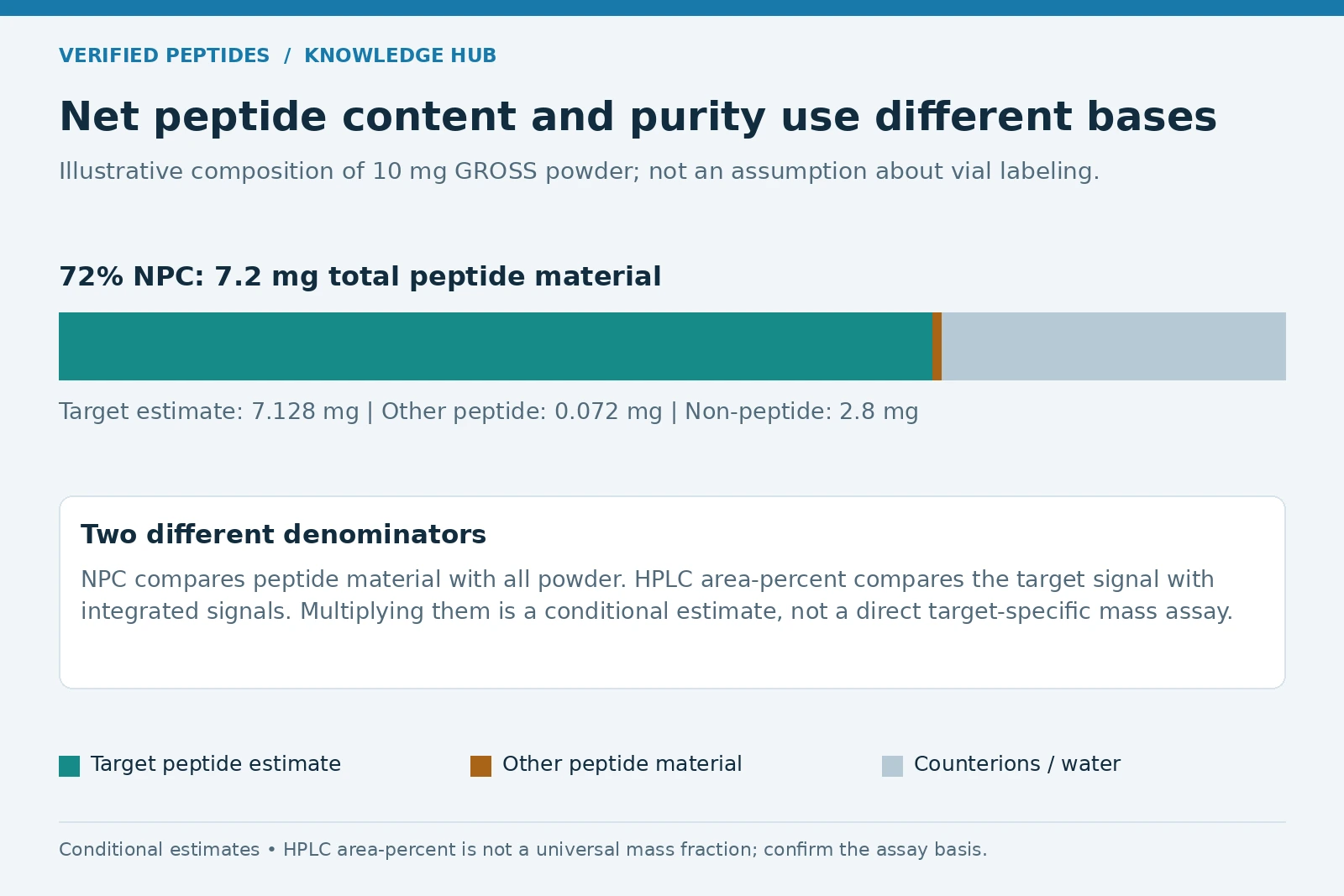
Purity tells you what share of the peptide material in a vial is the correct target sequence; net peptide content (NPC) tells you what share of the total powder weight is peptide at all. A batch can be 99 percent pure and roughly 72 percent net peptide content (illustrative figures), because the rest of the weight is counterions, bound water, and other non-peptide material. That means 10 mg of powder does not hold 10 mg of peptide, and a concentration calculated from gross weight will be too high.
Both figures belong on a complete certificate of analysis (COA); this guide shows how to read and use each one.
Quick Answer: Two Numbers, Two Questions
Peptide purity and net peptide content answer two different questions, so neither can stand in for the other. Purity asks, “Of the peptide material here, how much is the right sequence?” Net peptide content asks, “Of everything in this vial by weight, how much is peptide?”
Suppliers say the same thing in their own documentation. Tocris notes that a peptide quoted at 98 percent purity may have a net peptide content of only 70 percent,1 and AAPPTec describes peptide content and purity as two independent measurements.2
| Feature | HPLC purity | Net peptide content |
|---|---|---|
| Question it answers | How much of the peptide material is the target sequence? | How much of the powder weight is peptide? |
| Usual method | Reversed-phase HPLC with UV detection3 | Elemental (nitrogen) analysis or amino acid analysis4 |
| Counted as the “rest” | Peptide-related impurities | Counterions, water, and other non-peptide material |
| Includes peptide impurities? | No; they lower the figure | Yes; they count as peptide3 |
What Peptide Purity Measures
A peptide purity figure is the target peptide’s peak area as a percentage of all peak area in a reversed-phase HPLC chromatogram, usually read by UV detection. Bachem defines HPLC purity as the percentage of the requested peptide relative to all material absorbing at 220 nm, which includes the target, peptide by-products, and other impurities.5
That makes purity a comparison between the target sequence and peptide-related impurities, such as truncated and deletion sequences (see common peptide impurities). It leaves out anything that produces no peak: water and salt components cannot be detected by this method,6 so they do not lower the purity figure even though they add weight to the vial. Purity is commonly read at 210 to 220 nm.3
The method matters. USP <621> sets general chromatography requirements such as system suitability, resolution, and peak symmetry, and limits how far conditions like the gradient may be adjusted,7 and EMA’s peptide guideline addresses impurities that co-elute as one peak.8 The method should therefore be named on the COA. For more on reading chromatograms, see the role of HPLC in peptide characterization.
What Net Peptide Content Measures
Net peptide content is the percentage of the total powder weight that is peptide, as opposed to non-peptide material. Bachem defines it as the percentage of peptides relative to non-peptidic material, mostly counterions and moisture.3
In elemental (nitrogen) analysis, the nitrogen content is measured and compared with the value calculated from the sequence; because counterions such as acetate and trifluoroacetate and adhered water contain no nitrogen, the result reflects peptide content.4 In quantitative amino acid analysis (AAA), a strong acid breaks the peptide into its amino acids, which are then measured; AAA gives no sequence information.3
Net peptide content is not a purity measure. It counts peptide-related impurities as peptide, so Bachem notes that NPC and purity are not equivalent.3
Why the Numbers Differ: What Else Is in the Vial
Synthetic peptides are isolated as salts and hold moisture, so part of the weight is always non-peptide. Bachem describes the gross weight of a peptide sample as the weight of the peptide, counter-ions, and adhered water.5 Each item below lowers net peptide content without changing HPLC purity.
Counterions such as TFA and acetate
Trifluoroacetic acid (TFA) is used in cleavage and in reversed-phase HPLC purification, so peptides are very often obtained as TFA salts.9 The counterion pairs with positively charged groups: the N-terminal amino group and the basic residues arginine, histidine, and lysine.10 Bachem notes that TFA cannot be completely removed because of this salt formation.3
Sequences with many basic residues carry more counterion weight, so Bachem expects relatively low peptide content when a peptide contains a large proportion of basic amino acids, especially arginine.4 AAPPTec gives a simple theoretical case: a 1,000 Da peptide with two basic sites (for example, a free N-terminus plus one arginine) pairs with two TFA counterions of about 114 Da each, so counterions alone cap content at about 81 percent before any water is counted.2 Acetate or hydrochloride forms require an additional ion-exchange step.11 How to choose a salt form is covered in acetate and other counterions.
Bound water and hygroscopic peptides
Lyophilized peptides retain residual moisture and can take up more. Bachem notes that peptides tend to be hygroscopic and that absorbing atmospheric moisture reduces the overall peptide content,12 and that hydrophilic peptides can absorb considerable amounts of moisture.3 Water is measured separately, commonly by Karl Fischer titration.3
NPC can vary from batch to batch2 and can fall after a vial is opened in humid air. Bachem advises letting the container reach ambient temperature in a desiccator before opening and weighing quickly.12 Storage steps that limit moisture are in lyophilized peptide storage: temperature, humidity, and light.
Worked Example: Calculating True Peptide Mass
To find peptide mass, multiply gross weight by net peptide content; to find target peptide mass, multiply that result by purity. Bachem’s FAQ combines HPLC purity and NPC the same way for molar calculations.5 Figures are illustrative, for laboratory solution preparation.
- 1Start with gross weight 10 mg of lyophilized powder, as read on the balance.
- 2Apply net peptide content 10 mg × 0.72 = 7.2 mg of peptide material.
- 3Apply purity 7.2 mg × 0.99 = about 7.1 mg of target peptide.
- 4Compare with the nominal figure Dissolved in 1.0 mL, the solution holds about 7.2 mg/mL of peptide material, not 10 mg/mL.
If net peptide content is ignored, the solution is labeled 10 mg/mL while the true peptide concentration is 28 percent lower; put the other way, the labeled figure overstates the true value by about 39 percent. To prepare a solution containing 10 mg of peptide material at this NPC, about 13.9 mg of powder would be weighed (10 ÷ 0.72). Some suppliers correct for this at filling: Tocris supplies 1.43 mg of material per 1 mg of a 70 percent NPC peptide.1 Comparing prices on a peptide-mass basis is covered in cost per verified milligram.
How to Find Both Figures on a COA
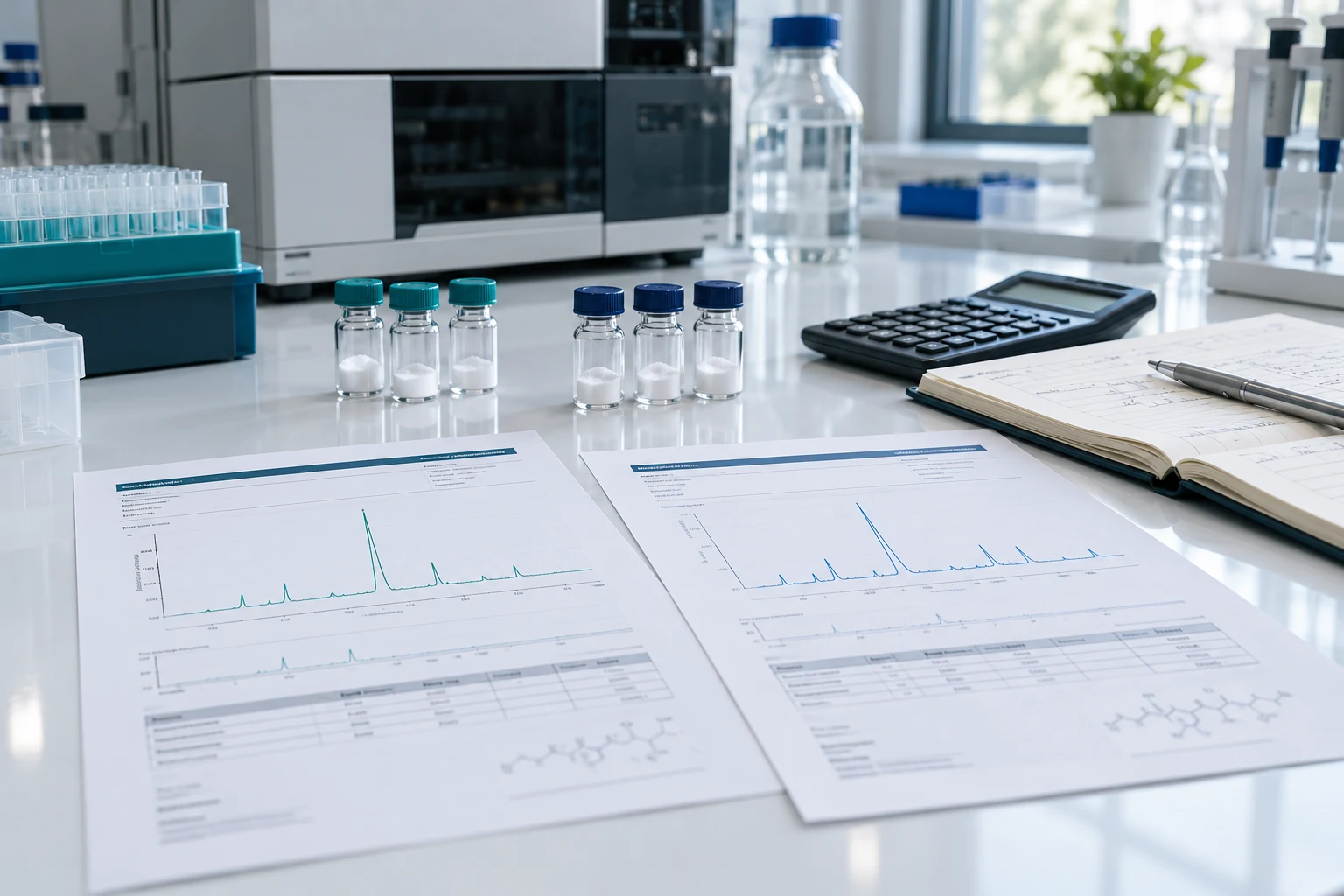
A complete COA shows purity with its HPLC method, identity by mass spectrometry, and net peptide content with its method. Check for:
- Purity (%) with the HPLC conditions: column, gradient, and detection wavelength
- Identity by mass spectrometry, with observed and expected mass
- Net peptide content (%) or measured peptide content (mg per vial) with the method (nitrogen analysis or amino acid analysis)
- Salt form (TFA, acetate, or hydrochloride) and, where given, counterion content
- Water content, commonly by Karl Fischer titration
- Fill basis: whether the stated vial weight is gross powder or net peptide
Some third-party reports state peptide content as a measured amount in milligrams per vial rather than as a percentage. When that result is the actual amount of the target peptide, use the reported mg directly: no additional NPC or HPLC purity multiplication is needed. The gross-powder worked example above is a different reporting format. For example, the Verified Peptides Lab Reports archive links each batch to third-party reports that give purity and the measured peptide content in milligrams, along with a numeric endotoxin result in EU per vial.13
If neither a measured peptide amount nor sufficient gross-weight and NPC data is reported, request lot-specific content data. A COA that already reports actual peptide content in mg per vial does not need an NPC percentage for that calculation. Missing content data limits what can be calculated; it does not by itself prove a defective sample. In pharmaceutical manufacturing, EMA’s guideline lists counter-ion content and water content as specification tests and expresses LC assay limits on a counter-ion-free, anhydrous basis unless otherwise justified.8 The full field checklist is in what a good peptide COA should include, and a side-by-side method is in how to compare two peptide suppliers using their COAs.
Frequently Asked Questions About Net Peptide Content
What is the difference between peptide purity and net peptide content?
Purity is the share of the peptide material that is the correct sequence, measured by HPLC; net peptide content is the share of total powder weight that is peptide. They answer different questions, and both belong on a COA.
Does 99 percent purity mean 99 percent peptide?
No. Purity describes only the peptide material; counterions and water can make up a large share of the weight, so a 99 percent pure batch might be about 72 percent peptide by weight (illustrative).
Why is net peptide content lower than purity?
Counterions and bound water add weight but are invisible to HPLC-UV purity measurement. Sequences rich in basic residues such as arginine and lysine carry the most counterion weight.
What is a normal net peptide content?
AAPPTec notes that net peptide content can range from about 50 to 90 percent, depending on purity, sequence, and method of synthesis and purification.2 Because it varies by peptide and salt form, the lot-specific figure is the one to use.
How is net peptide content determined?
By elemental (nitrogen) analysis or quantitative amino acid analysis.
Does a low net peptide content mean a peptide is low quality?
Not on its own. A highly pure peptide with many basic residues tends to have lower NPC, so quality is judged on purity, identity, and complete documentation together.
How do I use net peptide content when preparing a solution?
If the COA reports actual target-peptide content in mg per vial, use that amount directly to calculate concentration; do not multiply it by NPC or HPLC purity again. If the report gives NPC as a percentage of gross powder weight, multiply the known gross weight by that fraction (for example, 10 mg × 0.72 = 7.2 mg of peptide material).
Can counterions be removed to raise net peptide content?
TFA can be exchanged for acetate or hydrochloride by an ion-exchange step, which may change net content. Some counterion typically remains, because peptides are isolated as salts and TFA cannot be completely removed.
Is net peptide content listed on a certificate of analysis?
On a complete COA, yes, with the method used. If it is missing, that is a documentation gap to raise with the supplier, not proof of a product defect.
All peptides discussed here are for research use only.
Key Takeaways
- Purity measures sequence correctness among the peptide material; net peptide content measures the peptide share of total weight.
- Counterions and water explain most of the gap; basic and hydrophilic peptides tend to have lower NPC.
- Use COA-reported actual target-peptide mg directly. The gross-weight × NPC calculation applies to percentage-based reporting; any additional purity adjustment belongs only to a justified estimate, not an already measured target-peptide amount.
- Use the lot’s measured peptide mg for solution calculations when available. If content is reported as an NPC percentage instead, confirm the gross powder mass and calculation basis.
- Figures here are illustrative and apply to laboratory research materials; the lot-specific COA value is the one that counts.
References
- Tocris Bioscience (Bio-Techne). Peptides (technical information: net peptide content). rndsystems.com
- AAPPTec. Peptide Quality: Frequently Asked Questions. peptide.com
- Bachem. Quality Control of Amino Acids and Peptides: A Guide. Knowledge center. bachem.com
- Bachem. What does net peptide content mean? FAQ. bachem.com
- Bachem. What does HPLC purity mean? FAQ. bachem.com
- Iris Biotech GmbH. Net Content and Purity, Two Key Parameters in Peptide Synthesis. April 2025. iris-biotech.de
- United States Pharmacopeia. Notice of Adoption of Harmonized Standard: <621> Chromatography (official December 1, 2022; system suitability, peak symmetry, resolution, and allowed adjustments including gradient elution). usp.org
- European Medicines Agency. Guideline on the Development and Manufacture of Synthetic Peptides (EMA/CHMP/CVMP/QWP/367182/2025; effective 1 June 2026), sections 4.4.1, 4.4.2, 4.4.5, 4.7.1. ema.europa.eu
- Iris Biotech GmbH. Conversion of TFA Salts. August 2026. iris-biotech.de
- Sikora K, Jaśkiewicz M, Neubauer D, Migoń D, Kamysz W. The role of counter-ions in peptides: an overview. Pharmaceuticals. 2020;13(12):442. PMC7761850
- Bachem. TFA (trifluoroacetic acid) FAQ. bachem.com
- Bachem. Handling and Storage Guidelines for Peptides. Knowledge center. bachem.com
- Verified Peptides. Lab Reports (batch-specific third-party test reports). verifiedpeptides.com