

Short answer
You can compare two peptide suppliers from their COAs alone by reading six fields side by side: batch match, purity and its method, identity by mass, net peptide content, additional tests, and who ran the analysis. A peptide certificate of analysis complete on all six documents more than one reporting a single purity figure. Either way, a COA describes one tested batch, not every vial a supplier will ship.
New to COAs? Start with what a certificate of analysis is, then come back for the comparison method.
Quick Answer: The Six COA Fields That Separate Two Suppliers
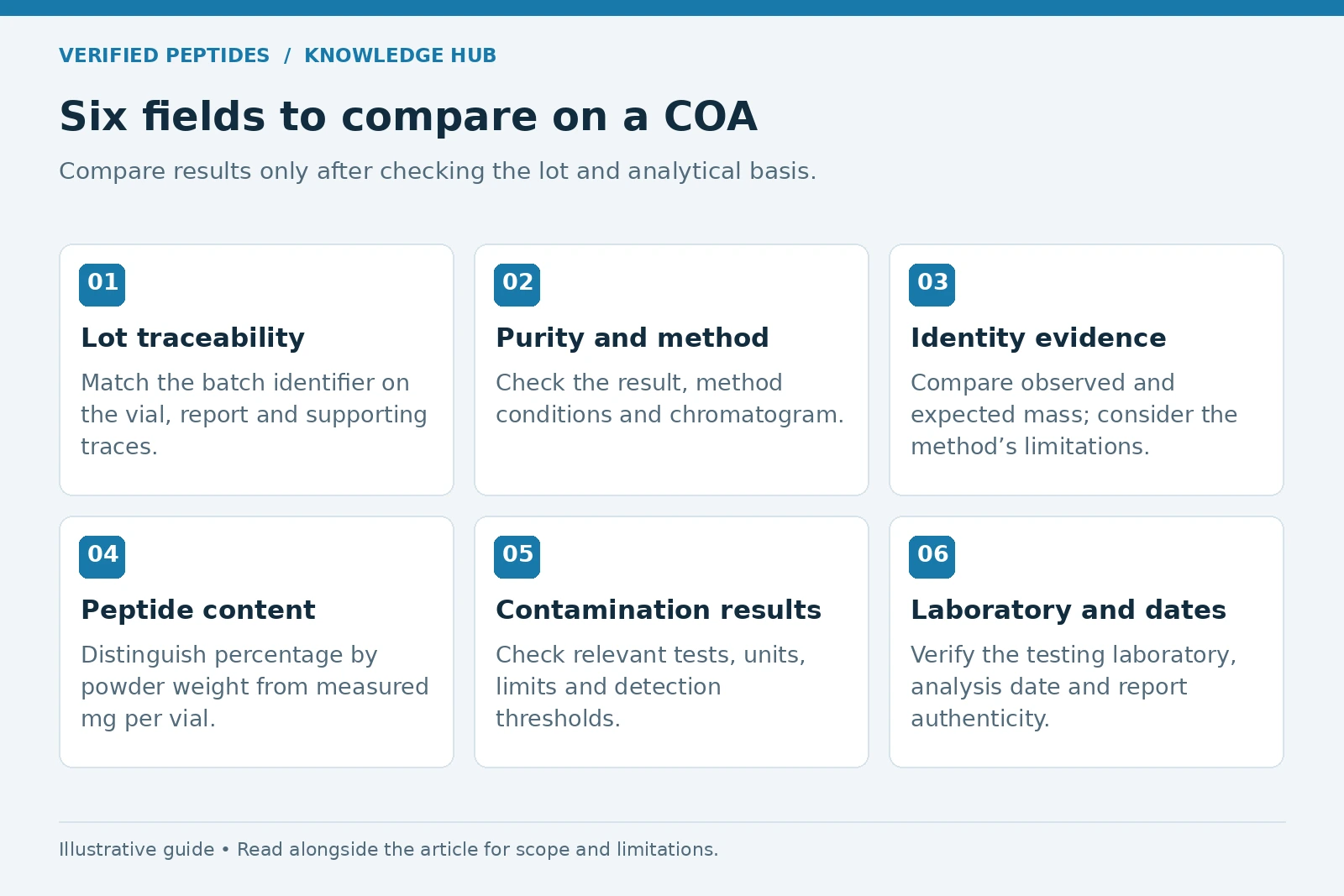
Six fields carry most of the comparison value:
- Batch match: a lot number matching the batch supplied.
- Purity and method: the HPLC result with its method and chromatogram.
- Identity: mass spectrometry confirming the expected compound.
- Net peptide content: how much of the powder is peptide at all.
- Additional tests: such as water, residual solvents, or endotoxin.
- Testing laboratory: who ran the analysis, and under what accreditation.
Purity without identity leaves open what the compound is, and identity without net content leaves open how much of the vial is peptide. A missing field is information: equal purity figures are not equivalent if only one COA confirms the mass. This is document review, not your own qualification of the material. For every field one certificate should carry, see the 12 non-negotiables of a good peptide COA.
Field 1: Does the COA Belong to the Batch Being Sold?
A COA is evidence only for the lot it names, so check that its batch number matches the vial or the batch on the product page. GMP guidance for active pharmaceutical ingredients (APIs) expects a certificate per batch, showing the batch number and release date.1
Next, check that the analysis date follows the manufacture date; a certificate dated before the batch it covers is a mismatch worth asking about. A “representative” or “typical” COA shows what the supplier usually achieves, which is weaker evidence than one tied to the vial in hand (see batch-specific COAs vs generic PDFs).
If a supplier cannot produce a certificate for the batch it is shipping, this field is decided. Some suppliers publish COA libraries searchable by lot number.2
Field 2: The Purity Result and the Method Behind It
A purity percentage is only interpretable alongside its method, detection wavelength, and chromatogram. Synthetic peptides are usually analyzed by reversed-phase HPLC with UV detection at 210 to 220 nm, reporting the main peak area as a percentage of total peak area.3
Area percent counts only material that absorbs at the detection wavelength4; anything that does not absorb there, or does not elute under the method conditions, is missed. So 99% from one method is not automatically better than 98% from another with a longer gradient and a visible chromatogram. Validation shows a method can measure the peptide in the presence of expected impurities (specificity).5 In one published evaluation, 43 of 98 peptides (44%) met their stated purity of at least 95% when the researchers ran their own quality control, and the authors judged one supplier’s method to lack selectivity.6
What the Chromatogram Itself Tells You
A figure with no trace is a claim; a trace is evidence. Check that each COA includes one and states method conditions, then look for a stable baseline, a reasonably symmetric main peak, a stated retention time, and shoulders or small peaks close to the main peak. Pharmacopeial standards check resolution and peak symmetry for the same reason.7 Close neighbors are often related impurities (see common peptide impurities and the role of HPLC in peptide characterization).
Field 3: Identity Confirmation, Not Just Purity
Purity says how much of the sample is one compound; identity says which compound, and it comes from a different test. Identity is usually confirmed by mass spectrometry, commonly LC-MS (liquid chromatography coupled to MS) or MALDI-TOF (a laser-based MS method), which compares the observed mass with the theoretical mass calculated from the sequence.3, 8
A purity-only COA does not rule out a pure but incorrect compound: in the same evaluation, mass spectrometry showed that one peptide’s main peak had a different structure from the requested sequence.6 Compare whether each certificate reports a mass spectrum, or at least observed and expected mass values.
Check the theoretical mass against the published molecular weight; a transposed digit is easy to spot and hard to explain. Before calling a mismatch, note that monoisotopic and average mass differ by roughly 0.06% for peptides,9 so a certificate should say which it reports.
Field 4: Net Peptide Content and What Is in the Rest of the Vial
Net peptide content (NPC) states what fraction of the lyophilized powder is peptide; the rest is mostly counterions, such as trifluoroacetate, acetate, or hydrochloride, and moisture.3 It is a separate measurement from purity.10 As an illustrative example, a batch can be 99 percent pure and roughly 72 percent net peptide content, so 10 mg of powder holds about 7.2 mg of peptide material.
Water content (commonly by Karl Fischer titration) and counterion content (by methods such as ion chromatography) make the figure interpretable.3
NPC is often absent from a weak COA, so it is a strong differentiator. Check that each certificate reports it as its own assay (for example, amino acid analysis or elemental nitrogen), not folded into purity. See net peptide content vs purity. Some reports state the actual peptide amount in milligrams per vial instead of an NPC percentage. This also documents content. Use the measured target-peptide mg directly in quantity or price calculations without multiplying by NPC or HPLC purity again. Compare reports on the same basis.
Field 5: What Else Was Tested
Additional tests widen the picture, and which matter depends on the application. Common fields are water content, residual solvents, appearance, sterility where claimed, and bacterial endotoxin (commonly under USP <85>).11
More tests signal a fuller analytical program, but a missing test is not a defect if irrelevant to the compound. These results describe material properties only, not suitability for any use. Compare breadth and relevance, not the number of lines.
Field 6: Who Ran the Analysis
A third-party result is generally stronger evidence than an in-house one, because the lab has no stake in whether the batch passes, and an accredited lab is stronger still (see in-house vs third-party lab testing).
ISO/IEC 17025 sets requirements for the competence, impartiality, and consistent operation of testing laboratories,12 and accreditation bodies such as ANAB assess labs against it.13 Accreditation is method-scoped: the scope of accreditation lists the specific test methods covered, and data outside it should be identified as such,14 so a lab can be accredited for some tests on a certificate and not others.
Traceability comes from the lab name and address, a report number, and a dated reviewer signature. When a distributor reissues a certificate, GMP guidance expects it to name the testing lab and refer to the original batch certificate.1 Some labs also print an online verification key so anyone can confirm the report with the issuing lab. As one example, the Verified Peptides Lab Reports archive links each batch to third-party reports that carry a report number, testing dates, a signature, and a verification key.15 Compare whether each document can be traced back to its issuing lab at all.
Putting It Together: A Side-by-Side Comparison Approach
List the six fields down the left, the two suppliers across the top, and mark each cell present, partial, or absent. The entries below are illustrative.
| COA field | Role | Supplier A | Supplier B |
|---|---|---|---|
| 1. Batch match | Gate | Present | Present |
| 2. Purity and method | Differentiator | Present | Partial (figure only, no trace) |
| 3. Identity by mass | Gate | Present | Present |
| 4. Net peptide content | Differentiator | Absent | Present |
| 5. Additional tests | Differentiator | Partial (water only) | Present |
| 6. Testing laboratory | Differentiator | Present (third-party) | Partial (in-house) |
Batch match and identity are pass-or-fail gates; a certificate failing either is weak evidence. The other four fields separate documents that both pass.
One supplier rarely wins every field, so decide which gaps your application can accept. If the documents tie, send both suppliers the same follow-up request (say, the chromatogram or NPC result for the shipped lot) and compare the answers.
Red Flags That End the Comparison Early
These document gaps end the comparison before the grid is finished:
- No batch or lot number, or a number that does not match the product.
- A purity figure with no method, no chromatogram, and no analysis date.
- No identity confirmation of any kind.
- A theoretical mass that does not match the molecular weight for the sequence.
- An unnamed laboratory, or no report number, signatory, or reviewer.
- Identical certificates reused across different batch numbers, or edited, inconsistent fonts and fields.
- Purity claims on the product page that the attached certificate does not support.

Frequently Asked Questions About Comparing Peptide COAs
What is a peptide certificate of analysis?
A batch-specific document reporting analytical results, typically HPLC purity and identity by mass spectrometry, for the tested batch only. To read one for comparison, work through six fields in order: batch match, purity with its method, identity by mass, net peptide content, additional tests, and the issuing lab; for a section-by-section walkthrough see certificates of analysis: what researchers need to know.
Which COA fields matter most when comparing two suppliers?
Batch match, purity and method, identity, net peptide content, additional tests, and testing lab. Batch match and identity are gates; the other four separate documents that both pass.
What is the difference between HPLC purity and net peptide content?
HPLC purity is the share of UV-absorbing material that is the target peptide; net peptide content is the share of the whole powder that is peptide rather than water and counterions.4 A batch can be 99 percent pure and roughly 72 percent net peptide content (illustrative), so you need both.
Is a higher purity percentage always the better choice?
No: figures are only comparable when methods are, and a lower figure with a visible trace can be stronger evidence than a higher one without. The grade needed depends on the application; GenScript, for example, recommends higher grades for quantitative studies than for initial screening.16
How can I tell if a COA is batch specific?
Its lot number matches the vial or listed batch and its analysis date follows manufacture; a certificate labeled representative or typical is not batch specific. GMP guidance for APIs expects a certificate for each batch.1
What does ISO/IEC 17025 accreditation mean on a peptide COA?
Third-party tested means an independent lab ran the analysis; ISO/IEC 17025 accreditation means an accreditation body has assessed that lab’s competence, scoped to specific methods.12, 14 No single rule requires it for research-grade material, but it is an independent check worth looking for.
What are the clearest signs a COA is unreliable?
No batch number, no method or date behind the purity figure, no identity confirmation, an unnamed lab, or a theoretical mass that does not match the sequence. Documents can be edited or reused, so confirm the report with the issuing lab using contact details you find yourself.
Should I keep COAs on file after the order arrives?
Yes: it ties a specific batch to a specific result, keeping later work traceable and reproducible.
All peptides discussed here are for research use only.
Key Takeaways
- Compare six fields: batch match, purity and method, identity, net peptide content, additional tests, and testing lab. Missing fields count.
- Two gates are pass or fail: the certificate must name the batch supplied, and it must confirm identity.
- A COA documents one tested batch and does not extend to future lots.
- Request the batch-specific certificate before ordering and keep it with your lot records.
References
- US Food and Drug Administration / International Council for Harmonisation. Q7 Good Manufacturing Practice Guidance for Active Pharmaceutical Ingredients. Guidance for industry (section 11.4, certificates of analysis). fda.gov
- Sigma-Aldrich (Merck). Documents Search: Certificates of Analysis (search by lot or batch number). sigmaaldrich.com
- Bachem. Quality Control of Amino Acids & Peptides: A Guide. Knowledge center. bachem.com
- Bachem. What does HPLC purity mean? FAQ. bachem.com
- United States Pharmacopeia. General Chapter <1225> Validation of Compendial Procedures (definition of validation; validation characteristics including specificity). USP-NF. uspnf.com
- Verbeke F, Wynendaele E, Braet S, D’Hondt M, De Spiegeleer B. Quality evaluation of synthetic quorum sensing peptides used in R&D. Journal of Pharmaceutical Analysis. 2015;5(3):169-181. PMC5762210
- United States Pharmacopeia. Notice of Adoption of Harmonized Standard: General Chapter <621> Chromatography (resolution and peak symmetry under system suitability; official December 1, 2022). November 2021. usp.org
- McCarthy D, Han Y, Carrick K, et al. Reference standards to support quality of synthetic peptide therapeutics. Pharmaceutical Research. 2023;40(6):1317-1328. PMC10338602
- Matrix Science. Mass accuracy and resolution (Mascot help documentation). mascot.biotech.illinois.edu
- AAPPTec. Peptide Quality: Frequently Asked Questions. peptide.com
- US Food and Drug Administration. Pyrogen and Endotoxins Testing: Questions and Answers. (Edition 2). Guidance for industry, March 2026. fda.gov
- International Organization for Standardization. ISO/IEC 17025:2017 General requirements for the competence of testing and calibration laboratories. Edition 3, confirmed 2023. iso.org
- ANSI National Accreditation Board (ANAB). ISO/IEC 17025 Testing Laboratory Accreditation. anab.ansi.org
- National Institute of Standards and Technology. NIST Handbook 150, National Voluntary Laboratory Accreditation Program (NVLAP) Procedures and General Requirements, 2020 Edition Update 1 (sections 1.3.5 and 1.5.29, scope of accreditation; Annex A, reports with data outside the scope). nvlpubs.nist.gov
- Verified Peptides. Lab Reports (batch-specific third-party test reports). verifiedpeptides.com
- GenScript. Recommended Peptide Purity. genscript.com