

Short answer
The documentation that ships with a research peptide is really three documents: the certificate of analysis (COA), the analytical traces behind it, and the vial label, and each uses its own vocabulary. This peptide glossary defines 60 of those terms in the order a reader meets them. Part 1 covers 24 fields on a certificate of analysis, Part 2 covers 20 terms on the chromatogram and mass spectrum, and Part 3 covers 16 terms on the label and the vial. These are documentation terms, not compound names.
- How the documents fit
- Part 1: COA terms (1 to 24)
- Part 2: Chromatogram terms (25 to 44)
- Part 3: Label terms (45 to 60)
- Commonly confused pairs
Each entry says what the term is and what it reports. For a method to set two certificates side by side, see how to compare two peptide suppliers using only their COAs.
How the Three Documents Fit Together
The label tells you what is claimed to be in the vial, the certificate of analysis states the test results for that specific batch, and the chromatogram is the raw evidence the certificate summarizes. The dependency runs in one direction: a label claim is only as good as the certificate that supports it, and a certificate is only as good as the traces and methods behind it.
So one check comes before any single field. The three documents should agree on batch number, peptide identity, and quantity, and a mismatch between any two is one of the most useful things a reader can find. Even then, a certificate reports one batch under one method, a narrower claim than it is often taken to be.
Part 1: Certificate of Analysis Terms (24 Terms)
A certificate of analysis is a batch-level test record, so every term below describes one specific lot rather than the product line.
Batch identity and document status (terms 1 to 8)
1. Certificate of analysis (COA). The batch-level document that reports test results for one lot of material against a specification, usually with each test’s method, result, and approval. The basics are covered in certificates of analysis: what researchers need to know.
2. Batch number (lot number). The unique identifier that ties a document to material made in one production run. It should appear identically on the label, the COA, and the traces; a missing or mismatched number breaks the link between the evidence and the vial.
3. Batch-specific COA. A certificate from testing the lot actually shipped, carrying that lot’s batch number and test dates. It is the only kind of COA that is direct evidence about the vial; see batch-specific COA vs generic PDF.
4. Generic or representative COA. A sample document reused across lots, sometimes with no batch number or one that does not match the vial. It shows a format, not a result, and carries no batch-level evidence.
5. Specification. The acceptance criterion a result is judged against, for example “purity: not less than 98.0 percent” (illustrative). It is set before testing and is not a measurement; a specification with no result beside it is incomplete.
6. Result. The measured value for that batch, reported next to its specification, such as 98.7 percent against a not-less-than 98.0 percent limit (illustrative). The word “conforms” alone tells a reader less than the number.
7. Test method reference. The named procedure behind each result, often a compendial chapter such as USP <621> for chromatography or USP <85> for bacterial endotoxins, both harmonized texts,1, 2 or an in-house method code. A result with no method cannot be fairly compared with another lab’s.
8. Issuing laboratory. The organization that performed the testing and signs the document, either the manufacturer’s own lab or an independent third party. Accreditation to ISO/IEC 17025, which sets requirements for the competence, impartiality, and consistent operation of laboratories, is one way a lab shows independently assessed competence, for the methods listed in its scope of accreditation.3
Purity, content, and identity (terms 9 to 18)
9. Purity. The proportion of the peptide-related material that is the target peptide, as measured by the stated method, almost always HPLC with UV detection. Bachem defines HPLC purity as the percentage of the requested peptide relative to the total material absorbing at 220 nm.4 It is not the share of the vial that is peptide (term 11).
10. Area percent purity. The main peak area divided by the total area of all integrated peaks, which is what most HPLC purity figures are.5 It counts only what the detector sees at the chosen wavelength, and co-eluting material under the main peak counts as target (term 40). It is a ratio, not a quantity.
11. Net peptide content (NPC). The fraction of the powder that is peptidic material rather than counterions and residual water.6 AAPPTec notes it may vary from 50 to 90 percent depending on purity, sequence, and production method.7 It is not purity: as an illustrative example, a batch can be 99 percent pure and roughly 72 percent net peptide content; see net peptide content vs purity.
12. Assay. A quantitative determination of how much of the named substance is present, usually against a reference standard. It is not area percent purity, which is a ratio within one chromatogram. Usage varies (Bachem reports its nitrogen-based net peptide content as the “assay”),6 so check the method named.
13. Identity confirmation. The test establishing that the material is the named peptide, most often by molecular weight measured with mass spectrometry.5 Purity without identity shows the main peak is clean, not that it is the right peptide.
14. Theoretical molecular weight. The mass calculated from the sequence and molecular formula, including terminal modifications; tools such as Expasy ProtParam compute it from an entered sequence.8 A COA should say whether it quotes average or monoisotopic mass, because they differ.
15. Observed molecular weight. The mass measured by mass spectrometry for the batch, which should match the theoretical value within the method tolerance. A gap can point to a missing or extra residue or an unexpected modification; see common peptide impurities.
16. Amino acid analysis (AAA). The peptide is broken into its constituent amino acids with strong acid, and these are separated by chromatography and quantified.5 Amino acid analysis confirms composition and can be used to determine net peptide content,6 but it gives no sequence information.5
17. Water content (Karl Fischer titration). The moisture fraction of the powder, commonly determined on peptide COAs by Karl Fischer titration.5 The method relies on iodine reacting with water in the presence of sulfur dioxide and a base in an alcohol, so without side reactions only water is determined, whereas loss on drying can also pick up other volatiles.9 Volumetric Karl Fischer suits 100 ppm to 100 percent water and coulometric suits trace levels from 1 ppm to 5 percent.10 Water counts against net peptide content.
18. Counterion content. The residual acid bound to the peptide, most often trifluoroacetate (TFA) or acetate, reported as a percentage. HPLC-purified peptides are usually obtained as TFA salts,7 and counterion lowers net peptide content; see acetate and other counterions.

Contamination testing and detection limits (terms 19 to 24)
19. Residual solvents. Process solvents left from synthesis and purification, usually measured by gas chromatography.5 Results are normally reported per solvent against a limit.
20. Bacterial endotoxin test (BET). The measurement of endotoxin load. Endotoxin is lipopolysaccharide (LPS) from the outer membrane of Gram-negative bacteria.11 USP <85> describes gel-clot and photometric (turbidimetric and chromogenic) techniques, with kinetic testing as a mode of the photometric methods.12
21. Endotoxin unit (EU). A unit of endotoxin activity, not a unit of mass. Do not use a universal conversion from EU to picograms: any conversion requires the potency assigned to the specific standard. Results may be reported in EU/mg, EU/mL or EU/vial; compare certificates on the same basis.
22. Bioburden and microbial limits. Tests that count viable microorganisms in a nonsterile material, usually as colony-forming units (CFU) per gram or milliliter. They count living organisms, unlike endotoxin testing, which detects a cell-wall component whether or not the bacteria are alive.
23. Sterility. The absence of viable microorganisms. A sterility test checks a sample under specified conditions; a passing result does not prove that every item in a batch is sterile. Sterility is separate from endotoxin and bioburden, and sterile material can still contain endotoxin. See endotoxin vs sterility vs bioburden.
24. Limit of detection (LOD) and limit of quantitation (LOQ). ICH Q2(R2) defines the detection limit as the lowest amount of analyte that can be detected, and the quantitation limit as the lowest amount that can be quantitatively determined with suitable precision and accuracy.13 The harmonized chromatography chapter ties the LOQ to a signal-to-noise ratio of 10.14 “Not detected” means below the method’s limit, not zero.
A result reported as “not detected” without a stated limit is an incomplete result.
Part 2: Chromatogram and Mass Spectrum Terms (20 Terms)
A chromatogram plots detector signal against time, so a peak is material leaving the column at a given moment, and peak area is proportional to how much of it there was. The mass spectrum is a separate trace that answers which molecule it is.
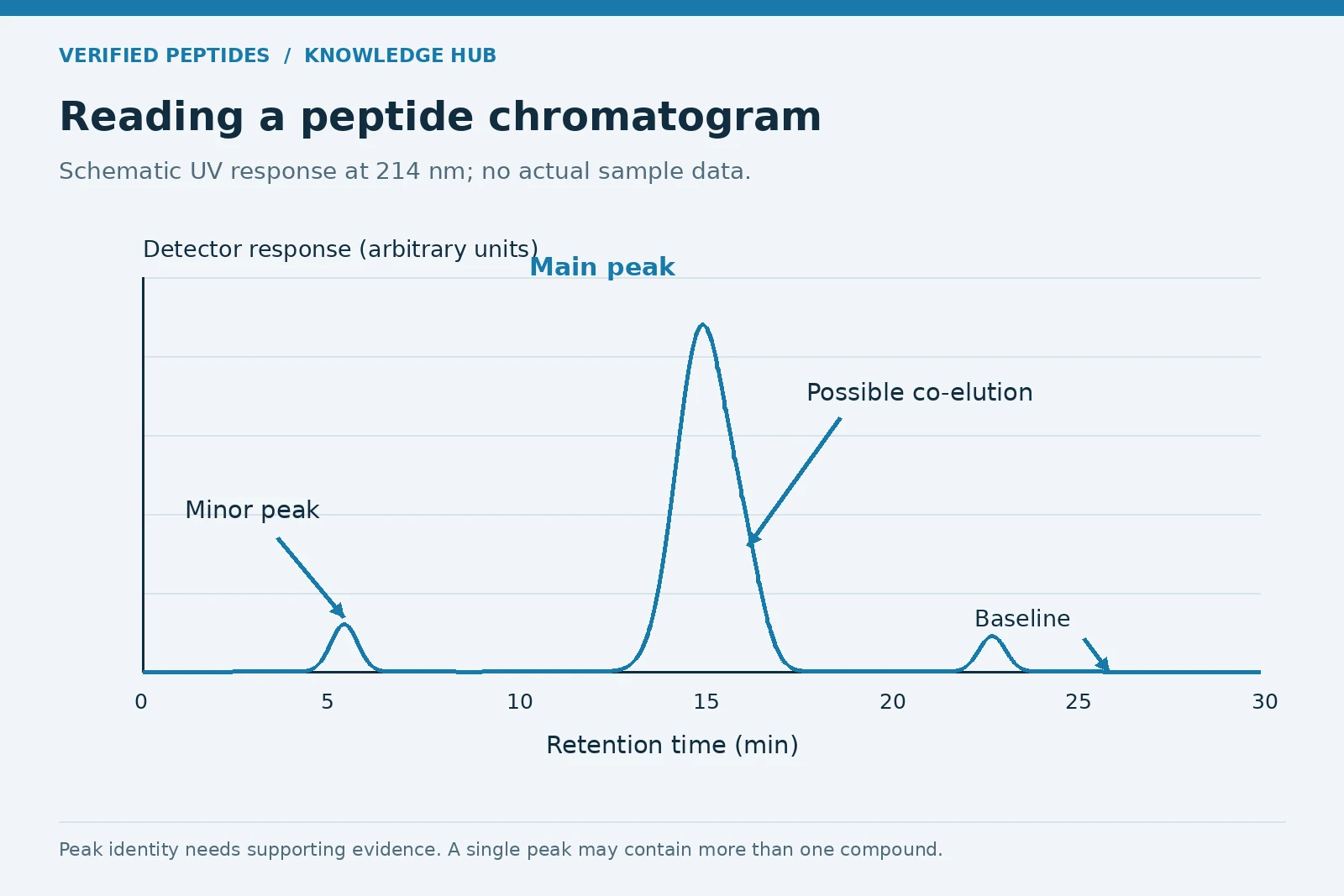
How to read a chromatogram
Start with the axes. The horizontal (x) axis is retention time, usually in minutes from the moment the sample is applied to the column; the vertical (y) axis is detector response, for peptides usually UV absorbance (often labeled mAU). Then read the trace in this order:
- 1Find the main peak Usually the largest; it is attributed to the target peptide (term 34).
- 2List the other peaks These are impurity peaks (term 35).
- 3Check the area percent The main peak’s share of total integrated area is the purity figure (term 36).
- 4Look at peak shape Tailing, shoulders, and poor resolution can hide impurities under the main peak (terms 38 to 40).
- 5Check system suitability Look for evidence the system passed its checks (term 41).
Reading the trace (terms 25 to 36)
25. Chromatogram. A graphical representation of detector response against time from a chromatographic run.14 On a peptide COA it is the raw evidence behind the purity figure.
26. HPLC (high-performance liquid chromatography). A technique that pumps a liquid sample through a packed column so its components leave at different times; it is behind most peptide purity figures.5 See the role of HPLC analysis in peptide characterization.
27. Reversed-phase HPLC (RP-HPLC). The mode used for most peptide purity work, separating molecules on the basis of hydrophobicity.15 More hydrophobic peptides are retained longer and elute later as organic solvent content rises.
28. Mobile phase and gradient. The mobile phase is the liquid carrying the sample; in a gradient run its organic solvent content increases over time.15 Peptide methods commonly pair water and acetonitrile, each with a little TFA.16 Gradient changes can shift peaks or cause co-elution.14
29. Stationary phase. The column material the sample interacts with.14 For peptides it is commonly C18-bonded silica,16 and the harmonized chapter does not permit swapping C18 for C8 as a method adjustment.14
30. Detection wavelength. The UV wavelength the detector reads, typically 210 to 220 nm for peptides,5 because the peptide backbone absorbs in the deep UV from 190 to 220 nm.17 Weakly absorbing impurities can be underrepresented.
31. Retention time (tR). The time elapsed between sample introduction and a peak’s maximum.14 It depends on column, gradient, flow rate, and instrument, so it can differ between labs.
32. Relative retention time (RRT). A peak’s retention time divided by that of a reference peak, usually the substance being examined.14 As a ratio, it makes impurities easier to compare across runs and instruments using the same method. Pharmacopeial RRTs are given for information, to aid peak identification, with no acceptance criteria.14
33. Peak. The portion of a chromatogram recording detector response while a single component elutes.14 A peak shows a band of material, not proof that only one substance is in it.
34. Main peak. The peak attributed to the target peptide, usually the largest. The trace alone does not prove its identity; mass spectrometry (terms 42 to 44) does.
35. Impurity peak. Any other peak in the integration window, such as truncated or deletion sequences from synthesis. Solvent-related peaks are excluded.14
36. Peak area and area percent. Peak area is the integrated signal under a peak; area percent is its share of the total area of all integrated peaks.14 The main peak’s area percent becomes the purity number on the certificate.5
Peak quality, system suitability, and the mass spectrum (terms 37 to 44)
Terms 39, 40, and 41 explain how a 99 percent purity figure can still overstate purity, so read them as a group.
37. Baseline. The detector signal when nothing is eluting. Baseline noise affects the precision and accuracy of quantitation,14 and drift can move small impurity peaks in or out of the integrated total.
38. Resolution (Rs). The separation between two adjacent peaks, calculated from retention times and peak widths at half height.1, 14 The Japanese Pharmacopoeia text notes that a resolution of not less than 1.5 corresponds to baseline separation.14
39. Tailing factor (symmetry factor). A measure of peak symmetry: 1.0 is symmetrical, above 1.0 is tailing, below 1.0 is fronting.14 Unless a procedure states otherwise, the harmonized chapter expects 0.8 to 1.8 for the peak used for quantitation.1, 14 A tailing main peak can hide co-eluting material.
40. Co-elution and shoulder peaks. Material leaving the column at nearly the same time as the target, seen as a shoulder or not at all. It is integrated as target, which inflates area percent purity; for partly separated impurities the harmonized chapter prefers tangential skim integration (running the integration line along the main peak’s edge under the shoulder).14
41. System suitability. Checks showing the system performed acceptably, which the harmonized chapter calls an integral part of the procedure.14 Parameters may include plate number, repeatability across replicate reference runs, signal-to-noise, symmetry factor, and resolution.14
42. Mass spectrum. The second trace, plotting ion signal against mass-to-charge ratio (m/z) rather than time. It answers identity, not purity.
43. Mass-to-charge ratio (m/z) and charge state. Peptides have several ionizable groups, so during electrospray ionization one molecule takes on multiple charge states and appears at several m/z values.18 The series of peaks from one molecule is called its charge envelope.
44. Deconvoluted mass. The single molecular mass back-calculated from the charge envelope by deconvolution.18 It is the number to compare with the theoretical molecular weight (term 14).
Part 3: Label and Vial Terms (16 Terms)
The label carries three kinds of information: the classification of the material, its chemical identity, and the physical conditions it needs.
Classification statements (terms 45 and 46)
45. RUO (research-use-only) label. A supplier classification stating that the material is supplied for laboratory research. It describes how the material is classified, not a test result; see research-use-only explained.
46. Use-restriction statement. The companion line printed alongside the RUO classification, stating that the material is not intended for use in people or animals. It restates the classification; it is not a test result.
Identity and quantity (terms 47 to 53)
47. Lyophilized powder. Freeze-dried solid, the standard shipping form for research peptides. Its appearance is often listed as a COA test.
48. Nominal vial content. The labeled quantity, for example 10 mg. Check whether the supplier means nominal peptide content or gross powder mass; do not assume they are the same. A lot-specific measured peptide result in mg documents the actual amount separately from the label claim.
49. Gross weight versus net peptide weight. Gross weight comprises peptide, counterions, and adhered water; net weight is gross weight multiplied by net peptide content.4 In Bachem’s example, 85 percent NPC gives 0.85 mg of peptide per 1 mg gross.6
50. Sequence. The order of amino acids from N-terminus to C-terminus, in one-letter or three-letter code, with modifications such as C-terminal amidation noted. A sequence error carries through to the theoretical mass and formula.
51. Molecular formula. The elemental composition of the peptide, computable from the sequence (ProtParam reports it as atomic composition).8 It normally describes the free peptide, not the salt.
52. CAS number. A Chemical Abstracts Service registry identifier for a substance. It identifies a substance record, not a batch, and salt forms can carry different numbers, so it alone confirms nothing about a vial.
53. Salt form. Whether the peptide is supplied as an acetate, hydrochloride, or trifluoroacetate salt. Because the counterion adds weight, the same nominal milligrams can hold different amounts of peptide, so the label should state the form.
Storage, handling, and multi-peptide vials (terms 54 to 60)
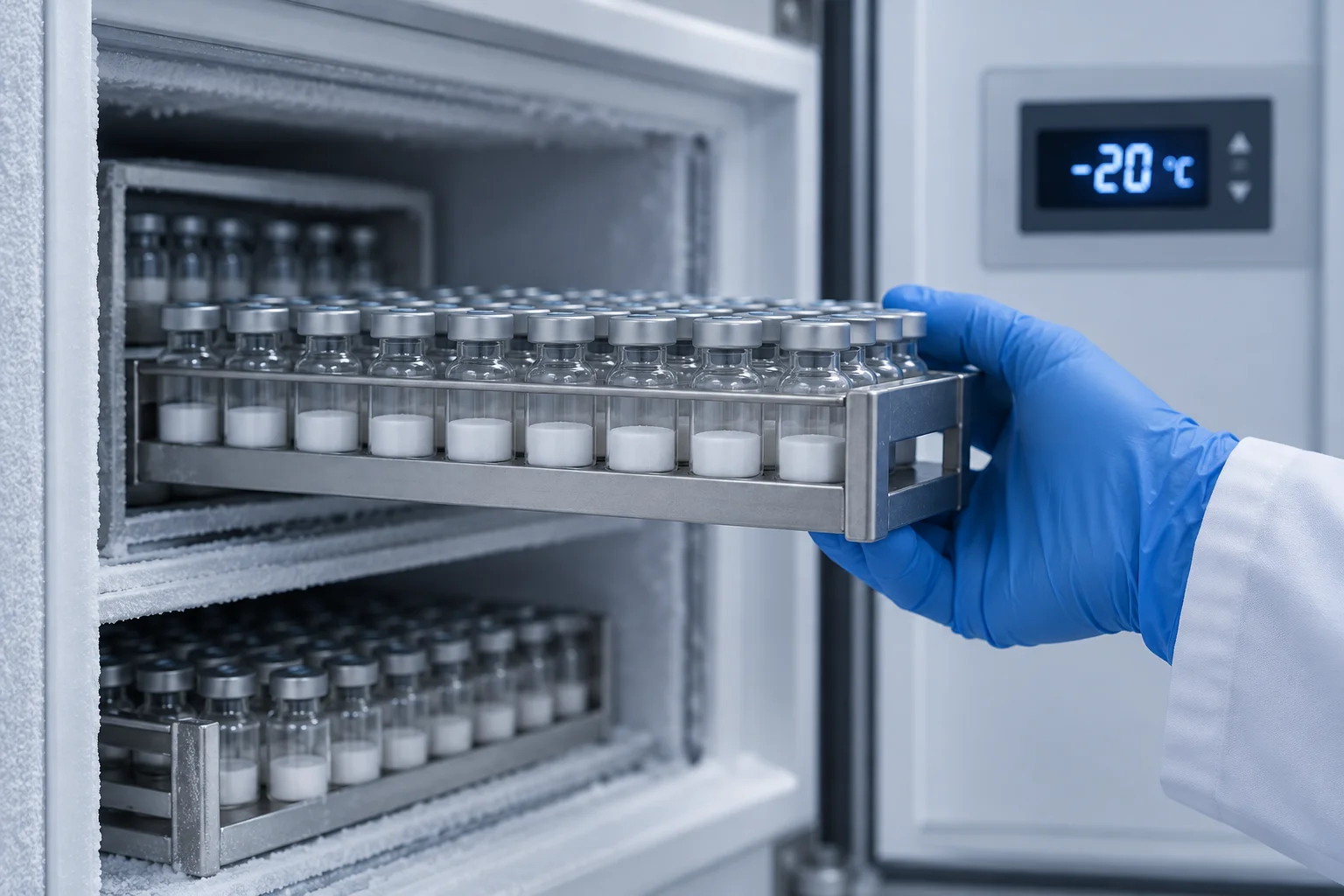
54. Storage conditions. The stated temperature, light, and moisture requirements for the material as supplied; lyophilized peptides are commonly stored at −20 °C or colder, with some suppliers preferring −80 °C, kept dry and away from light.19 Dating is covered in retest date vs expiration date.
55. Cold chain. Temperature-controlled handling through storage and transit, with records such as data-logger readings. A cold chain claim is only as strong as its records.
56. Desiccant and seal integrity. The physical safeguards on a lyophilized vial: desiccant absorbs moisture, and an intact stopper and crimp seal keep humidity out. A broken seal or collapsed, sticky powder suggests the material may have taken up water.
57. Reconstitution. Bringing lyophilized material into solution by adding a suitable liquid. It is defined here as a term only; see how to reconstitute lyophilized peptides.
58. Diluent. The liquid used to dissolve or dilute material, such as sterile water, a dilute acid, a buffer, or an organic co-solvent chosen from the sequence. The choice depends on charge and hydrophobicity; see why peptides fail to dissolve.
59. Blend label. The label of a multi-peptide vial, which should name each component and its nominal quantity. Each component needs its own identity, purity, and content documentation, because one purity figure cannot describe two peptides.
60. Research grade versus pharmaceutical grade. Research grade describes material intended for laboratory research; it is not one universally standardized manufacturing specification. Pharmaceutical suitability depends on applicable manufacturing controls, specifications and documentation. An RUO label alone does not establish whether GMP practices were followed, and research-use classification does not establish suitability for pharmaceutical use.
Terms That Get Confused With Each Other
These six pairs commonly cause misreadings of peptide documentation.
- Purity versus net peptide content. Purity is the share of peptide material that is the target; net peptide content is the share of the vial contents that is peptide at all. As an illustrative example, a batch can be 99 percent pure and roughly 72 percent net peptide content.
- Purity versus assay. Area percent purity is a relative measure within one chromatogram; an assay is a quantitative determination, usually against a reference standard.
- Endotoxin versus sterility versus bioburden. Endotoxin testing measures a bacterial cell-wall component, sterility testing checks a sample for viable microorganisms under specified conditions, and bioburden counts them; one result says nothing about the others.
- Retention time versus relative retention time. Retention time is specific to one column, method, and instrument; relative retention time is a ratio to a reference peak, so it travels better between runs.
- Theoretical versus observed molecular weight. The theoretical value is calculated from the sequence; the observed value is measured by mass spectrometry. A gap beyond the method tolerance suggests the material is not exactly the expected molecule.
- Batch-specific versus generic COA. A batch-specific COA is evidence about the vial in hand; a generic COA is a sample document that describes no particular lot.
Frequently Asked Questions About Peptide Documentation Terms
What is the difference between purity and net peptide content?
Purity is the share of peptide-related material that is the target peptide, while net peptide content is the share of the vial contents that is peptide rather than counterion and water. Because the denominators differ, a batch can be 99 percent pure and roughly 72 percent net peptide content (illustrative).
What does net peptide content mean on a peptide COA?
It is the percentage of the powder by weight that is peptidic material, with counterions and residual water making up the rest.
How do you read an HPLC chromatogram for peptide purity?
Read the axes (retention time across, detector response up), find the main peak and its area percent, then check peak shape, resolution, and system suitability before accepting the figure.
What does area percent purity actually measure?
It is the main peak area divided by the total area of all integrated peaks; it counts only what the detector sees at the chosen wavelength, and co-eluting impurities count as target.
What is relative retention time on a chromatogram?
It is a peak’s retention time divided by that of a reference peak, usually the peptide being examined (the main peak), which lets impurities be compared across runs using the same method.
Why does a mass spectrum show several peaks for one peptide?
The same molecule carries different numbers of charges, so it appears at several mass-to-charge values; deconvolution converts them into one molecular weight to compare with the theoretical mass.
What does the RUO (research-use-only) statement mean on a peptide label?
It states that the material is supplied for laboratory research and is not classified for use in people or animals.
Is a certificate of analysis without a batch number still useful?
No: without a batch number it cannot be tied to the vial in hand, so it reports on an unidentified lot, which is what separates a generic certificate from a batch-specific one.
What is the difference between a batch-specific COA and a generic COA?
A batch-specific COA reports testing on the lot shipped and carries its batch number; a generic COA is a sample document with no batch-level evidence.
What does EU per mg mean on a peptide COA?
It means endotoxin units per milligram of material; results per milligram, per milliliter, and per vial are not interchangeable, so match denominators before comparing certificates.
What is a counterion and why is it on the certificate?
It is the residual acid bound to the peptide from purification, most often trifluoroacetate or acetate, reported because it is part of the vial contents and, with water, lowers net peptide content.
Which terms should a reader check first?
Batch number consistency across label, COA, and trace; then net peptide content beside purity; then peak shape and system suitability; then observed versus theoretical mass.
All peptides discussed here are for research use only.
Key Takeaways
- The label states the claim, the COA states one batch’s results, and the chromatogram is the raw evidence behind them.
- First, confirm the batch number matches across the label, the certificate, and the trace.
- Read net peptide content alongside purity, not instead of it.
- Check peak shape and system suitability before accepting a purity figure.
- Confirm the observed (deconvoluted) mass matches the theoretical mass.
Linked Knowledge Hub articles cover each topic in more depth.
References
- United States Pharmacopeia. Notice of Adoption of Harmonized Standard: <621> Chromatography (official December 1, 2022). usp.org
- United States Pharmacopeia. Harmonized Standard: <85> Bacterial Endotoxins Test (official December 1, 2012). usp.org
- International Organization for Standardization. ISO/IEC 17025:2017 General requirements for the competence of testing and calibration laboratories. iso.org
- Bachem. What does HPLC purity mean? FAQ. bachem.com
- Bachem. Quality Control of Amino Acids and Peptides: A Guide. Knowledge center. bachem.com
- Bachem. What does net peptide content mean? FAQ. bachem.com
- AAPPTec. Peptide Quality: Frequently Asked Questions. peptide.com
- SIB Swiss Institute of Bioinformatics. Expasy ProtParam tool. web.expasy.org
- Bruttel P, Schlink R. Water Determination by Karl Fischer Titration. Metrohm Monograph 8.026.5013, 2006 (copy hosted by Aalto University). aalto.fi
- Mettler Toledo. Karl Fischer Titration Guide, Part 1: Principle. mt.com
- Thundimadathil J. Controlling endotoxin contamination during peptide manufacturing. R&D World (originally in Controlled Environments), 2012. rdworldonline.com
- United States Pharmacopeia. General Chapter <85> Bacterial Endotoxins Test. USP-NF. uspnf.com
- International Council for Harmonisation. ICH Q2(R2) Validation of Analytical Procedures (Step 4, November 1, 2023), glossary. database.ich.org
- Pharmaceuticals and Medical Devices Agency (Japan). Japanese Pharmacopoeia, General Tests 2.00 Chromatography (text harmonized with the European Pharmacopoeia and the United States Pharmacopeia). pmda.go.jp
- Aguilar MI. Reversed-phase high-performance liquid chromatography. In: HPLC of Peptides and Proteins: Methods and Protocols. Methods in Molecular Biology, vol. 251. Humana Press; 2004:9-22. link.springer.com
- Ricker R. High Resolution Microbore Reversed-Phase HPLC hGH Tryptic Digest. Agilent Technologies application note 5988-6318EN, 2002. agilent.com
- Thermo Fisher Scientific. Quantify Protein and Peptide Preparations at 205 nm (NanoDrop One application note AN52774), 2024. thermofisher.com
- Agilent Technologies. Molecular Weight Confirmation of a Peptide Using MS Spectral Deconvolution for OpenLab CDS and the Agilent InfinityLab LC/MSD XT System. Application note 5994-6927EN, 2024. agilent.com
- Sigma-Aldrich (Merck). Handling and Storage of Synthetic Peptides. Technical guide. sigmaaldrich.com