
Short answer
To compare peptide prices fairly, divide the vial price by the actual peptide content reported in milligrams on the lot’s COA. Cost per verified mg = price ÷ COA-reported peptide mg. When that result already measures the target peptide, do not multiply it by NPC or HPLC purity again. Purity remains a separate quality result.
All supplier figures on this page are illustrative round numbers for generic suppliers.
The Formula
Cost per verified milligram is the price divided by the documented milligrams of target peptide in the vial. Written in one line:
Cost per verified mg = price ÷ COA-reported peptide content (mg)
If a report instead gives NPC as a percentage of gross powder weight, a different calculation is needed. Bachem describes gross powder mass × NPC × purity as an estimate of desired peptide amount.1 That route requires a known gross mass and a suitable analytical basis. It must not be applied to a measured target-peptide amount that is already reported in milligrams.
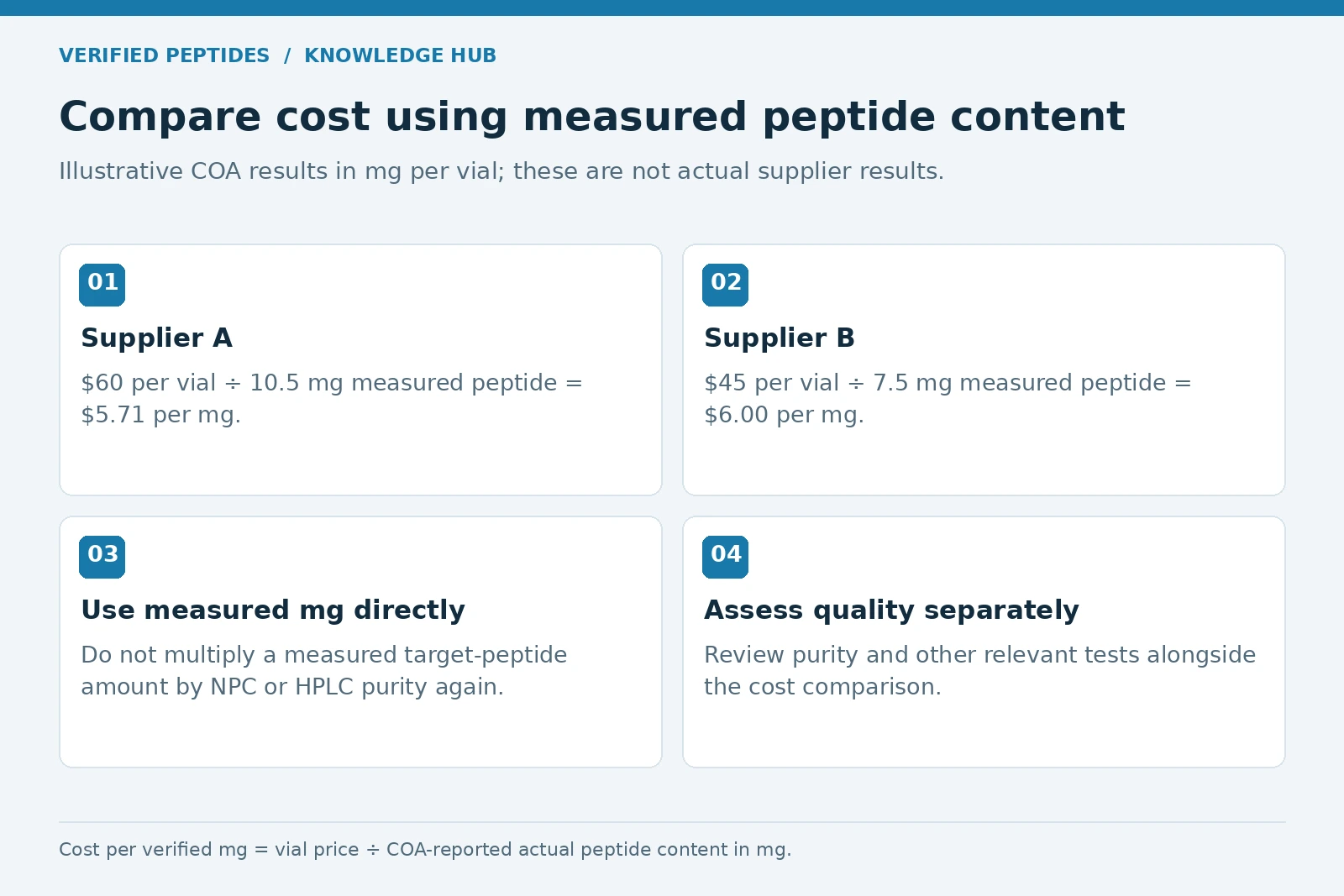
Verified Peptides’ Lab Reports give the actual peptide content in milligrams per vial alongside purity.2 Use those measured milligrams directly in the denominator. For example, a $60 vial with 10.5 mg of measured peptide costs $5.71 per verified mg. No additional NPC or purity adjustment is needed.
- Price: the vial price, or total order cost including shipping and testing fees.
- Measured peptide mg: the actual peptide amount reported for the vial on the lot-specific COA. The nominal amount on the label is a separate claim.
- NPC percentage: the peptide share of gross powder weight, excluding non-peptide material.3 Use this only for a gross-powder calculation, not to adjust an already measured peptide amount. See net peptide content vs purity.
- HPLC purity: a separate analytical quality result.4 Review it alongside measured content; do not multiply it into a target-peptide mg result again.
“Verified” means each input is backed by a lot-specific certificate of analysis (COA) or a third-party result for the same lot, not by a product page claim. The terms are also defined in the peptide research glossary.
Why Price Per Vial Is Misleading
Price per vial does not tell you the cost of the actual peptide amount. Two vials with the same nominal label quantity can have different measured contents. Check what the label states and use the lot’s measured peptide milligrams for a verified comparison.
Gross powder can include counterions and water as well as peptide. NPC percentages describe that distinction.3 Peptides purified using TFA may be supplied as TFA salts.5 A measured target-peptide amount already separates the quantity of interest from the total powder; do not subtract these components again. See acetate and other counterions.
Purity and content answer different questions. Use the measured peptide amount to calculate cost per mg, and assess the HPLC purity result separately when judging suitability for the experiment.4 A lower price per measured mg does not make a lower-purity sample equivalent in quality.
The Inputs and Where to Find Them
Each input has a specific home in the documentation, and the calculation is only as good as the weakest one. The table lists where to look and what to check.
| Input | Where it appears | What to check |
|---|---|---|
| Nominal labeled content (mg) | Vial label and product listing | Confirm the stated quantity; do not assume it is gross powder weight. |
| Measured peptide content (mg per vial) | Lot-specific COA or third-party quantitative report | Use the actual peptide amount; confirm the method and reporting basis. |
| HPLC purity (%) | Lot COA with chromatogram | Assess separately as a quality result; do not reapply it to measured target-peptide mg. |
| Price | Quote or order confirmation | Shipping, cold-chain packing, and testing fees if comparing total cost |
| Lot number | Vial label and COA | Same lot on both, so every input describes your vial |
Amino acid analysis breaks the peptide into its amino acids with strong acid; elemental analysis compares measured nitrogen, carbon, and hydrogen with calculated values. Identity is separate: molecular weight is confirmed by mass spectrometry.6 A COA for a pharmaceutical substance is expected to carry the batch number, each test performed, the acceptance limits, and the numerical results,7 and the same fields make a research COA usable. See what a good peptide COA should include and batch-specific COA vs generic PDF.
Worked Example: Comparing Two Generic Suppliers
In this illustrative example, Supplier A costs $60 and its COA reports 10.5 mg of actual peptide, giving $5.71 per verified mg. Supplier B costs $45 and its COA reports 7.5 mg, giving $6.00 per verified mg.
All figures below are illustrative and do not describe actual suppliers or VP batch results. Both COA content results are assumed to measure the target peptide directly in milligrams.
| Step | Supplier A | Supplier B |
|---|---|---|
| Price per vial | $60.00 | $45.00 |
| Nominal labeled content | 10 mg | 10 mg |
| Price per labeled mg | $6.00 | $4.50 |
| COA-reported actual peptide content | 10.5 mg | 7.5 mg |
| Calculation | $60 ÷ 10.5 mg | $45 ÷ 7.5 mg |
| Cost per verified mg | $5.71 | $6.00 |
Calculate with the reported content before rounding the final cost: $60 ÷ 10.5 = $5.714285… per mg; $45 ÷ 7.5 = $6.00 per mg. HPLC purity is not multiplied into either content result.
Supplier B is 25 percent cheaper per vial but 5 percent more expensive per measured peptide mg. At the same $45 price, it would need 7.875 mg of measured peptide to match Supplier A’s cost per mg. Quality results still need to be compared separately.
When Net Peptide Content Is Not Reported
If the COA reports actual peptide content in mg per vial, no NPC percentage is needed for this calculation. If neither a measured amount nor enough information for a justified gross-powder estimate is available, request a lot-specific content result. You can still compare price per labeled mg, but call it a label-based comparison, not cost per verified mg.
Do not fill a missing content result with an assumed NPC percentage or multiply nominal label mg by purity and call the result verified. NPC varies with the peptide and preparation.8 For reports using percentages, establish the gross powder mass and calculation basis first; keep any resulting estimate separate from a direct measured-mg comparison.
What the Calculation Cannot Tell You
Cost per verified milligram measures documented target peptide per dollar, not overall quality. It does not capture residual reagents, endotoxin, or stability, and it depends on accurate documentation matched to the lot in hand.
A low figure built on unverifiable inputs is not a meaningful comparison: if measured peptide content or the lot number cannot be traced to a batch-specific report, the result measures claims, not material. Weigh third-party testing and documentation transparency alongside price; in-house vs third-party lab testing explains why the issuing lab matters, and how to compare two peptide suppliers using only their COAs sets out a side-by-side document review.
Frequently Asked Questions About Comparing Peptide Prices
What is cost per verified milligram?
It is the vial price divided by the actual peptide content reported in mg on the lot’s COA. If the report already measures the target peptide, no additional NPC or purity multiplication is needed.
Why not just compare price per vial? Is a 10 mg vial actually 10 mg of peptide?
A 10 mg label states the nominal quantity; it does not by itself establish the measured amount in that vial. Check the lot-specific content result. Do not assume the label means gross powder weight.
Where do I find net peptide content, and what if a supplier does not report it?
Look for measured peptide content in mg per vial on the lot’s COA. If it is reported, you do not need an NPC percentage for the price calculation. If the content result is missing, request it; otherwise describe your comparison as price per labeled mg.
Is the lowest cost per verified milligram always the best choice?
Not necessarily. The figure is only as good as the documentation behind it, and it does not cover endotoxin, residual reagents, stability, or identity.
Should shipping and testing costs be included?
Include them when comparing total cost, and apply the same method to every supplier so the figures stay comparable.
Why do peptide prices vary so much between suppliers?
Prices can reflect sequence difficulty, purity grade, scale, and how much testing is done and documented; the label alone does not show which.
How do I compare peptide suppliers fairly? What should be on a peptide COA?
Apply the same formula and documentation standard to each, using lot-specific COAs that cover six fields: batch match, purity and its method, identity by mass spectrometry, net peptide content, additional tests, and who ran the analysis.
All peptides discussed here are for research use only.
Key Takeaways
- Cost per verified mg = vial price ÷ COA-reported actual peptide content in mg.
- Nominal label quantity, gross powder mass and measured peptide content are different. Use the measured peptide amount directly when it is available.
- In the illustrative example, the vial that is 25 percent cheaper costs 5 percent more per measured peptide mg.
- A measured peptide mg result needs no additional NPC or purity adjustment. Request content data when it is missing.
- Verification makes the number meaningful: keep each lot’s COA with its order records for later comparison.
References
- Bachem. How to calculate the molarity of a peptide solution? FAQ (gross weight x NPC x HPLC purity, with worked example). bachem.com
- Verified Peptides. Lab Reports (batch-specific third-party test reports). verifiedpeptides.com
- Bachem. What does net peptide content mean? FAQ. bachem.com
- Bachem. What does HPLC purity mean? FAQ. bachem.com
- Sikora K, Jaśkiewicz M, Neubauer D, Migoń D, Kamysz W. The role of counter-ions in peptides: an overview. Pharmaceuticals. 2020;13(12):442. PMC7761850
- Bachem. Quality Control of Amino Acids & Peptides: A Guide. Knowledge center (updated October 2026). bachem.com
- US Food and Drug Administration / ICH. Q7 Good Manufacturing Practice Guidance for Active Pharmaceutical Ingredients (sections 11.2 impurity profiles and 11.4 certificates of analysis). fda.gov
- AAPPTec. Peptide Quality: Frequently Asked Questions. peptide.com