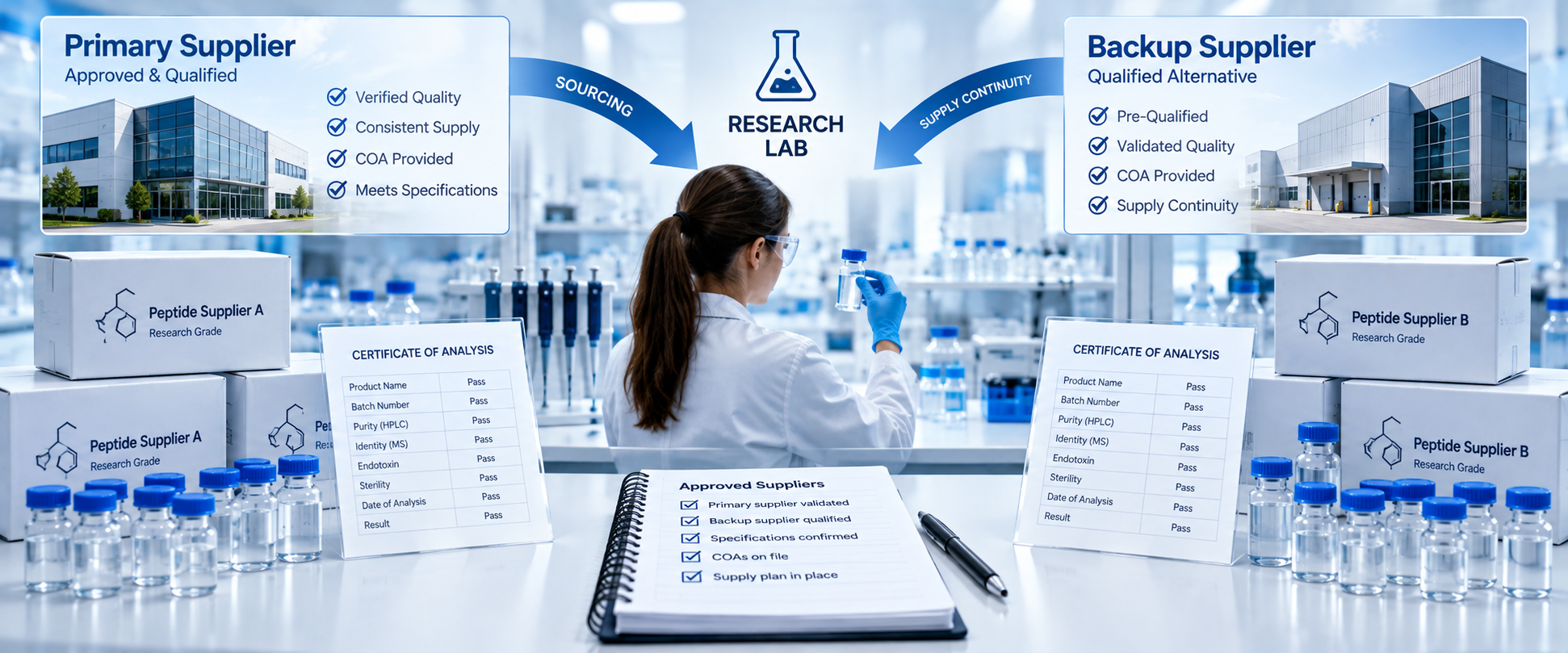
The March 2026 closure of Peptide Sciences, one of the largest research peptide suppliers in the United States, showed how quickly a single-source dependency becomes a continuity problem. The durable fix is to build supplier redundancy in advance: qualify at least one backup source, standardize how you evaluate suppliers, and hold a sensible buffer of your most critical materials.
This article covers what happened and why it matters, the case against single sourcing, how to qualify a second supplier before you need one, and how to operationalize redundancy without doubling your overhead.
Supplier redundancy means having more than one qualified source for critical materials, so that one vendor going offline does not stop your work. It is a standard risk control in many industries, applied here to research operations.
In practice, it comes down to three core moves:
Qualify a backup supplier before you need one, so activating it is a switch rather than a scramble.
Standardize your vetting criteria so every supplier is judged on the same basis.
Keep a modest buffer stock of the items whose absence would actually halt work.
Treat this as continuity planning for research operations, not as a one-time reaction to a single event.
What happened, and why it is a wake-up call
On March 6, 2026, Peptide Sciences announced a voluntary closure through a brief notice, with no detailed public explanation and no stated process for pending orders or refunds. By multiple third-party estimates it had been one of the largest US research peptide suppliers by sales and traffic before it closed, so the shutdown affected a large number of active researchers. It was part of a wider wave of research peptide vendor exits during 2025 and 2026, against a backdrop of heightened regulatory scrutiny of the sector.
The operational fallout for labs was immediate: interrupted orders, a scramble for alternatives, and open questions about refunds and continuity. Industry observers have widely interpreted the timing as a proactive exit ahead of tightening enforcement, but the company gave no official reason, so the general lesson matters more than any single company’s internal rationale. That lesson is straightforward: concentration risk is real, and a sector under pressure can change fast.
The case against single sourcing
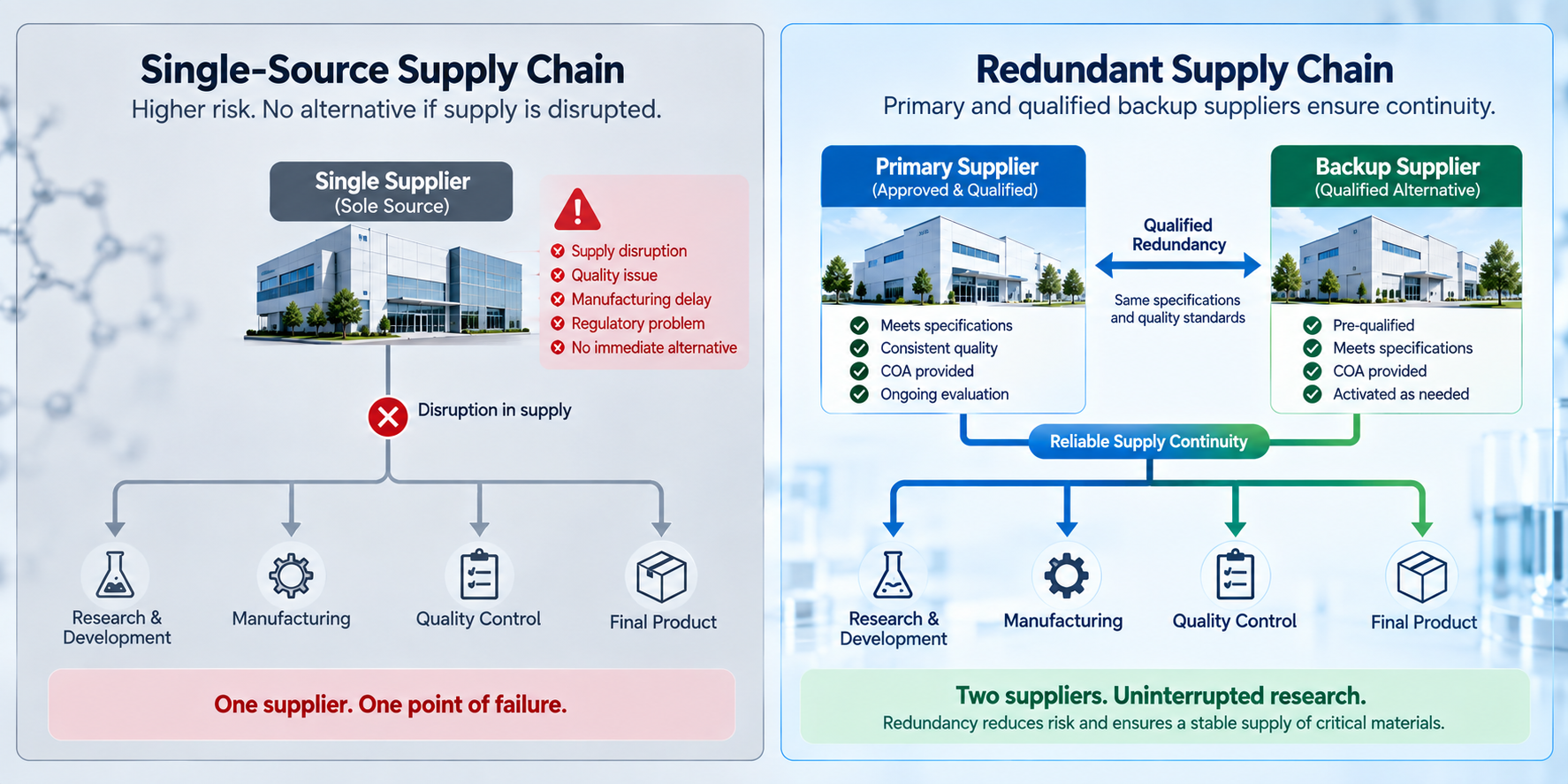
Relying on one supplier means their outage, price change, quality slip, or closure becomes your outage. That is the essence of concentration risk, and it applies whether the disruption is a business decision, a regulatory action, or a simple back-order.
The research peptide market in this period has been especially fragile, with regulatory pressure, payment-processing instability, and rapid vendor turnover all in play at once. This contrasts with established supply chain practice in regulated industries, where dual sourcing and qualified backups are treated as standard risk controls rather than luxuries.
It is worth being honest about the tradeoff. Redundancy has a cost in vetting time and possibly a higher per-unit price, which is exactly why it should be focused on critical materials rather than applied to everything you buy.
Figure 1: Single sourcing versus redundancy. With one source, that vendor’s outage is your outage; with a qualified backup and a focused buffer of critical items, a disruption becomes a switch rather than a stoppage.
How to qualify a backup supplier before you need one
The goal is a proactive qualification process, run calmly in advance, rather than an emergency search under pressure. A workable evaluation looks at three dimensions:
Analytical transparency: does the supplier provide batch-specific Certificates of Analysis with HPLC and mass spectrometry, and is that backed by independent or third-party testing?
Consistency: order a small qualifying batch and compare its documentation and analysis against your primary source.
Operations: shipping reliability, cold-chain handling, storage practices, communication, and refund or replacement policies.
Whatever you find, document it, so the backup is genuinely qualified and ready rather than just a name on a list.
A short qualification checklist
A backup is ready when you can check off the following:
A batch-specific COA with HPLC purity and mass spectrometry identity.
Evidence of third-party or independent verification.
Consistent labeling, lot tracking, and storage guidance.
Reasonable and clearly stated policies for refunds, replacements, and communication.
A completed small qualifying order that you have analyzed and logged.
For a fuller rubric, a companion guide on how to evaluate a research peptide supplier walks through these criteria in more detail.
Dual sourcing and buffer stock without doubling overhead
Two mechanisms do most of the work, and neither requires running a full second procurement operation.
Dual sourcing means splitting routine purchasing across two qualified suppliers, or keeping a primary plus a qualified secondary that you order from periodically just to keep it active. An account that has never placed an order is not a real backup when you need it in a hurry.
Buffer stock means holding a modest reserve of the most critical, hardest-to-replace materials, sized to your realistic lead times. The caution here is stability: avoid overstocking materials with limited shelf life, and balance buffer size against storage life and freeze-thaw handling. Concentrate the redundancy effort on the items whose absence would actually halt work, not on everything in the catalog.
Worth remembering: a backup supplier you have never ordered from is a plan on paper, not a working alternative. Placing an occasional qualifying order is what keeps the account, the documentation, and the shipping relationship genuinely ready.
Operationalizing redundancy: make it a standing process
To keep redundancy from decaying, turn it into a documented routine:
Maintain a simple supplier register that lists the primary and qualified backups for each critical item, with the date each backup was last verified.
Schedule periodic re-qualification, since a supplier’s quality and reliability can drift over time.
Monitor sector news, so a wave of closures is a signal you act on early rather than late.
A documented process is what turns a stressful scramble into a routine switch. The work is front-loaded once and maintained lightly thereafter.
What to do right now if your primary supplier just went offline
If you are reacting to a closure today, work through it in order:
Triage. Identify which in-flight work is actually blocked and which materials you still hold.
Activate a backup. Switch to any pre-qualified backup; if none exists, run an accelerated version of the qualification checklist rather than buying blind.
Preserve documentation. Keep records of unfulfilled orders and pursue refunds or chargebacks through your payment provider where appropriate.
Stand up a permanent process. Treat the disruption as the trigger to build the standing redundancy process described above.
Key takeaways
Single sourcing is concentration risk; the durable answer is a qualified backup, standardized vetting, and a focused buffer of critical materials.
Qualify backups proactively on analytical transparency, consistency, and operations, and document the results.
Use dual sourcing and modest buffer stock, concentrated on the items whose absence would halt work, and keep backups active with occasional orders.
Redundancy is a standing process, not a one-time reaction to a headline. Build it before the next disruption, not during it.
Frequently asked questions (FAQs)
Why does supplier redundancy matter after the 2026 peptide vendor closures?
The closures showed how a single-source dependency turns any one vendor’s outage into your outage. Redundancy keeps research supplied through disruption. The point is continuity planning, not any individual vendor’s internal reasons for closing.
What is the difference between a backup supplier and dual sourcing?
A backup supplier is a qualified alternative you can activate when needed. Dual sourcing means routinely splitting purchasing across two qualified suppliers so both stay active and ready, which avoids the cold-start problem of a backup you have never used.
How do I qualify a backup peptide supplier?
Check for a batch-specific COA with HPLC and mass spectrometry, evidence of third-party verification, consistent lot tracking and storage guidance, and clear refund and replacement policies. Then place a small qualifying order, analyze it, and log the results.
How much buffer stock should a lab keep?
Size buffer stock to your realistic lead times and concentrate it on critical, hard-to-replace materials. Avoid overstocking items with limited stability, since shelf life and freeze-thaw handling can undermine a reserve that is too large.
What should I do immediately if my main supplier closes?
Identify blocked work and remaining stock, activate a pre-qualified backup or run an accelerated qualification, preserve order documentation for refunds, and use the disruption as the trigger to stand up a permanent redundancy process.
Isn’t keeping two suppliers just extra cost and work?
There is a real tradeoff in vetting time and possibly per-unit price. Focusing redundancy on the few genuinely critical items keeps that overhead modest relative to the cost of a full work stoppage.
Suggested references
Thermo Fisher Scientific. Derisking your supply chain with dual sourcing, on dual sourcing as a supply chain risk control. thermofisher.com
Lab Manager. Building a resilient laboratory supply chain in an era of disruption. labmanager.com
LGM Pharma. When and why to qualify a second source, on the rationale and process for a qualified second supplier. lgmpharma.com
Verified Peptides. Knowledge Hub: How to Evaluate a Research Peptide Supplier in 2026. verifiedpeptides.com
FDA Disclaimer: The statements made within this website have not been evaluated by the US Food and Drug Administration. The statements and the products of this company are not intended to diagnose, treat, cure, or prevent any disease. Verified Peptides is a chemical supplier. All products are sold for research, laboratory, or analytical purposes only, and are not for human consumption. This content is informational and is not medical advice.