
Tesofensine (400 mcg, 60 units)


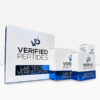





PT-141 Peptide (10MG)
This batch of PT-141 has been third party lab tested and verified for quality.

TESTED FOR:

purity
weight
TFA FREE
sterility
endotoxins(lps)
$34.99
| Quantity | Price | |
|---|---|---|
| 0% | 1 - 4 | $34.99 |
| 10% | 5 - 9 | $31.49 |
| 20% | 10 - 19 | $27.99 |
| 30% | 20 + | $24.49 |
This product comes as lyophilized powder and is not reconstituted. All products and materials sold on this site are for Research Use Only and not for human use; subject to our Terms and Conditions.

2-Day Shipping
Order by 2:00 PM ET

INSULATED SHIPPING
Ice foam-box shipping available
| Peptide vial specifications | Results | |
|---|---|---|
Not reconstituted | ||
Bottle type: | Vial - sealed - flip top | |
Form: | Powder (lyophilized) | |
Vial size: | 3ML | |
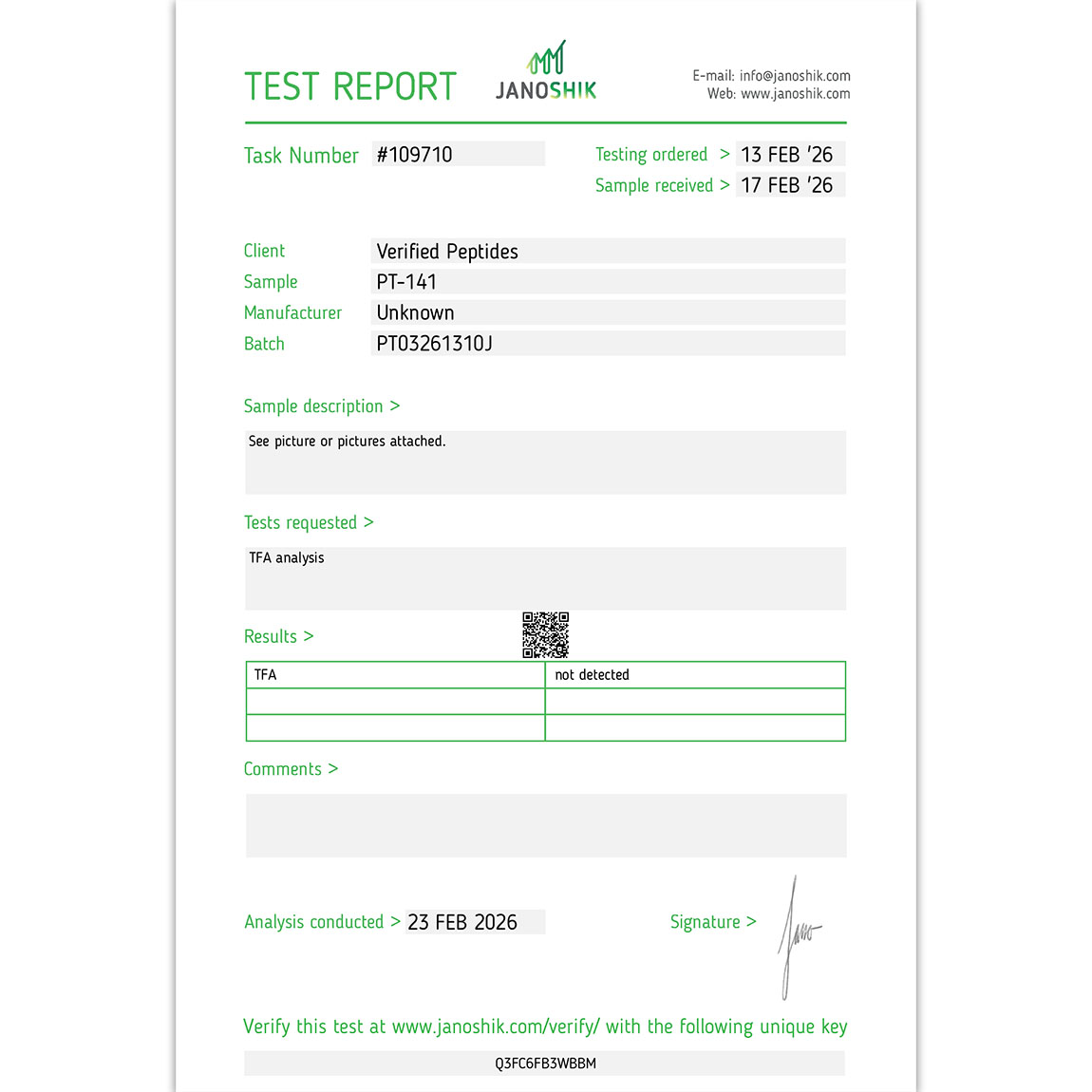
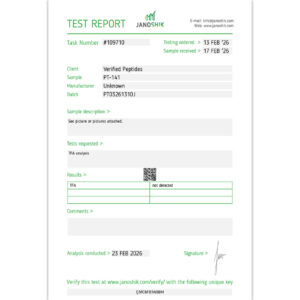
PT-141 Certificate of Analysis (COA) Test Result
| Date Tested: | |
|---|---|
| Purity: | 99.719% |
| Weight: | 10.35mg |
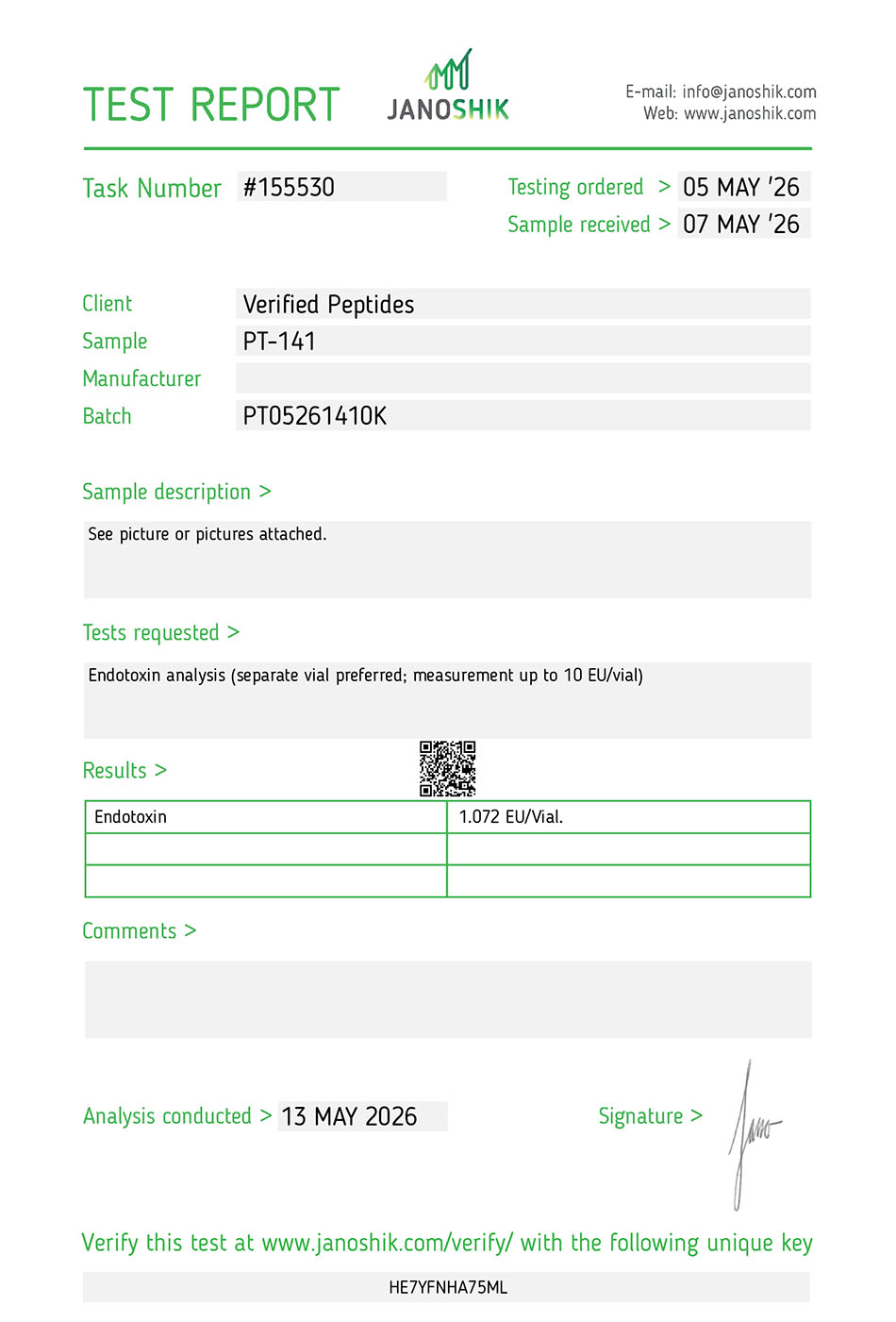
| Endotoxins (LPS): | Pass |
| TFA: | Not detected |
| Batch #: | PT05261410K |
| Testing Lab: | Janoshik |
| COA Verified Link: | Purity Report Endotoxin Report |
| Testing Methods: | HPLC, LAL, TAMC/YAMC USP <71> |

PT-141 Specifications: Molecular Weight, CAS Number & Sequence
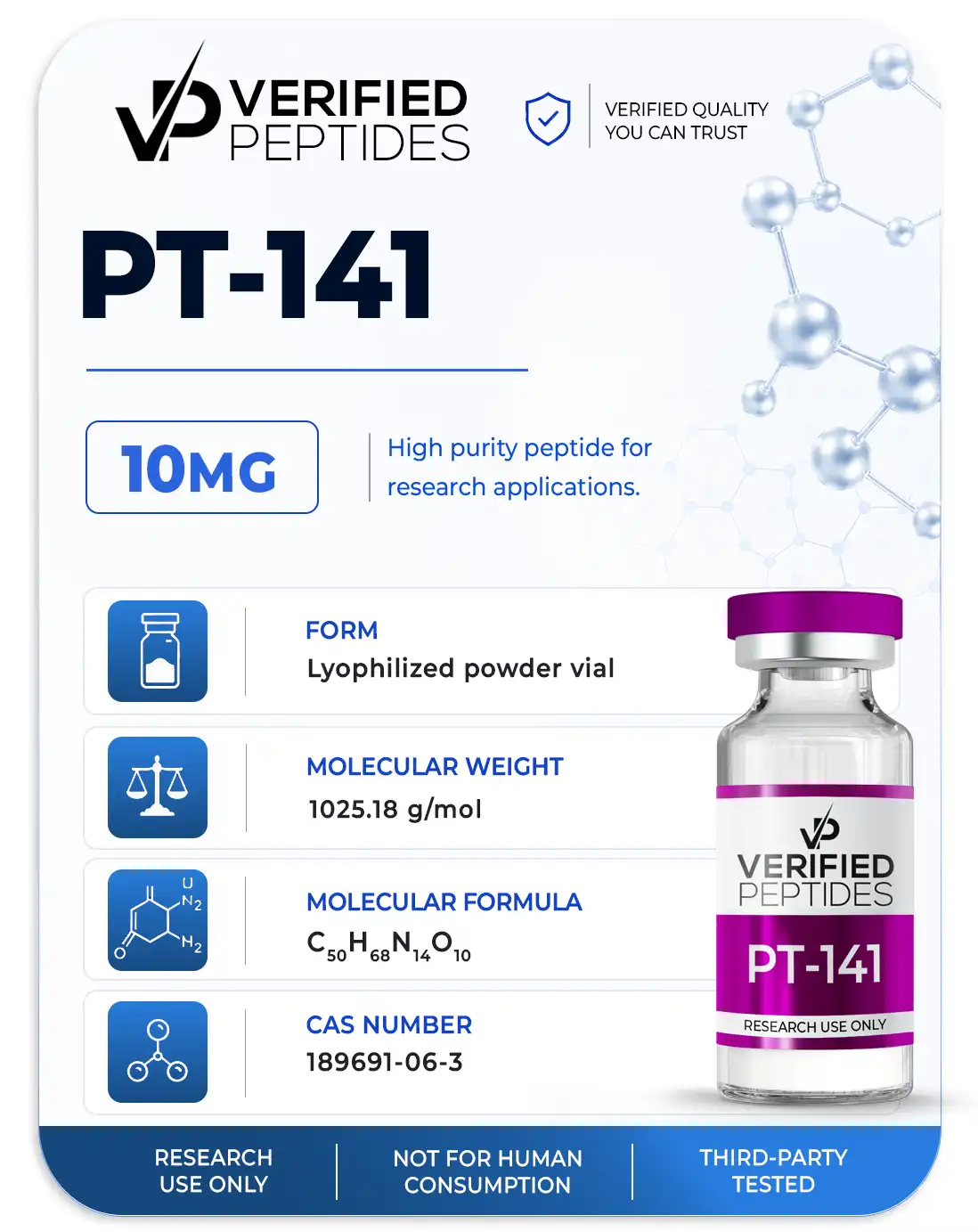
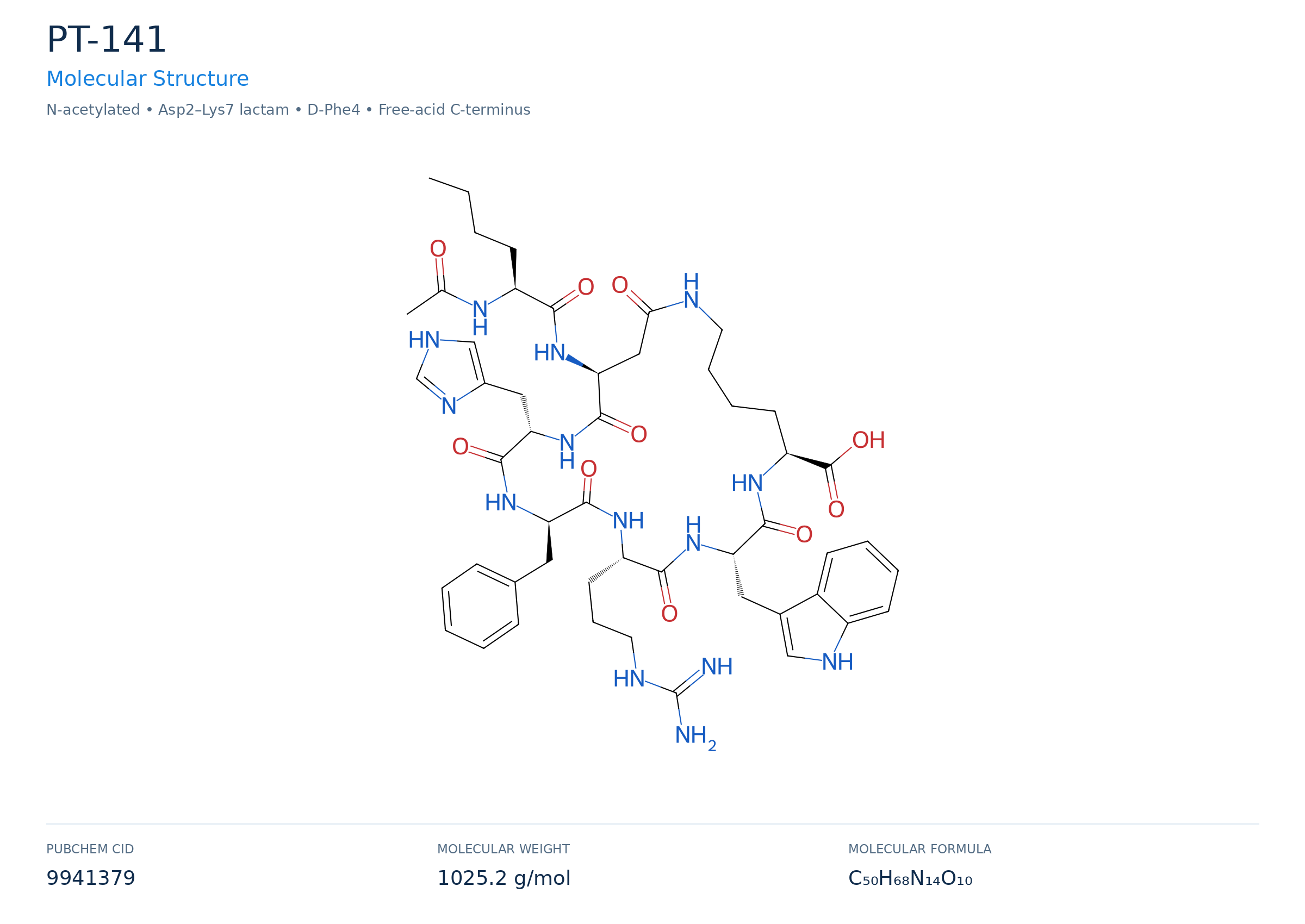
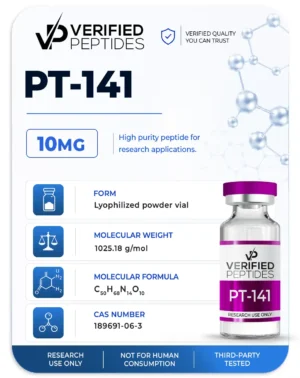
PT-141 (CAS 189691-06-3) is a research peptide with the molecular formula C50H68N14O10 and a molecular weight of 1025.182 g/mol.
| Form: | Powder (lyophilized) |
|---|---|
| Weight: | 10mg |
| Appearance: | White lyophilized powder |
| CAS Number: | 189691-06-3 |
| Molecular Formula: | C50H68N14O10 |
| Molecular Weight: | 1025.182 g/mol |
| PubChem CID: | 9941379 |
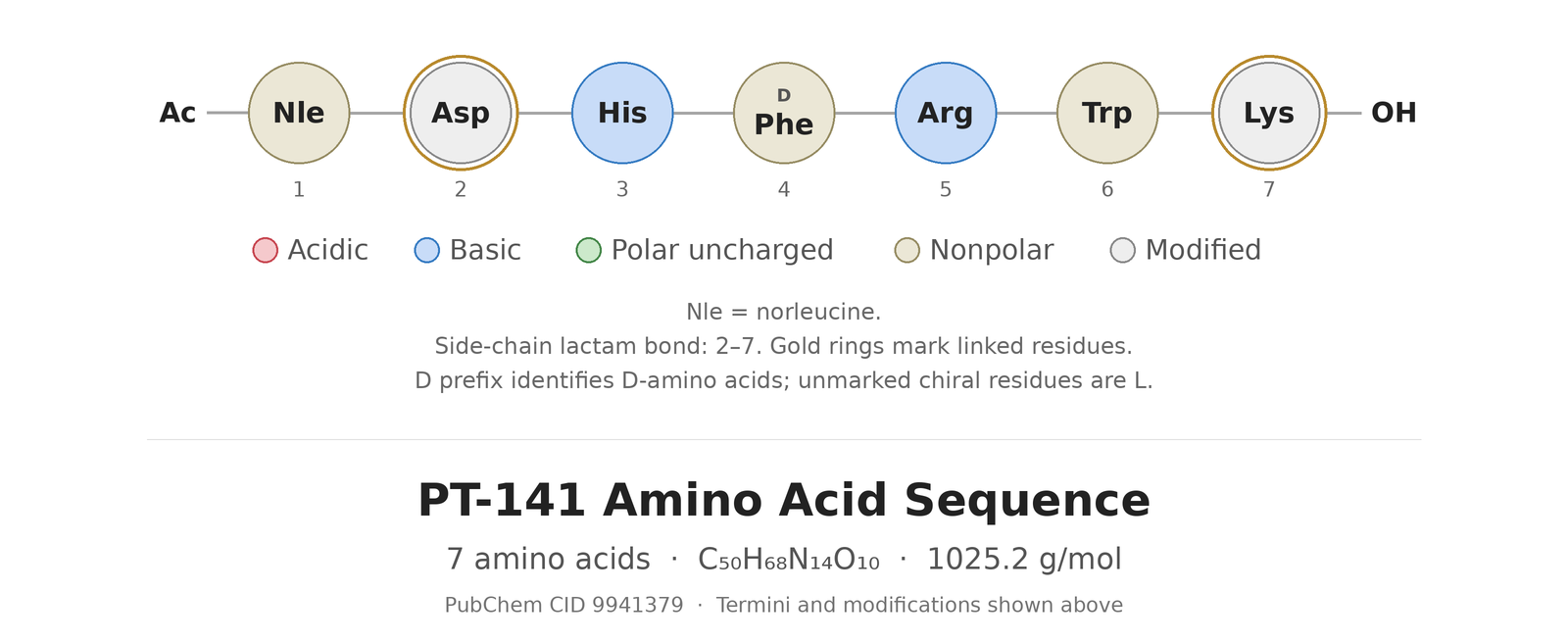
| Sequence: | Ac-Nle-Asp(1)-His-D-Phe-Arg-Trp-Lys(1) |
| Other Names: | PT141, PT 141 |
| Terms: | Subject to our Terms and Conditions. This material is sold for laboratory research use only. Not for human consumption, animal, or medical use. |
PT-141 Molecular Structure
PT-141 Amino Acid Sequence

The industry's most trusted source for research peptides
The Leader In Peptide Testing
500+ Certificates of Analysis
You can be sure we don't cut corners on testing every single batch.
Visit our Lab Reports page.
An Established, Trusted Company
6+ Years of Peptides
We pioneered third party lab testing and have stood the test of time. Our first lab report dates back to 2019 proving our track record.
Fair market pricing
Competitively priced cost per milligram for verified quality.
Peptides Tested For More Than Purity
We conduct an array of analytical testing for our peptides:
purity, weight, endotoxins(LPS), sterility (bacteria & mold/yeast), and TFA content.
Transparent. Consistent. Reliable.
- Batch number on every vial
- Published Certificates of Analysis
- Expert customer service
- Satisfaction and quality guarantee
- Cold pack foam-lined shipping
Explore Other High-Purity Peptides
Peptide Blends
Price range: $65.00 through $107.00
Peptides
$49.99
Peptides
$44.99
Peptides
$62.00
Peptides
$119.00

Peptides
Price range: $43.00 through $77.00
Peptides
$34.99
Hear What Our Customers Say
Trusted by thousands of researchers for high-quality peptides

This is a first class operation. Quality products and the best customer service. There may be many similar type of companies out there, but this one is trusted and affordable. [...] I highly recommend this company.
Verified Peptides is hands down my favorite website for these products. I can always count on the products to be legitimate and effective, all while being affordable. Will continue to give them my business.
Outstanding product, outstanding price, outstanding shipping
What is PT-141?
PT-141 (bremelanotide) is a synthetic cyclic heptapeptide analog of α-melanocyte-stimulating hormone (α-MSH). In receptor-binding work cited by the study below, it bound melanocortin receptor subtypes 1, 3 and 4, with no significant binding to 30 other neuropeptide or monoamine receptors tested. Researchers have used PT-141 in rodent studies of how central melanocortin signaling relates to specific components of sexual behavior.
PT-141 Peptide Research Studies
Summaries of peer-reviewed research. For research and educational purposes only.
📚 Peer-Reviewed Study · Rat Model
PT-141 Rat Study: Melanocortin Receptor Activation and Solicitation Behavior in Female Rats (Pfaus et al., PNAS, 2004)
Overview of the PT-141 Study
This 2004 study in the Proceedings of the National Academy of Sciences (Pfaus et al., Concordia University) tested PT-141 in hormone-primed, ovariectomized female rats. Behavioral neuroscience divides female rat sexual behavior into appetitive behaviors, such as solicitations and hops and darts, and receptive behaviors, such as the lordosis posture. The researchers asked whether PT-141 changes one category without changing the other.
They also tested whether PT-141 changed general movement in an open field, or the conditioned place preference that rats develop for a chamber linked to paced mating.
Scope: This was a behavioral study in female rats. It did not test PT-141 in people.
PT-141 Study at a Glance
- Citation: Pfaus JG, Shadiack A, Van Soest T, Tse M, Molinoff P. Proc Natl Acad Sci USA. 2004;101(27):10201–10204.
- Animals: Ovariectomized female Long-Evans rats, primed with estradiol plus progesterone, or estradiol alone
- Groups: 40 rats (bilevel chambers, estradiol plus progesterone), 20 (bilevel, estradiol alone), 40 (unilevel chambers), 20 (open field) and 20 (place preference)
- Administration in the study: Subcutaneous, 5 minutes before each test, compared with saline
- Measurements: Solicitations, hops and darts, pacing, lordosis quotient, female mounting, return latencies, locomotion, conditioned place preference
- Funding and disclosure: Palatin Technologies, which manufactures PT-141, provided financial support. Two authors owned Palatin stock.
Why Researchers Study PT-141 in Female Rat Models
Many earlier pharmacology studies of female rat sexual behavior focused on lordosis, a reflexive posture. The authors argued that this focus misses the appetitive behaviors female rats use to initiate and pace contact. Central melanocortin receptors, especially MC3 and MC4, are expressed in hypothalamic and limbic regions involved in motivated behavior.
This study used PT-141 as a pharmacological tool to examine whether activating these receptors selectively changes appetitive measures.
Experimental Design and Methodology
Females were ovariectomized and primed with estradiol benzoate plus progesterone, or estradiol alone. Each received 10 preliminary sexual-behavior tests before the experiment. In the main experiments, rats received PT-141 at 0 (saline), 50, 100 or 200 µg/kg. The estradiol-alone group received only 0 or 200 µg/kg. These amounts describe the published rat protocol only.
The researchers used two testing set-ups:
- Bilevel chambers: The female can solicit the male, run to another level and pace contact. Researchers scored solicitations, hops and darts, pacing, rejections and lordosis quotients over 30 minutes.
- Unilevel pacing chambers: A divider with small holes lets only the female cross. Researchers scored the same behaviors, plus female mounting and return latencies after mounts, intromissions and ejaculation.
Separate groups were tested for locomotion in an open field and for conditioned place preference linked to paced mating.
What Did the PT-141 Study Find? Results in Bilevel Chambers
In rats primed with estradiol plus progesterone, PT-141 at 100 and 200 µg/kg significantly increased the number of solicitations compared with saline. The 200 µg/kg dose also increased solicitations in rats primed with estradiol alone.
PT-141 did not change pacing, lordosis quotients or the other behaviors scored in the bilevel chambers.
Results in Unilevel Pacing Chambers
In unilevel chambers, PT-141 significantly increased both solicitations and hops and darts, but not lordosis. Rats given the highest dose also showed more female mounting of the male.
Return latencies after mounts and intromissions did not change. Return latency after ejaculation, which is normally longer, increased further with PT-141.
Locomotion and Conditioned Place Preference
PT-141 at 200 µg/kg did not increase grid crossings in an open field, so the behavioral changes were not explained by a general increase in activity. PT-141 also did not alter the normal development of conditioned place preference for paced mating. The authors interpreted this as no change in the rewarding properties of paced copulation in this paradigm.
Proposed Mechanism
PT-141 binds melanocortin receptor subtypes 1, 3 and 4. The authors proposed that the behavioral effects most likely involve MC3 and MC4 receptors in the central nervous system. This was an interpretation: the study did not identify the brain regions or receptor subtypes involved, and it did not rule out peripheral actions.
Limitations and Research Context
- The study used ovariectomized, hormone-primed rats, which is a specific experimental model of female rat sexual behavior.
- Results depended on the testing set-up and hormone priming, with clearer effects in unilevel chambers.
- Group sizes were moderate (20–40 rats per experiment), and some measures were tested at only one dose.
- The manufacturer of PT-141 funded the study, and two authors held stock in the company.
- Rat behavioral measures do not establish effects, safety or dosing in other species, including people.
Conclusion
Pfaus et al. (2004) reported that PT-141 increased appetitive measures in hormone-primed female rats, including solicitations, hops and darts, and, at the highest dose, female mounting. Lordosis, pacing, general locomotion and conditioned place preference did not change. The authors linked these behavior-specific effects to central melanocortin receptor activation.
This summary is provided for research and educational purposes. Statements on this page have not been evaluated by the FDA. Research compounds offered on this site are for laboratory research use only. They are not intended for human or veterinary use, or to diagnose, treat, cure, mitigate or prevent any disease.
Frequently Asked Questions
What is PT-141 (bremelanotide)?
PT-141 is a synthetic cyclic heptapeptide analog of α-MSH. It binds melanocortin receptor subtypes 1, 3 and 4 and has been used in rodent studies of central melanocortin signaling.
What did the 2004 PT-141 female rat study find?
In ovariectomized, hormone-primed female rats, PT-141 increased solicitations and hops and darts, and at the highest dose, female mounting. It did not change lordosis, pacing, open-field locomotion or conditioned place preference.
What is the difference between appetitive and receptive behaviors in female rats?
Appetitive behaviors, such as solicitations and hops and darts, are actions the female uses to initiate and pace contact. Receptive behavior refers mainly to lordosis, a reflexive posture. This study measured both to see which category PT-141 affected.
Why did the researchers use bilevel and unilevel chambers?
The two set-ups allow female rats to pace contact in different ways and let researchers measure different behaviors. PT-141's effects were clearer in unilevel chambers, where hops and darts and female mounting could also be scored.
Did PT-141 increase general activity in the rats?
No. PT-141 at 200 µg/kg did not increase grid crossings in an open-field test, so the behavioral changes were not explained by increased general movement.
Study Reference
Pfaus JG, Shadiack A, Van Soest T, Tse M, Molinoff P. Selective facilitation of sexual solicitation in the female rat by a melanocortin receptor agonist. Proc Natl Acad Sci USA. 2004;101(27):10201–10204. doi:10.1073/pnas.0400491101
https://doi.org/10.1073/pnas.0400491101
IN THE KNOW
Join over 5,000 active members and get updates on new arrivals and latest lab reports.