
Short answer
Report metrics are the measured values in a lab report, such as HPLC purity, observed mass, net peptide content, and endotoxin, that together show whether a peptide batch is what it claims to be. Reading them well means checking each number against its specification and understanding what each method can and cannot show.
This guide explains the core peptide report metrics, how to interpret mass spectrometry and chromatography data, and how to spot an unreliable report.
Why Lab Reports Matter in Peptide Research
Lab reports matter because they are the evidence behind a peptide’s label. They show what was tested, how, and with what result, so researchers can verify material before it shapes an experiment, which is the kind of authentication NIH expects for key chemical resources.1
Key Report Metrics to Look For
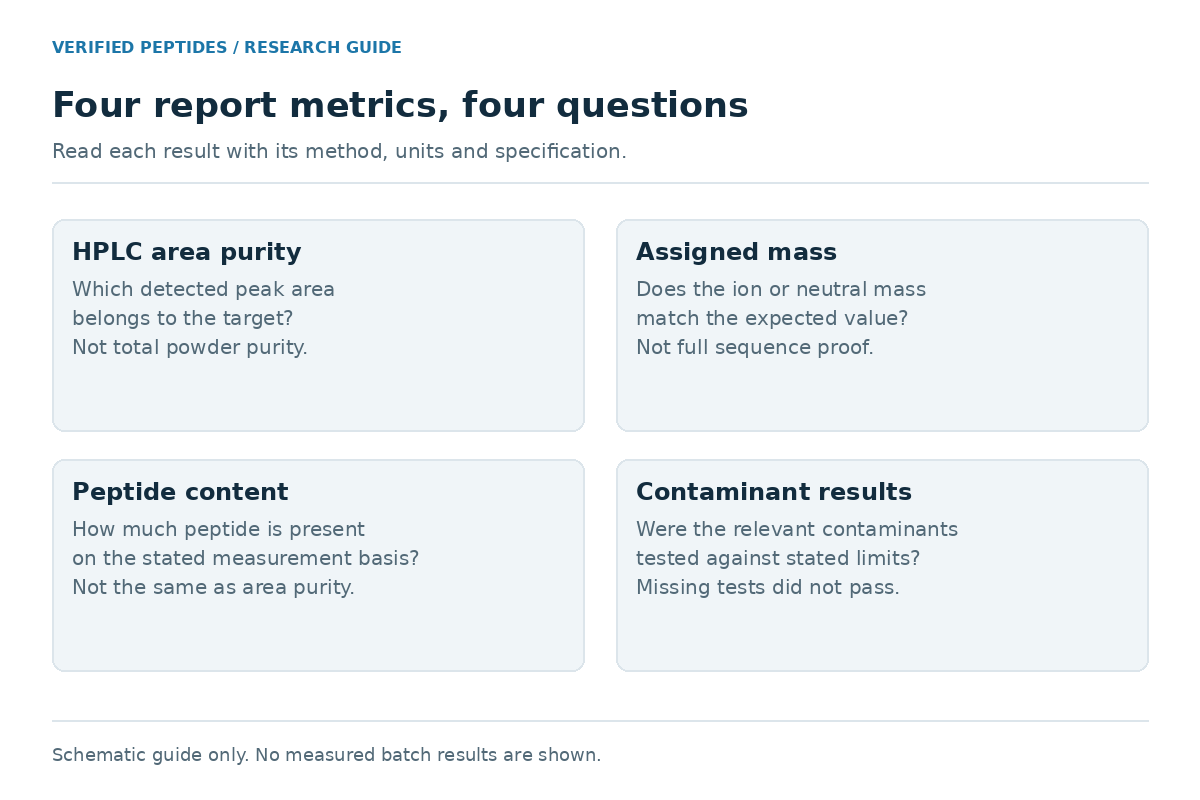
The core peptide report metrics are purity percentage, molecular weight accuracy, net peptide content, and contaminant results such as endotoxin and sterility. Each answers a different question. Microbial counts and sterility tests are not interchangeable, and an unreported test should not be assumed to have passed.
| Report metric | What it measures | What to check |
|---|---|---|
| Purity (%) | Target peptide share of UV-detected signal by HPLC | Meets the stated specification |
| Observed mass | Molecular weight by mass spectrometry | Matches the expected mass within the method’s accuracy |
| Net peptide content | Peptide fraction of the powder | Reported separately from purity |
| Endotoxin | Bacterial endotoxin level | Both the result and the limit are shown2 |
| Sterility or microbial tests | Viable microorganisms | Method and outcome are stated |
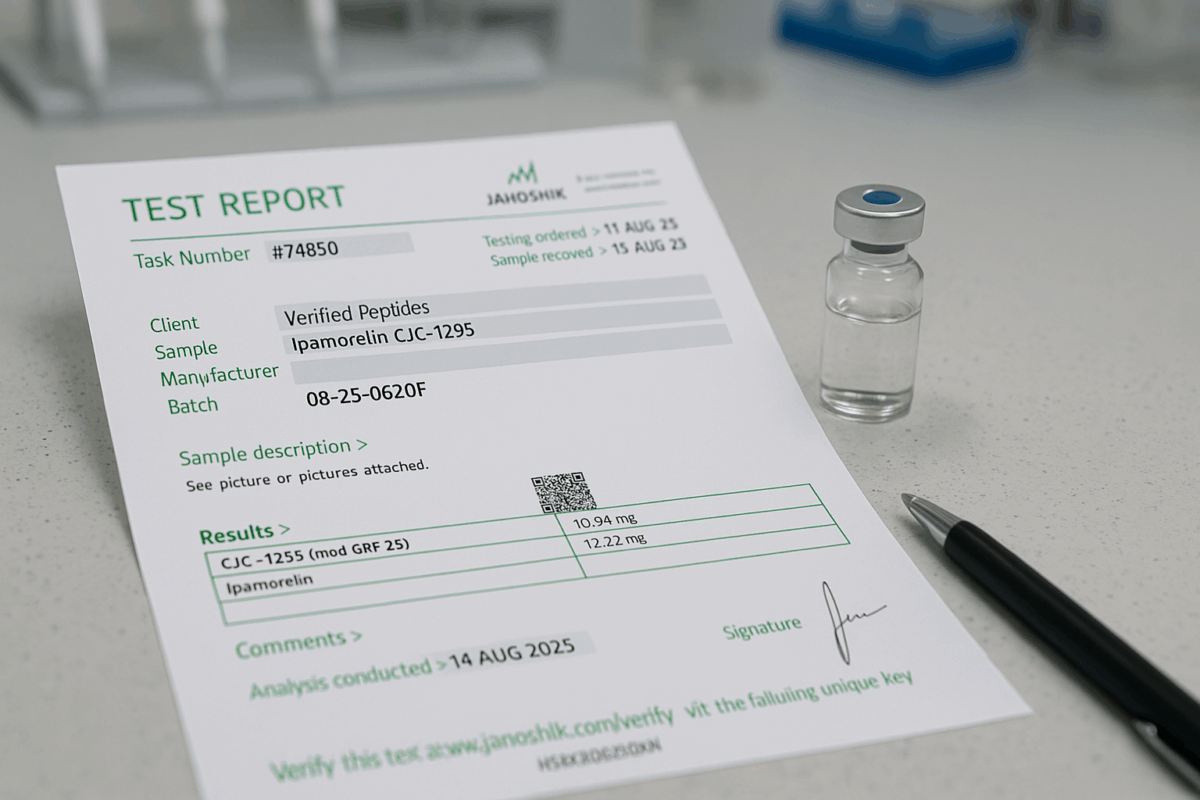
| Batch, date, and lab | Traceability | Matches your material |
Understanding Purity and Impurities
HPLC area purity is the assigned target peak’s share of integrated UV signal. Co-eluting or undetected impurities can be missed; the percentage is not the peptide fraction of the total powder.
Impurities are typically closely related sequences, such as sequences missing one or more amino acids, incompletely deprotected peptides, and oxidized forms, that arise during synthesis or storage.3, 4 Two batches with the same purity can still carry different impurities, so the impurity pattern is worth comparing, not just the headline number; see batch-to-batch variability.
Interpreting Mass Spectrometry and Chromatography Data
In mass spectrometry data, compare the assigned ion or deconvoluted neutral mass with the expected value. In chromatography data, check the assigned target peak, its integration, and any additional peaks; the largest peak is not automatically the target. Mass spectrometry supports identity assessment, while chromatography mainly addresses purity. A matching intact mass does not establish the full sequence or stereochemistry.
The expected mass is calculated from the amino acids in the sequence, as the sum of the amino acid residues plus the termini, and mass values can be reported as monoisotopic or average mass depending on instrument resolution, so compare like with like.5 Electrospray often shows the same peptide at several charge states, and the scanned mass-to-charge range must cover the expected ions, or the peptide will not appear at all; see electrospray ionization.
| Signal in the spectrum | What it usually means | What to do |
|---|---|---|
| Main peak at the expected mass | Identity is consistent with the sequence | Note whether the mass is monoisotopic or average |
| [M+Na]+ or [M+K]+ peaks | Normal adducts from sodium or potassium in water or buffers4 | Confirm the assignment; ask about unexpected or dominant adduct signals |
| A cluster of closely spaced peaks | Normal isotope pattern from heavier natural isotopes | Read the correct peak in the cluster |
| Several charge states | Normal for electrospray ionization | Confirm each converts to the same mass |
| An unexpected major mass | Possible wrong peptide, impurity, or modification | Ask the supplier; MS/MS can help identify it |
Modifications shift the observed mass by predictable amounts, whether they come from oxidation in a synthetic peptide or from post translational modifications in protein-derived peptides. On the chromatogram, a shoulder or an extra peak can signal a co-eluting impurity, and retention time should stay within the method’s expected variation when batches are compared under the same conditions.6 For more on peptide identification by mass, see peptide fragmentation patterns.
Additional Quality Metrics: Endotoxin Testing and More
Beyond identity and purity, many reports include endotoxin testing, sterility or microbial testing, and sometimes counter-ion or residual solvent results.
Endotoxin is commonly measured with LAL or recombinant reagent assays and reported against a limit.2 Counter-ions such as trifluoroacetate change how much of the powder is peptide, which is why net content is reported separately from purity.7 Some reports also list water content, often by Karl Fischer titration, residual solvents, or chiral purity; these are usually secondary, but they matter when exact amounts or stereochemistry are critical.8 Modified peptides, such as cyclized or labeled sequences, need evidence appropriate to the modification. An expected mass shift can support the assignment, but mass or retention time alone may not establish the modification site or connectivity.4 See endotoxin vs. sterility vs. bioburden for how these tests differ.
How to Read Certificates of Analysis (CoAs)
Read a CoA by matching the batch number first, then checking each reported metric against its specification, and finally confirming the lab, method, and dates. A CoA summarizes results; the underlying lab report and raw data, such as chromatograms and spectra, show how they were obtained. See certificates of analysis explained.
Common Red Flags in Lab Reports
Red flags are observable gaps or inconsistencies that make a report hard to verify. Published evaluations of research peptides have shown that stated purity does not always match independently measured purity, so these checks matter.9
- Purity reported with no chromatogram or method.
- Observed mass missing, or not compared with the expected mass.
- Batch number, test date, or lab details missing.
- Repeated identical detailed results or traces across batches; rounded values alone are not evidence of a problem.
- An endotoxin “pass” with no limit or units.
- A modification listed in the sequence but not confirmed by mass or another test.
- A report that cannot be traced back to the issuing lab.
Best Practices for Using Report Metrics in Research
Use report metrics actively: record them with your experiment, compare them across batches, and confirm anything critical independently.
Keep the CoA and raw data with your lab records, note batch numbers in methods sections, and compare purity, mass, and impurity patterns each time you reorder. When results matter for a key experiment, independent retesting adds confidence. An orthogonal check uses a complementary measurement, such as MS alongside HPLC-UV; repeating the same method is not itself orthogonal.9, 10 For how these methods work, see peptide separation by HPLC.
Key takeaways
- The core report metrics are purity, observed mass, net peptide content, and contaminant results.
- HPLC purity covers related impurities, not water, salts, or counter-ions.
- Mass spectrometry data should match the expected mass, with the mass type, charge states, and normal adducts considered.
- Gaps such as missing methods, raw data, or traceability are the clearest red flags.
Read every report as data to check, not a stamp to accept, and peptide verification becomes routine.
Frequently asked questions
What are report metrics in lab reports?
They are the measured values a lab report presents, such as purity percentage, observed mass, net content, and endotoxin results, each compared against a specification.
Why are purity levels important in peptide research?
Because impurities, often closely related sequences, can affect experimental results. Purity shows how much of the detected material is the target peptide.
How do you interpret mass spectrometry results?
Check the assigned ion’s mass-to-charge ratio or deconvoluted neutral mass against the expected value and method tolerance. Use the same mass convention and account for charge states. Sodium or potassium adduct peaks are common, but their assignments should still be checked; unexpected major masses can indicate impurities, missing amino acids, or modifications, including post translational modifications in protein-derived samples.
What should be included in a Certificate of Analysis?
At minimum, the product and batch number, test dates, methods, specifications, results for identity and purity, any contaminant tests, and the issuer’s details, with the performing laboratory identified for outsourced tests.
How can researchers spot unreliable lab reports?
Look for gaps: missing batch numbers, methods, raw data, or lab details, unexplained identical detailed results or traces across batches, or values without specifications. Rounded values can legitimately repeat. Reports that cannot be traced to a lab warrant caution.
All peptides discussed here are for research use only.
References
- National Institutes of Health. Guidance: Rigor and Reproducibility in Grant Applications (authentication of key biological and/or chemical resources). grants.nih.gov
- US Food and Drug Administration. Pyrogen and Endotoxins Testing: Questions and Answers (Edition 2). Guidance for industry, March 2026. fda.gov
- D’Hondt M, Bracke N, Taevernier L, et al. Related impurities in peptide medicines. Journal of Pharmaceutical and Biomedical Analysis. 2014;101:2-30. PubMed 25044089
- AAPPTec. Peptide Quality: Frequently Asked Questions. peptide.com
- Matrix Science. Mass accuracy and resolution (Mascot help documentation). matrixscience.com
- Mant CT, Chen Y, Yan Z, et al. HPLC analysis and purification of peptides. Methods in Molecular Biology. 2007;386:3-55. Full text
- Sikora K, Jaśkiewicz M, Neubauer D, Migoń D, Kamysz W. The role of counter-ions in peptides: an overview. Pharmaceuticals. 2020;13(12):442. PMC7761850
- Iris Biotech GmbH. How to Decipher a Certificate of Analysis (CoA). June 2025. iris-biotech.de
- Verbeke F, Wynendaele E, Braet S, D’Hondt M, De Spiegeleer B. Quality evaluation of synthetic quorum sensing peptides used in R&D. Journal of Pharmaceutical Analysis. 2015;5(3):169-181. PMC5762210
- International Council for Harmonisation. ICH Q2(R2) Validation of analytical procedures (scientific guideline, European Medicines Agency). ema.europa.eu