
Short answer
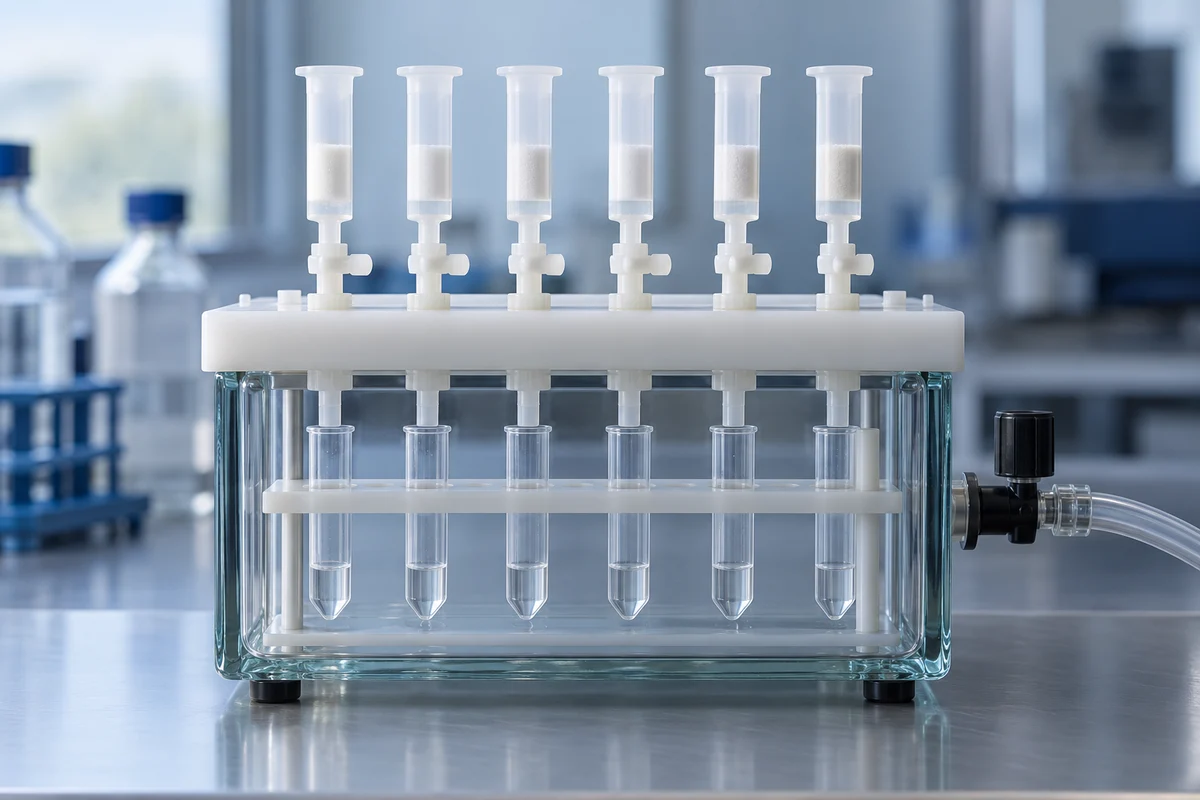
A solid-phase extraction (SPE) protocol cleans up and concentrates peptides by binding them to a sorbent, washing away salts and other interferences, and eluting them in a cleaner solvent. An optimized SPE protocol matches the sorbent and solvents to the peptide’s properties, which generally improves recovery, purity, and analytical reproducibility.
This guide covers the factors that shape an SPE protocol, how to choose a sorbent, a reproducible five-step workflow, and how to troubleshoot low recovery.
Understanding the Role of SPE in Peptide Purification
SPE is mainly a sample cleanup and concentration step, not a high-resolution purification method. It removes salts, buffers, and other interferences so that later analysis, such as LC-MS or MALDI, gives cleaner, more consistent data.1, 2 In peptide sample preparation, SPE usually sits between digestion or synthesis and analysis. Pipette-tip formats such as StageTips, described in a widely cited published protocol, are commonly used to desalt and concentrate small peptide amounts before mass spectrometry.1 For larger-scale peptide purification, chromatography does the fine separation; see chromatographic purification techniques.
Key Factors That Influence SPE Protocol Efficiency
Five factors usually decide whether the method works: sorbent chemistry, sample pretreatment, solvent composition, sample load, and flow rate.
- Sorbent chemistry
- Reverse-phase sorbents retain peptides by hydrophobicity; ion exchange sorbents retain them by charge.
- Sample pretreatment
- Acidifying the sample and keeping its organic content low commonly improves retention on reverse-phase SPE.
- Solvent composition
- The wash should remove interferences without eluting peptides, and the elution solvent should release them fully.
- Sample load
- Overloading can cause breakthrough and loss. One study found that under-loading C18 SPE plates improved reproducibility.3
- Flow rate
- Moving liquid through too quickly can reduce binding, while consistent flow improves repeatability.
Choosing the Right SPE Sorbent for Peptides
Choose the SPE sorbent by the peptide’s hydrophobicity and charge. C18 is a common starting point for moderately hydrophobic peptides, while polymeric and mixed-mode sorbents can retain more hydrophilic ones.
Polymeric reverse-phase sorbents have been reported to retain hydrophilic peptides better than C18, sometimes with greater loss of very hydrophobic peptides.3 Mixed-mode sorbents, which combine reverse-phase and ion exchange retention, retained small and hydrophilic peptides more effectively than conventional reverse-phase SPE in a published comparison.2 For a new peptide, testing two sorbents side by side on a small sample is often faster than troubleshooting one later.
Step-by-Step: Designing a Reproducible Solid-Phase Extraction Protocol
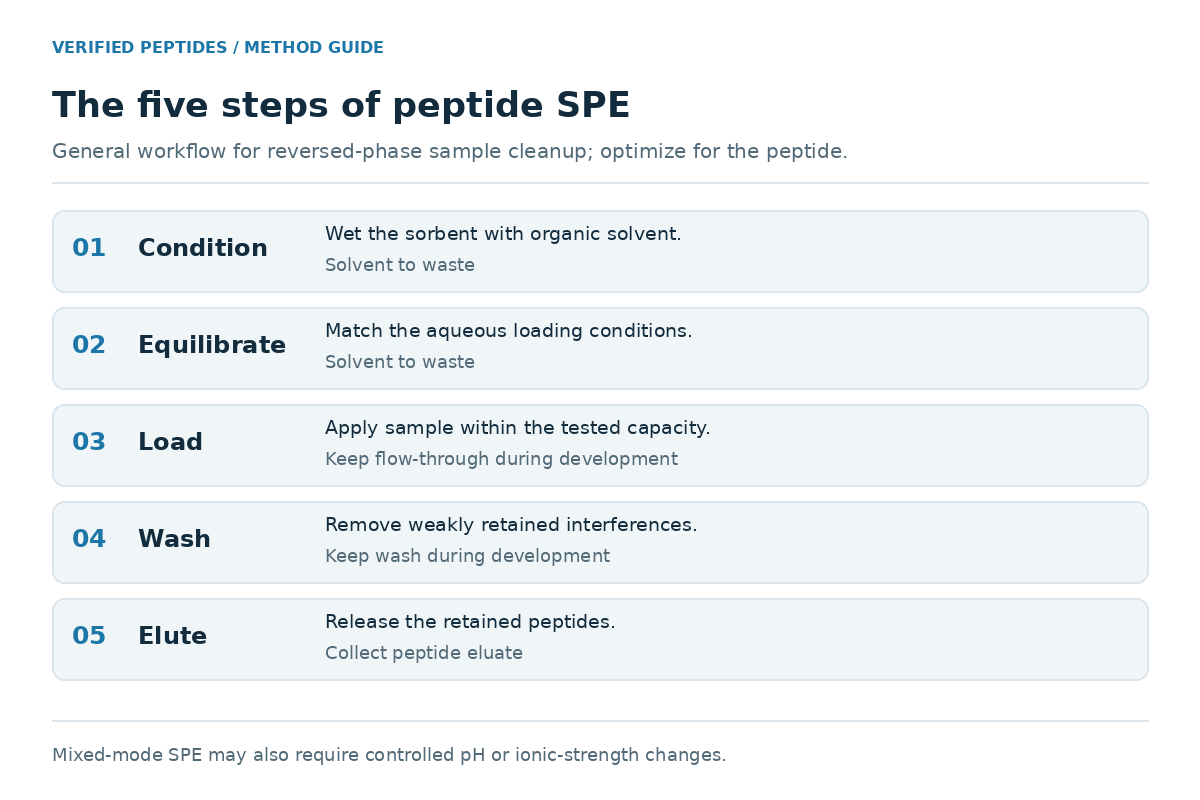
Most SPE protocols for peptide sample preparation follow five steps: condition, equilibrate, load, wash, and elute. Write each step down with solvents, volumes, and timing so the protocol runs the same way every time, and collect the flow-through and wash fractions during development to see where any peptide is lost. This is a development framework, not a validated recipe: select solvent percentages, volumes, pH, and load for the actual peptide and cartridge. Mixed-mode elution may need pH or salt changes as well as organic solvent.
- 1Condition Wet the sorbent with an organic solvent so it can interact with the sample.
- 2Equilibrate Rinse with a solvent similar to the sample, commonly acidified water.
- 3Load Apply the pretreated sample slowly so peptides bind.
- 4Wash Remove salts and weakly bound interferences without eluting the peptide.
- 5Elute Release peptides with conditions suited to the sorbent, then dry or dilute for analysis.
Common Pitfalls in Peptide SPE and How to Avoid Them
Most SPE problems trace back to weak retention, incomplete peptide elution, or interferences that the protocol does not remove. A short SPE troubleshooting log, noting which fraction contained the peptide, makes patterns easier to spot.
- Peptide in the flow-through. Retention was too weak. Check sample pH, lower the organic content of the sample, or try a more retentive sorbent.
- Peptide in the wash. The wash is too strong. Use a weaker wash solvent.
- Low signal after elution. Elution may be incomplete, but low signal can also reflect ion suppression or surface loss. Check recovery with a standard before changing solvent strength or adding a second elution.
- Sorbent dried out. Follow the sorbent instructions on wetting. Conventional silica C18 commonly needs to stay wetted through loading and washing; some polymeric phases tolerate drying.
- Detergents or polymers remain. Some interferences are not removed by reverse-phase SPE and need a separate cleanup step first.
Tips for Maximizing Recovery and Reducing Peptide Loss
To improve peptide recovery, limit surface losses, stay within sorbent capacity, and confirm that elution is complete.
- Use low-binding plastics
- Peptides can adsorb to tubes and tips, especially at low concentrations.
- Respect capacity
- Staying below the sorbent limit, or deliberately under-loading, can improve consistency.3
- Match elution strength
- Very hydrophobic peptides may need a stronger elution solvent than hydrophilic ones.
- Avoid over-drying
- Fully dried eluates can be harder to redissolve. See solubility troubleshooting.
Comparing C18 vs. Mixed-Mode SPE for Peptide Applications
C18 SPE is often straightforward for peptides with enough hydrophobic retention, while mixed-mode SPE adds ion exchange selectivity that helps with small, hydrophilic, or charged peptides.2
| Feature | C18 (reverse-phase SPE) | Mixed-mode SPE |
|---|---|---|
| Retention mechanism | Hydrophobic interaction | Hydrophobic interaction plus ion exchange |
| Well suited to | Moderately hydrophobic peptides | Small, polar, or charged peptides |
| Selectivity | Moderate | Additional charge selectivity; not always better recovery |
| Method development | Simpler | More variables, such as pH and ionic strength |
| Common use | Desalting and sample cleanup before LC-MS or MALDI | Cleaner extracts from complex samples |
When to Validate and Standardize Your SPE Workflow
Validate an SPE protocol before using it to compare samples or batches, and reassess its performance when the sorbent, solvents, or sample type changes. The extent of revalidation should match the effect of the change. Validation typically checks recovery, repeatability, and how cleanly interferences are removed, and running a known peptide standard through the full protocol is a practical way to measure analytical reproducibility. For context, see why laboratory validation matters.
- Sorbent type, format, and lot recorded.
- Conditioning, wash, and elution solvents defined in writing.
- Sample pretreatment step documented, including pH adjustment.
- Sample load within the tested capacity.
- Recovery and analytical reproducibility checked with a standard.
Key takeaways
- An SPE protocol is a cleanup and concentration step that prepares peptides for analysis.
- Sorbent choice, sample pretreatment, solvent strength, load, and flow rate decide most outcomes.
- C18 suits many moderately hydrophobic peptides; mixed-mode sorbents help with small, polar, or charged peptides.
- Document every step and validate with a standard before comparing samples.
A written, validated protocol is one of the simplest ways to make peptide sample preparation, and the data that follow, more consistent.
Frequently asked questions
What is an SPE protocol in peptide research?
It is a defined set of steps for binding peptides to a sorbent, washing away interferences, and eluting a cleaner, more concentrated sample. It is mainly used to prepare peptides for analysis.
How do I choose the right SPE cartridge for peptides?
Start from the peptide’s hydrophobicity and charge. C18 suits many moderately hydrophobic peptides, while polymeric or mixed-mode cartridges often work better for small, polar, or charged peptides.
What is the ideal solvent system for peptide SPE?
There is no single ideal system, but a common pattern is an acidified aqueous solvent for loading and washing and a higher proportion of organic solvent, often acetonitrile, for elution. The exact composition should be tested for each peptide.
How can I improve peptide recovery using SPE?
Use low-binding plastics, stay within sorbent capacity, adjust sample pH, and confirm complete elution. Checking the flow-through and wash fractions shows where loss occurs.
Are there SPE kits optimized for peptides?
Yes. Several laboratory suppliers offer cartridges, plates, and pipette-tip formats designed for peptide cleanup. Choose by sorbent chemistry and sample volume rather than by format alone.
All peptides discussed here are for research use only.
References
- Rappsilber J, Mann M, Ishihama Y. Protocol for micro-purification, enrichment, pre-fractionation and storage of peptides for proteomics using StageTips. Nature Protocols. 2007;2(8):1896-1906. doi:10.1038/nprot.2007.261
- Huang YP, Robinson RC, Dias FFG, et al. Solid-phase extraction approaches for improving oligosaccharide and small peptide identification with liquid chromatography-high-resolution mass spectrometry: a case study on proteolyzed almond extract. Foods. 2022;11(3):340. PMC8834518
- The use of under-loaded C18 solid-phase extraction plates increases reproducibility of analysis of tryptic peptides from unfractionated human plasma. Author manuscript, PubMed Central. PMC3369824