
Short answer
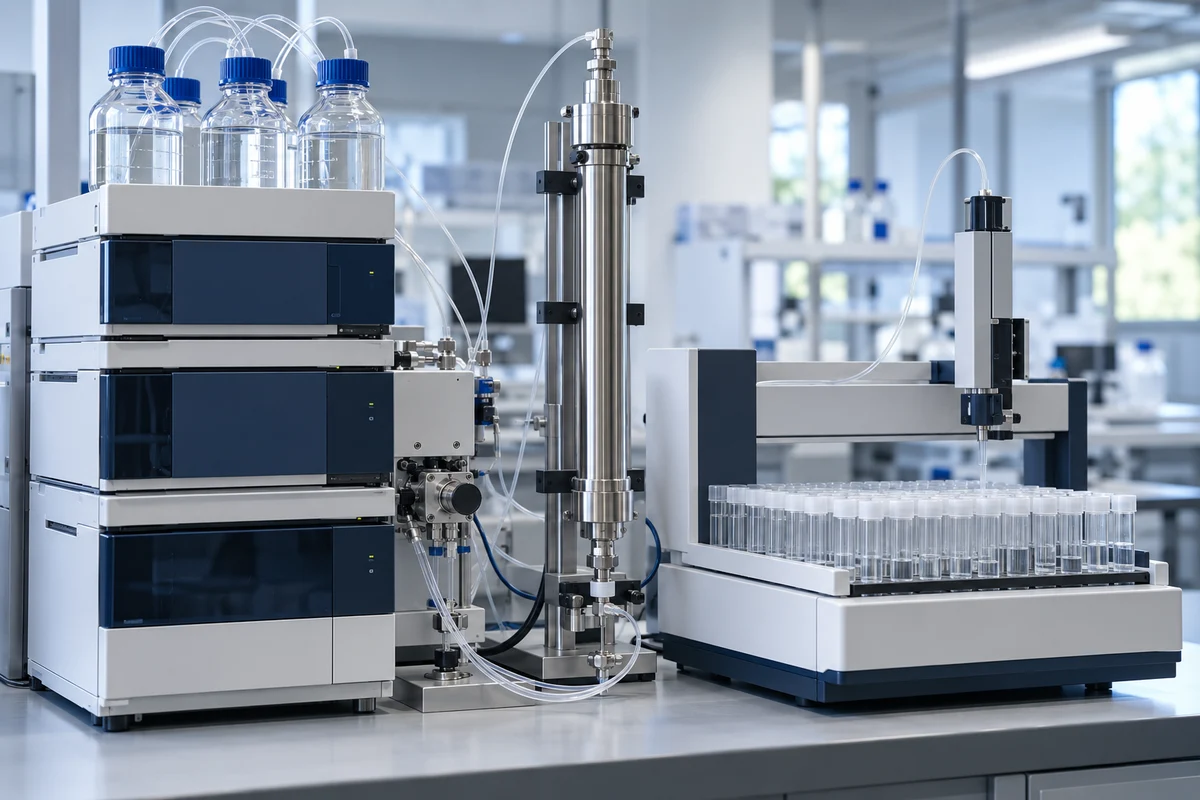
Peptide purification is the process of separating a target peptide from the impurities left after synthesis, such as truncated or modified sequences, reagents, and salts. Chromatographic techniques do most of this work: reverse-phase HPLC is used most widely, and ion exchange or size-exclusion chromatography add selectivity where needed.
This guide compares the main peptide separation methods, explains how to choose among them, and covers the pitfalls that commonly reduce purity or recovery.
Why Peptide Purity Matters in Analytical and Laboratory Research
Purity matters because impurities can change experimental results. Truncated sequences, deletion peptides, and modified forms often resemble the target closely, so they can interfere with assays or skew measurements.1 In peptide research, even a small amount of a closely related impurity can matter when results depend on binding behavior or analytical specificity, which is why many labs look for high-purity peptides backed by documented analytical data.
High-purity peptides also make work easier to reproduce. When the same purification and analytical methods are used across batches, results can be compared with more confidence, which is why batch-to-batch consistency is worth checking. Purity is commonly reported as an HPLC area percentage on a Certificate of Analysis (COA), ideally alongside mass spectrometry to support identity assessment. HPLC area percentage describes detected peaks under that method; it is not the percentage of peptide by total powder weight.
Overview of Chromatographic Peptide Purification Methods
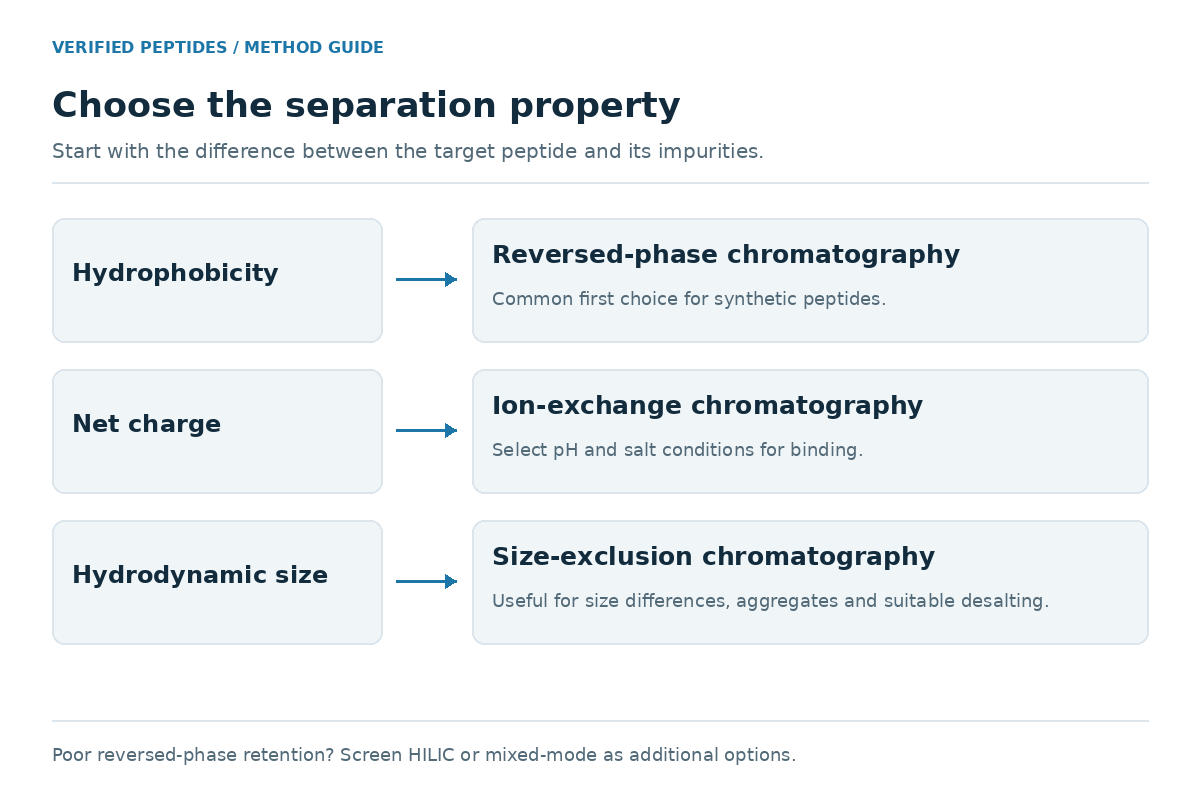
Most purification work relies on three chromatographic techniques, each separating by a different property: hydrophobicity, charge, or size.2
| Technique | Separates by | Typical peptide use | Main limitation |
|---|---|---|---|
| Reverse-phase chromatography (RP-HPLC) | Hydrophobicity | Primary purification and purity analysis | Very polar or aggregating peptides can be difficult |
| Ion exchange chromatography | Net charge | Charged peptides; a complementary step to reverse phase | Salts usually need removal afterward |
| Size-exclusion chromatography | Molecular size | Desalting, buffer exchange, aggregate checks | Limited resolution for similar-sized peptides |
| Mixed-mode or HILIC | Mixed-mode: combined interactions; HILIC: hydrophilic retention | Polar peptides poorly retained by reverse phase | Method development can take longer |
These peptide separation methods are often combined. Pairing techniques that separate by different properties, known as orthogonal methods, commonly removes impurities that one method alone would miss.2
Reverse-Phase HPLC: The Gold Standard for Peptide Purification
Reverse-phase HPLC is widely regarded as the standard method for purifying synthetic peptides because it offers high resolution and works across a broad range of sequences.2
In reverse-phase chromatography, peptides bind to a hydrophobic stationary phase, often C18, and elute as the proportion of organic solvent in the mobile phase increases. An acidic additive such as trifluoroacetic acid (TFA) is commonly used to sharpen peaks, although it can remain in the final material as a counter-ion.2, 3 Preparative runs isolate the target, while analytical runs measure the result. For method details, see peptide separation by HPLC.
Gradient design matters as much as the column. A shallower increase in organic solvent spreads closely eluting peptides apart, while a steeper one saves time, so many methods start with a broad scouting gradient and then narrow the range around the target peak.
Using Ion Exchange Chromatography for Charged Peptide Separation
Ion exchange chromatography separates peptides by net charge, so it works well when the target and its impurities carry different numbers of charged residues.2
Cation exchange binds positively charged peptides and is common because many peptides carry basic residues at low pH, while anion exchange binds negatively charged species. Peptides are typically released with increasing salt or a change in pH.2 The technique can also concentrate dilute samples, since peptides bind and then elute in a smaller volume. Because this mode separates by a different property than reverse-phase chromatography, it is often used as a complementary step, followed by desalting with a column or solid-phase extraction.
Size-Exclusion Chromatography: When Molecular Weight Matters
Size-exclusion chromatography separates by hydrodynamic size, so it is useful for size-based fractionation and aggregate assessment. Desalting and buffer exchange require a resin that separates the peptide from the salts; very small peptides may not be recovered well on a standard protein-desalting column.2 Larger molecules access fewer pores and usually elute earlier, while smaller molecules enter more of the pores and elute later.4 Similar-sized peptides tend to elute together, which limits resolution for closely related impurities. It can also help when characterizing peptide aggregation.
Method Selection: Matching Chromatography to Peptide Characteristics
Choose the method by the property that most clearly distinguishes your peptide from its impurities: hydrophobicity, charge, or size. In practice, the first method is often chosen from the sequence, and the second from the impurities that remain in the first chromatogram.
- Hydrophobic or mid-polarity
- Reverse-phase chromatography is usually the first choice.
- Highly charged or very polar
- Ion exchange, mixed-mode, or HILIC can retain what reverse phase misses.2
- Salts or aggregates present
- A size-based column helps with cleanup and aggregate assessment.
- Complex crude mixtures
- An orthogonal pair, such as ion exchange followed by reverse phase, often gives the cleanest result.
Solubility shapes the choice too. A peptide that will not dissolve in the starting mobile phase is hard to purify by any method, so check solvent compatibility during peptide sample preparation. See choosing solvents for hydrophobic and hydrophilic peptides.
Common Pitfalls in Peptide Purification and How to Avoid Them
Most problems come from overloading, poor solubility, peptide loss, degradation, or pooling fractions without checking them.
- Overloading the column. Broad, overlapping peaks often mean too much sample. Reduce the load or move to a larger column.
- Poor solubility or aggregation. Test solvents first and consider a different mode. See solubility troubleshooting.
- Low recovery. Peptides can stick to surfaces or remain on the column. Check wash and strip fractions before assuming loss.
- Degradation. Some residues oxidize or degrade under unsuitable pH or long processing. Work efficiently and use storage conditions supported by the peptide’s stability and solubility. See peptide stability across pH.
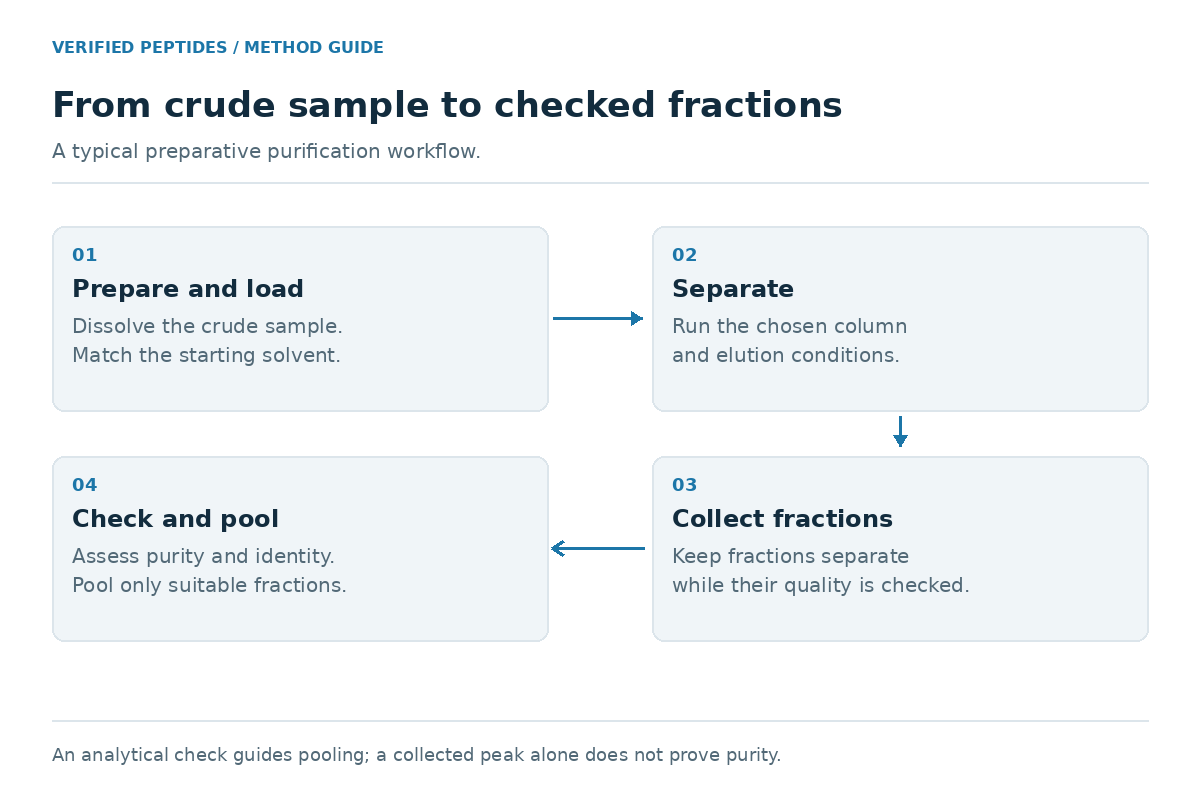
- Unchecked fractions. Pooling fractions without an analytical check can lower final purity. Purification and handling can also affect endotoxin load.
- Unconfirmed identity. A clean peak is not proof of the right sequence. Confirm identity after purification with mass spectrometry or sequencing.
Future Innovations in Chromatographic Peptide Purification
The main trends are more sustainable solvents, continuous chromatography, and greater automation.5
Preparative reverse-phase purification uses large volumes of solvent, so greener eluents and processes are being evaluated.6 Multicolumn countercurrent solvent gradient purification (MCSGP), a continuous approach that recycles partially separated fractions, has been studied as a way to improve yield and productivity, including with greener solvent systems.7 Improved column materials and automated systems continue to expand what analytical chemistry and purification labs can do. For most research labs, reverse-phase HPLC is likely to remain central, with these approaches mainly improving efficiency at larger scales.
Key takeaways
- Peptide purification separates the target from synthesis impurities, mostly with chromatographic techniques.
- Reverse-phase HPLC is the most widely used method; charge- and size-based modes add selectivity.
- Choose by hydrophobicity, charge, and size, and combine orthogonal methods for complex mixtures.
- Confirm results with analytical HPLC and mass spectrometry before relying on high-purity peptides in peptide research.
When reviewing a purified peptide, look for documented methods and batch-specific analytical results.
Frequently asked questions
What is peptide purification, and why is it important?
It is the separation of a target peptide from synthesis byproducts, salts, and related impurities. It matters because impurities can affect experimental results and make findings harder to reproduce.
Which chromatography method is best for peptide separation?
Reverse-phase HPLC is generally the most effective single method for synthetic peptides. For charged, very polar, or complex samples, pairing it with ion exchange or another mode often works better.
How do reverse-phase and ion exchange chromatography differ in peptide work?
Reverse phase separates by hydrophobicity using an organic solvent gradient, while ion exchange separates by charge using salt or pH changes. Because they work on different properties, they are often used together.
What are the challenges in peptide purification?
Common challenges include closely related impurities, poor solubility, aggregation, low recovery, and degradation. Careful method selection and analytical checks of fractions address most of them.
All peptides discussed here are for research use only.
References
- D’Hondt M, Bracke N, Taevernier L, et al. Related impurities in peptide medicines. Journal of Pharmaceutical and Biomedical Analysis. 2014;101:2-30. PubMed 25044089
- Mant CT, Chen Y, Yan Z, et al. HPLC analysis and purification of peptides. Methods in Molecular Biology. 2007;386:3-55. Full text
- Sikora K, Jaśkiewicz M, Neubauer D, Migoń D, Kamysz W. The role of counter-ions in peptides: an overview. Pharmaceuticals. 2020;13(12):442. PMC7761850
- JoVE Core Cell Biology. Types of Column Chromatography. jove.com
- Ferrazzano L, Catani M, Cavazzini A, et al. Sustainability in peptide chemistry: current synthesis and purification technologies and future challenges. Green Chemistry. 2022. doi:10.1039/d1gc04387k
- Isidro-Llobet A, Kenworthy MN, Mukherjee S, et al. Sustainability challenges in peptide synthesis and purification: from R&D to production. Journal of Organic Chemistry. 2019;84(8):4615-4628. doi:10.1021/acs.joc.8b03001
- Prestia R, Hauri D, Sponchioni M, Vogg S, Müller-Späth T. Counter-current chromatography enables use of green solvents for productive peptide purification processes. Separations. 2026;13:195. doi:10.3390/separations13070195