

Short answer
A peptide blend COA should identify every peptide, explain the purity evidence and report measured content for each component when a ratio is claimed. A suitable chromatogram can separate the expected components, but peak-area percentages alone do not establish each peptide’s purity or the blend’s mass ratio.
This guide explains why blends are tested differently, what a complete blend COA includes, how to read a blend chromatogram, and the red flags specific to blends.
Quick Answer: How a Blend COA Differs From a Single-Peptide COA
A blend COA has to answer three questions: which peptides are present, what evidence supports their quality, and how much of each is in the vial. That requires component-level documentation as well as testing of the finished blend.
On a single-peptide COA, HPLC commonly reports chromatographic purity and mass spectrometry provides identity evidence for that lot. A blend needs those questions addressed for every component, plus a quantitative check when the labeled proportions matter.1, 2 A blend COA keeps that structure but repeats it for every component and adds a ratio check.
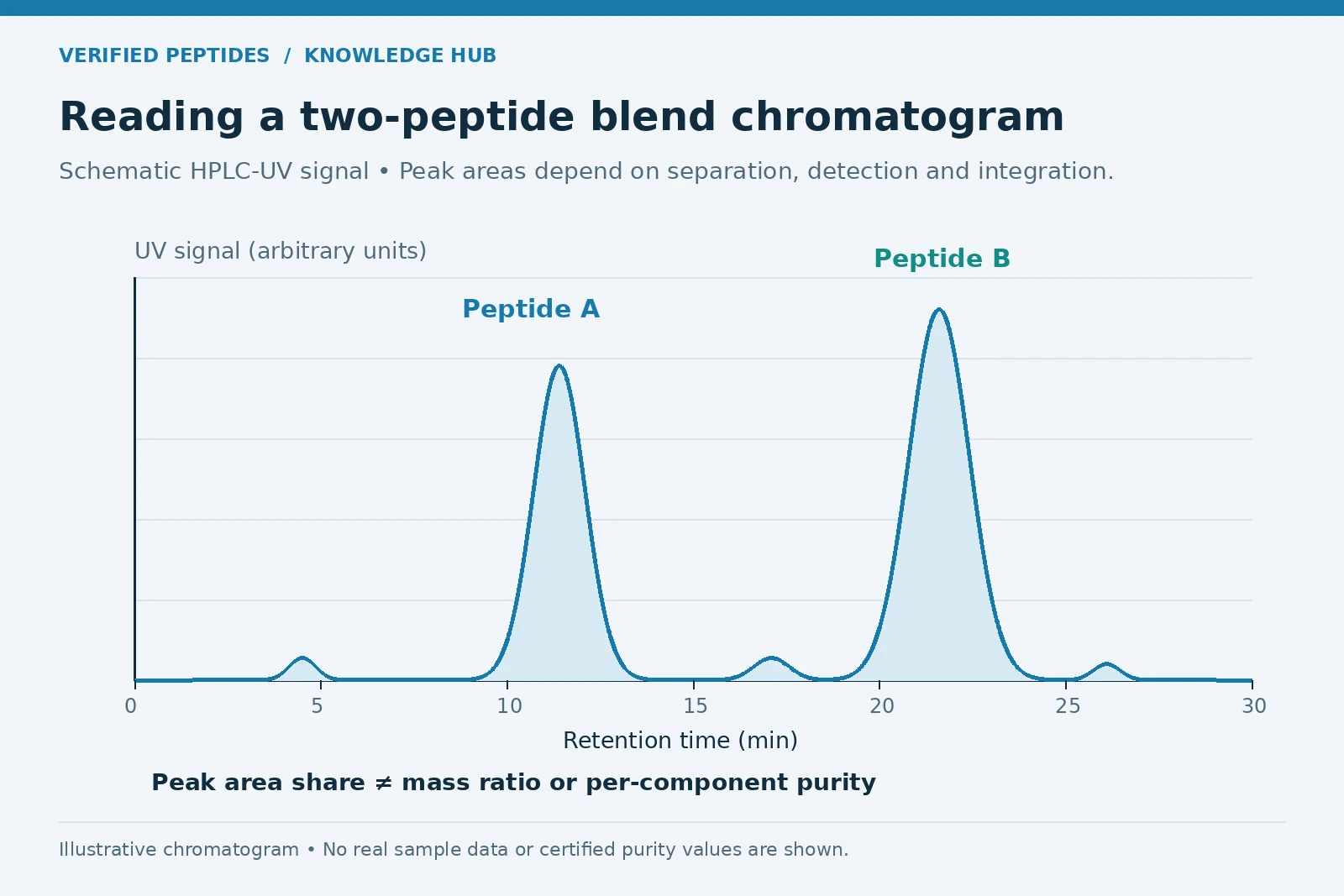
A resolved blend may show a main peak for each peptide. However, intended components are not impurities of one another. A peptide’s share of the total blend peak area is therefore not its purity, and different detector responses mean equal areas do not necessarily mean equal masses.
Why Peptide Blends Exist in the Research Peptide Market
Blends exist mainly for convenience: one vial to store, track, and reconstitute instead of several. Common research catalog examples include BPC-157 with TB-500, Ipamorelin with CJC-1295 (No DAC), GLOW (GHK-Cu, BPC-157, and TB-500), and KLOW (KPV, GHK-Cu, BPC-157, and TB-500).
Some study designs also examine defined combinations of peptides side by side. A pre-combined vial keeps the stated proportion the same from one experiment to the next, provided the ratio has actually been verified analytically, which is covered below.
Combining peptides in one vial adds quality control complexity, so it is worth understanding before evaluating the documentation. For single-peptide basics, see certificates of analysis for peptides.
What Makes Blend QC More Complex Than Single-Peptide QC
Every analytical question must be answered once per peptide, without one peptide hiding another.
| Challenge | Why it matters |
|---|---|
| Identity per component | Each peptide needs appropriate identity evidence, commonly LC-MS with observed versus theoretical mass1 |
| Purity per component | Document starting-component purity and use a suitable final-blend method to assess relevant impurities |
| Ratio | Confirming the labeled proportions requires quantitative analysis, not just identification |
| Co-elution | Peptides with similar hydrophobicity can exit the column together, so one peak may hide another2 |
| Shared-vial stability | Peptides stored together can behave differently than alone; lyophilization generally improves long-term stability, but it does not remove this risk3 |
How Peptide Blends Are Tested for Purity
RP-HPLC is commonly used to separate the intended peptides from detectable impurities. Ask whether reported purity values describe the individual starting materials or the finished blend. In a finished blend, a per-component purity value needs a defined calculation and a method that can assign the relevant impurities; simply dividing one main peak by the total blend area is not that calculation.2, 4 When two peptides behave similarly on the column they can co-elute, so peak assignment generally needs support from mass spectrometry or from reference standards of each peptide run under the same conditions.
Why Identity Testing Matters for Every Component
A peak at the expected retention time is not proof of identity. A published study of 98 synthetic quorum-sensing peptides found substantial discrepancies between requested and measured purity, including an incorrect main compound in one sample. That study supports checking analytical evidence, but it does not establish the failure rate for all research peptide suppliers.1 Comparing observed with theoretical mass for every component is what catches this kind of error, and in a blend it has to be done once per peptide.
A matching intact mass is useful evidence, not a complete sequence check. Some different sequences and isomers share the same mass; additional analysis may be needed to distinguish them.
Ratio work adds a further layer: it depends on calibration standards and a validated quantitative HPLC method, described in the ratio section below.5
What a Complete Peptide Blend COA Should Include
A complete blend COA builds on the standard single-peptide elements and adds per-component detail.
- A batch or lot number tied to the blend itself.
- Each peptide’s name, sequence, molecular formula, and molecular weight.
- Mass spectrometry (often LC-MS) for each peptide, with observed versus theoretical mass.
- An HPLC chromatogram showing all expected peaks, each labeled or assignable to a peptide.
- Purity evidence for each starting component, plus a clearly explained final-blend impurity assessment. Any final-blend per-component purity claim needs a defined, suitable method.
- Net peptide content for each component, ideally with the resulting ratio.6
- Final-blend endotoxin and microbial results appropriate to the intended research; sterility evidence if the material is specified as sterile.7, 8, 9
- HPLC method details: column, gradient, mobile phases, and wavelength.
- The third-party lab’s name, the analysis date, and a verifiable signature or identifier.
For a two-peptide blend, look for identity evidence for both components, traceable purity documentation, measured content for each when a ratio is claimed, and relevant microbial or endotoxin results for the finished lot. Starting-material reports alone do not establish the final blend’s composition.
Why Per-Component Purity Matters
A single combined figure can conceal an impure starting component or an unresolved impurity. The useful question is how the lab assessed each component’s quality and the finished blend’s impurities. Ask for the calculation and supporting data, not just two percentages.
Net Peptide Content and Counter-Ions
Net peptide content is reported separately from purity because a lyophilized peptide powder is not all peptide. Synthetic peptides purified by RP-HPLC are typically isolated as salts, commonly trifluoroacetate (TFA) or acetate, and the powder can also hold residual water. For that reason, peptide mass fraction, counter-ion content, and water content are determined as separate quality attributes.6 In a blend, the components can carry different counter-ion and water levels, so equal gross weights do not necessarily mean equal peptide amounts. For background, see acetate and other counter-ions.
How to Read a Blend HPLC Chromatogram
In a method that resolves a two-peptide blend, expect two assigned main peaks; a four-peptide blend may have four. Treat that as a useful pattern, not a guaranteed peak count: co-elution, degradation, multiple forms or method conditions can change the picture.
In reversed-phase HPLC, peptides separate largely by hydrophobicity, so closely matched peptides can need a longer or more refined gradient to resolve.2 Each main peak should be labeled or matched to a peptide in an identification table, and smaller impurity peaks should be a minor share of total area. Method details should accompany the chromatogram so retention times can be interpreted; see HPLC analysis in peptide characterization.
Red Flags on a Peptide Blend COA
Red flags are gaps that leave part of the blend unverified.
- A combined “blend purity” percentage with no explanation of component purity evidence or final-blend impurity testing.
- The expected number of peaks, but no labels or assignments.
- Mass spectrometry data for only one of the peptides, which suggests incomplete testing.
- No stated ratio, or a ratio that does not match the labeled amounts.
- Ratio claims supported only by the formulation record, with no measured content per component.
- The same chromatogram image across several blend products.
- Sterility or endotoxin results that appear copied from another product, another lot, or a single-peptide report.
- No third-party lab named, or a lab that cannot be independently verified.
How Blend Ratio Is Typically Verified
By quantitative HPLC: each peptide’s peak area is compared against a calibration curve built from a reference standard of that peptide, then converted to mass per vial and compared with the labeled ratio.
This is more demanding than purity-only analysis, because the quantitative method generally needs to be validated, showing it is specific and accurate for each component in the presence of the others.4, 5 Not every supplier does it on every batch, so it is reasonable to ask whether per-component net content is measured for each lot.
Example: A Vial Labeled 10 mg and 10 mg
Take a vial labeled as containing 10 mg of BPC-157 and 10 mg of TB-500. The label states the intended content of the vial. A COA supports that statement only if it reports a measured content value for each peptide, ideally on a net peptide basis, together with the method used. A formulation or batch record shows what was intended to go into the vial, not what the finished lot actually contains, so a label ratio is most credible when backed by analytical data rather than the manufacturing recipe alone.
Practical Evaluation Checklist for Blend Buyers
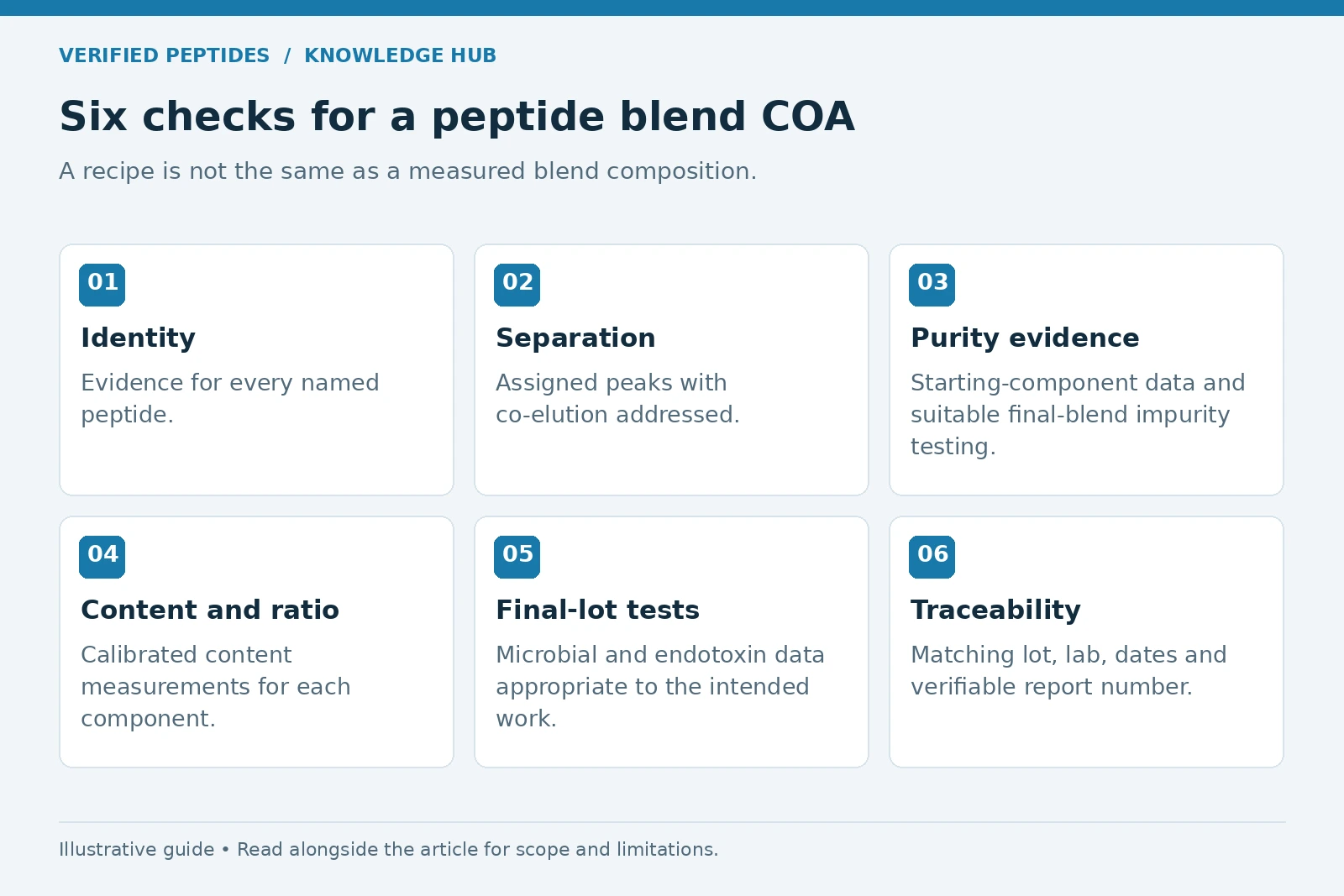
Run any blend certificate through six checks before accepting a lot for research.
- 1Identity Each peptide named and supported by appropriate identity data.
- 2Peaks Assigned peaks and evidence that important co-elution is addressed.
- 3Purity Starting-component evidence and a suitable final-blend impurity assessment.
- 4Content Net content per component documented.
- 5Final lot Relevant endotoxin and microbial results obtained for the final blend, not borrowed from another lot.7, 10
- 6Traceability Batch-specific, dated, and issued by a named third-party lab.
If anything is missing, request it from the supplier before the lot is used. Verified Peptides publishes batch-specific third-party reports, including for blends, in its Lab Reports archive.11
Frequently Asked Questions About Peptide Blend COAs
How is a peptide blend COA different from a single-peptide COA?
A blend COA must address every component’s identity and quality, then support the finished blend’s labeled composition. A single-peptide COA has only one intended peptide to assess.
What does a blend HPLC chromatogram look like?
When the method resolves the blend, it shows assigned main peaks for the intended peptides plus any detected impurities. The expected number of main peaks is a useful check, but it cannot rule out co-elution.
How are peptide blends tested for purity?
Typically with RP-HPLC supported by identity data. Review starting-component purity and final-blend impurity testing. A main peak’s share of total blend area is not that component’s purity.
What should a BPC-157 and TB-500 blend COA include?
Identity evidence for both peptides, starting-component purity documentation, a suitable final-blend chromatogram, measured content or ratio data, and microbial or endotoxin results appropriate to the research.
Why does per-component purity matter on a blend COA?
It helps show whether each starting peptide met its specification. For a finished blend, ask how the lab assigns impurities and calculates any per-component value; a blended peak-area average is not enough.
How is blend ratio verified analytically?
Quantitative HPLC against calibration standards determines each peptide’s mass per vial, which is then compared with the labeled ratio.
Are sterility and endotoxin tests on a blend the same as on a single peptide?
The compendial methods are the same, but method suitability (LAL inhibition/enhancement, and bacteriostasis/fungistasis for sterility) must be shown for the blend matrix itself, and results must come from the final blend lot.
What are the biggest red flags on a blend COA?
Unexplained purity figures, missing identity or content data, unresolved peaks, reports from another lot, or a testing laboratory and report that cannot be verified.
All peptides discussed here are for research use only.
Key Takeaways
- Blend documentation should address every component’s identity, purity evidence and measured content.
- A useful blend COA combines component documentation with suitable final-blend analytical and microbial tests.
- Peak-area share is not per-component purity or a calibrated mass ratio.
- Every component needs identity evidence; retention time or intact mass alone has limits.
- A label ratio is credible when the COA reports measured content per peptide, not just the formulation record.
- The extra analytical complexity should be reflected in the documentation.
Before accepting a multi-peptide lot for research, compare its blend COA against this checklist.
References
- Verbeke F, Wynendaele E, Braet S, D’Hondt M, De Spiegeleer B. Quality evaluation of synthetic quorum sensing peptides used in R&D. Journal of Pharmaceutical Analysis. 2015;5(3):169-181. PMC5762210
- Mant CT, Chen Y, Yan Z, et al. HPLC analysis and purification of peptides. Methods in Molecular Biology. 2007;386:3-55. PMC7119934
- Wang W. Lyophilization and development of solid protein pharmaceuticals. International Journal of Pharmaceutics. 2000;203(1-2):1-60. PubMed 10967429
- United States Pharmacopeia. General Chapter <621> Chromatography (system suitability). USP-NF. uspnf.com
- International Council for Harmonisation. ICH Q2(R2) Validation of analytical procedures (scientific guideline, European Medicines Agency). ema.europa.eu
- Sikora K, Jaśkiewicz M, Neubauer D, Migoń D, Kamysz W. The role of counter-ions in peptides: an overview. Pharmaceuticals. 2020;13(12):442. PMC7761850
- United States Pharmacopeia. General Chapter <85> Bacterial Endotoxins Test. USP-NF. uspnf.com
- United States Pharmacopeia. General Chapter <71> Sterility Tests (harmonized with Ph. Eur. 2.6.1 and JP 4.06). USP-NF. usp.org
- United States Pharmacopeia. General Chapter <61> Microbiological Examination of Nonsterile Products: Microbial Enumeration Tests. USP-NF. usp.org
- US Food and Drug Administration. Pyrogen and Endotoxins Testing: Questions and Answers. Guidance for industry (revised), March 2026. fda.gov
- Verified Peptides. Lab Reports (batch-specific third-party test reports). verifiedpeptides.com