
Short answer
Low-pressure liquid chromatography (LPLC) separates peptides on columns packed with relatively large particles, using gravity or a simple pump instead of a high-pressure system. It often trades some resolution for simpler equipment and lower cost, which makes it well suited to desalting, cleanup, and first-pass purification before a final HPLC step.
This guide explains how LPLC works, where it fits in peptide research, what limits its resolution, and how to choose between LPLC, HPLC, and related methods.
What Is Low-Pressure Liquid Chromatography (LPLC)?
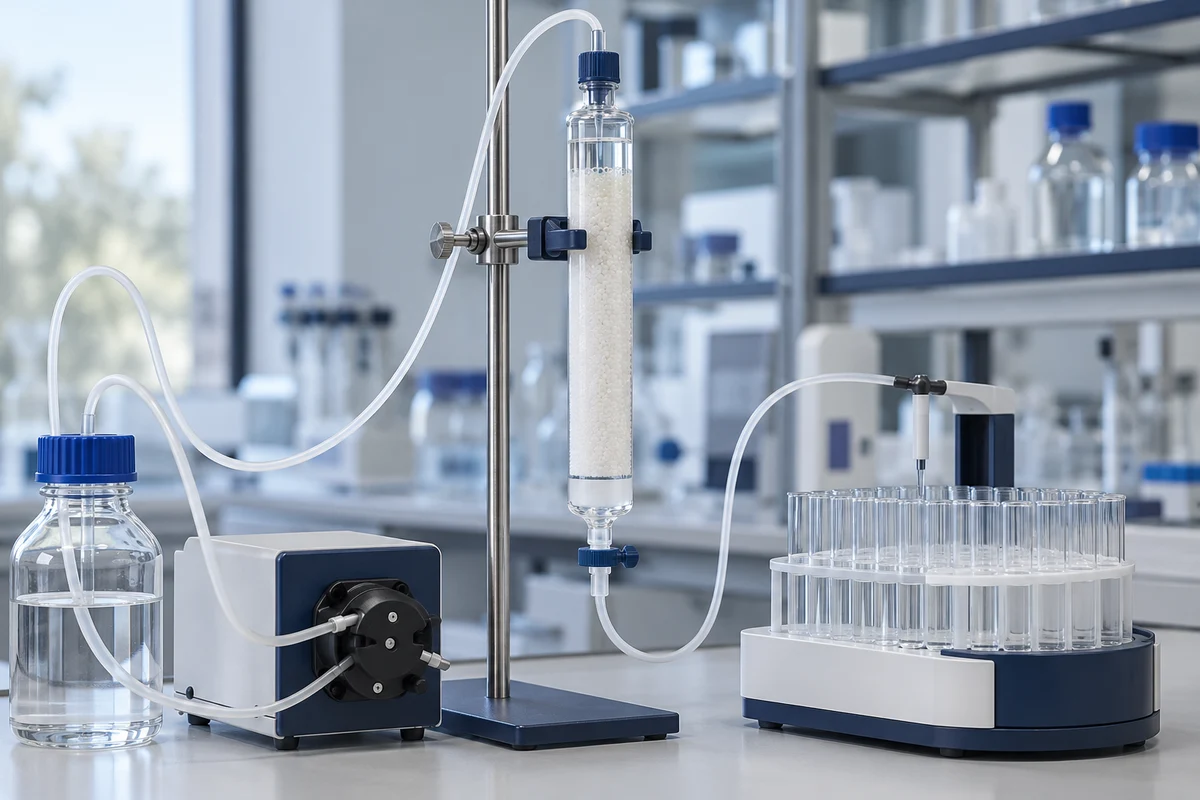
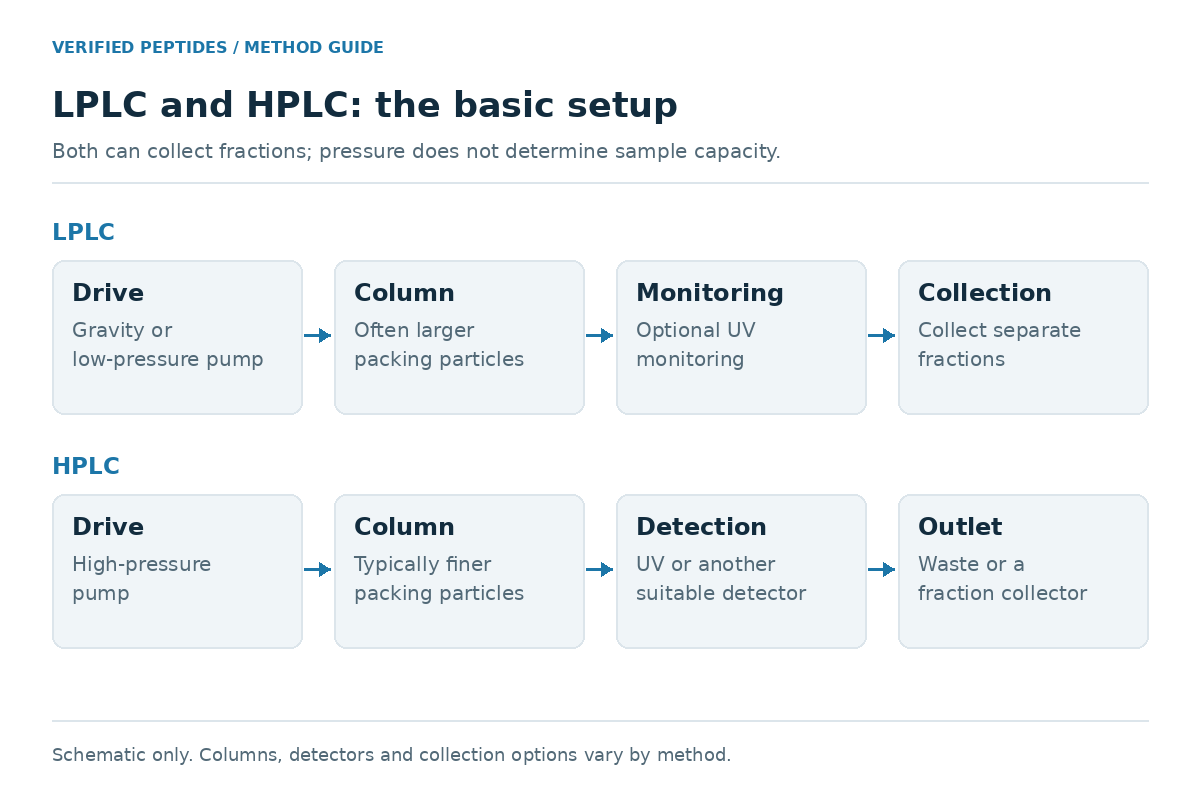
Low-pressure liquid chromatography is column chromatography run at modest pressure, usually driven by gravity or a peristaltic pump, with comparatively large stationary-phase particles. Setups commonly range from a simple gravity column to a pump with a fraction collector.1
The principle is the same as in any liquid chromatography. A sample moves through a packed column in a liquid mobile phase, and its components separate according to how strongly they interact with the stationary phase. The difference is particle size: larger particles let liquid flow without high back pressure, but they generally produce broader peaks than the fine particles used in high-performance liquid chromatography (HPLC).1, 2
FPLC and flash systems can operate across different pressure ranges; they are not a single pressure category between LPLC and HPLC.1 Many labs use “LPLC” loosely for any non-HPLC column work, so it helps to check the pressure rating and particle size of the specific setup.
Why LPLC Works Well for Peptide Purification and Analysis
LPLC works well for peptides when the goal is bulk cleanup rather than fine separation. Crude synthetic peptides contain the target alongside salts, scavengers, and synthesis byproducts, and a low-pressure step can remove much of that material before a higher-resolution polish.3 Three low-pressure modes are commonly used with peptides:
- Size exclusion
- Separates by hydrodynamic size. Desalting works only when the resin separates the peptide from the smaller salts.4
- Ion exchange
- Separates by net charge, which helps when peptides differ in acidic or basic residues.5
- Reversed-phase flash
- Separates by hydrophobicity on larger-particle C18 media, often as a first pass on crude synthetic peptides.2
Larger preparative columns can accept more sample, but capacity depends on resin chemistry, bed volume, sample properties, and the required separation—not on low pressure alone. That makes it useful when the next step needs a cleaner, more concentrated starting material rather than a finished product.
Key Advantages of LPLC Over High-Pressure Methods
The main advantages of a simple LPLC setup are lower equipment cost and accessible preparative operation. Both low-pressure chromatography and HPLC can be scaled up. The main trade-off is resolution.
| Factor | LPLC | HPLC |
|---|---|---|
| Particle size | Larger particles | Smaller particles |
| Operating pressure | Gravity or a low-pressure pump | High-pressure pumps |
| Resolution | Lower; broader peaks | Higher; sharper peaks |
| Sample capacity | Depends on bed volume and resin | Analytical to large preparative scale |
| Equipment cost | Generally lower | Generally higher |
| Typical peptide role | Desalting, cleanup, first-pass purification | Final purification and purity analysis |
A vendor white paper reports examples of high sample loading and shorter purification with reversed-phase flash chromatography, with some loss of resolution. These are method-specific results, not a universal capacity advantage.2 In one academic application note, a flash method separated a deletion peptide from its parent sequence with efficiency comparable to preparative HPLC, in less time.6 These gains depend on the sample. When impurities closely resemble the target, the extra resolution of HPLC is usually still needed. For a broader comparison, see high- vs. low-pressure chromatography in peptide studies.
LPLC in Academic and Industrial Peptide Research Settings
LPLC appears in both academic and industrial labs, mostly as an upstream step that makes later purification or analysis easier.
In academic labs, low-pressure columns are common for desalting, buffer exchange, and fractionating mixtures before mass spectrometry or HPLC. The equipment is affordable and simple to maintain, which suits shared facilities and teaching labs.1 In industrial and biopharma research, low- and medium-pressure steps are often used to reduce the load on preparative HPLC. Removing most impurities first can shorten the high-resolution step and save time and solvent.3
Low-pressure liquid chromatography also scales in a straightforward way. Scale-up commonly increases column diameter while keeping bed height, linear flow velocity, and loading per unit bed volume similar. Pump flow, detector range, and pressure limits still need checking; larger equipment may be required.
Either way, the final material is typically confirmed by analytical HPLC and mass spectrometry, because LPLC is not designed to document final purity or identity on its own. Batch-specific results are usually reported on a Certificate of Analysis (COA).
Optimizing LPLC for Peptide Resolution: What to Watch For
Resolution in LPLC depends mostly on column choice, sample load, flow rate, and mobile phase conditions. Small adjustments to each can noticeably sharpen peaks.
- Match the mode to the peptide. Choose size exclusion, ion exchange, or reversed phase based on the property that most clearly separates the target from its impurities.
- Avoid overloading. Exceeding column capacity commonly causes broad, overlapping peaks.
- Control the flow rate. Start within the resin manufacturer’s recommended flow range. Excessively fast flow can reduce separation, while very slow flow can broaden peaks and extend run time.
- Use gentle gradients. Gradual changes in salt or organic solvent often separate closely eluting peptides better than steep steps.
- Check solubility first. Peptides that aggregate or precipitate on the column lose both resolution and recovery. See solubility troubleshooting.
- Pack and equilibrate carefully. Uneven packing or incomplete equilibration can distort peaks.
Monitoring fractions by UV absorbance and confirming key fractions by analytical HPLC helps catch problems before fractions are pooled.5
Is LPLC Right for Your Peptide Workflow?
LPLC is a good fit when you need affordable preparative cleanup and can follow it with a high-resolution check. It is usually not enough on its own when the target must be separated from near-identical impurities.
Decision Guide: Lab Needs, Throughput, and Budget
- 1What does the sample need? Desalting or bulk cleanup points to LPLC; final purity work points to HPLC.
- 2How much material, how often? For larger loads, compare appropriately sized preparative systems, including both flash and preparative HPLC.
- 3What does the budget allow? Limited budgets often start with LPLC and reserve HPLC time for final checks.
When to Use LPLC vs. HPLC or Other Methods
| Goal | Typically choose | Why |
|---|---|---|
| Desalting or buffer exchange | LPLC (size exclusion) | Useful if the resin suits the peptide size |
| First-pass cleanup of crude peptide | LPLC or flash (reversed phase) | Preparative cleanup; check capacity and selectivity |
| Separating near-identical impurities | HPLC (reversed phase) | Higher resolution |
| Final purity analysis | Analytical HPLC with mass spectrometry | Quantitative, documented results |
| Small-volume cleanup before MS | Solid-phase extraction | Quick, small-scale sample preparation |
Many workflows combine the two: a low-pressure or flash step first, then HPLC for the final polish and analysis.3 For a wider view of options, see chromatographic approaches to peptide purification.
Key takeaways
- LPLC separates peptides on larger-particle columns at low pressure, often trading some resolution for simpler equipment and lower cost.
- It is well suited to desalting, buffer exchange, and first-pass cleanup of crude peptides.
- HPLC is generally still needed for near-identical impurities and for final purity analysis.
- Combining LPLC with HPLC often saves time and solvent compared with HPLC alone.
Low-pressure liquid chromatography earns its place as a practical cleanup and scale-up tool. Choose the method by what the sample needs next, then confirm results with analytical testing.
Frequently asked questions
What is low-pressure liquid chromatography used for?
It is mainly used for preparative work such as desalting, buffer exchange, and first-pass purification. In peptide research, it often cleans up crude material before HPLC or mass spectrometry.
Is LPLC suitable for peptide separation?
Yes, for many tasks. It generally separates peptides that differ clearly in size, charge, or hydrophobicity, but closely related impurities usually need HPLC.
How does LPLC differ from HPLC?
LPLC uses larger particles at low pressure, while HPLC uses smaller particles at high pressure. As a result, HPLC typically gives sharper separation, and a simple LPLC setup can cost less. Capacity depends on column size, resin, and sample.
What are the benefits of LPLC in a research setting?
The main benefits are affordable equipment, simple operation, and flexible preparative formats. Used as a cleanup step, it can also reduce the workload on HPLC.
All peptides discussed here are for research use only.
References
- Bio-Rad Laboratories. Introduction to Column Chromatography Methods and Instrumentation. bio-rad.com
- Biotage. Achieve Highly Pure Peptides with High Performance Flash Chromatography (white paper). biotage.com
- Duggan AR, Mehrotra A. High performance flash chromatography: an alternative technique to rapidly and efficiently purify crude synthetic peptides. 12th Australian Peptide Conference; 2017. Abstract
- JoVE Core Cell Biology. Types of Column Chromatography. jove.com
- Mant CT, Chen Y, Yan Z, et al. HPLC analysis and purification of peptides. Methods in Molecular Biology. 2007;386:3-55. Full text
- D’Aloisio V, Coxon C. Reversed Phase Flash Chromatography Purification of Peptide-Peptoid Hybrids (application note). Heriot-Watt University; 2021. researchportal.hw.ac.uk