
Short answer
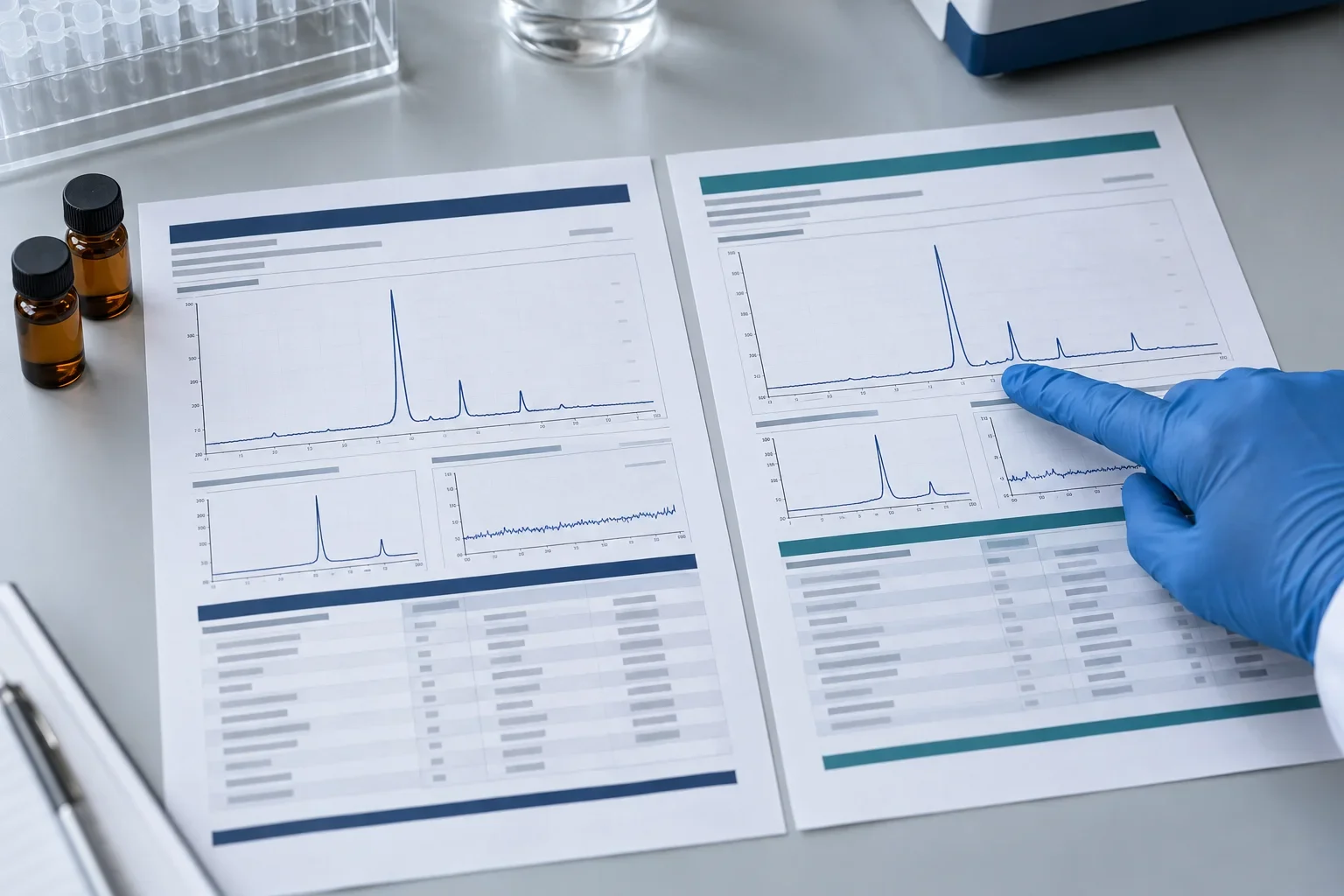
Peptide batch testing measures defined quality attributes in samples linked to one production lot. A useful program specifies what to test, how to select representative samples, which limits apply, and how results are reviewed before release. Independent testing adds an outside check; suitable methods and a documented sampling plan make the evidence meaningful.
In short, each lot needs its own evidence: a report from one batch says little about the next.
Why Batch Testing Is Critical in Peptide Research
Batch testing is critical because every synthesis and purification run can differ slightly, and only a test of the specific lot shows what a researcher is actually using. The impurity profile, and especially the peptide content, can vary from batch to batch even when protocols have not changed.1 Closely related impurities, such as sequences missing an amino acid, are inherent to peptide synthesis and can affect experimental results.2 For research-grade peptides, a batch-specific test is also the most direct way to authenticate a key chemical resource, as NIH expects.3
What Is Batch Testing in Peptide Production?
Batch testing is the analysis of a sample from one defined production batch, with results tied to that batch number. US regulations define a batch as a quantity of material intended to have uniform quality within specified limits, made under a single manufacturing order; a lot is a batch or an identified part of one.4 The batch number links the vial on the bench to its report and manufacturing history. Batch release testing is the set of tests a batch must pass against its specification, meaning its list of tests and acceptance criteria, before it is released for use.5
How a Peptide Batch Is Tested, Step by Step
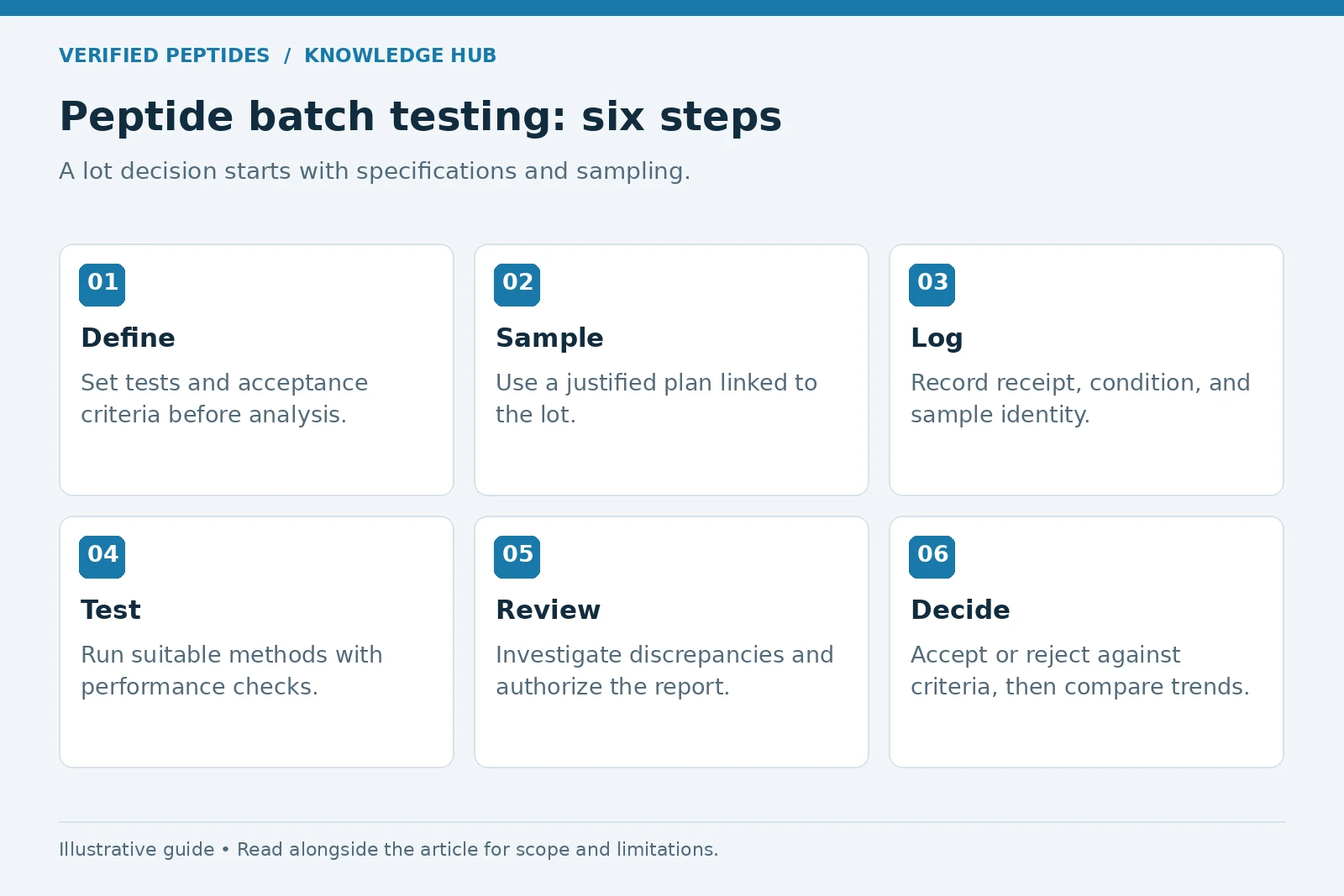
A batch is tested by sampling it representatively, analyzing the sample with validated methods, and issuing a lot-linked report that supports an accept or reject decision.
- 1Define the specification. Tests and acceptance criteria are fixed before sampling.5
- 2Take a representative sample. The sample should stand for the whole lot and be labeled with the lot number, date, and who collected it.6
- 3Log and prepare it. The lab assigns a unique ID and weighs the material under controlled humidity, since many peptides absorb moisture.7, 8
- 4Run validated methods. HPLC, mass spectrometry, and other tests run with system suitability checks.9, 10
- 5Issue the report. It names the lab, the method, and who authorized it, and states that results relate only to the items tested.7
- 6Release and compare. The lot is accepted or rejected, and results are compared with earlier lots to spot drift.
The Role of Independent Testing in Ensuring Objectivity
Independent testing separates analysis from the seller, but it still needs impartiality safeguards and representative sampling. A technically sound internal laboratory can also produce reliable results. For a comparison of roles and controls, see in-house vs. third-party peptide testing.
How Independent Labs Help Prevent Research Errors
Testing can identify problems before a lot enters an experiment. Mass spectrometry supplies identity evidence; content measurements help avoid concentration errors; and appropriate endotoxin tests can identify a confounding factor in cell-based work. Each method has limits, so select tests for the material and intended experiment.11112
Key Quality Metrics Measured in Peptide Batch Testing
Most peptide batch testing covers identity, purity, net peptide content, and contaminants. Each method has blind spots, which is why reports combine several.
| Metric | Typical method | What it can miss |
|---|---|---|
| Identity | Mass spectrometry11 | Same-mass variants, such as leucine for isoleucine or D- for L-amino acids8 |
| Purity | HPLC with UV detection13, 14 | Impurities hidden under the main peak; water and salts8, 14 |
| Net peptide content | Amino acid analysis1 | Sequence order11 |
| Structure (if specified) | NMR spectroscopy | Becomes harder to interpret for longer peptides8 |
| Water, counter-ions, solvents | Karl Fischer titration; ion or gas chromatography11 | Peptide-related impurities |
| Endotoxin | LAL or recombinant reagent assays, in endotoxin units (EU)15, 16 | Living microorganisms12 |
| Microbes | Microbial enumeration reports counts such as CFU; sterility testing reports growth/no growth under its conditions.17, 18 | Endotoxin left by dead bacteria12 |
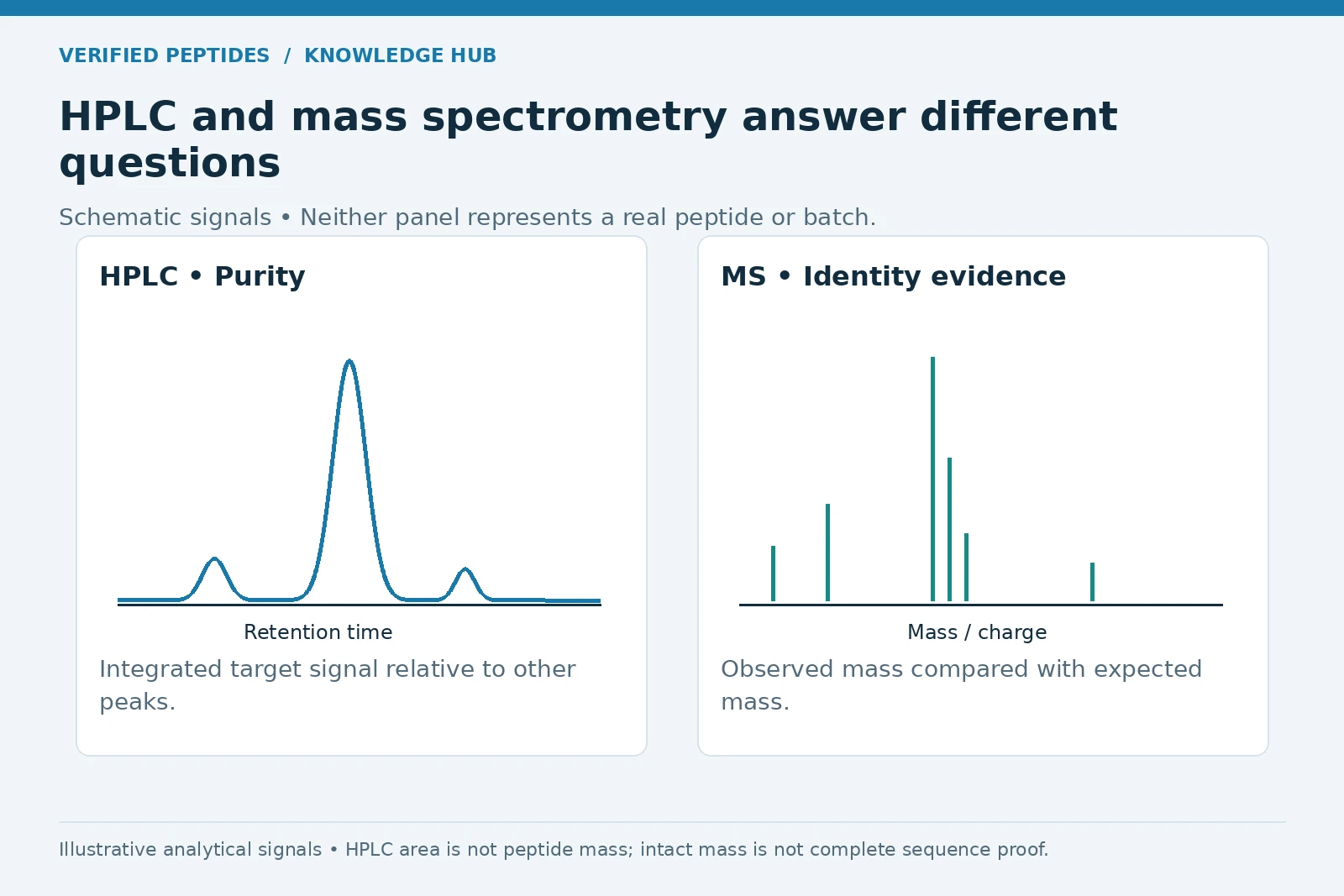
HPLC area percent is the target peak’s share of the integrated detector signal under stated conditions. It is not the fraction of all powder mass that is peptide, and co-eluting or undetected impurities can be missed. Read the chromatogram and method alongside the number. See peptide COAs explained.14
Lot Sampling vs. an Unlinked Sample Result
A single tested sample can support batch testing if its identity and selection are justified. The distinction is not “one sample versus a batch”; it is whether a documented sampling plan connects the result to the lot. Ask how many containers or locations were sampled, why they were chosen, and whether testing covered bulk peptide or final filled vials. No sample result proves that every vial is identical.467
| Aspect | Documented lot sampling | Unlinked or unexplained sample |
|---|---|---|
| Results describe | The tested sample, with a justified basis for assessing the lot | Only the item analyzed |
| Traceability | Lot number, date, and report ID | Lot identity or sampling basis missing |
| Across lots | Comparable when methods stay the same | Cannot show whether later lots match |
How Consistency Impacts Research Outcomes
Consistent material removes one source of experimental variation. Changes in purity, content, or contamination can shift results even when the experimental protocol stays the same, but material consistency alone cannot guarantee reproducibility.
An Illustrative Scenario: Same Purity, Different Results
Illustrative example: lot A is 80% net peptide content and lot B is 65%. Dissolving 1 mg of gross powder per mL gives 0.80 mg/mL peptide from A and 0.65 mg/mL from B—18.75% less peptide from B. This calculation applies to gross powder mass. If the COA already gives measured peptide mg per vial, use that amount and do not correct it again. Similar HPLC purity does not resolve this content difference.
How Often Should Peptide Batches Be Tested?
Review batch-specific evidence for every lot before use. This does not necessarily mean a researcher must commission duplicate testing when suitable supplier reports already exist. Additional tests or retesting should follow the material’s risk, condition, retest guidance, and the needs of the experiment:5, 20
- Long storage or a passed retest date.5, 21
- Exposure to heat, air, or moisture; peptides with Cys, Met, or Trp oxidize readily.21, 22
- A change in synthesis, raw materials, purification, or site.5
- A new impurity peak, a shifted value, or results that do not fit.
Compare methods and reporting bases across lots. Using the same lab can simplify this, but does not guarantee comparability; another qualified lab can also provide comparable results through suitable method verification or transfer.9
Choosing a Reputable Independent Testing Laboratory
Look for relevant peptide expertise, suitable methods, sample traceability, and clear reporting. Verify the scope of any claimed accreditation. The full checklist is in our in-house vs. third-party testing guide.
What Peptide Testing Labs Do and How to Evaluate Them
Peptide testing labs are analytical laboratories that test identity, purity, content, and contaminants and report results against a specification; contract labs commonly offer LC-MS identity, LC-UV purity, amino acid analysis, residual solvents, sterility, endotoxin, and stability testing.23 ISO/IEC 17025 accreditation is granted for a defined scope, so check that it covers the tests on the report.24 Also look for:
- Reports tied to a batch number, date, and unique report ID.
- Supporting chromatograms and spectra, with traceable original data retained by the lab.
- Participation in proficiency testing, where labs analyze the same material and compare results.25
- Comparable methods and reporting bases across batches, with changes explained.
Common Methods Used in Peptide Batch Testing
The core methods are HPLC for purity and mass spectrometry for identity, supported by amino acid analysis, Karl Fischer titration, endotoxin assays, and microbial tests. Because each misses something, a common, robust approach pairs orthogonal methods, meaning methods based on different principles.8 A typical set is a selective, validated HPLC method, mass spectrometry for identity, and a content method, with contaminant tests added for the intended application. For how methods are validated, see why laboratory validation matters.
Addressing Contamination and Impurities Early
Batch testing can detect the contaminants and impurities covered by the methods used; it cannot rule out everything. Related peptide impurities may arise during synthesis or storage, while microbes and endotoxin require their own tests. Lyophilization does not reliably remove peptide-bound TFA or establish low endotoxin. See endotoxin, sterility, and bioburden.2, 1511, 1912
Batch Testing for Regulatory and Compliance Requirements
Research-use documentation requirements depend on the material and setting. Pharmaceutical rules provide examples of formal release controls: US drug-product GMP requires testing against specifications, and EU medicinal-product batches have Qualified Person certification requirements. These scopes should not be applied automatically to all research-use peptides.2026
Research labs can borrow that logic without claiming GMP status: expect a lot-linked report for every batch, periodically confirm a supplier’s results with an independent lab, and keep reports with experimental records to support publications and audits. For how supplier documentation fits in, see what researchers need to know about COAs. The Verified Peptides Lab Reports archive lists third-party results by batch number.27
Frequently Asked Questions
What is batch testing in peptide production?
It is the analysis of a representative sample from each production lot to confirm identity, purity, content, and contaminant limits before release, with results tied to the batch number.
Why is independent batch testing important?
It adds a separate check of supplier claims. Its reliability still depends on sample selection, suitable methods, and impartial reporting.
How often should peptide batches be tested?
Obtain suitable batch-specific results for every lot. Consider additional testing after a relevant storage excursion, a passed retest date, a process change, or an unexplained result; the need and test panel depend on the risk.
What does peptide purity mean in research?
Usually it refers to HPLC area percent: the target peak’s share of the integrated signal. It is not the total peptide mass fraction and can miss co-eluting or undetected material.
Can independent testing detect contaminants in peptides?
Yes, if the right tests are run: endotoxin assays, microbial tests, and impurity profiling each detect different contaminants, and none replaces another.
All peptides discussed here are for research use only.
Key Takeaways
- Batch testing confirms that each specific lot matches its specification.
- A justified sampling plan and lot traceability connect the tested sample to a batch decision; they do not prove every vial is identical.
- Independent labs add objectivity; pair HPLC with mass spectrometry and a content method.
- Review each lot, and use risk-based follow-up testing when storage, process changes, or unexpected results warrant it.
- Check that a lab’s ISO/IEC 17025 scope covers the tests, and that methods stay the same across lots.
Ask for the batch report every time a new lot arrives.
References
- AAPPTec. Peptide Quality: Frequently Asked Questions. peptide.com
- D’Hondt M, Bracke N, Taevernier L, et al. Related impurities in peptide medicines. Journal of Pharmaceutical and Biomedical Analysis. 2014;101:2-30. PubMed 25044089
- National Institutes of Health. Guidance: Rigor and Reproducibility in Grant Applications (authentication of key biological and/or chemical resources). grants.nih.gov
- US Code of Federal Regulations. 21 CFR 210.3, Definitions (batch, lot, lot number, representative sample). ecfr.gov
- US Food and Drug Administration / ICH. Q7 Good Manufacturing Practice Guidance for Active Pharmaceutical Ingredients (sections 7.3 testing of materials, 11.2 testing, 11.5 stability monitoring, 11.6 expiry and retest dating, 13 change control, and glossary). fda.gov
- US Code of Federal Regulations. 21 CFR 211.84, Testing and approval or rejection of components, drug product containers, and closures. ecfr.gov
- National Institute of Standards and Technology, Office of Weights and Measures. ISO/IEC 17025 Crosswalk: Reporting the Results (clause 7.8 report contents). February 2018. nist.gov
- Verlander M, Rode H. Control strategies for synthetic therapeutic peptide APIs, Part I: analytical considerations. BioPharm International. 2014;27(3). biopharminternational.com
- International Council for Harmonisation. ICH Q2(R2) Validation of analytical procedures (scientific guideline, European Medicines Agency). ema.europa.eu
- United States Pharmacopeia. General Chapter <621> Chromatography (system suitability). USP-NF. uspnf.com
- Bachem. Quality Control of Amino Acids & Peptides: A Guide. Knowledge center. bachem.com
- Magalhães PO, Lopes AM, Mazzola PG, Rangel-Yagui C, Penna TCV, Pessoa A Jr. Methods of endotoxin removal from biological preparations: a review. Journal of Pharmacy and Pharmaceutical Sciences. 2007;10(3):388-404. J Pharm Pharm Sci
- Mant CT, Chen Y, Yan Z, et al. HPLC analysis and purification of peptides. Methods in Molecular Biology. 2007;386:3-55. PMC7119934
- Bachem. What does HPLC purity mean? FAQ. bachem.com
- US Food and Drug Administration. Pyrogen and Endotoxins Testing: Questions and Answers. Guidance for industry (revised), March 2026. fda.gov
- United States Pharmacopeia. General Chapter <85> Bacterial Endotoxins Test. USP-NF. uspnf.com
- United States Pharmacopeia. General Chapter <71> Sterility Tests (harmonized with Ph. Eur. 2.6.1 and JP 4.06). USP-NF. uspnf.com
- United States Pharmacopeia. General Chapter <61> Microbiological Examination of Nonsterile Products: Microbial Enumeration Tests. USP-NF. uspnf.com
- Sikora K, Jaśkiewicz M, Neubauer D, Migoń D, Kamysz W. The role of counter-ions in peptides: an overview. Pharmaceuticals. 2020;13(12):442. PMC7761850
- US Code of Federal Regulations. 21 CFR 211.165, Testing and release for distribution. ecfr.gov
- US Code of Federal Regulations. 21 CFR 211.87, Retesting of approved components, drug product containers, and closures. ecfr.gov
- GenScript. Peptide Storage and Handling Guidelines. genscript.com
- Eurofins BioPharma Product Testing. Peptides Testing Services. eurofins.com
- ANSI National Accreditation Board (ANAB). What Is Laboratory Accreditation? The ANSI Blog. blog.ansi.org
- Klemm K. Ensuring the Validity of Results in ISO/IEC 17025:2017. ANSI National Accreditation Board (ANAB), The ANSI Blog, July 2021 (updated May 2025). blog.ansi.org
- European Commission. EudraLex Volume 4, Annex 16: Certification by a Qualified Person and Batch Release. October 2015. health.ec.europa.eu
- Verified Peptides. Lab Reports (batch-specific third-party test reports). verifiedpeptides.com