

Short answer
A peptide certificate of analysis (COA) records test results for a specific batch. To read one, match the lot number to your vial, then check identity, HPLC purity, peptide content, and any contaminant tests against their stated limits. Finally, verify the issuing lab and report ID. A COA supports a quality decision; it does not guarantee every vial or every untested attribute.
Need only the field-by-field checklist for a peptide COA? See the 12 non-negotiables.
What Is a Certificate of Analysis (COA)?
A certificate of analysis (COA, sometimes written CoA) is a record of test results for one batch of material, showing whether it met its specifications. A specification is simply the list of tests a material must pass and the limits for each one, so a COA works like a scorecard for one batch.1 Because each batch is made to be uniform within set limits, a COA describes the batch that was tested, not every batch sold under the same product name.
COAs are issued by the manufacturer’s quality department, by an independent analytical lab, or by a distributor passing on one of those reports. When a reseller reissues a certificate, it should still name the lab that did the testing and refer back to the original manufacturer’s certificate.1 For peptides, a COA usually reports identity by mass spectrometry and purity by HPLC (high-performance liquid chromatography), plus other tests where performed.2
What Does a Certificate of Analysis Prove?
A COA documents what was tested and reported for an identified sample or batch. Confirming it with the issuing lab helps establish authenticity. It does not cover other lots, unlisted tests, or changes during later storage and shipping. Whether the tested sample represents the material you received depends on the sampling plan and lot traceability.
Why Certificates of Analysis Matter in Scientific Research
Certificates of analysis matter because they are the main written evidence that research-grade materials are what they claim to be. Most labs cannot re-test every reagent they receive, so the COA for a lab-tested batch is how they know what was checked and against which limits.
COAs also support reproducibility. Funders such as NIH expect key chemical resources to be authenticated,3 and recording the lot number and COA results lets other labs judge and repeat the work, and helps you troubleshoot when results look unexpected. A COA on file also keeps your records consistent when you move from one lot to the next.
What’s Included in a COA? Key Data Points to Review
A complete COA ties the results to one batch, shows each test with its method, limit, and result, and says who tested and approved the batch. No single rule sets the contents of a research COA, but the fields below are the ones most commonly found on a peptide COA.
| COA field | What it tells you |
|---|---|
| Product name and lot number | What the material is, and the code that ties every result to one batch1 |
| Dates | When the batch was tested, and a retest or expiry date where one applies |
| Identity (mass spectrometry) | Whether the main component has the expected molecular mass2 |
| Purity (HPLC) | The target peak’s share of the integrated detector signal under the stated method. It is not the percentage of the vial’s total mass that is peptide.4 |
| Net peptide content | Peptide mass fraction, or a separately measured amount such as mg per vial. Check the units and measurement basis; these are different from HPLC area percent.5 |
| Contaminant tests | Endotoxin (in endotoxin units, EU) or microbial results, where tested6 |
| Methods and limits | How each test was run and the result it had to meet |
| Lab details and approval | Who tested the batch, a report number, and a signature or verifiable code |
HPLC purity and net peptide content answer different questions. HPLC area percent compares the target peak with other integrated peaks; it can miss co-eluting impurities and material the detector does not measure. Net content accounts for how much peptide is present relative to water, counter-ions, and other non-peptide mass. If the report already gives measured peptide mg per vial, do not apply a content-percentage correction again.5
For the full standard a peptide COA should meet, see what a good peptide COA should include: 12 non-negotiables.
Key COA Terms: Assay, Impurity Profile, Lot Number
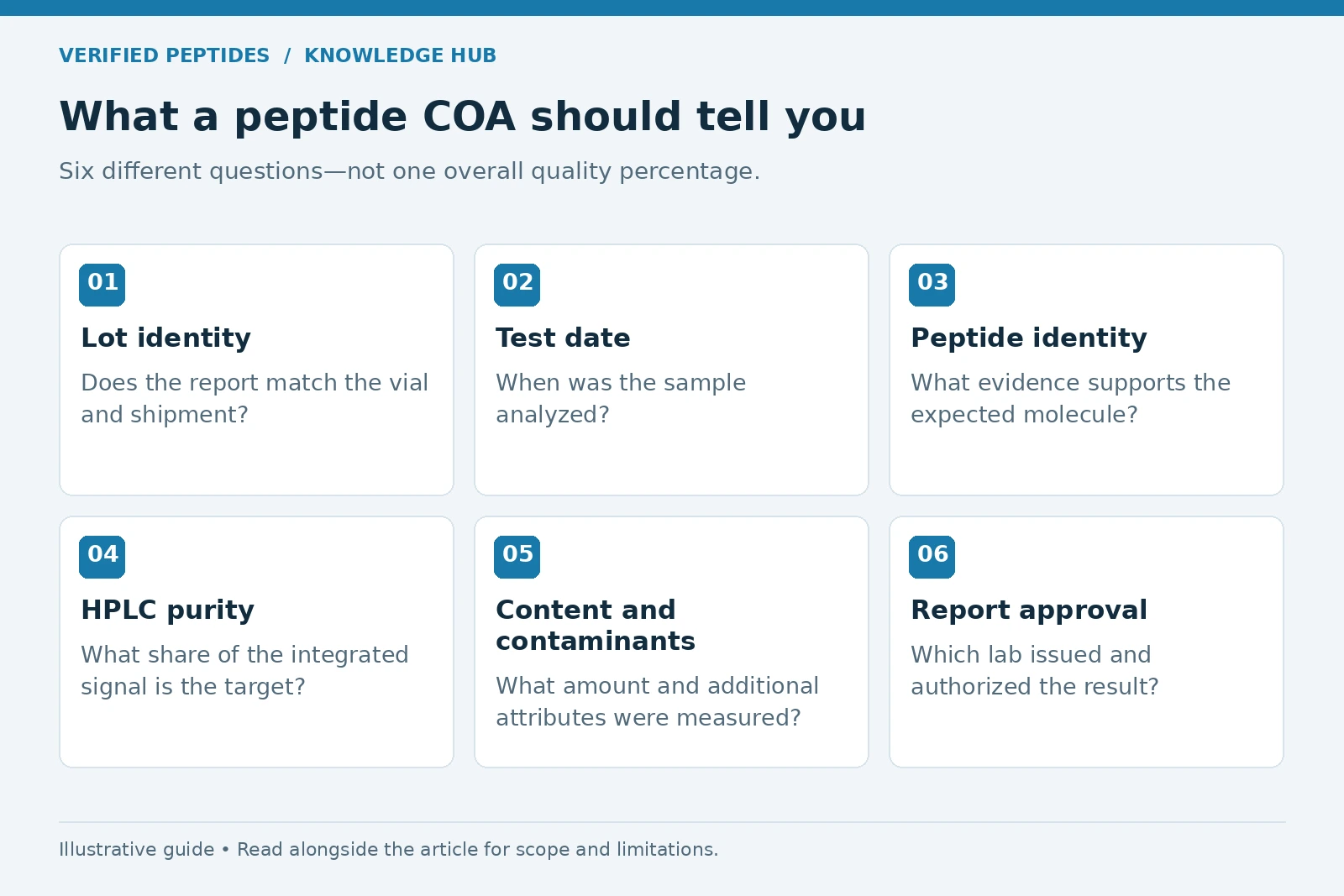
An assay measures how much of a specified substance is present; read its method and units rather than assuming it means HPLC purity. An impurity profile describes the impurities found alongside the target. A lot number links the results to a batch. Quantitative tests should show numerical results and limits. A qualitative identity or sterility result may legitimately say “Conforms” or “Pass” when the method and criterion are clear.71
Third-Party Testing vs In-House COAs
An in-house COA comes from the manufacturer or seller; a third-party report comes from an outside testing laboratory. Either can be technically sound. Independent testing adds separation from the seller, but client pressure, sample selection, and reporting choices still matter. Judge the methods, traceability, and supporting evidence as well as who paid for the work. See in-house vs. third-party peptide testing.
Batch-Specific vs Generic COAs
A batch-specific COA carries the lot number and results for that lot. A generic example or specification sheet describes a product without establishing the results for your shipment. Match the actual lot before relying on the document, and ask whether testing covered bulk material or the final filled vials. See batch-specific COAs vs. generic PDFs.8
How to Read a Certificate of Analysis, Section by Section
Read a certificate of analysis from top to bottom: who issued it, which batch it covers, identity, purity, other tests, and finally the approval. This order catches the biggest problems, such as the wrong batch, first.
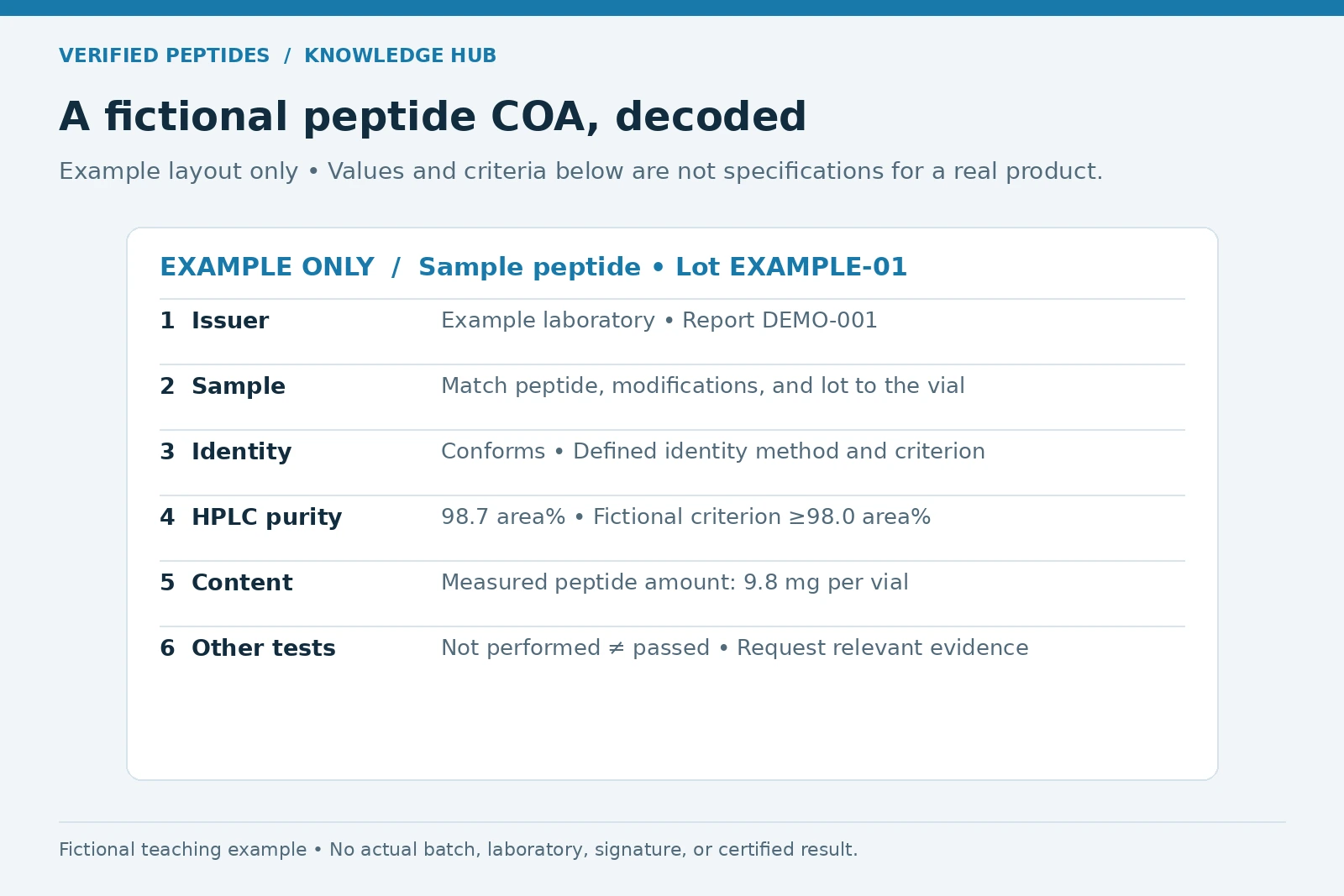
- 1Check the header Note the lab name, address, and report number.
- 2Match the batch The lot number should match your vial and packing documents. If it does not, stop.
- 3Confirm identity Compare the observed and expected mass on the same basis and within the method’s tolerance. Intact mass is supporting evidence, not full sequence proof.
- 4Review purity Compare the HPLC result with its limit and look at the chromatogram.
- 5Check other tests Note which tests were done, such as net peptide content or endotoxin, not only which passed.
- 6Confirm approval Look for dates and a signature or verifiable code.1
Read identity and purity together: a sample can be very pure and still be the wrong molecule. Purity figures also depend on the test conditions, which is why the method belongs on the COA.4 The role of HPLC in peptide characterization explains how to read a chromatogram. The same reading order works for other chemicals and research reagents; only the specific tests change. When a lot arrives, file its COA with the lot number and note any gaps before the material goes into an experiment; labs running long studies may also choose to confirm identity themselves.
COAs, Research Documentation, and Pharmaceutical Standards
For laboratory research, the required documentation depends on the material, institution, and intended work. Pharmaceutical GMP provides a useful benchmark: ICH Q7 describes batch-specific certificates listing tests, acceptance criteria, results, and authorized approval. Those pharmaceutical requirements do not automatically apply to every research-use peptide.1
Regulated industries also set rules on when a supplier’s COA can be relied on. US pharmaceutical rules, for example, allow a supplier’s report to replace full testing only if the manufacturer still runs its own identity test and checks the supplier’s results at intervals.9 For labs, ISO/IEC 17025 accreditation is a useful signal that the issuing lab’s competence has been independently assessed;10 it is worth checking that the lab’s scope covers the tests on your COA, as why laboratory validation matters explains.
Where to Source Products with Verified COAs
Source research materials from suppliers that publish batch-specific, third-party certificates of analysis before you accept a lot. Good signs are reports listed by lot number, a named lab you can contact, and methods and raw data shown or available on request, because lab-verified results like these can be confirmed independently.
Verified Peptides, for example, lists batch-numbered third-party reports with their test dates in its Lab Reports archive.11 For a broader framework, see how to evaluate a research peptide supplier.
What to Do If a Supplier Won’t Provide a COA
Ask again in writing for the COA for your specific lot and the name of the testing lab. If none arrives, regard the material as a quality control gap: hold the lot, consider independent testing before use, or choose a supplier that documents its batches. Note the decision alongside the lot number so it can be traced later.
Red Flags in a COA to Watch For
Red flags are gaps you can see: missing information, mismatches, or results that cannot be traced to a real lab. Any one of them is a reason to ask questions before the lot is used.
How to Verify That a COA Is Legitimate
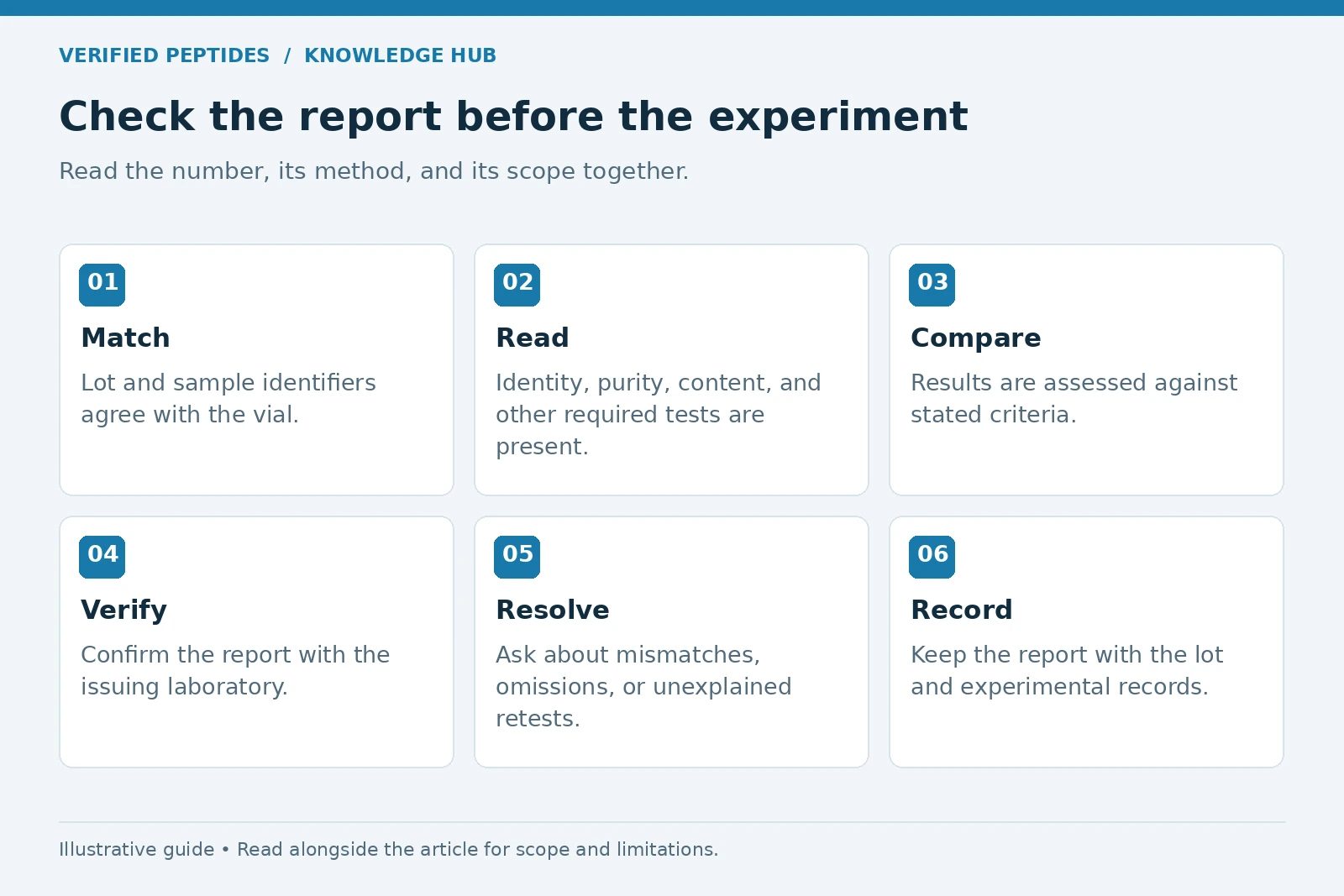
Match the report to your vial, check its internal consistency, and verify its report ID through the issuing lab’s official website or independently found contact details. A professional layout alone is not proof of authenticity. Ask the supplier to resolve mismatches before using the lot.
| Check | Verifiable COA | Red flag |
|---|---|---|
| Batch | Lot number matches your vial | No lot number, or a mismatch |
| Dates | Test and issue dates in a logical order | Missing dates, or test dates before the batch was made |
| Results | Numerical results for quantitative tests; clear criteria for qualitative results | No method or acceptance criterion; only “Pass” for a test that should report a number |
| Identity | Mass result alongside purity | Purity with no identity test |
| Lab | Named lab with contact details and report number | No lab named, or the lab cannot confirm the report |
| Reissued COA | Refers to the original manufacturer and testing lab1 | A reseller’s COA with no link to the original |
| Approval | Dated and signed, or a verifiable code | Undated and unsigned |
| Across lots | Comparable methods and an explainable lot history | Unexplained conflicting results for the same attribute and batch. Repeated rounded values alone are not evidence of falsification. |
Frequently Asked Questions About Certificates of Analysis
What does COA stand for?
COA stands for certificate of analysis, also written CoA or C of A.
What is a certificate of analysis used for?
It is used to confirm that a specific batch met its specifications before use, and to keep that evidence for quality control records, audits, and publications.
Is a certificate of analysis the same as a lab report?
A COA usually summarizes batch results against specifications. A lab report may provide more detail about the submitted sample, methods, chromatograms, and spectra. Neither necessarily contains the complete original instrument files or audit trail.
Who provides a certificate of analysis?
Usually the manufacturer or supplier, either from its own testing or from an independent analytical lab that issues the report directly.
How do I read a CoA for chemicals or research reagents?
Match the lot number, check identity and purity against their limits, review any other tests, then confirm the lab, dates, and approval.
What does USP Verified mean on a certificate of analysis?
USP Verified is the United States Pharmacopeia’s verification mark for dietary supplements, based on a facility audit and laboratory testing.12 It is not a standard feature of research peptide COAs; a COA that cites a USP chapter is only naming the test method it followed.
All peptides discussed here are for research use only.
Key Takeaways
- A COA reports test results for one specific batch against its specifications.
- Read it in order: issuer, lot number, identity, purity, other tests, approval.
- Independent testing adds useful evidence when the report is batch-specific, authentic, and based on suitable methods.
- Missing lot numbers, unclear methods or limits, and unverifiable lab details deserve follow-up.
- Keep each COA with your records; checking it against the lot in hand is the simplest CoA verification.
References
- US Food and Drug Administration / International Council for Harmonisation. Q7 Good Manufacturing Practice Guidance for Active Pharmaceutical Ingredients. Guidance for industry (section 7.3 testing of incoming materials, section 11.4 certificates of analysis, and section 20 glossary). fda.gov
- Bachem. Quality Control of Amino Acids & Peptides: A Guide. Knowledge center. bachem.com
- National Institutes of Health. Guidance: Rigor and Reproducibility in Grant Applications (authentication of key biological and/or chemical resources). grants.nih.gov
- Bachem. What does HPLC purity mean? FAQ. bachem.com
- AAPPTec. Peptide Quality: Frequently Asked Questions. peptide.com
- US Food and Drug Administration. Pyrogen and Endotoxins Testing: Questions and Answers. Guidance for industry (revised), March 2026. fda.gov
- Iris Biotech GmbH. How to Decipher a Certificate of Analysis (CoA). June 2025. iris-biotech.de
- Sigma-Aldrich (Merck). Documents Search: Certificates of Analysis (search by lot or batch number). sigmaaldrich.com
- US Code of Federal Regulations. 21 CFR 211.84, Testing and approval or rejection of components, drug product containers, and closures (paragraph (d)). ecfr.gov
- International Organization for Standardization. ISO/IEC 17025:2017 General requirements for the competence of testing and calibration laboratories. iso.org
- Verified Peptides. Lab Reports (batch-specific third-party test reports). verifiedpeptides.com
- United States Pharmacopeia. USP Verified Mark (Dietary Supplement Verification Program). usp.org